This Failed Galaxy Is 99.99% Dark Matter And Defies Explanation
This video, hosted by Anton, examines Dragonfly 44, a so-called 'failed galaxy' or dark galaxy in the Coma Cluster that has roughly the mass and physical size of the Milky Way but only about 1% of its stars. The organizing idea is using globular cluster counts, drawn from a new Hubble Space Telescope study, to pin down the galaxy's true dark matter halo mass and settle a dispute between earlier, conflicting measurements. No institutional affiliation or academic credentials for Anton are stated in the source. The video closes on the idea that these dark galaxies remain an unresolved problem for current models of galaxy formation, and that dark matter might be studied directly by observing them.
Context: the mystery object discussed is located 330 million light years away in the Coma Cluster and was discovered only a few years ago [00:00]
- Concept: the object is called Dragonfly 44, nicknamed a 'failed galaxy' when first discovered [00:29]
- Comparative example: Dragonfly 44 has roughly the same mass and physical size as the Milky Way but only about 1% of the stars, making it appear almost invisible [00:45]
- Concept: because it is mostly dark matter with few stars, Dragonfly 44 is classified as a dark galaxy resembling a dwarf galaxy despite its large size and mass [01:16]
- Context: new ultra-deep images from the Hubble Space Telescope may finally provide an answer to the mystery [01:50]
+ 33 more takeaways
- Concept: Dragonfly 44 belongs to a class called UDGs (ultra-diffuse galaxies), low-density objects first seen in the 1980s but originally mistaken for tiny dwarf galaxies [02:11]
- Concept: many UDGs appear 'quenched,' having stopped forming stars long ago and now made mostly of ancient stars billions of years old [04:28]
- Mechanism: the Dragonfly telephoto array, built from clustered telephoto camera lenses and named for resembling a dragonfly's eye, was used to detect these faint objects [03:51]
- Mechanism: the Dragonfly instrument is designed specifically to see faint, fluffy objects invisible to a normal telescope [04:12]
- Mechanism: stars at the edges of Dragonfly 44 move much faster than expected and orbit normally rather than flying apart, which the lecturer presents as a classic signature of dark matter [04:58]
- Mechanism: galactic formation theory holds that most known galaxies started as massive halos that attracted gas and stars, which then interacted, formed new stars, and built up into galaxies like the Milky Way [09:17]
- Mechanism: the Hubble imaging used the F350LP filter, described as exceptionally good at capturing nearly every photon of light from extremely faint objects [07:25]
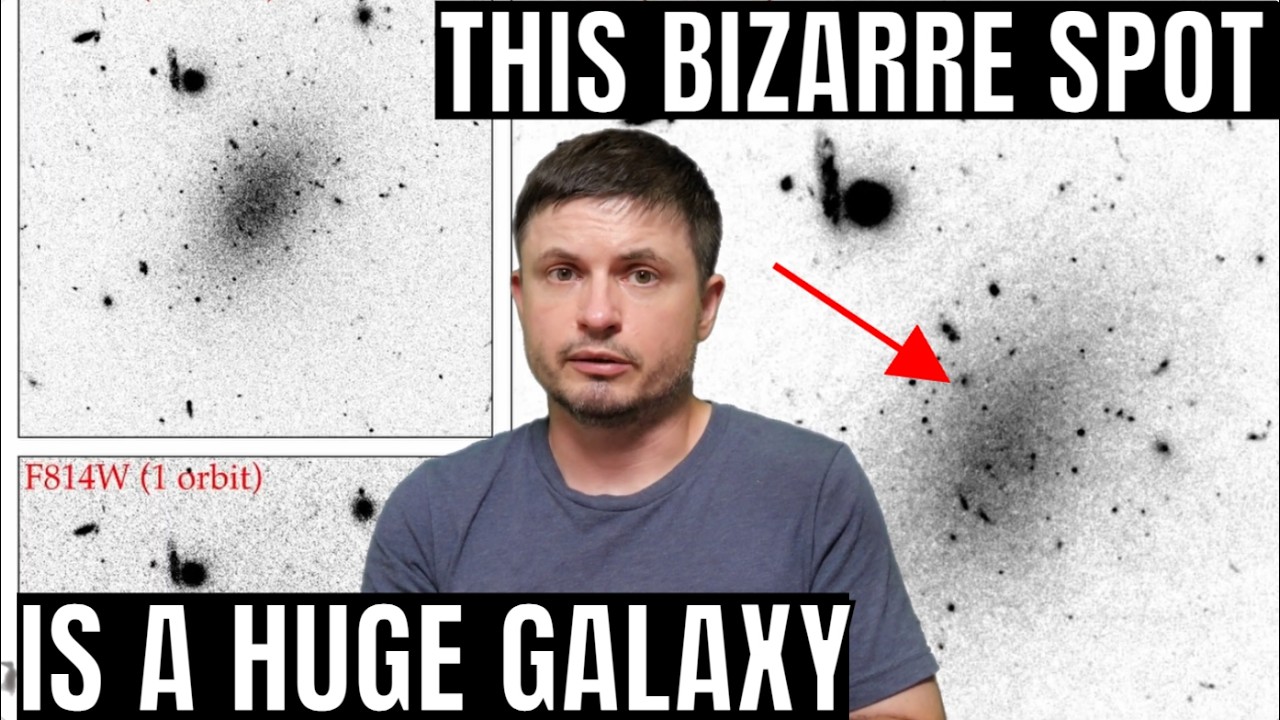
- Mechanism: an imaging comparison shows F814W taken over 1 orbit versus F350LP taken over 9 orbits [07:31]
- Mechanism: researchers spent approximately 30,000 seconds staring at the galaxy nonstop to collect the imaging data [07:38]
- Mechanism: Figure 2 shows the galaxy subtraction process for DF44, a sky-subtracted F350LP mosaic, a best-fit elliptical isophotal model built with photutils Ellipse, and a smoothed residual image revealing numerous compact sources [07:44]
- Mechanism: the residual analysis found a non-negligible background of compact sources requiring large corrections, typically a factor of about 4, with PSF magnitudes sometimes impacted by non-Gaussian residuals from the galaxy fit [07:44]
- Mechanism (presented without cited evidence, an open proposition): one idea redefines dark matter as a particle that can interact with itself, involving heavy and light dark matter particles that collide and cause mass segregation, with heavy particles sinking to the center and light ones spreading out [11:08]
- Mechanism: this segregation process can create cores in dwarf galaxies where dark matter density is much lower than expected, which the lecturer says also seems to apply to Dragonfly 44 [11:32]
- Named study: a previous video discussed NGC 1052-DF2, a related object found to have practically no dark matter, explained by a collisional event [03:03]
- Named study: in 2016, Dragonfly 44 was determined to be approximately 99.99% dark matter, the most dark matter-dominated galaxy ever seen, with a mass close to the Milky Way's at roughly a trillion solar masses despite containing few stars [05:41]
- Named study: that 2016 analysis found 90 globular clusters, just under the Milky Way's count, and the lecturer notes clusters are normally acquired through galactic collisions correlating with mass [06:10]
- Named study: other teams reanalyzed the data and argued the galaxy was much lighter, just a regular dwarf galaxy, attributing the original result to miscalculated distances and forced perspective, with some studies claiming only 20 globular clusters instead of 90 [06:24]
- Named study: a new study by Maria Luisa Buzzo and team used ultra-deep Hubble Space Telescope WFC3/UVIS imaging in the F350LP filter, finding Ngc = 78.3 ± 3.7 globular clusters and a halo mass of log(Mvir/Mo) = 11.6 ± 0.3 [07:08]
- Named study: the paper's authors set out to determine which of the conflicting published globular cluster counts for DF44 was correct [07:14]
- Named study: researchers used the Hubble Space Telescope to take white-light imaging of DF44 specifically to settle that discrepancy [07:18]
- Named study finding (flagged in the source as not yet definitively confirmed): researchers reported 78.3 ± 3.7 globular clusters, almost 80, around DF44 [07:50]
- Named study: the lecturer states these globular clusters have not been definitively confirmed [07:59]
- Named study: the large number of globular clusters is presented as confirming DF44 cannot be a simple dwarf galaxy and is closer to a 'failed galaxy' that lost most of its gas and never went through a star-forming stage [08:01]
- Named study: a key reason earlier studies missed these clusters is that the system is spatially extended, with clusters spread out well beyond the galaxy's visible stars rather than clustered at the center [08:33]
- Named study: the large spread of clusters suggests a relatively large dark matter halo holding the clusters together and preventing them from flying apart [08:47]
- Named study: based on the number of clusters, the invisible halo mass is estimated at approximately 400 billion solar masses, about half the mass of the Milky Way [09:50]
- Comparative example: a cosmological simulation labeled ILLUSTRIS is shown with timestamps from 1.7 to 2.5 billion years since the Big Bang, and the lecturer states no computer model or simulation can currently perfectly reproduce how this type of galaxy formed [10:37]
- Comparative example: the most recent example of such a dark galaxy cited is one called Nube, discovered a couple of years back [12:19]
- Comparative example: a galaxy known as CDG2 was accidentally revealed when scientists found unusual globular clusters orbiting a central point, with the stars themselves not even visible [12:32]
- Why it matters: the existence of these failed galaxies is described as a major problem for modern cosmological models and theories of galactic formation [10:48]
- Why it matters: as of 2026, the lecturer states nobody knows why dark galaxies exist or how they are possible [10:57]
- Why it matters: dark matter appears to be something physical that can potentially be studied by observing these galaxies and detecting their emissions [12:51]
- Why it matters: the lecturer states these are confirmed to be failed galaxies rather than miscalculations, and they appear more complex than initially thought [13:43]
How this brief was shaped: Lecture / Educational Explainer · confidence Medium
Single narrator Anton systematically explains an established astronomical mystery, Dragonfly 44, its discovery, its dark galaxy classification, and related low surface brightness galaxies, with no personal thesis or debate. OCR shows a peer reviewed research paper on screen, reinforcing this is a comprehensive explanation of established science rather than the creator's own argument.
The lens sets this brief's structure, never its facts — every claim is held to the same citation and fact-check standard.