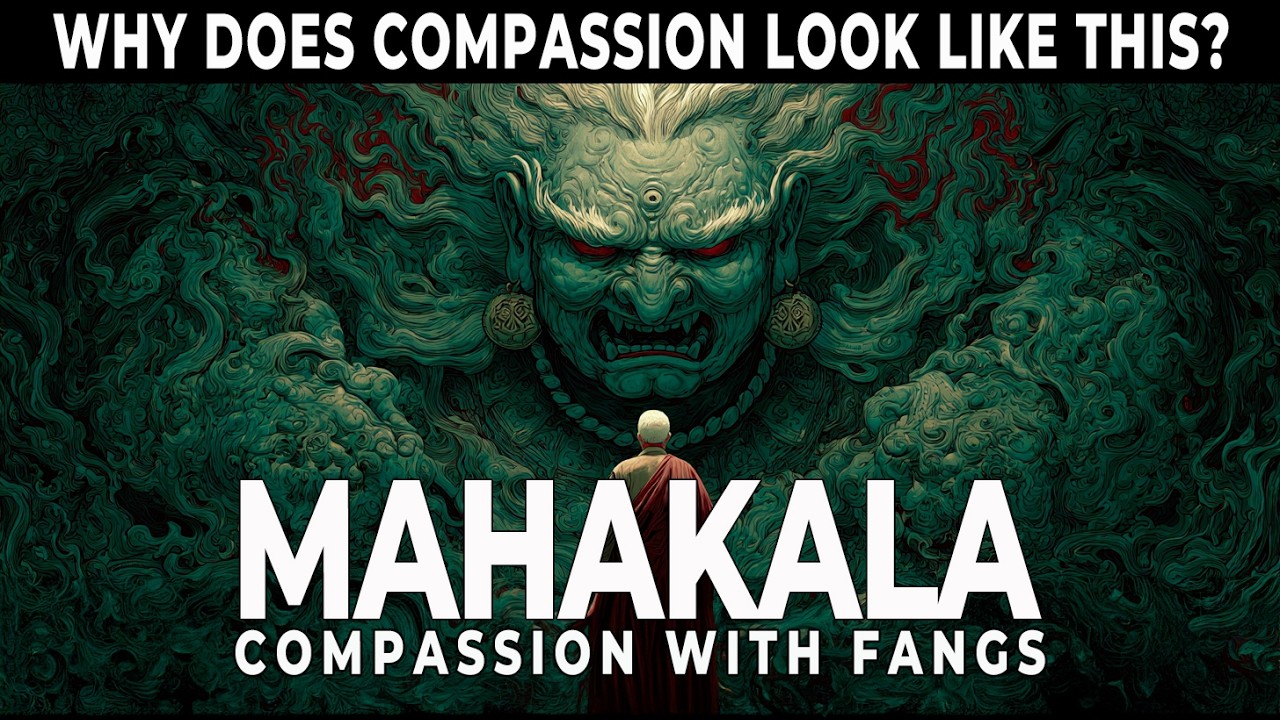
MAHAKALA: The Buddhist Protector Who Looks Like a DEMON
This is a narrated documentary-style video essay, hosted by Matt, tracing the Tibetan Buddhist protector deity Mahakala from devotional legend through iconography and history. It opens with a folkloric story of an Indian sculptor who dances and vanishes into an unfinished statue at Eastern Tibet's De Tsang monastery, explicitly flagged as retelling rather than documented history, then follows separate legend cycles including the hunter Shavaripa's transformation, before walking through the symbolism of Mahakala's six arms, weapons, and ornaments. The piece closes by tracking how different forms of Mahakala spread across Mongolia, Japan (as Daikokuten), and into the Dalai Lama's own 2024 teaching and 1959 flight from Tibet. No competition, score, or single conclusive origin story is given; the video ends by inviting viewers to watch a related video on Chenrezig and comment which protector to cover next.
The video opens with a devotional legend (explicitly flagged by narrator Matt as retelling, not documented history) of a crow at a red temple window read as either an omen of death or a sign a protector has already arrived
- In the opening legend, an Indian sculptor at a monastery opening in Eastern Tibet asks to dance in a wrathful mask before an unfinished statue is complete, and his body shrinks until the costume collapses and the mask drops empty
- The monks then find the once-unfinished statue completed: a six-armed figure with a crown of human skulls standing in a mountain of flame, identified as Mahakala, 'the Great Black One'
- The narration notes Mahakala has no single origin story, sometimes shown with two, four, or six arms, in different colors across different lineages
- Monastery De Tsang in the Gyalrong district of eastern Tibet is traditionally dated to 1414, founded by monk Tsako Ngawang Drakpa, a disciple of Tsongkhapa
+ 49 more takeaways
- Legend holds Ngawang Drakpa chose the site after a crow took his ceremonial scarf and left it in a juniper tree, and he built the prayer hall's pillar from that tree's trunk
- In this version of the story, the crow is identified as one of the forms Mahakala takes, already present rather than sending a sign
- When walls built during the day kept collapsing overnight, Ngawang Drakpa wrote to Tsongkhapa in Lhasa via the crow, which returned carrying the 'Solitary Hero Vajrabhairava Sadhana' text
- Three Indian strangers arrived at the monastery; two settled elsewhere, each carved and vanished into a Mahakala statue, becoming known as the three Mahakala brothers (six arms at De Tsang, four arms at the second site, white at the third)
- The video specifies it will follow the six-armed Mahakala of the 'Eight Chapter Mahakala Tantra,' who entered Tibet in the 11th century through the Shangpa Kagyu lineage under the title 'Swift-Acting Lord of Pristine Awareness with Six Hands'
- Protector practice is described as praise, offerings, and ritual requests that obstacles be cleared, not feeding or appeasing a demon to keep it away
- This form of Mahakala is classified as a Dharmapala wisdom protector, an enlightened emanation, distinct from worldly spirits Padmasambhava bound into service who remain within samsara
- A wisdom protector's work has three parts: guard the teaching, guard the people practicing it, and guard their vows and tantric commitments
- A separate lineage story recalls Shavaripa as a skilled hunter in India before his vision
- A stranger challenged Shavaripa to a shooting contest, dropped a hundred animals with a single arrow that turned out to be apparitions, then showed him the Hell Realm awaiting a hunter, after which Shavaripa never hunted again
- [06:57] Years later Shavaripa was meditating in the Cool Grove charnel ground, a burning ground chosen by Indian yogins because it was unbearable
- At a 2024 public teaching, the Dalai Lama recounted that Mahakala appeared to Shavaripa there surrounded by flames and taught him how four deities could be practiced together, after which Avalokitesvara, Vajrayogini, and Tara each appeared with their own instructions
- Shavaripa composed a praise that night; tradition explains its structure (starting at the ankles and rising to the face) as reflecting that he was too overwhelmed by the protector's presence to look directly at him
- The praise's opening line is quoted: 'Wearing anklets, your feet trample Vinayaka'
- Shavaripa's combined method passed to his student Maitripa, then to Khyungpo Naljor, who carried it to Tibet and founded the Shangpa Kagyu lineage
- Khyungpo Naljor's key teacher Niguma ordered that her complete instructions pass from one master to one disciple for seven generations to prevent the teaching from hardening into an institution
- The iconography walkthrough begins with Mahakala standing on a lotus above a trampled elephant-headed figure, sometimes called Vinayaka or Ganesha and read as obstruction or the uncontrolled mind
- He wears a tiger skin, elephant hide, and a garland of freshly severed heads, bones, snakes, and small bells
- [10:33] His central hands hold a curved knife and a skull cup together in front of the heart
- [10:37] Per Kenpo Karthar Rinpoche, the knife is not aimed at a person but cuts the pattern of aggression, hatred, and ignorance that keeps suffering running
- [10:51] The skull cup receives what the knife severs and holds it in a vessel of transformation
- [11:01] The remaining arms hold a rosary of skulls, a trident, a damaru drum read as the sound that summons the Buddhas, and a lasso that restrains obstructive forces
- [11:23] One traditional interpretation reads the six arms as the six perfections: generosity, discipline, patience, diligence, meditation, and wisdom
- [11:36] The crown of five human skulls represents the five poisons, transformed into five wisdoms rather than eliminated
- [12:24] In the Shangpa lineage, this six-armed Mahakala is understood as a wrathful emanation of Avalokiteshvara, identified with the succession of Dalai Lamas
- [13:14] The hunter who challenged Shavaripa is revealed to be Avalokiteshvara, who met him twice, once as archer and once as a mountain of flame, and was saving him both times
- [13:38] Khenpo Karthar Rinpoche states Mahakala is 'none other than the inseparability of compassion and loving-kindness,' likened to a parent acting fiercely to stop a child running into the road
- [14:01] Wrathful compassion is described as action without hatred, not permission to frighten, dominate, or punish another person
- [14:17] The title 'Swift Acting' is compared to a surgeon cutting away dead tissue to preserve the limb, meaning awakened activity does not hesitate, not that it is impulsive
- [15:32] Art historians place Mahakala's imagery within the shared medieval Buddhist and Shaiva Tantra visual world, especially Bhairava, with the trident and damaru carried over
- [16:01] Chinese monk Yi Jing, traveling India in the late 600s, described Mahakala as a small wooden figure two or three feet high by the monastery kitchen pillar, face blackened from oil, tended with lamps, incense, and food
- [16:31] The Mahakala who reached the center of the Mongol Empire was a different figure, Panjaranatha, principal protector of the Sakya school, connected with the Hevajra cycle
- [16:45] Under Sakya masters at the Mongol court, Panjaranatha became a state protector, with Mongol victories attributed to rituals summoning him and a symbol of Kublai Khan's imperial power
- [17:00] A stone sculpture at the Musee Guimet in Paris carries an inscription from 1292 naming Kublai Khan
- [17:17] The Shangpa six-armed form later entered Tsongkhapa's Gelug tradition to become one of its principal protectors
- [17:27] In Japan, the cult arrives as Daikokuten, one of the seven gods of good fortune, round-bellied, sitting on two bales of rice with mice at his feet and holding a wish-granting mallet
- [18:16] One of Daikokuten's oldest roles in Japan is guardian of the temple kitchen, the same role Yi Jing found him in India over a thousand years earlier
- [18:56] At the same 2024 ceremony, the Dalai Lama said he had felt close to Mahakala since childhood, recalling his mother's phrase 'our Mahakala, our protector'
- [19:15] In 1959, before fleeing Norbulingka Palace and Tibet, the Dalai Lama prayed at the Mahakala chapel and said he felt the protector nod, as if the question of Tibet would eventually be settled
- [20:41] His name is said to carry two resonances, blackness and time, with time as the force that consumes every form
- [20:35] He does not appear because the path is easy; he appears where the path is blocked
- [21:20] When the Dalai Lama gave the six-armed Mahakala permission in 2024, he transmitted the mantra as part of that ceremony with vows and visualization instruction
- [21:42] Per tradition, generating oneself as Mahakala, versus reciting his mantra while visualizing him, requires a teacher
- [21:54] The mantra as published by the Dalai Lama's office is quoted: 'Om Vajra Mahakala Kshim Kshetra Vighan Vinaya Tra Hum Hum Phat Phat Svaha'
- [22:12] The Dalai Lama closed the ceremony by giving out Shavaripa's charnel-ground praise, saying he recites it every day and telling listeners to recite it too
- [22:20] The prayer is described as a thousand years old, written by a hunter who quit
- [22:33] The video points viewers to another video on Chenrezig, described as the peaceful form that hears every cry
- [22:43] The host asks viewers to comment which wrathful protector should be covered next
- [22:50] The video closes with 'Stay curious. Stay wise.'
How this brief was shaped: Narrative (vlog / gaming / travel / entertainment) · confidence Low
Single narrator retells Tibetan folklore stories in chronological sequence (the sculptor dance, Shavaripa the hunter) framed as devotional legend rather than argued thesis, with OCR showing animated monastery and deity dance scenes reinforcing a story-driven format. There is some explanatory content about Mahakala's symbolism and lineages, but the spine is the sequence of myths being retold rather than a systematic teaching structure.
The lens sets this brief's structure, never its facts — every claim is held to the same citation and fact-check standard.