"Neuroscience Beyond Neurons: communicating with unconventional minds" by Michael Levin
Michael Levin (Allen Discovery Center, Tufts) argues that goal-directed 'mind-like' behavior is not limited to brains and neurons, but also shows up in cell collectives, gene regulatory networks, and lab-built constructs like xenobots and anthrobots, and that bioelectric signaling (voltage patterns across ion channels and gap junctions) works as a communication interface for these non-neural minds. Most of this rests on Levin describing experiments from his own lab (researcher-stated), such as inducing extra eyes, two-headed planaria, and self-replicating xenobots, with a handful of points citing other named figures (Darwin, von Baer, Bubenik, and co-authors Varley, Pai, Grasso, Lunshof, Bongard) for historical framing or a specific information-theory comparison. Partway through, the talk shifts from these described biology experiments into an explicitly philosophical claim that mathematical truths are a non-physical third source of order shaping minds, a jump the speaker frames himself as philosophy rather than data.
Claim: Michael Levin argues that minds with goals and competencies exist in many non-neural systems, including cell collectives, gene networks, and bioengineered constructs, not just brains. [00:40]
- Mechanism: Levin proposes that bioelectricity (voltage states transmitted via ion channels and gap junctions) acts as a 'cognitive glue' holding together the collective mind of the body, similar to neuronal communication in the brain. [05:13]
- Evidence class: RESEARCHER-STATED - the bioelectric 'cognitive glue' framing is presented as Levin's own lab framework, not a single cited study. [05:13]
- Term: 'Mind blindness' is defined as the limitation of finite observers, evolved to detect intelligence only at certain scales of time and space. [03:19]
- Speculation: Levin predicts future humans will pursue augmentation and hybridization technologies beyond repairing damage, meaning neighbors may have brain implants with different sensors and effectors. [02:20]
+ 59 more takeaways
- Term: 'Cognitive light cone' is defined as the size of the biggest goal a system can pursue, not the range of its sensors or effectors. [10:03]
- Claim: single cells have a tiny cognitive light cone, able to pursue only scalar goals like pH or metabolic level. [10:16]
- Researcher-stated: no individual limb cell knows what a limb is or how many fingers it should have, but the collective does, giving the network a larger cognitive light cone than a single cell. [10:57]
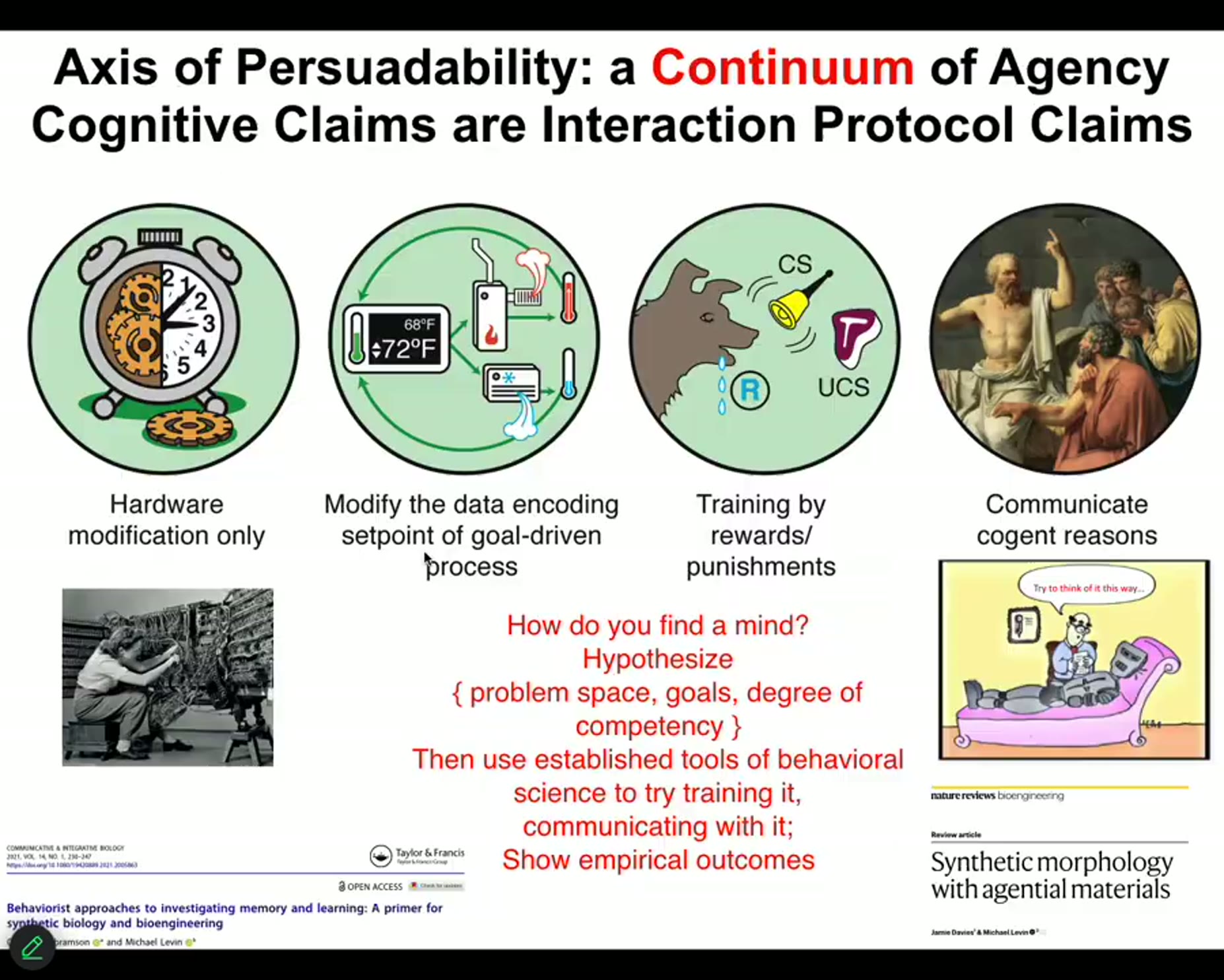
- Term: the 'Axis of Persuadability' is introduced by the speaker as his own proposed tool, arguing intelligence cannot be judged philosophically and must be tested experimentally. [11:57]
- Evidence class: SPECULATION / original framework - the Axis of Persuadability is presented as the speaker's own construct, not an established or externally validated measure. [11:57]
- Mechanism: Levin's method for finding a novel kind of mind is to hypothesize its problem space and goals, then run perturbative experiments testing competency, training, communication, and goal-rewriting. [12:34]
- Term: a 'multi-scale competency architecture' describes how every level of a system, from molecular to tissue, has its own agendas and competencies in different problem spaces. [13:20]
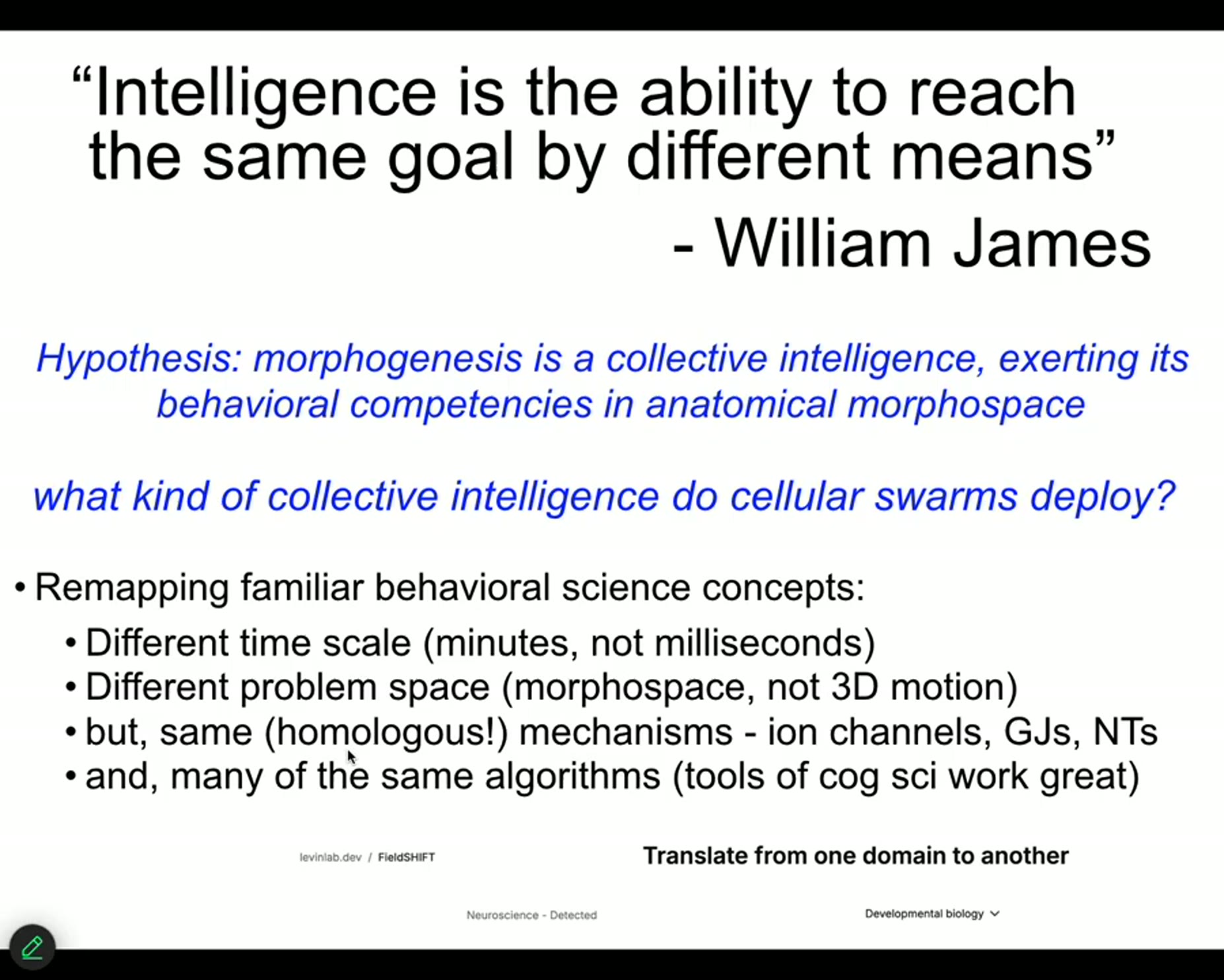
- Term: William James's definition of intelligence, cited by Levin, is 'the ability to reach the same goal by different means,' framed as substrate-agnostic and experimentally testable. [15:34]
- Claim: Levin's longstanding hypothesis is that morphogenesis (building, regenerating, and maintaining a body) is the behavior of a collective intelligence of cells operating in 'anatomical morphospace.' [16:00]
- Evidence class: RESEARCHER-STATED - this morphogenesis-as-collective-intelligence hypothesis is the speaker's own hypothesis, not a cited external study. [16:00]
- Researcher-stated: axolotls regrow an amputated limb back to the correct position and stop, described as anatomical homeostasis with a set point. [18:44]
- Researcher-stated: cutting an early human embryo in half produces two normal monozygotic twins rather than half-bodies, cited as evidence the goal state isn't hardwired. [19:19]
- Published: in research from around 2012, so-called 'Picasso tadpoles' with scrambled craniofacial organ positions still developed into normal-looking frogs. [19:37]
- Researcher-stated: in Picasso tadpoles, the displaced organs keep moving, sometimes overshooting and correcting, until they settle into the correct pattern and stop. [20:17]
- Researcher-stated: Levin cites old work from the 1950s in which a tail grafted onto an animal's flank remodeled over weeks into a limb, with tail-tip cells becoming fingers despite no local damage. [22:24]
- Term: 'hierarchical non-local control' describes how abstract goals cause ions to cross muscle membranes to execute behavior. [21:14]
- Term: 'hackability' describes cognitive systems as more like software than hardware, meaning trainable, exploitable, and able to communicate and make decisions. [23:32]
- Claim: the genome does not directly specify anatomy, containing only proteins and timing information about when proteins become available to cells. [24:36]
- Analogy: Levin compares this to ant and spider genomes, which don't encode termite mound or web shape, calling the genome 'hardware' and anatomical outcomes 'software.' [24:59]
- Researcher-stated: Levin's lab developed the first molecular tools to read and write electrophysiological information in non-neural cells. [28:48]
- Researcher-stated: using voltage-sensitive dyes, Levin's team tracked electrical states of individual cells in a developing Xenopus frog embryo, describing 'electrical conversations' determining eye number, head location, and tail number. [29:02]
- Open question: Levin states this bioelectricity work applies outside the brain despite developmental biology and neuroscience having separate departments, journals, and funding bodies. [30:01]
- Term: the 'electric face' is a bioelectric prepattern in early frog embryos that previews where the eye, mouth, and placodes will form via voltage and resting potential. [30:37]
- Researcher-stated: changing these bioelectric patterns changes gene expression and subsequently the anatomy of the face. [31:11]
- Researcher-stated: when one frog embryo is poked, neighboring embryos detect the injury wave spreading and register it within about 30 seconds. [31:41]
- Researcher-stated: Levin's team injected RNA encoding a potassium channel into early embryos to establish an eye-inducing voltage pattern at an ectopic site such as the gut. [34:14]
- Researcher-stated: these ectopic eyes had a lens, retina, and optic nerve, the same as normal eyes. [34:27]
- Researcher-stated: after the potassium-channel injection, the early eye marker Rx1 showed up to five extra eye-forming regions. [35:34]
- Researcher-stated: by the next day only one or two of those extra eye-forming regions remained, explained as a 'battle of worldviews' between injected cells and an ancient cancer-suppression mechanism in neighboring cells. [36:04]
- Researcher-stated: in planaria, cutting off the head and tail from a middle section regenerates a normal one-head, one-tail worm every time, with wound orientation determining head versus tail. [37:03]
- Researcher-stated: using ion channel drugs to encode a 'two heads' bioelectric pattern causes a cut planarian worm to grow two heads, with the latent memory invisible until an injury triggers it. [37:38]
- Researcher-stated: if two-headed worms are amputated in the middle, the middle fragments continue to regenerate as two-headed, cited as evidence the information is not stored in DNA. [39:12]
- Researcher-stated: two-headed worms can be rewritten back to one-headed, since the genome's default memory is rewritable and reprogrammable. [39:30]
- Researcher-stated: using ion channel modulation after head amputation on a triangular doradocephala, the team produced head shapes resembling other species about 100 to 150 million years evolutionarily distant, without altering DNA. [40:17]
- Researcher-stated: gene regulatory (molecular) networks can perform Pavlovian conditioning given the right choice of stimulus and response nodes. [42:56]
- Researcher-stated: the smallest molecular network found capable of Pavlovian conditioning has only four nodes. [43:21]
- Researcher-stated: such molecular networks can perform about six kinds of learning, including habituation, sensitization, associative conditioning, and counting to small numbers. [43:25]
- Published: researcher Bubenik found, after about 35 years of experiments, that damaging a deer antler at one point causes a new ectopic tine to grow at that same location the following year after regrowth. [44:45]
- Published: this antler location memory persists for five or six years before disappearing. [45:14]
- Researcher-stated: planaria exposed to barium chloride have their heads degenerate and fall off, but regrow new heads that are completely barium-insensitive. [46:01]
- Researcher-stated: only about a dozen genes were found to be up- or down-regulated to produce this barium tolerance, despite planaria never naturally encountering barium. [46:32]
- Researcher-stated (quoting another named researcher): Patrick Erickson is quoted saying that if models of this cellular problem-solving existed, AI and biomedicine would be way further along. [47:17]
- Researcher-stated: in polyploid newts with added genetic material, cells and nuclei get bigger but the animal stays the same size, with fewer, larger cells still forming the same kidney tubule structure. [47:26]
- Researcher-stated: xenobots are named after Xenopus laevis, created from scraped embryonic frog skin cells, and use coordinated cilia to row against water and move collectively. [49:32]
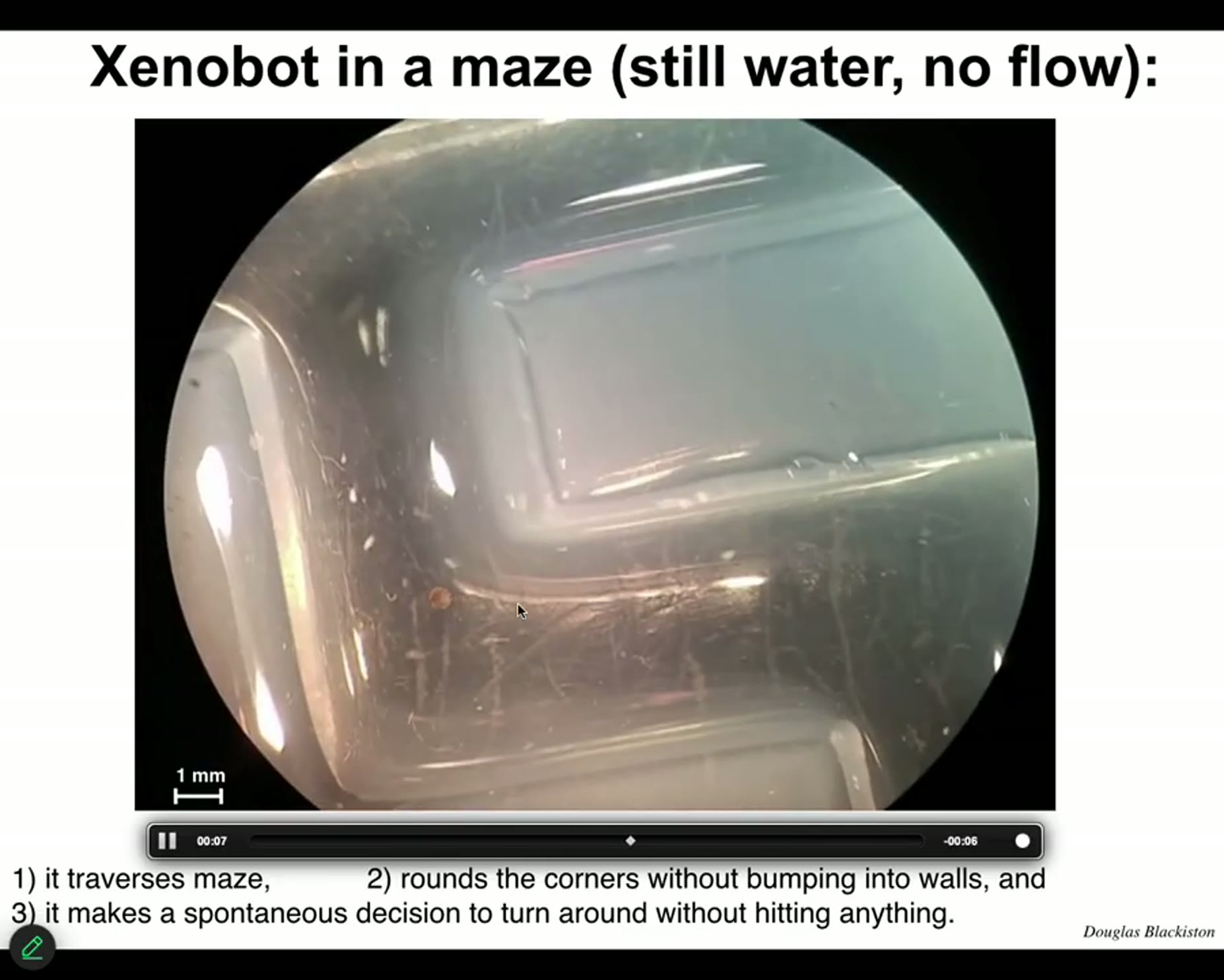
- Researcher-stated: in maze navigation, a xenobot traverses the maze, rounds corners without bumping walls, and spontaneously turns around without hitting anything. [50:36]
- Published: citing Varley, Pai, Grasso, Lunshof, Levin and Bongard's work, the team applied information-theory 'phi' metrics (used by neurologists to assess human consciousness) to calcium signals in xenobots, which have no neurons. [51:44]
- Published: this analysis found xenobot signals were as different from their null models as human fMRI data are from their null models by these same metrics. [51:48]
- Term: 'kinematic self-replication' describes xenobots pushing loose epithelial cells into piles that become the next generation of xenobots, which repeat the process. [52:23]
- Researcher-stated: xenobots express hundreds of genes differently than in the frog body, including genes related to hearing, and respond to sound from a speaker placed under the dish. [52:49]
- Researcher-stated: xenobots can form at least two different kinds of memories, readable 24 hours later via behavior, calcium signaling, and transcription, despite having no neurons. [53:04]
- Researcher-stated: anthrobots are made from adult human tracheal cells, often from elderly biopsy patients, with a 100% normal human genome and no synthetic biology, scaffolds, or nanomaterials. [53:36]
- Researcher-stated: anthrobots placed near scratched human neurons formed a 'SuperBot cluster' and healed the damage within four days, showing over 9,000 differentially expressed genes and four specific trackable behaviors. [54:15]
- Speculation: Levin argues there was no selection pressure for xenobots to self-replicate, hear, or for anthrobots to heal neural wounds, since no such organism or developmental stage ever existed before. [55:51]
- Researcher-stated: Levin shows an 83-day-old xenobot and says he has no idea what it is becoming. [56:15]
- Speculation (metaphysical transition point): Levin proposes that beyond selection and physics, 'the truths of mathematics' are a third source of biological order, illustrated with a Halley plot of z=z^2+3 producing structure not explained by physics or biology. [57:15]
- Speculation: Levin credits Plato and Pythagoras, 2,000 years ago, with recognizing a space of important facts that are not physical and cannot be changed by altering universal constants. [57:46]
- Speculation: Levin proposes a spectrum of agency levels in this pattern-space, from low-agency mathematical objects to higher-agency 'minds,' arguing mind-body relations mirror the relation between mathematical truths and physical facts. [58:58]
- Speculation: Levin states that embryos, biobots, cyborgs, and robots are 'front-end thin clients' for a rich ecosystem of patterns that ingress into them, calling for recognizing 'ethical synthbiosis' with diverse novel beings. [59:36]
- Open question: Levin says science still doesn't know how many personalities neural tissue can support per cubic millimeter. [09:45]
How this brief was shaped: Neuroscience / Mind Science · confidence High
The narrator explicitly frames the talk as visualizing neuroscience and communicating with unconventional minds, and the OCR main-points slide lists morphogenesis, basal cognition, bioelectricity as cognitive glue, and hypotheses about collective intelligence, which is the core signal set for the neuroscience lens rather than a general taught-course structure.
The lens sets this brief's structure, never its facts — every claim is held to the same citation and fact-check standard.