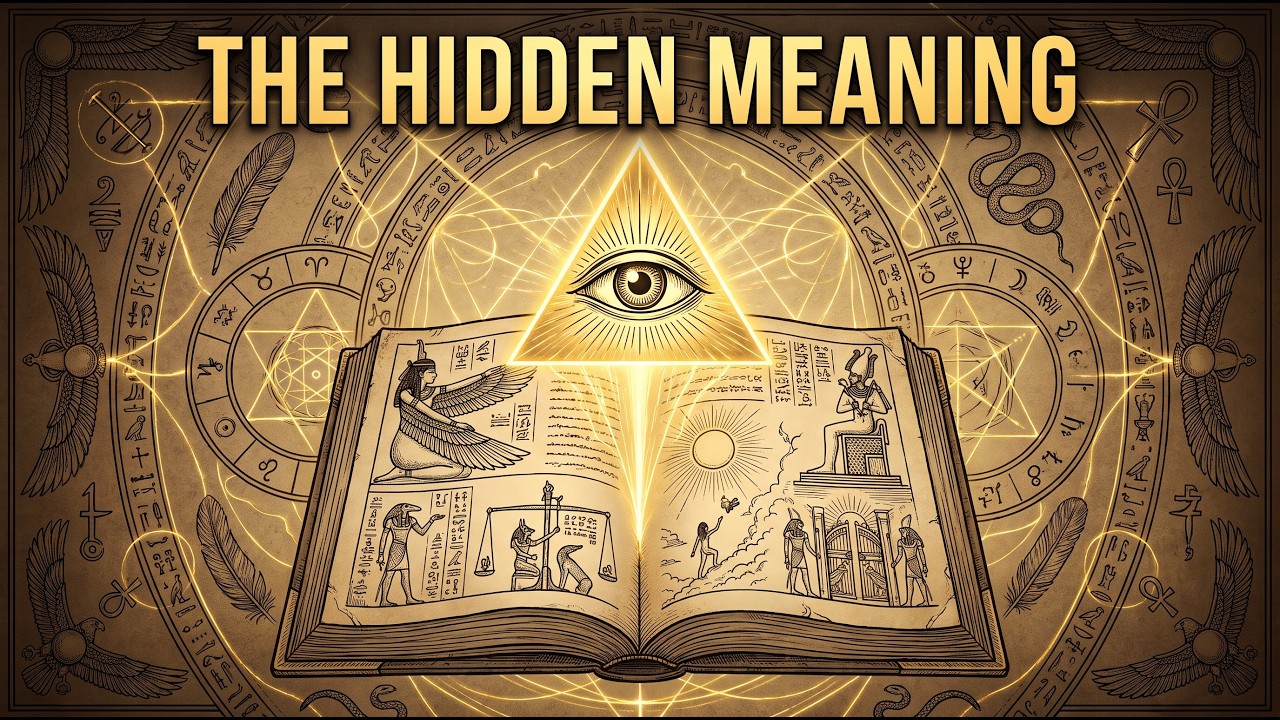
The Hidden Meaning of the Egyptian Book of the Dead
This is a single-narrator video essay (speaker identity not stated in the transcript) arguing that the Egyptian Book of the Dead, which the Egyptians themselves called the Book of Going Forth by Day, encodes a philosophy of inner awakening rather than simply a guide to the afterlife. The narrator traces this reinterpretation through the Osiris and Isis myths, the judgment of the heart against the feather of Ma'at, and later comparisons to the Greek/Gnostic figure Sophia, the concept of gnosis, and the Nag Hammadi codices. Because this is a single-voice essay rather than a debate, there is no dialogic disagreement between speakers; the recurring tension the narrator raises instead is between institutional religious authority and personally discovered spiritual knowledge, paired with repeated cautions against overstating direct historical links between Egyptian religion and later Gnostic traditions.
The narrator's core thesis is that ancient Egypt preserved a vision of death not as an ending but as a passage and transformation involving confrontation with cosmic and personal forces. [00:22]
- The narrator states the collection popularly called the Egyptian Book of the Dead was never a single book, but a body of funerary spells the Egyptians called the Book of Going Forth by Day. [00:51]
- The narrator explicitly frames the episode's intent as not claiming every ancient symbol means the same thing and not turning history into fantasy. [02:30]
- The narrator suggests the deepest secret of the text was never about escaping death but about learning to 'go forth into the light while still alive.' [02:50]
- The narrator states the funerary texts' roots reach back to the Pyramid Texts of the Old Kingdom and the Coffin Texts of the Middle Kingdom. [03:36]
+ 55 more takeaways
- The narrator states that by the New Kingdom these traditions had developed into the funerary manuscripts recognized today. [03:44]
- The narrator frames the underlying question as what a human being must become to pass through death without being destroyed by it. [03:57]
- The narrator describes the deceased entering a divine tribunal in the judgment scene. [04:09]
- The narrator states the deceased's heart is weighed against the feather associated with Ma'at, the principle of truth, balance, justice, and cosmic order. [04:12]
- The narrator states Isis emerged, centuries after the Egyptian funerary traditions were established, as one of the most powerful divine figures in the Mediterranean world. [04:38]
- The narrator states Isis's mythology of restoring Osiris symbolically offered the idea that what has been broken can be gathered together and what appears dead can be transformed. [04:54]
- The narrator states early Christianity later featured a comparable feminine wisdom figure, Sophia, from a different religious and philosophical environment than Isis. [05:07]
- The narrator cautions that historians should not collapse the Isis and Sophia traditions into one, even though the comparison is fascinating. [05:21]
- The narrator cautions that the term 'Gnostic' can be misleading since Gnosticism describes a wide variety of ancient movements rather than one unified religion. [05:42]
- The narrator states many Gnostic writings emphasized gnosis, a transformative knowledge of the divine experienced as an awakening rather than an intellectual belief. [05:55]
- The narrator states that in 1945, near Nag Hammadi in Egypt, 13 ancient codices containing 54 works were discovered, including the Gospel of Thomas. [06:12]
- The narrator states the Nag Hammadi find also included the Gospel of Truth and other writings scholars classify as Gnostic. [06:23]
- The narrator states the Nag Hammadi codices were written in Coptic and had been buried centuries before their discovery. [06:31]
- The narrator states scholarship on the Gospel of Truth has identified evidence of ideological alteration in one surviving version. [07:21]
- The narrator states plainly that the Egyptians did not secretly predict Gnosticism. [07:53]
- The narrator identifies a shared intuition across traditions: that another order of reality lies beneath the visible world and that awakening requires encountering something ancient within that predates ordinary identity. [08:06]
- The narrator states the Egyptians called this inner journey 'going forth by day,' while later mystics used terms like illumination, rebirth, revelation, or gnosis. [08:30]
- The narrator states the deceased's underworld journey is filled with gates, guardians, and judgment chambers, and the way through is rarely brute force. [09:53]
- The narrator gives the guiding principle 'know the names.' [10:10]
- The narrator gives the second directive 'know the words.' [10:12]
- The narrator gives the third directive 'know the correct forms.' [10:14]
- The narrator gives the fourth directive 'know the powers encountered along the way.' [10:16]
- The narrator states that to know the nature of a thing is, in some sense, to cease being powerless before it. [10:25]
- The narrator recounts the Osiris myth in which he is murdered, dismembered, and restored through the efforts of Isis. [12:02]
- The narrator interprets Osiris psychologically as representing the fragmented human being, divided by grief, ambition, guilt, desire, fear, and imposed social roles. [12:14]
- The narrator states Sophia, the Greek word for wisdom, became a personified figure in Jewish and Christian wisdom traditions and later took on distinct meanings within several Gnostic systems. [13:20]
- On screen, a diagram pairs dichotomies such as Honesty vs Deception and Courage vs Fear around a Ma'at-style scale weighing a heart against a feather. [13:45]
- The narrator's analogy for gnosis is that reading a thousand descriptions of fire is different from touching warmth. [14:29]
- The narrator suggests the 'underworld' is also what happens whenever an inherited identity collapses, such as when a relationship ends or a career disappears. [15:12]
- The narrator states the judgment was never about whether one was powerful enough to defeat the gods but whether one's inner world was aligned with truth. [16:48]
- The narrator states the scales do not care who you claim to be; they reveal what you actually carried within you. [18:08]
- The narrator states that in the Osiris myth, Isis enters a world broken by death and searches for what has been scattered in order to restore it. [19:37]
- The narrator states that within certain Gnostic cosmologies, Sophia becomes associated with dissent, disruption, longing, error, and restoration, unlike wisdom safely possessed by an institution. [21:21]
- The narrator states the paradox that consciousness sometimes discovers itself precisely through separation, since deeper traditions suggest descent is part of the initiation. [21:44]
- The narrator states the deceased must pass through the underworld (Duat) without forgetting who they are, calling 'remember' one of the most important concepts in the mystical tradition. [22:36]
- The narrator states the human problem in this framework was not simply ignorance but forgetfulness of one's origin and deeper nature. [23:09]
- The narrator cautions it would be irresponsible to claim Egyptian religion directly became Gnosticism, while noting extensive cultural contact across the Hellenistic and Roman Mediterranean. [23:26]
- The narrator states the suppression of Gnostic texts was not simply the Church destroying all ancient truth, since there was no single Gnostic doctrine and some texts survived by accident. [24:24]
- The narrator states institutional religion and personal gnosis are not necessarily enemies, since traditions preserve wisdom and teachers guide people through experiences they might otherwise misunderstand. [25:49]
- The narrator states that once spiritual authority becomes concentrated, power appears, raising questions of who interprets revelation and decides what is sacred. [26:19]
- The narrator cautions against going too far toward private intuition, since ego, desire, and fantasy can imitate divine revelation. [26:44]
- The narrator states the goal was never simply to believe whatever you feel inside, but to learn to distinguish the voice of truth from the voice of the self. [27:15]
- Quotable: the narrator states the heart 'must become lighter, not empty, not emotionless, but aligned.' [27:37]
- The narrator offers a nightly practice: sit quietly for five minutes before sleep with phone away and music off, then ask where you were truthful, where you betrayed what you knew was right, and what you were pretending not to know. [29:10]
- The narrator introduces 'the Isis practice of restoration,' writing down the different versions of yourself you have been carrying, such as the responsible one, the ambitious one, or the frightened one. [30:31]
- The narrator instructs choosing one limiting belief about yourself and testing it in real life, such as speaking once when you would normally stay silent if you believe you can't speak confidently. [31:43]
- The narrator offers a morning practice of 10 minutes without entertainment, notifications, podcasts, or conversation, observing thoughts without fighting or chasing them. [32:14]
- The narrator states that thoughts, emotions, memories, and desires arise, yet something is capable of witnessing all of them. [33:01]
- The narrator offers a discernment test: ask whether an inner revelation makes you more truthful or merely more certain, more compassionate or more self-important. [33:57]
- Quotable: the narrator states 'the labyrinth is already inside you,' with fears as the guardians, habits as the gates, attachments as the shadows, conscience as the scale, and attention as the torch. [35:16]
- On screen, a banner reads 'DO NOT WAIT FOR DEATH TO DISCOVER WHETHER YOU WERE AWAKE,' shown above a glowing figure ascending toward a sun between two temple pylons. [36:46]
- The narrator explicitly states Isis did not simply become Sophia and Egyptian religion did not secretly become Gnosticism. [37:23]
- On screen, a diagram shows a heart on balance scales labeled 'HEART' and 'MA'AT TRUTH/ORDER,' illustrating that the scales test whether one's life can withstand the truth one claims to believe. [38:15]
- The narrator closes with a series of imperatives: begin now, gather what has been scattered, examine the heart, and learn the difference between intuition and illusion. [39:03]
- The narrator closes by saying not to wait for death to discover whether you were truly awake, inviting viewers to explore further forgotten texts and traditions. [39:48]
How this brief was shaped: Discourse (interview / podcast / video essay) · confidence Medium
Single narrator argues a reinterpretive thesis that the Egyptian Book of the Dead teaches inner awakening rather than literal death, opening with rhetorical questions and later comparing the Egyptian worldview to other spiritual traditions, with no procedure, product, or course context present. OCR sample is garbled and unreadable so the call rests on the transcript alone.
The lens sets this brief's structure, never its facts — every claim is held to the same citation and fact-check standard.