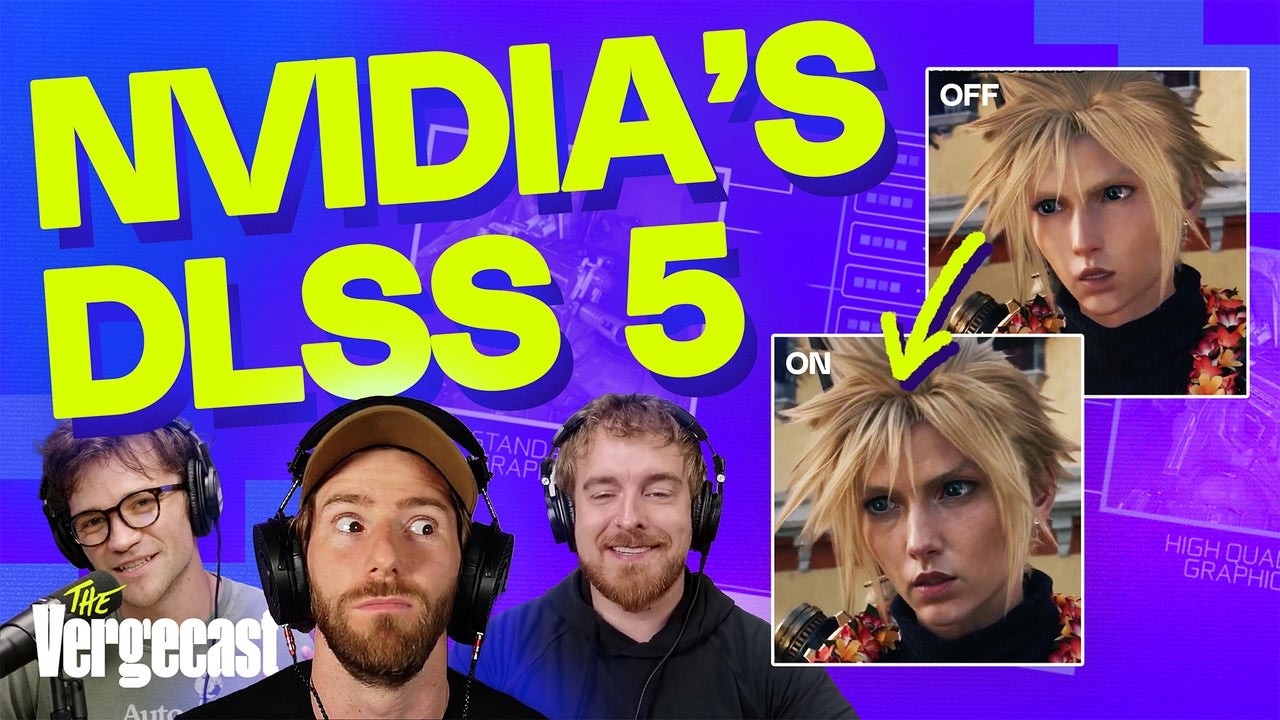
DLSS5 Explained with Linus Tech Tips | The Vergecast
The discussion centers on NVIDIA's DLSS5, released September 3rd, 2026, and whether it represents a genuine advance in neural rendering or an overreach that papers over stalled hardware progress. The host and a guest, David (Gauthier), walk through DLSS5's technical behavior, early implementations in games like Clair Obscur: Expedition 33, NBA 2K27, and Kingdom Come Deliverance 2, and the backlash around AI-altered visuals. The center of gravity is a tension between DLSS5's potential (photorealistic enhancement, performance gains over time) and its current limitations (catastrophic performance cost, 'AI look', early-stage detail generation), with disagreement over whether it will work for stylized art styles versus only photorealistic games.
NVIDIA's DLSS5, released September 3rd, 2026, is a supersampling technology described as notably different from past versions [00:08].
- The host explains supersampling is used to boost video game fidelity and performance on existing hardware [00:17].
- The host notes there has been pushback from parts of the gaming and developer communities about DLSS5 [00:22].
- Linus Sebastian explains past DLSS used machine learning to extrapolate a low-resolution image, comparing it to stretching and sharpening a photo from a one-megapixel digital camera [03:02].
- Linus Sebastian says DLSS5 differs because it seems to add elements of the scene, not just pixels, or add colors that weren't there before [03:42].
+ 45 more takeaways
- NVIDIA has stated outright that neural rendering is the future because Moore's Law-style transistor scaling for better rendering is dead, stated without further evidence given [03:57].
- One host describes neural rendering as taking a relatively low fidelity scene and using a trained AI model to guess the creator's intent [04:23].
- David Gauthier, who spent more time with DLSS5 than the host, tested it on games NVIDIA did not authorize [05:36].
- David says DLSS5's biggest limitation is that it must render at least 60 times a second, which limits how much creativity the AI can apply [06:21].
- David notes even NVIDIA is trying to distance DLSS5 in messaging from being called generative AI [06:38].
- David explains the program separates objects so users can apply different amounts of effect individually, but it cannot transform a crude drawing into a finished object and needs fairly good input, per NVIDIA's own claim that better input yields better output [06:46].
- David says DLSS5 still has 'that AI look' and won't change the minds of people who have an immediate disgust reaction to AI-generated content [07:15].
- A host observed the haze went away and contrast went up when DLSS5 was applied to the fantasy harbor scene in Clair Obscur: Expedition 33 [07:43].
- A host noted only NBA 2K27 has actually been tuned with all the sliders NVIDIA makes available to developers for these effects [08:14].
- For every other game shown, the hosts said they were making best guesses at what might look okay, stated without rigorous testing evidence given [08:26].
- Kingdom Come Deliverance 2 creative director Daniel Vavra defended DLSS5 on Twitter/X, stating nothing about the character models or appearance was leaked, only normal maps used to create better skin texture and facial detail, and that this is how the faces were supposed to look [08:57].
- One host predicted DLSS5 will currently and in the near future only work well in games chasing photorealism, not stylized looks, marking a key point of disagreement over the technology's scope [09:23].
- One host noted the AI's training data set seems to suck the color out of images similarly to lazy color correction in film, trying to make games look more like movies without the detail work to make it pop [09:45].
- One host described the performance hit of DLSS5 as already catastrophic on a 5090, making it not yet a mainstream technology [11:02].
- One host said the feature's implementation is still early stage because it isn't creating detail from nothing that perfectly integrates into the rest of the scene [12:17].
- The host found DLSS5's AI-generated results pleasing at times, citing more immersive NPC-populated street scenes in Cyberpunk [12:57].
- NVIDIA has said DLSS5 is five times more performant since spring, when the original demos required two 5090s to run, stated without independent evidence given [14:47].
- NVIDIA said it will work on a 4000-series version of DLSS5 in response to backlash [15:24].
- The 40 series can run DLSS5, but a host described this as the lightest version of DLSS5 that will likely ever exist [15:52].
- The host predicted DLSS5 versions will be tuned differently for each GPU generation, similar to how the Transformer model runs worse on older cards [16:24].
- The host recalled that almost 25 years ago, cards lacking DirectX 9C support just meant buying a new one when a performant card cost about $150 [17:16].
- The host found 5080s priced around $1,500 to $1,600 on Newegg [18:01].
- A speaker recalled a previous version of DLSS generated frames, prompting complaints that GPUs weren't truly generating all displayed frames [22:58].
- A speaker stated the new DLSS approach does upscaling but at roughly a 50% performance cost even on a 5090 [23:19].
- A speaker said NVIDIA's messaging is confused because they want to sell high frame rate, high resolution, and ray-traced lighting simultaneously [23:37].
- The host said NVIDIA wants to sell high frame rate, high resolution, ray-traced lighting, and AI-assisted enhancement all at once, calling this unrealistic with the phrase 'pick two' [23:53].
- One host argued NVIDIA deliberately tanks performance so gamers become dependent on DLSS, reasoning that AMD can compete dollar-for-dollar on raw performance but not on DLSS versus FSR [24:20].
- A host pointed out the DLSS5 news broke the same week as the GTA 6 drop, a game built with no AI-generated content that runs well on a base PS5, framing a point of contrast between the two approaches [26:17].
- A host estimated GTA 6 costs between one billion and three billion dollars to produce and called it a guaranteed payout with a built-in buyer base, explaining why other studios can't match its optimization [27:04].
- A host cited Expedition 33 as a smaller indie-ish studio game that looks amazing but took criticism for being poorly optimized [27:59].
- A host noted Expedition 33 can run well on handheld PCs with tuned settings but struggles badly when settings are cranked up without high-end hardware [28:27].
- The hosts noted engines like Unreal Engine are now built with scalable future-proofed settings that nothing can fully run yet, unlike in the past [29:01].
- The host referenced the GTX 970 selling for $350, noting this was before 'the scandal,' stated without further detail given [29:58].
- The host said he has seen people hooking up DLSS5 filters to capture cards and even webcam output [30:08].
- The guest stated NVIDIA holds over 90% market share in discrete GPUs [31:08].
- The guest stated DLSS5 requires vector data that a webcam simply doesn't have, so applying it to a webcam isn't really DLSS5 [32:11].
- The guest recalled a Samsung frame-interpolation demo from his computer store days running up to roughly 900Hz fake refresh, using a scene of hundreds of flying birds that looked glitchy because the processor couldn't predict wing motion [32:41].
- The guest recalled that when DLSS5 first launched a few months prior, it drew criticism for 'Yassifying' people's faces, though face structures have since improved [34:36].
- A host suggested having DLSS5 officially work on only the 50-90 for one game may be NVIDIA's way to buy time to optimize it before it trickles down to cheaper graphics cards, stated without confirming evidence given [34:53].
- One host said this is the worst version of DLSS5 that will ever be seen and predicted it will get better [35:21].
- One host said DLSS 4.5 was a turning point where they went from skeptical to willing to turn it on [35:58].
- The host credited NVIDIA for nailing the DLSS 4.5 prediction, which now lends credibility to DLSS5 claims [36:32].
- The host suggested this object-enhancement feature is branded as DLSS to lean on the credibility NVIDIA built with the DLSS brand [36:59].
- David predicted the DLSS5 available in a year will be markedly different, with a slew of refined titles compared to current mixed YouTube reactions [37:31].
- It's still pretty expensive at $2,195, but this time, it can save 50% of the floor space when it's folded up.
After all the controversy about NVIDIA's DLSS 5 being a terrible AI slop, I played around a bit with the leaked DLSS 5 version in KCD2. First off — what was leaked of the models or the appearance of the characters in any way. What it does is take existing normal maps and create much better skin texture and facial detail (examples 6 and 2) than the lighting model in the game. It also looks a bit like an attempt at subsurface scattering and other advanced skin rendering dehaze filters which have very similar effect. I often criticized the character artists' work when certain faces in the game looked lacking in detail and plasticity, and they'd often show me that it looked fine on their computers and that the problem was with the lighting in the game. Well, now it looks right in the game, too! This is how those faces were supposed to look. The AI isn't making anything up.
File: renodx-dlss5.addon64
Version: 0.2026.827.2036
Description: Generic experimental DLSS Neural Rendering post-pass for DX12 games using NGX or Streamline DLSS
DLSS NRV3 10.8.8: ACTIVE
Backend: NGX core | one-pass-per-output: enabled
NGX hooks: creates 6 | evaluations 38858
Streamline: DLSS/DLSS D evaluations 38858 | all evaluations 38858
Streamline tags: calls 42558211 [...] (mask 8x08)
How this brief was shaped: Discourse (interview / podcast / video essay) · confidence Medium
Podcast host brings on two guests from Linus Tech Tips to debate DLSS5 with disagreement over whether the AI supersampling is good or controversial slop, transcript shows back and forth opinion exchange rather than a procedure or product verdict, OCR shows game screenshots and a leaked mod file plus a quoted tweet from a developer as discussion evidence rather than a structured spec sheet.
The lens sets this brief's structure, never its facts — every claim is held to the same citation and fact-check standard.