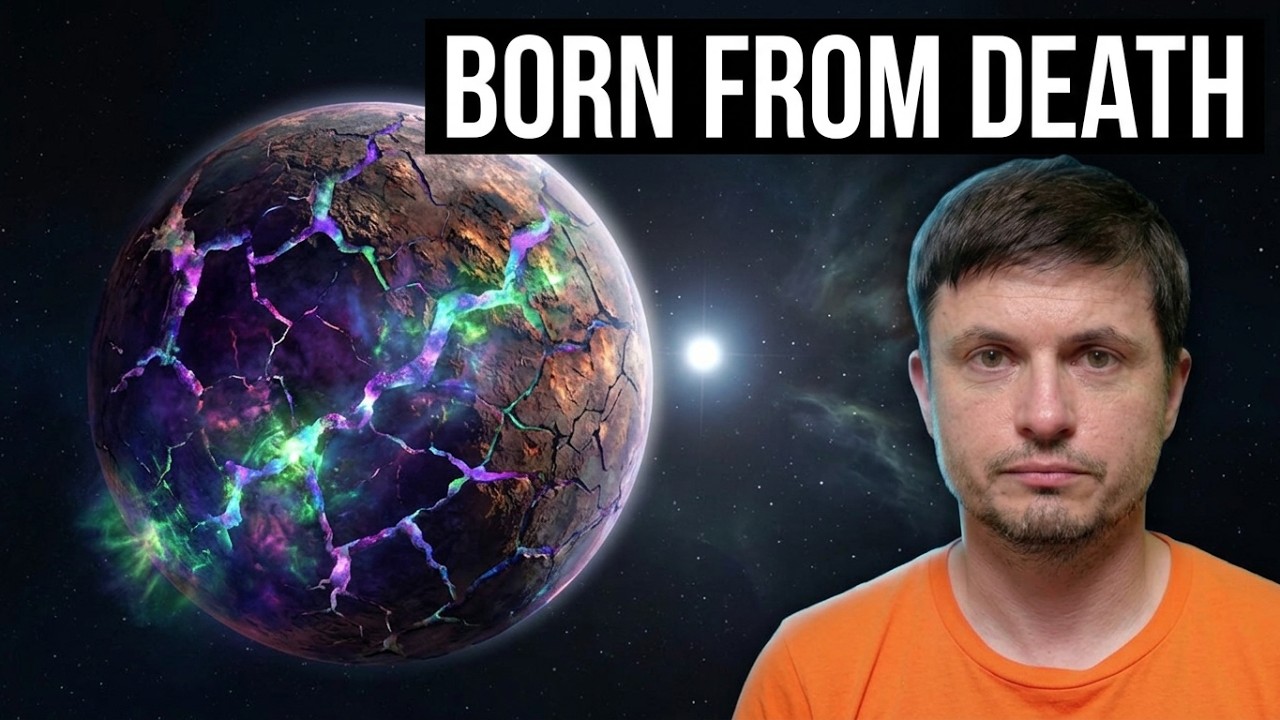
A Second-Generation Planet Was Just Found Around a Dead Star
What this video is
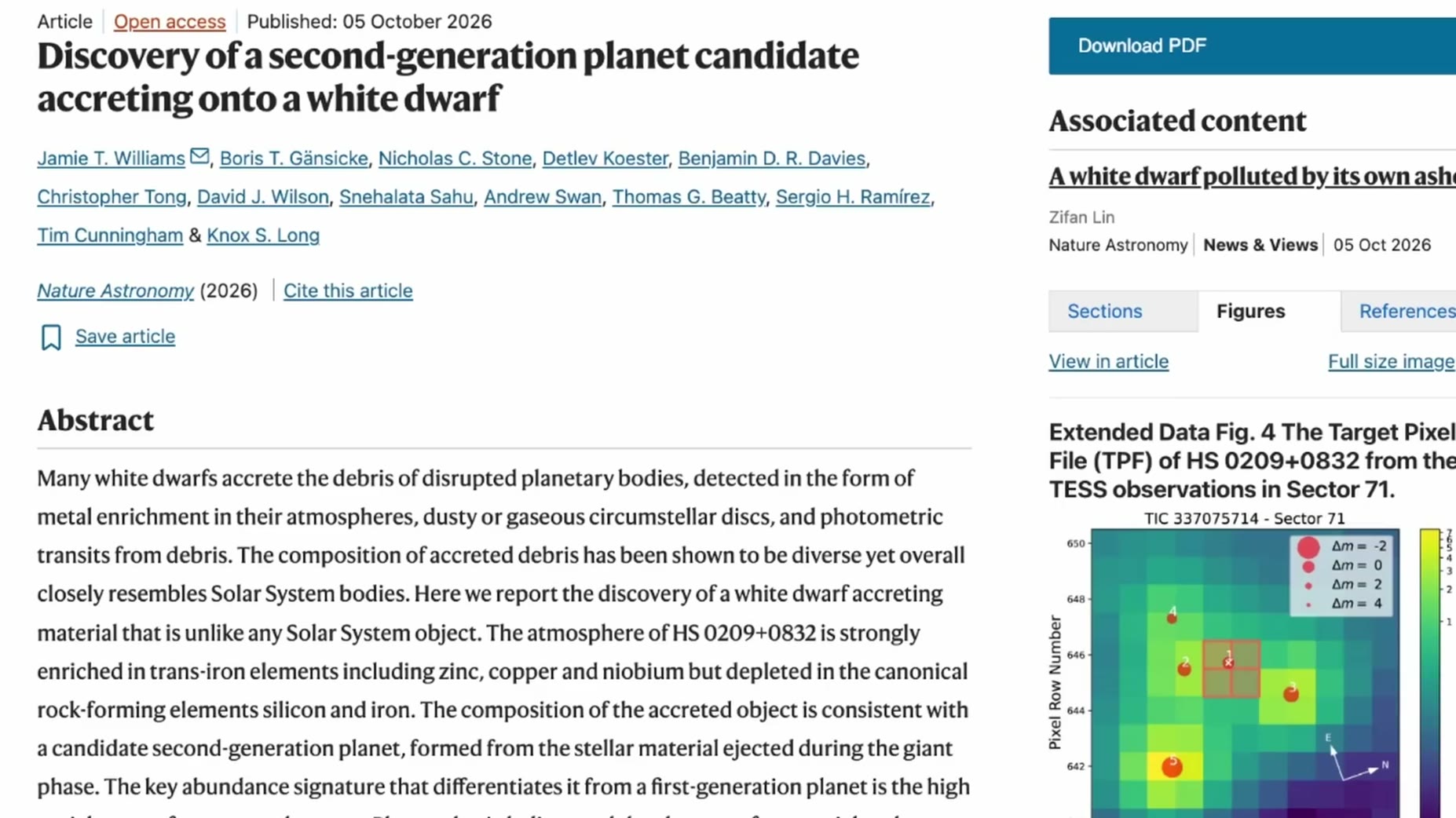
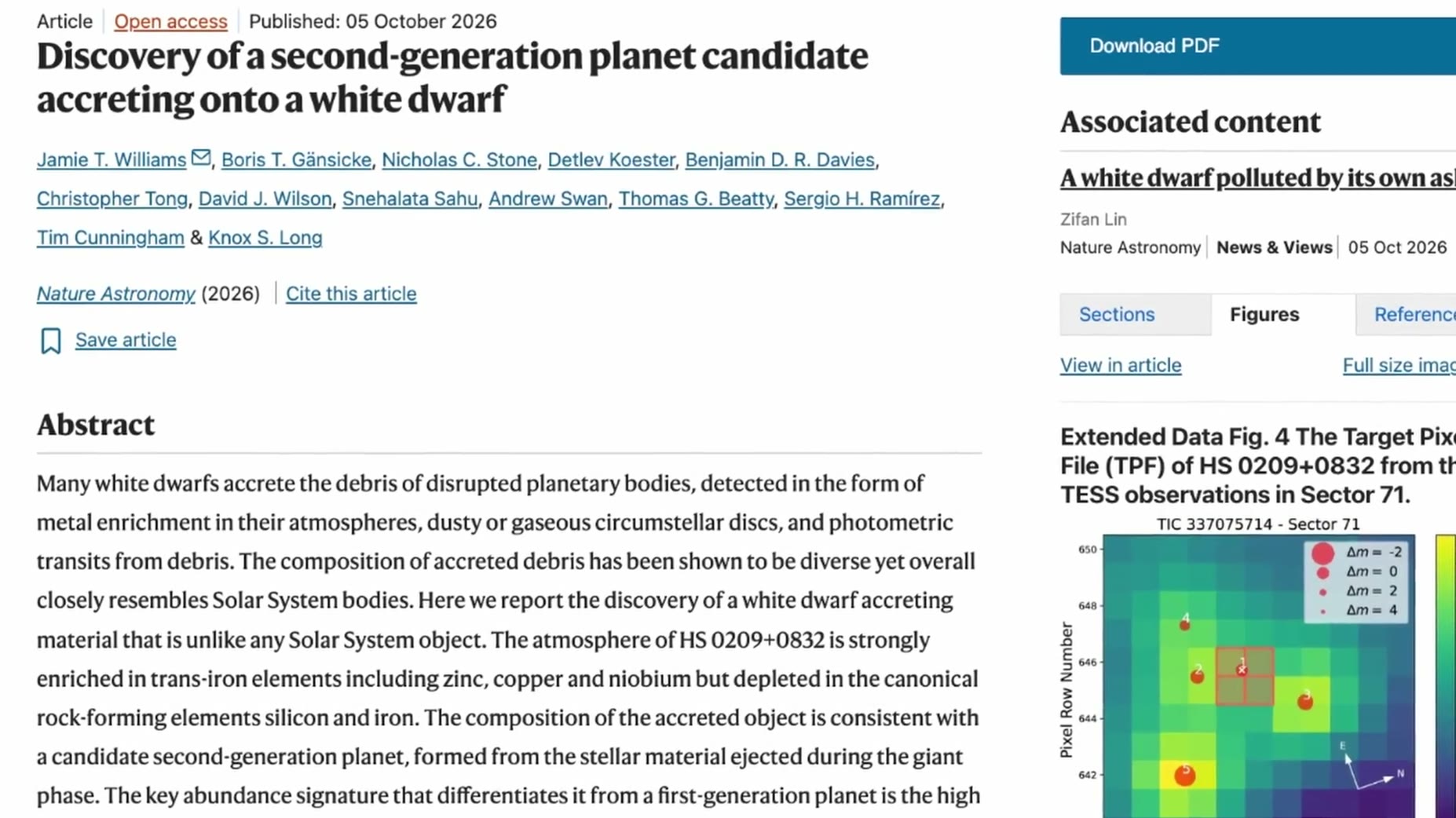
⚡ a 15-minute video, readable in 60 secondsA 2026 Nature Astronomy study led by Jamie T. Williams, Boris T. Gansicke, Nicholas C. Stone and a University of Warwick team reports a candidate 'second-generation' planet, one formed not at a star's birth but from material the star itself ejected while dying. The white dwarf HS0209+0832 shows an atmosphere polluted with trans-iron elements like zinc, copper and niobium rather than the usual asteroid-debris signature of silicon and iron, pointing to a world built from the star's own shed material. This challenges the long-held assumption that all planets form once, early in a system's life, from a single proto-planetary disk. It also raises the possibility that stars, including the Sun, could seed new planets even after death.
[01:51] A 2026 Nature Astronomy study by Jamie T. Williams, Boris T. Gansicke, Nicholas C. Stone and a University of Warwick team reported a candidate second-generation planet.
Key takeaways
- [01:55] The white dwarf HS0209+0832's atmosphere is strongly enriched in trans-iron elements like zinc, copper and niobium, but depleted in the rock-forming elements silicon and iron.
- [05:06] Niobium levels in the white dwarf's atmosphere are over a thousand times higher than inside the Sun.
- [05:16] Niobium and zinc are S-process elements, formed by slow neutron capture in the bloated atmospheres of AGB (asymptotic giant branch) stars.
- [06:54] NASA's TESS telescope detected a repeating signal every 4.4 days, indicating the object orbits at 0.04 AU, 25 times closer than Earth is to the Sun, with a 0.12% brightness difference between its dayside and nightside.
+ 7 more takeaways
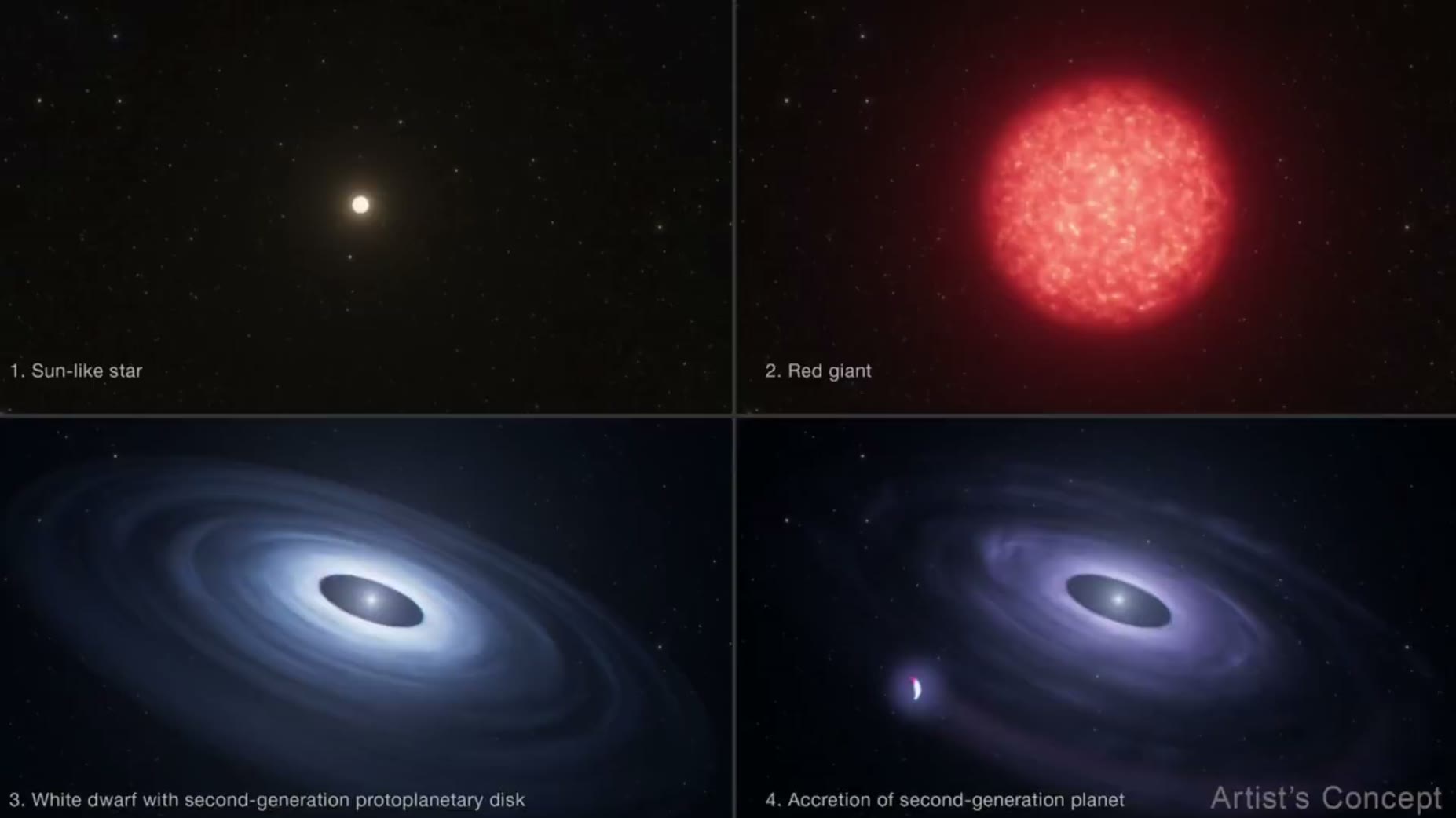
- [06:21] The findings suggest this material came from a world that condensed out of a second-generation disk formed from the star's own ejected material, not from an ancient asteroid or terrestrial planet.
- [04:32] A typical polluted white dwarf is enriched in silicon, iron, oxygen and magnesium from shattered asteroids, the basic building blocks of a terrestrial planet like Earth.
- [04:50] This white dwarf instead shows almost no iron or silicon, and is overwhelmingly enriched in trans-iron elements such as zinc, copper, nickel, carbon and niobium.
- [00:13] Astronomers previously assumed planets form at the start of a star system's life from massive clouds forming proto-planetary disks.
- [01:11] Some astronomers proposed a second generation planet could form when an old star runs out of fuel, becomes a red giant, swallows some planets, then throws off gas forming a nebula.
- [03:10] The white dwarf's gravity is 100,000 times stronger than Earth's, strong enough to sink heavy elements like iron, silicon and calcium within weeks or months.
- [13:33] Scientists speculate that when the Sun eventually sheds half its mass as it dies, the ejected material could similarly transform into heavier elements and form a newborn planet made of niobium and zinc.
Jump to a moment
Their links, sorted & clickable
🏛️ Communities & courses1
Support this channel on Patreon to help me make this a full time jobWas this brief useful?