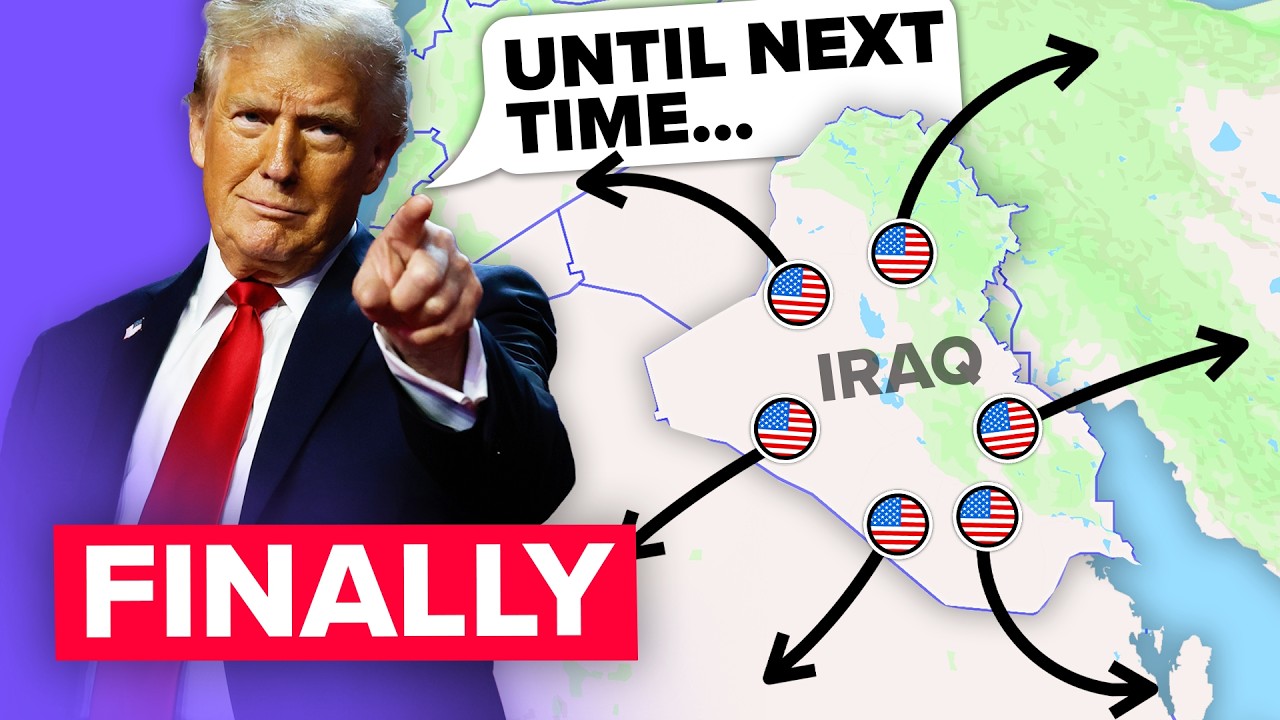
The US Finally Withdraws From Iraq: What Next?
This is a TLDR News-style history and current-events explainer, hosted by Jack Kelly and animated by Jan Adamic. It traces roughly 35 years of US military presence in Iraq, from the 1991 Gulf War and 2003 invasion through the fight against ISIS, up to the final withdrawal of US troops from the country this week. The piece also covers Iraq's parallel, and now delayed, push to disarm its militias, and closes on the open question of how Iraq will balance relations with the West and Iran going forward. It ends with a sponsored segment for ProtonMail.
For most of the past 35 years, since the Gulf War in 1991, Iraq has been under some sort of foreign military supervision, ranging from a no-fly zone up to a peak deployment of around 170,000 troops.
- The first time the US got directly involved in Iraq was during the Gulf War, which began in early 1991.
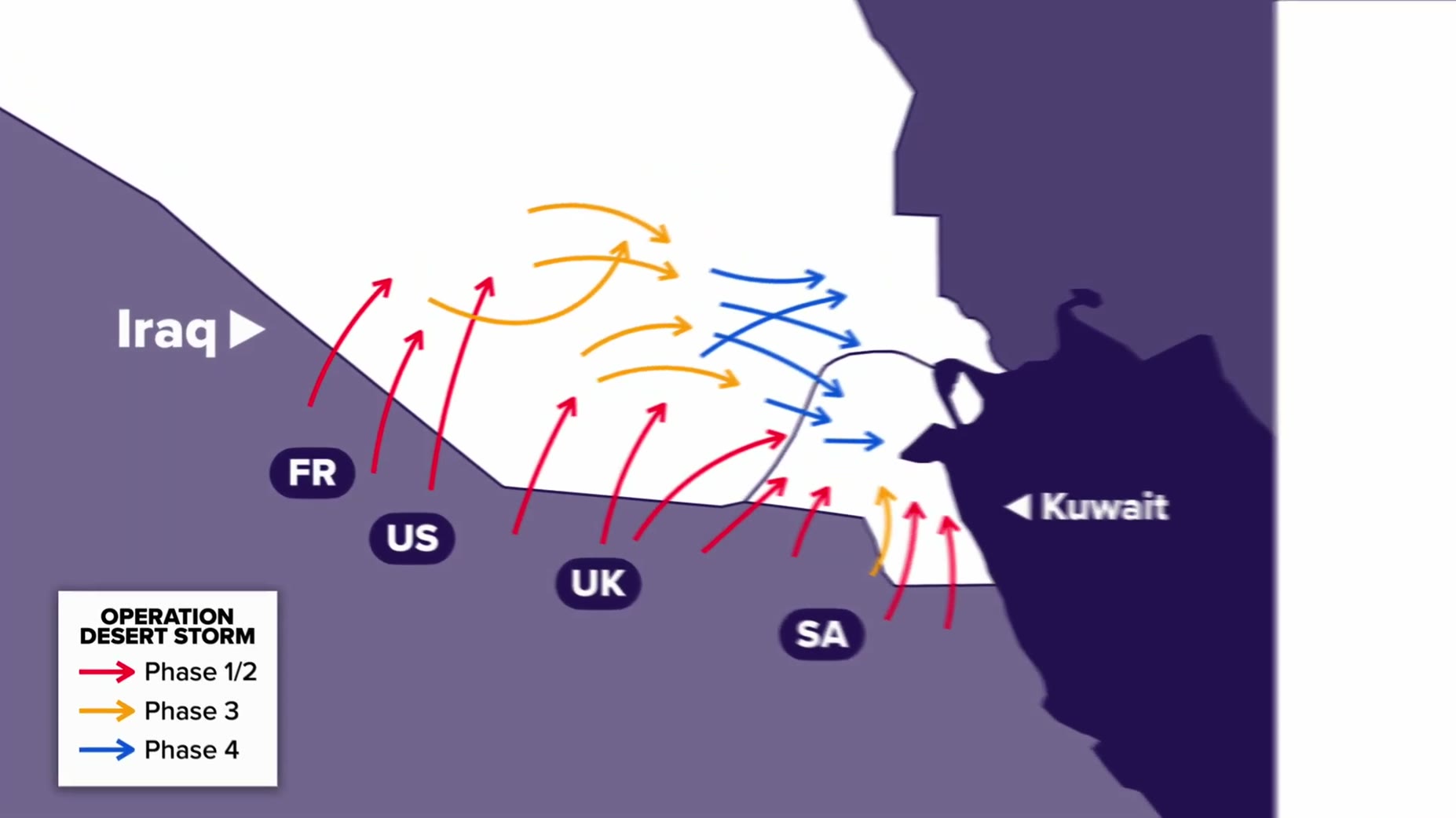
- [01:10] The US led a 42-country coalition, described as the broadest alliance since World War II, against Saddam Hussein's government after Iraq invaded Kuwait in late 1990.
- [01:21] The coalition campaign began with airstrikes.
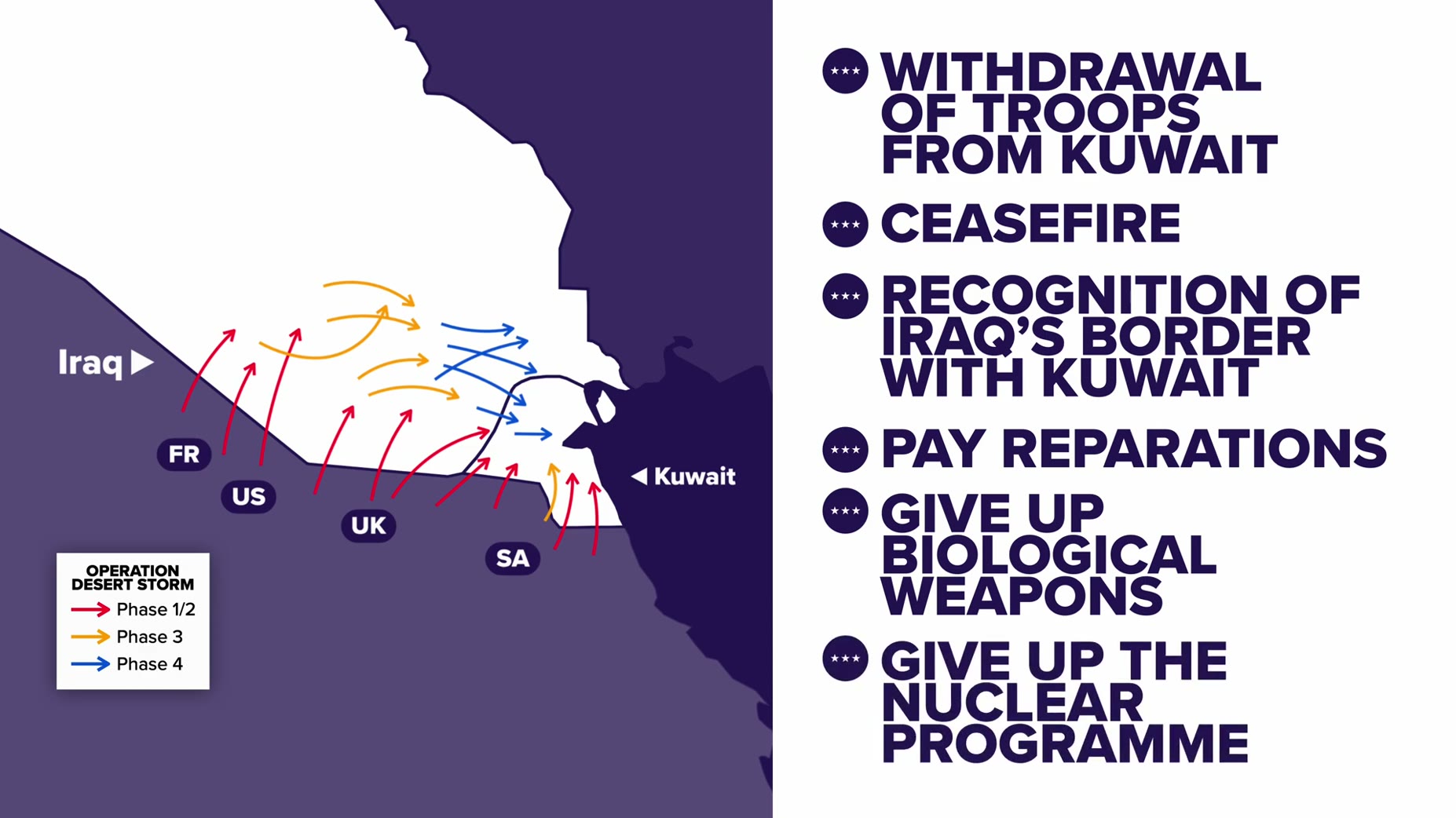
- [01:21] The coalition then launched a decisive ground assault from Saudi Arabia in February 1991, pushing into Kuwait and southern Iraq.
+ 36 more takeaways
- [01:33] Saddam withdrew troops from Kuwait in late February 1991.
- [01:33] Iraq agreed to a UN-backed ceasefire in April 1991, recognizing its border with Kuwait, paying reparations, and giving up its chemical, biological, and nuclear weapons programs plus ballistic missiles with a range above 150km.
- [02:01] The US and allies maintained a no-fly zone over Iraq until 2003, without US troops on the ground.
- [02:18] Tensions over suspected, and ultimately incorrect, Iraqi weapons of mass destruction programs led the US to invade Iraq in 2003.
- [02:18] The 2003 invasion toppled Saddam Hussein but triggered a civil war and anti-US insurgency.
- [02:33] US troop deployment in Iraq peaked at roughly 170,000 during the 2007 surge.
- [02:33] The US agreed to withdraw from Iraq in 2008.
- [02:33] The last US troops left Iraq in December 2011.
- [02:51] After the 2011 withdrawal, a residual US presence remained, including a Marine Corps Guard Detachment at the Baghdad embassy.
- [02:51] The residual presence also included thousands of private contractors.
- [02:51] The residual presence also included the Office of Security Cooperation-Iraq, a few-hundred-staff logistics and training office under embassy authority.
- [03:22] When ISIS emerged around 2014, the US redeployed about 4,000 troops to Iraq, mostly in northern bases.
- [03:22] Iraqi troops did most of the ground fighting against ISIS, with US air support.
- Even after ISIS had been defeated and Iraq had established its own democracy, the US maintained a few thousand troops in the country.
- [04:28] The US assassinated Qasem Soleimani in 2020, which triggered militia attacks.
- [04:28] Militia attacks occurred again after October 7th and during the ongoing US-Iran war.
- [04:39] In September 2024, the US under President Joe Biden and Iraq under PM Mohammad Shia al-Sudani negotiated a two-year timeline for all US troops to leave Iraq by September 2026.
- [04:58] The withdrawal plan was endorsed by Biden's successor Donald Trump and al-Sudani's successor Ali al-Zaidi.
- [04:58] Al-Zaidi visited the Oval Office earlier this year.
- [05:17] Both parties reaffirmed commitment to withdrawing all US troops from Iraq by September 30th.
- [05:17] Al-Zaidi confirmed plans, first laid out in June, to require all non-state militias to disarm by September 30th.
- [05:30] The Iraqi government has been trying to establish a state monopoly on weapons for years.
- [05:30] Al-Zaidi tried to use the end of the US deployment to leverage disarmament of the militias.
- [05:43] On September 30th the US did in fact withdraw its last remaining troops from Iraq.
- [06:16] Al-Zaidi has already pushed back the militia disarmament deadline from September 2026 to June 2027.
- [06:16] Ambiguity remains over what happens to combatants' weapons.
- [06:28] Al-Zaidi must balance maintaining functional relations with the West and with neighboring Iran.
- [06:28] Iran will still significantly influence Iraq even if proxy militias disarm.
- The video is hosted by Jack Kelly and animated by Jan Adamic.
- [07:09] The host promotes ProtonMail, the video's sponsor, as a private, secure alternative to companies that want to sell user data.
- [07:20] ProtonMail uses end-to-end, zero-access encryption to keep email and information secure.
- [07:27] ProtonMail offers no ads, no tracking, and no profiling.
- [07:35] ProtonMail's Easy Switch tool lets users move email and contacts from their current provider in a few steps.
- [07:41] Users can connect their Gmail account to send and receive messages directly in ProtonMail while transferring everything over at their own pace.
- [07:52] Viewers are told to start using ProtonMail for free via the link proton.me/tldr.
- [08:05] Credits: Host Jack Kelly, Writer Zac Michaelis, Video Editor Jana Damic, Thumbnail Scarlett Watchorn, copyright Three26 Ltd 2026.

How this brief was shaped: Narrative (vlog / gaming / travel / entertainment) · confidence Low
The transcript is explicitly structured as a chronological history, with the narrator saying let's start with a quick history of the US's involvement in Iraq and walking through 1991 Gulf War, the no-fly zone, the 2003 invasion, and on to the 2026 withdrawal in time order. The OCR/vision sample mostly shows an unrelated channel editorial policy document rather than content tied to this topic, so it adds little usable signal.
The lens sets this brief's structure, never its facts — every claim is held to the same citation and fact-check standard.