Why a 1960 Science Paper Predicted End of Humanity on Nov 13, 2026
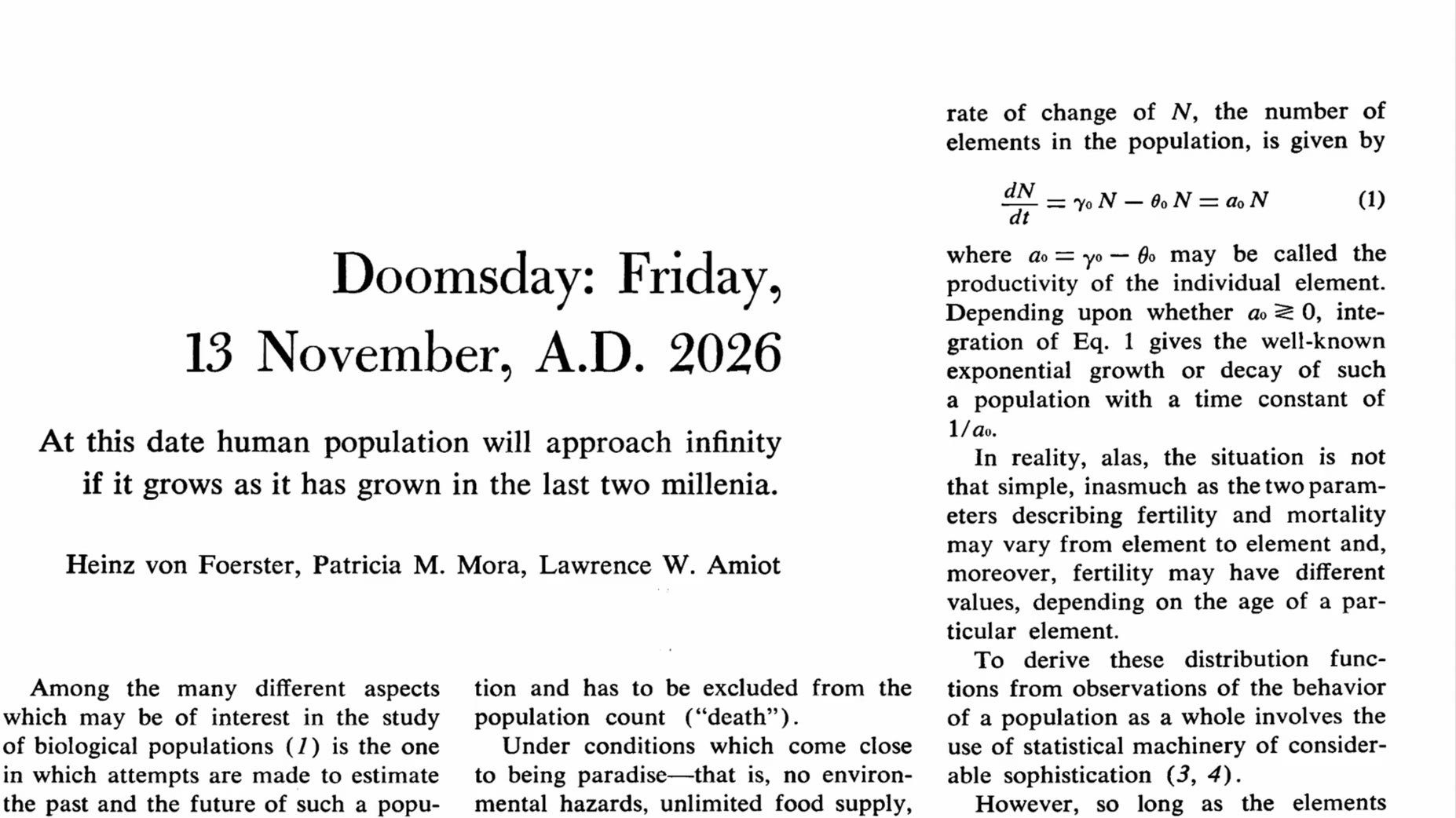
In 1960, Heinz von Foerster, Patricia Mora, and Lawrence Amiot published a paper titled 'Doomsday: Friday, 13 November, A.D. 2026,' predicting that human population would hit a mathematical singularity (infinity) on that date if growth continued as it had for the prior two millennia. The video traces how this hyper-exponential model, built on humans' unique capacity for coalition-building and technological innovation, outperformed standard biological growth curves and even UN demographic models for decades, before the real-world demographic transition broke the trend. It argues the paper was less a failed prophecy than deliberate scientific stagecraft by von Foerster, a former stage magician, designed to force attention onto unsustainable population growth.
[00:48] The paper 'Doomsday: Friday, 13 November, A.D. 2026' was authored by Heinz von Foerster, Patricia M. Mora, and Lawrence W. Amiot.
- [00:22] It predicted human population would approach infinity on that exact date if growth continued as it had over the prior two millennia.
- [00:32] The authors wrote that descendants would not starve but instead be 'squeezed to death.'
- [04:27] The projection was based on 24 independent world population estimates spanning nearly 2000 years, using historical data from year 0 to 1958.
- [01:45] The model built on Thomas Malthus's 1798 essay arguing population grows geometrically (2, 4, 8, 16) while food grows only arithmetically.
+ 14 more takeaways
- [02:15] Standard biology instead uses a logistic growth curve, where populations like fruit flies or bacteria level off at a limit.
- [02:58] Von Foerster argued humans are exceptional because language and communication let them form coalitions, driving what his team called hyper-exponential growth.
- [05:57] Extrapolating the equation backward gave a population of exactly one roughly 200 billion years ago, at least 10 times older than the universe's then-estimated 24-billion-year age, a cosmological paradox.
- [06:54] When published in 1960, many demographers and mathematicians were outraged, with letters demanding the paper be withdrawn as 'ridiculous and manifestly absurd.'
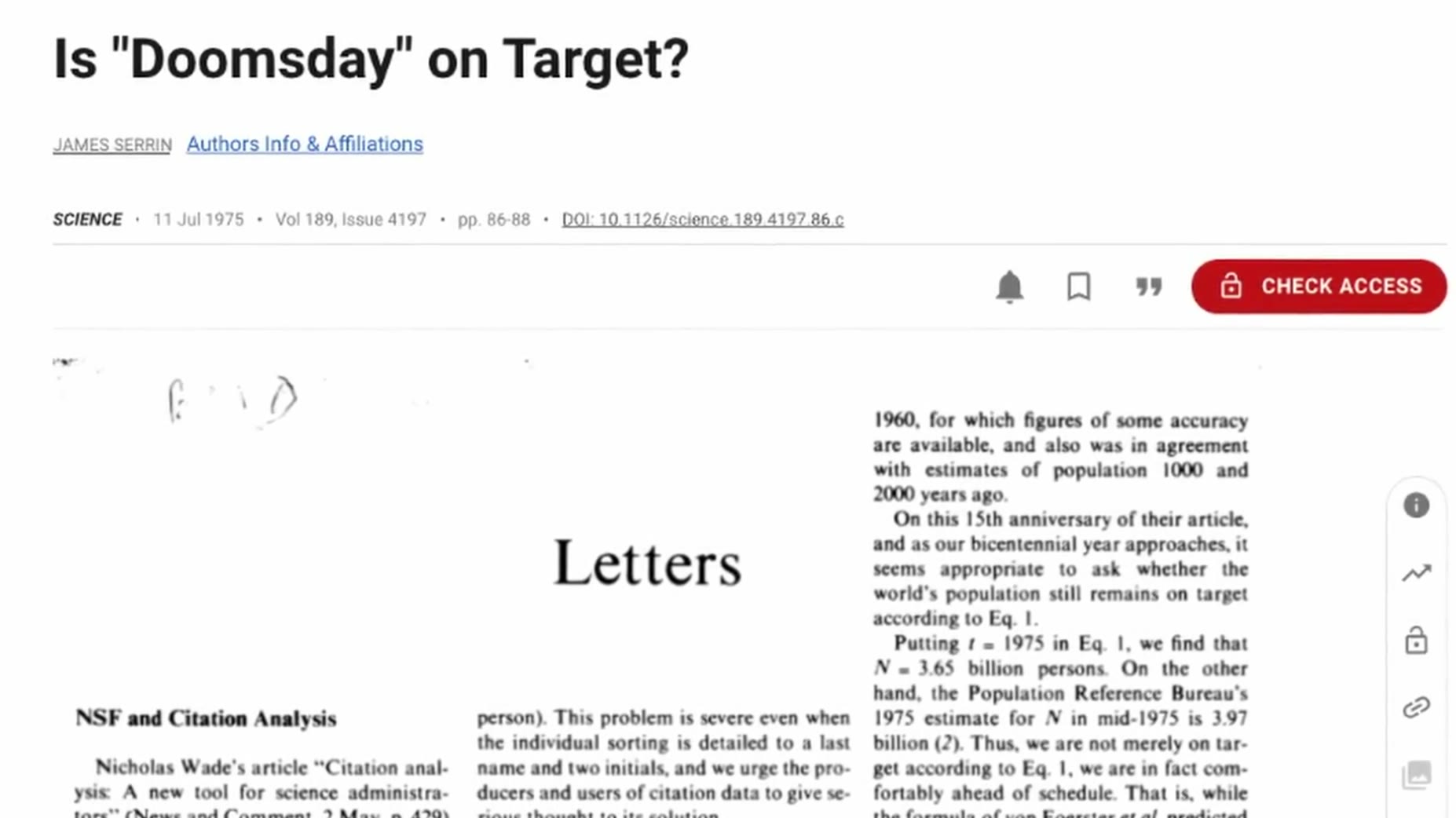
- [07:18] A 1975 Science article by James Serrin found the equation predicted 3.65 billion people versus the actual 3.97 billion, meaning the world was ahead of the doomsday schedule rather than merely on target.
- [07:43] The simple formula is claimed to have predicted global population more accurately than complex UN demographer computer models.
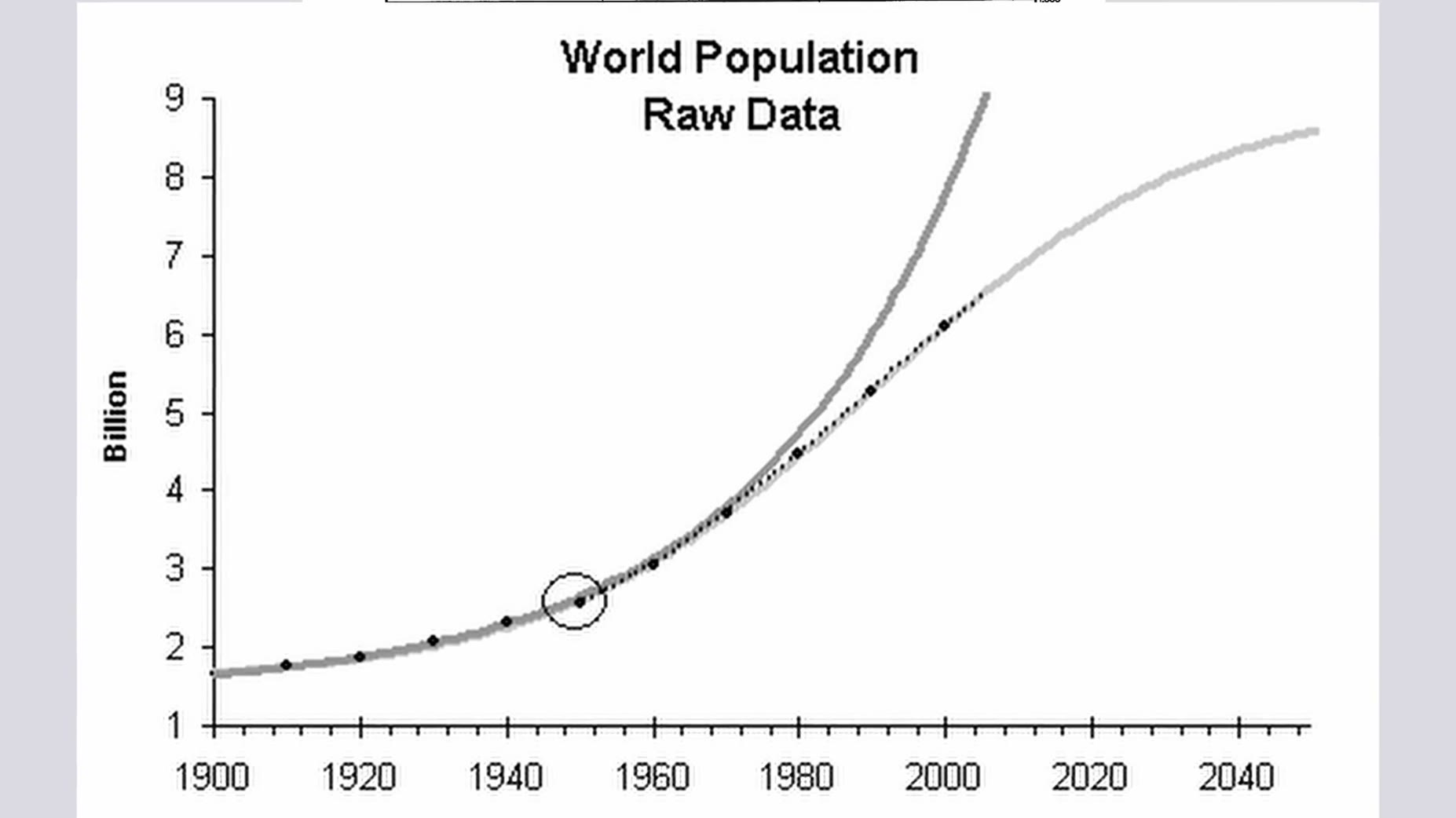
- [07:50] World population hit 3 billion in the 1960s, 4 billion in 1974, and 5 billion in 1987, tracking closely with the Foerster curve.
- [08:15] In 1963 the chemical industry cited the study to the Canadian Parliament to justify synthetic pesticide production.
- [08:33] The study was cited in 1975 US Supreme Court legal briefs on national population policy.
- [08:52] Astrophysicist Sebastian von Horner published a similar 1975 hyperbolic growth formula predicting an infinite population singularity by 2025.
- [09:32] Around 1993, roughly halfway to the predicted date, real population data diverged from the model's curve.
- [10:07] Scientists in the 1960s had not foreseen the demographic transition, where falling infant mortality and urbanization led parents to have fewer children.
- [11:05] In the roughly 50 years after publication, global birth rates halved largely as von Foerster's own paper had prescribed, which is why no catastrophe occurs in 2026.
- [11:35] Von Foerster had worked as a professional stage magician in Austria before becoming a cybernetics professor, shaping his use of a provocative title as deliberate scientific stagecraft.