
Rubin Observatory Finds the 6th Dwarf Planet in the Solar System
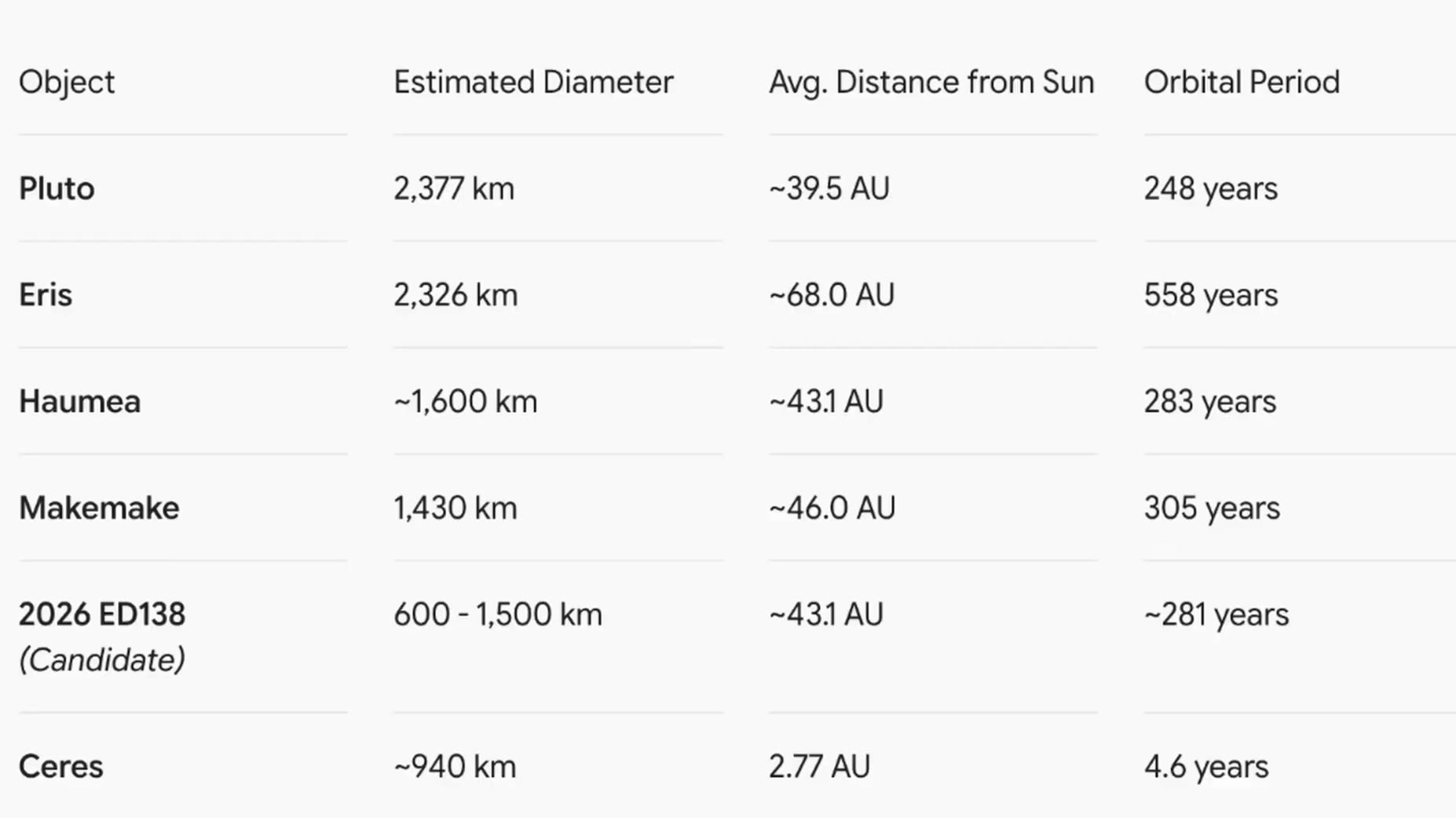
The creator reports that using data from the Vera Rubin Observatory, astrophysicist Dr. Matthew Holman and his team identified a new trans-Neptunian object, provisionally designated 2026 ED-138 and recognized on October 13, 2026, with an orbital period of about 283 years and an orbit closely resembling Pluto's. Its diameter is only estimated at 600 to 1,500 kilometers, a figure the video itself frames as a candidate measurement rather than a confirmed one, so its dwarf planet status is not yet settled. The creator argues that if confirmed, it would become the sixth official dwarf planet, and separately relays newer JWST and Hubble survey findings showing many small Kuiper Belt objects preserve their original 4.5 billion year old surfaces, which researchers interpret as evidence the belt formed through gentle clumping rather than being ground down by collisions.
Confirmed: Using data from the Vera Rubin Observatory, researchers discovered a new object in a region beyond Neptune already thought to be well known. [00:20]
- Confirmed: The object is provisionally designated 2026 ED-138 and was recognized on October 13, 2026. [00:33]
- Source cited: The discovery is credited to astrophysicist Dr. Matthew Holman and his team, who used an automated computer program to search Vera Rubin Observatory images. [00:46]
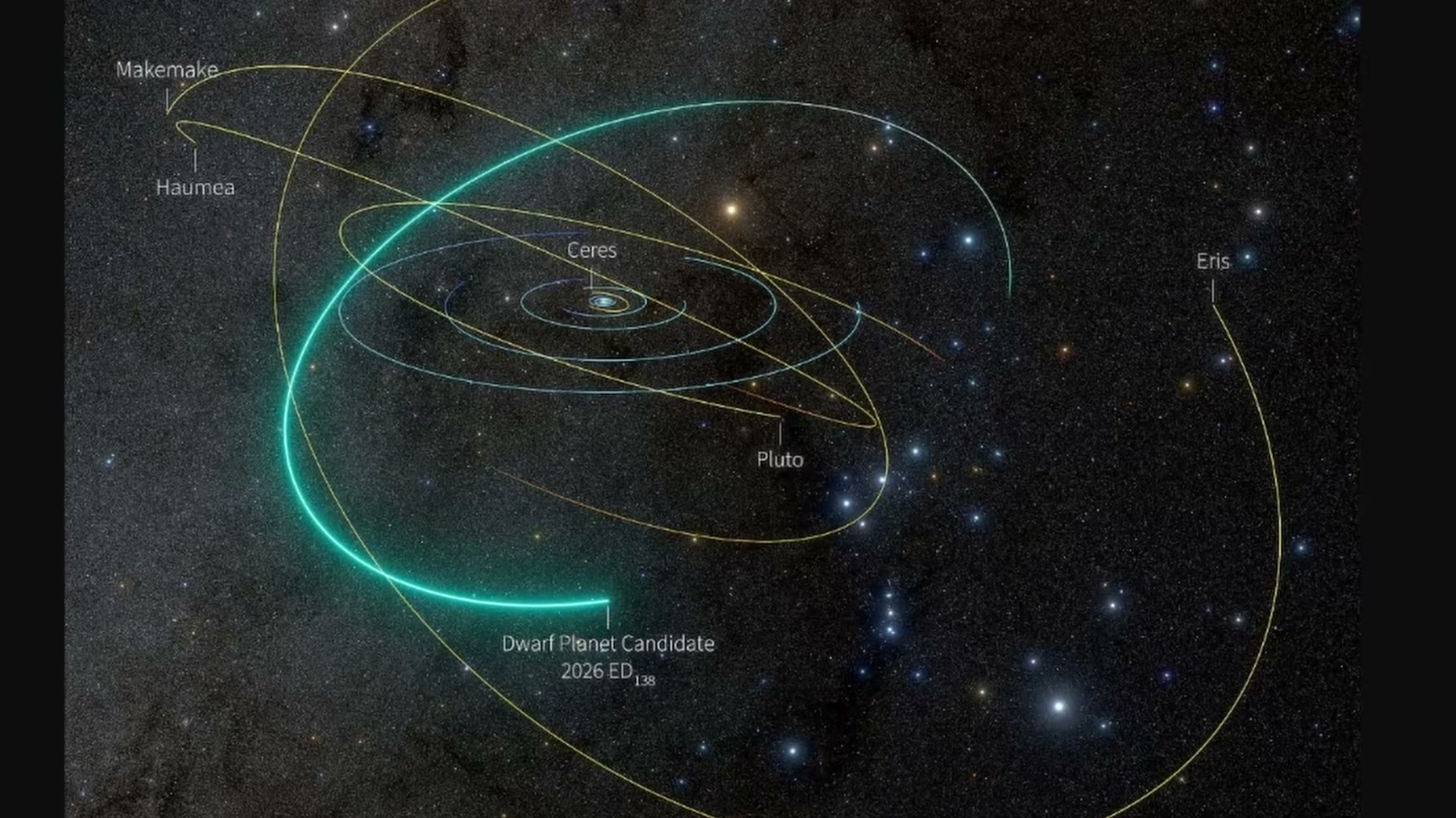
- Confirmed: 2026 ED-138's closest approach to the Sun is about 37 AU and its farthest point is about 49 AU, averaging 43 AU. [01:31]
- Confirmed: It takes approximately 283 years for 2026 ED-138 to orbit the Sun once. [01:44]
+ 29 more takeaways
- Confirmed: 2026 ED-138's orbit closely resembles Pluto's orbit. [02:06]
- Take (narrator): The creator finds it surprising that an object with an orbit so similar to Pluto's had not been spotted until now. [02:06]
- Confirmed: To qualify as a dwarf planet, an object must have enough mass to be spherical, and scientists estimate 2026 ED-138 is anywhere from 600 to 1,500 kilometers across, a figure presented as a candidate estimate, not a confirmed measurement. [02:21]
- Take (narrator): The creator says that if confirmed, 2026 ED-138 would become the sixth official dwarf planet in the solar system, joining Pluto, Eris, Haumea, Makemake, and Ceres. [02:34]
- Confirmed: The last dwarf planet discovery was over two decades ago in 2005, when Eris was found, leading scientists to reclassify these objects as dwarf planets and causing Pluto to lose its planet status. [02:42]
- Confirmed: Scientists missed 2026 ED-138 partly because it sits in a sky region aligned closely with the plane of the Milky Way, making a faint, slow-moving dot hard to pick out among millions of background objects. [03:11]
- Confirmed: The object's orbit is tilted nearly 24.5 degrees relative to the solar system's ecliptic plane, and because most searches focus on the ecliptic plane itself, the inclination caused it to be overlooked. [03:39]
- Confirmed: After an algorithm flagged the object, researchers found archival images of it from the Dark Energy Camera dating back to 2023, 2019, and 2016. [04:05]
- Confirmed: The Vista telescope also accidentally captured the object in 2010 and 2011. [04:16]
- Open question: The video does not state whether a follow-up infrared observation or stellar occultation has yet confirmed whether 2026 ED-138 is a small bright object or a large dark one covered in organic molecules. [04:49]
- Take (narrator): The creator describes the candidate as becoming spherical in shape, calling it one of the largest dwarf planet candidates discovered in years. [05:28]
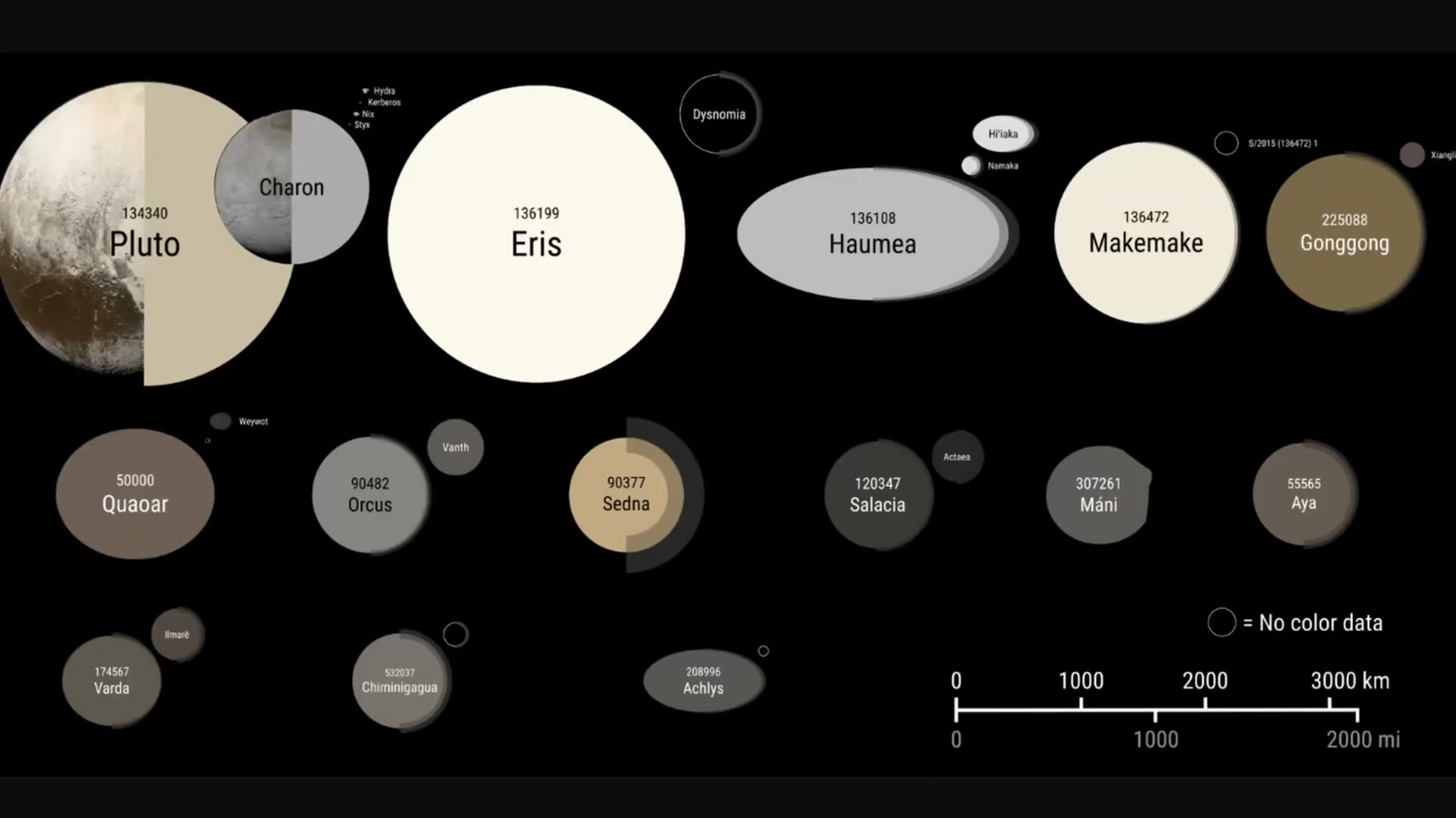
- Take (narrator): The creator compares 2026 ED-138's scale to Makemake and Haumea. [05:35]
- Confirmed: Because 2026 ED-138 was only just discovered, there is no additional data on it yet. [05:45]
- Confirmed: As of 2026, researchers conducted the deepest solar system survey in history, focusing on a 0.05 square degree patch of sky observed with the JWST. [06:10]
- Confirmed: This survey found 27 ultra faint trans-Neptunian objects, among the smallest and faintest bodies ever directly seen in the Kuiper Belt. [06:48]
- Confirmed: The smallest confirmed object found is about 5 kilometers (3 miles) across, billions of kilometers away, and over 100 million times fainter than the human eye can see. [07:02]
- Confirmed: Both Webb and Hubble discovered far fewer tiny objects than predicted by collisional models. [08:03]
- Take (researchers): The finding is read as suggesting the Kuiper Belt was never heavily ground down by collisions and instead formed via streaming instability and pebble cloud collapse directly into 100 km objects. [08:03]
- Open question: The source does not state whether astronomers' expectation that impacts would strip away ancient crust to expose fresh subsurface ice was borne out. [09:22]
- Confirmed: Both Hubble and Webb showed that smaller objects 5 to 40 kilometers in size display the same colors as larger dwarf-planet-sized siblings at least 700 kilometers across. [09:57]
- Source cited: Astronomer Anastasia Morgan, who led the study, says these bodies are preserving the chemical signatures of where and how they were born 4.5 billion years ago. [10:28]
- Take (researchers): The matching colors are read as showing these objects avoided getting smashed up and still carry the same crust that formed them 4.5 billion years ago. [10:20]
- Confirmed: Unlike contact-binary objects such as Arrokoth, which change brightness a lot when spinning, most of these newly discovered rocks show relatively similar brightness as they spin. [10:58]
- Take (researchers): The similar brightness is read as suggesting these objects are round rather than contact binaries. [10:58]
- Confirmed: These rocks are distributed relatively equally across the entire Kuiper Belt. [11:32]
- Take (researchers): The even distribution is read as suggesting the solar system's clumping process built these objects using the same recipe regardless of local conditions. [11:32]
- Confirmed: Preliminary observations from the Vera Rubin Observatory have already identified 11,000 newly discovered asteroids and minor planets, including 380 trans-Neptunian objects. [11:53]
- Prediction: Once Rubin's 10-year LSST survey begins, it is expected to scan the entire southern sky every few nights and discover 20,000 to 30,000 asteroids per week. [12:12]
- Prediction: The survey is expected to triple or quadruple known asteroid and Kuiper Belt objects and increase known trans-Neptunian objects by at least 10 times within 10 years. [12:12]
How this brief was shaped: News Analysis / Commentary · confidence Medium
floor demotion: 'breaking_news' 0.72 < 0.75 floor -> classifier fallback 'news_analysis'. Transcript frames this as a newly recognized object with a provisional designation, exact discovery date, and named discoverer, and OCR shows a comparison table listing 2026 ED138 diameter and orbit as a Candidate alongside Pluto, Eris, Haumea, and Makemake. The spine is reporting what was just found and how confirmed it is, not an argued thesis or a taught course.
The lens sets this brief's structure, never its facts — every claim is held to the same citation and fact-check standard.