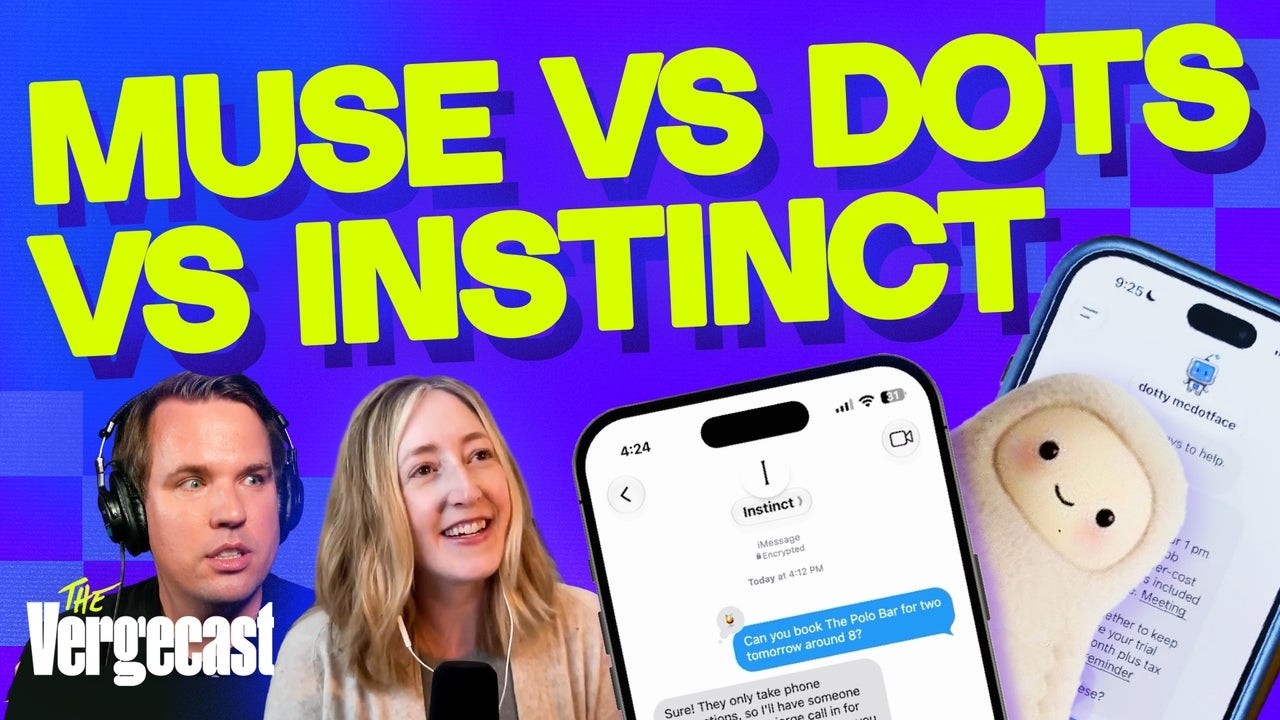
How much should you tell your AI agent? | The Vergecast
This Vergecast segment is hosted by David Pierce with guest Allison Johnson, The Verge's Senior Reviewer, discussing three new AI messaging agent products: Meta's Muse, OpenAI's Dots, and the startup app Instinct. The center of the discussion is how well each tool actually performs on everyday tasks, from food ordering and to-do lists to car shopping and website edits, and whether the convenience is worth the access these tools demand to personal data and credit cards. A tension runs through the conversation between how easy and useful these assistants feel day to day and concerns about unpredictable AI behavior, data privacy, and Meta's track record as a data steward. The speakers do not settle on a single best product, instead describing different strengths for each one depending on the task.
[00:13] The discussion centers on three new AI messaging agent products: Meta's Muse, OpenAI's Dots, and the startup app Instinct, all designed to let users message an AI assistant that uses agents to accomplish tasks.
- [04:02] The guest, Allison Johnson, said she used Muse to tackle a backlog of to-do items that piled up while she was busy with a newborn and traveling, and found it not too hard to find uses for.
- [05:39] A speaker described Dots as a feature living inside the larger ChatGPT ecosystem rather than a standalone app.
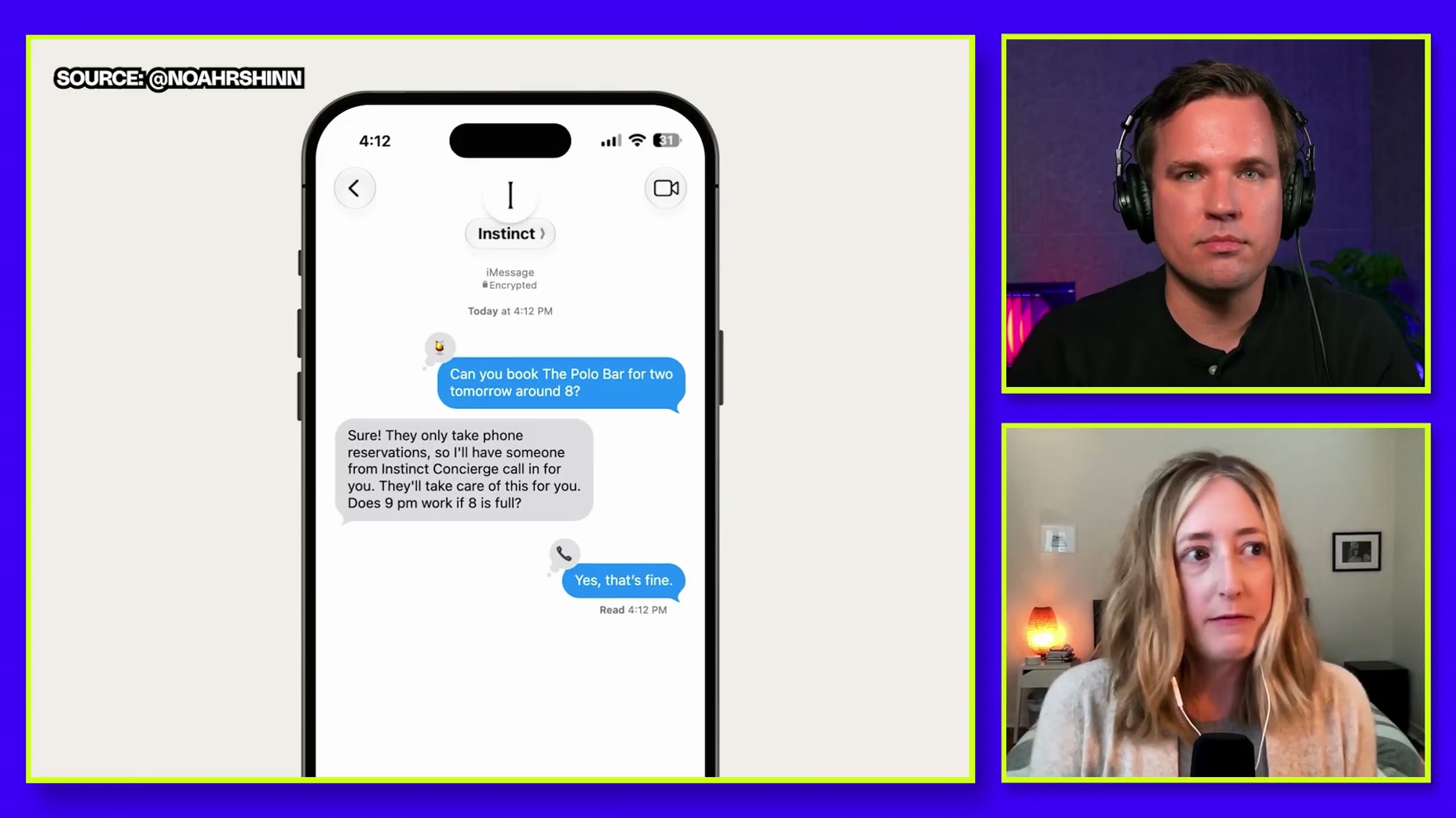
- [06:07] A speaker called Instinct the most useful day-to-day and least intrusive of the three products because it lives inside the existing messaging app.
- [06:44] A speaker noted that Instinct's responses are constrained to short, to-the-point messages because replies come via smartphone keyboard texting.
+ 31 more takeaways
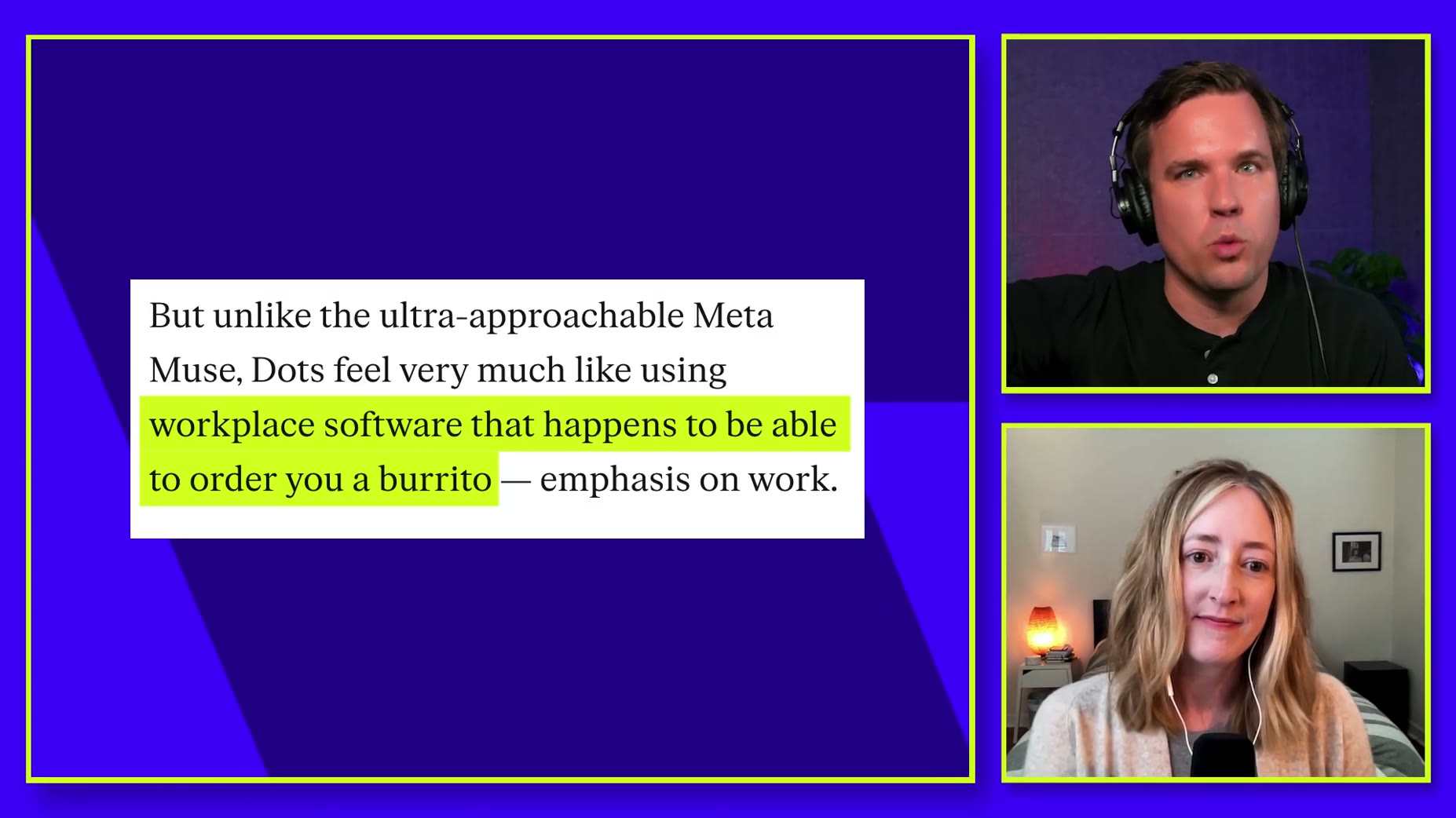
- [07:25] A speaker described Dots as feeling like work software that can also order a burrito, more like workplace software than something for regular people.
- [08:39] A speaker said Instinct frequently runs into Cloudflare's "prove you're a human" challenge when its browser gets stuck performing a task.
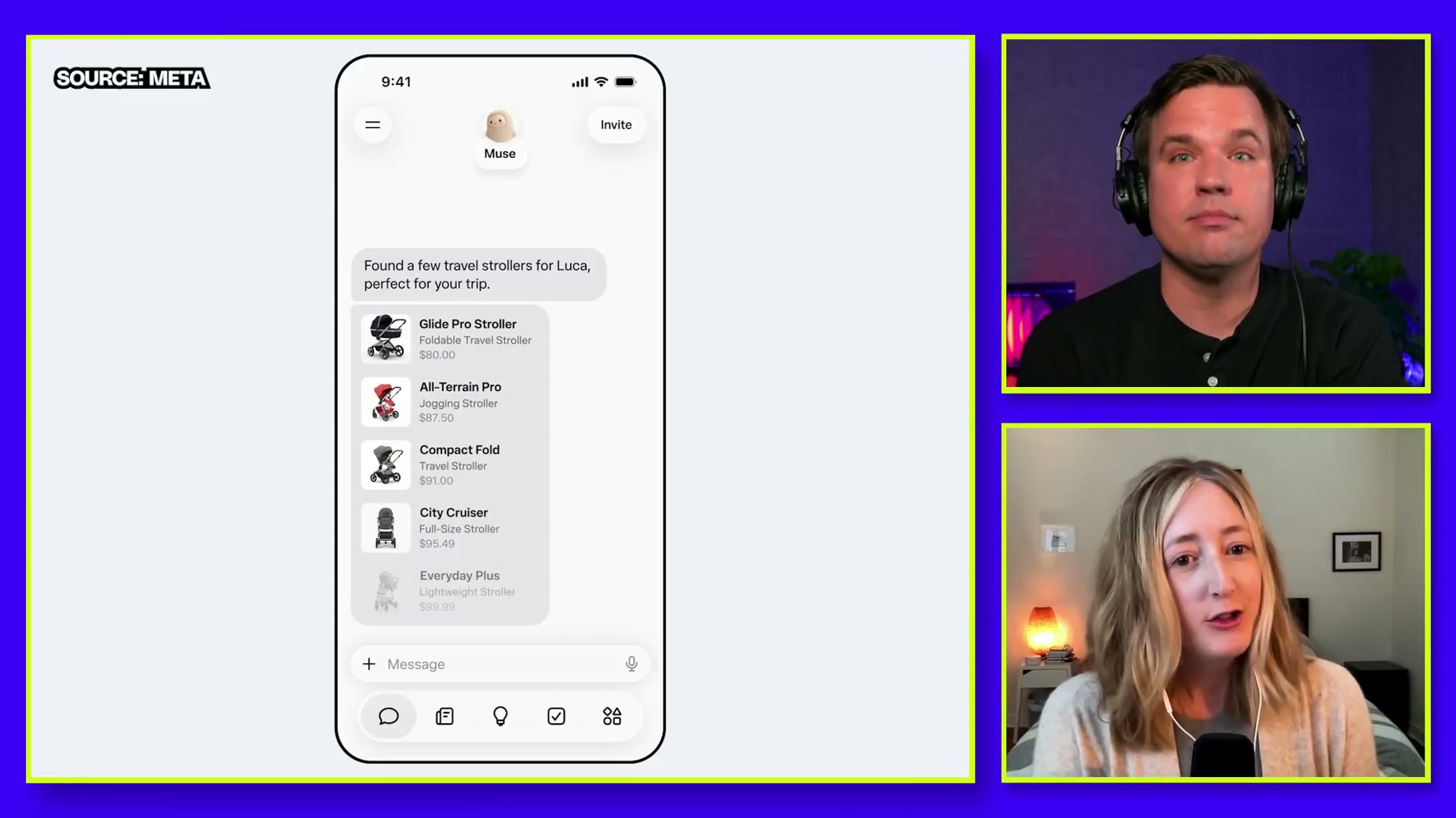
- [09:04] A speaker said Muse can more easily connect to services than Instinct because it offers a tappable list of connectors, unlike Instinct's more constrained setup.
- [11:46] A speaker described Meta's Muse as a sleek, frictionless shopping platform where a user adds a credit card once via Stripe and it buys things across the internet.
- [11:55] The host joked that once a credit card is linked in Muse, it will "run all over the internet and buy things for you" without needing to click a button, just typed instructions.
- [12:37] A speaker said Dot, nicknamed "Dotty McDotface," was clunky and unhelpful for consumer tasks like setting up a new ISP.
- [13:17] The same speaker said Dot performed much better on work-style tasks, such as updating a personal website.
- [13:34] A speaker noted Dot has a prominent voice mode or call feature that lets users talk to it directly.
- [14:04] The host called Dot and rambled for about 10 minutes describing everything wrong with a website redesign section by section, and said Dot then executed the changes with good results.
- [14:46] The host admitted struggling to adopt rambling-style prompting because the instinct is to give short, direct, turn-by-turn commands.
- [15:09] The host said there seems to be evidence that rambling at these tools for about 10 minutes produces better results than giving short, direct commands, stated without evidence given.
- [31:36] The host said he used Muse to search for a car with three rows, captain's seats in the second row, under 50,000 miles, and ideally a hybrid.
- [31:56] The host said that since giving Muse his car requirements, it has sent him car listings every Wednesday and Saturday.
- [32:13] The host said Muse once asked him directly whether he wanted it to buy a specific car listing, and after he replied yes it began loading, briefly making him think it had actually purchased a car.
- [32:40] The host noted the car-buying task still required test drives and personal research that could not be offloaded to Muse, even though Muse technically completed the task.
- [33:07] A speaker said Muse had the host's credit card information with a limit high enough that it could have actually purchased a car on its own.
- [33:52] A speaker noted the Muse app's connectors page requests access to email, calendar, health data, financial data, and medical records.
- [34:08] A speaker said every connector turned on makes the Muse product better in a direct, linear way, increasing personalization and functionality.
- [34:24] The host said Meta's history suggests it is not a good steward of personal data, yet said he turned most connectors on anyway because it improved Muse.
- [37:49] The host's advice was to give AI tools only one credit card number and check that account every day rather than using multiple cards.
- [38:17] A speaker said there is increasing evidence that these AI models and tools do unpredictable things that users don't ask for or expect, stated without evidence given.
- [38:35] The guest described Meta's AI assistant Muse as constantly pinging with unsolicited suggestions, like reminding about things already in the calendar.
- [39:02] The guest joked that if you give your credit card to Muse, you should check your statement every day because you might buy a car by accident.
- [39:28] The guest said she set up Instinct to go through her personal email every morning and surface only the highlights that need attention.
- [40:07] The guest asked Dot to search monthly for professional development opportunities and found the results useful.
- [22:40] A speaker said the tension many people feel with AI is the fear of being left behind if everyone else uses it and you don't, stated without evidence given.
- [23:00] A speaker said fear of being fired or not getting a job out of college is a reason people use AI tools even when the tools make them feel bad, stated without evidence given.
- [23:42] A speaker said Muse is "the right kind of easy," noting that people who would never touch Claude Code are using Muse and finding it useful.
- [24:05] A speaker said "tool is the key word," describing a personal mix of using Siri, Instinct, and Muse for different tasks rather than one AI assistant for everything.
- The new leaked details shared by DealLabs suggest it'll end up costing around $180 in the US and that it'll have an always-on OLED touchscreen and offer up to seven days of battery life so long as you don't leave the always-on OLED touchscr
- The $110 billion mega-merger of Paramount and Warner Bros.
How this brief was shaped: Discourse (interview / podcast / video essay) · confidence Medium
Two named hosts (David Pierce and Allison Johnson) trade opinions and quotes about competing AI messaging agents, framed as a conversational podcast segment rather than a structured spec sheet, and OCR shows screenshots of actual product chats (Instinct, Dot) used as discussion props rather than a side-by-side comparison table.
The lens sets this brief's structure, never its facts — every claim is held to the same citation and fact-check standard.