Do cells have goals? | with Melanie Challenger, Nick Lane & Philip Ball
A panel discussion held on the publication day of a new book titled Alive, featuring Nick Lane and Philip Ball, argues that mainstream biology's gene-centered account of life is incomplete. The panel traces the history of thinking about life from Aristotle's holistic psyche through Descartes' mechanistic body and 19th-century vitalism to the rise of DNA-centered biology, then tests that history against modern evidence, including synthetic spud cells that replicate but aren't alive and NASA's own definition of life, both of which the panel finds inadequate. They build a case that agency is a real, measurable property of organisms rather than a circular metaphor, grounding it in the physics of cellular energy production, in hydrothermal vent hypotheses where metabolism preceded genes, and in the single evolutionary event that produced eukaryotic and multicellular life. The discussion matters because it challenges the idea of genes as life's sole agents and bears on how we understand consciousness, brain organoids, and the real agency of AI systems.
[02:21] Nick Lane frames the talk around the origin of life and what it implies for agency, self, and the meaning of cells and organisms
- [03:08] The panel opens by challenging Richard Dawkins' 1991 claim that nature has no purpose and human purpose is just a brain-based byproduct of evolution
- [09:12] Synthetic biologists built 'spud cells,' lipid-membrane structures with a fully synthetic 36-gene genome plus hand-assembled enzymes and ribosomes (Adamala and Engelhart, University of Minnesota, 2026)
- [10:42] Spud cells can replicate, divide, and show selection-like competition, but aren't considered alive since they depend entirely on external chemicals, can't build their own ribosomes, and stall after a few rounds
- [23:06] Francois Jacob (1970) and Ernst Mayr (2004) framed biology around DNA and the genetic program as life's center, underpinning the Human Genome Project
+ 13 more takeaways
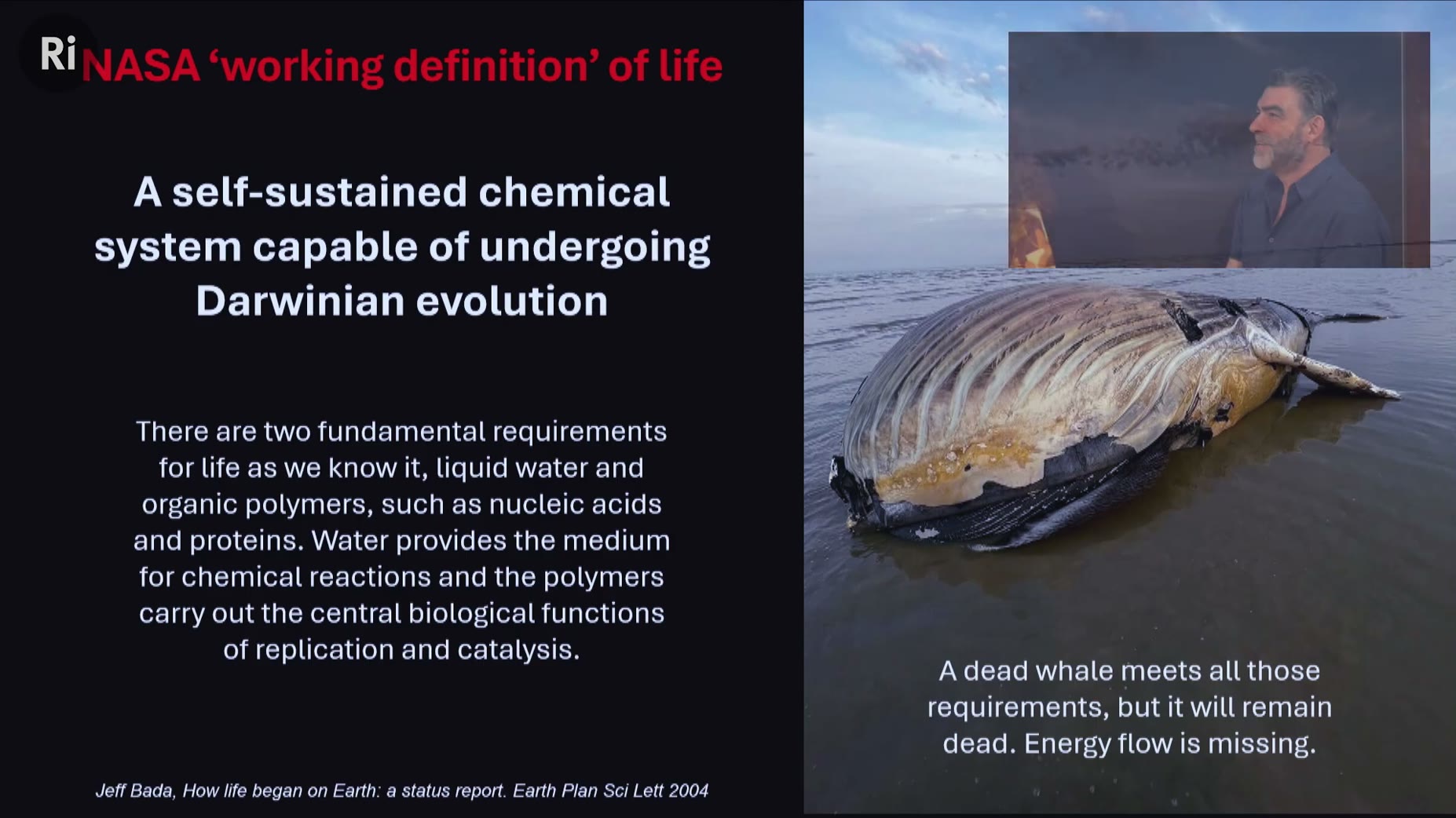
- [25:57] NASA's working definition of life, 'a self-sustained chemical system capable of undergoing Darwinian evolution,' is challenged by the panel as flawed
- [29:10] Peter Mitchell's 1957 Moscow conference quote treats organism and environment as 'equivalent phases' linked by membranes, a founding idea for the panel's origin-of-life argument
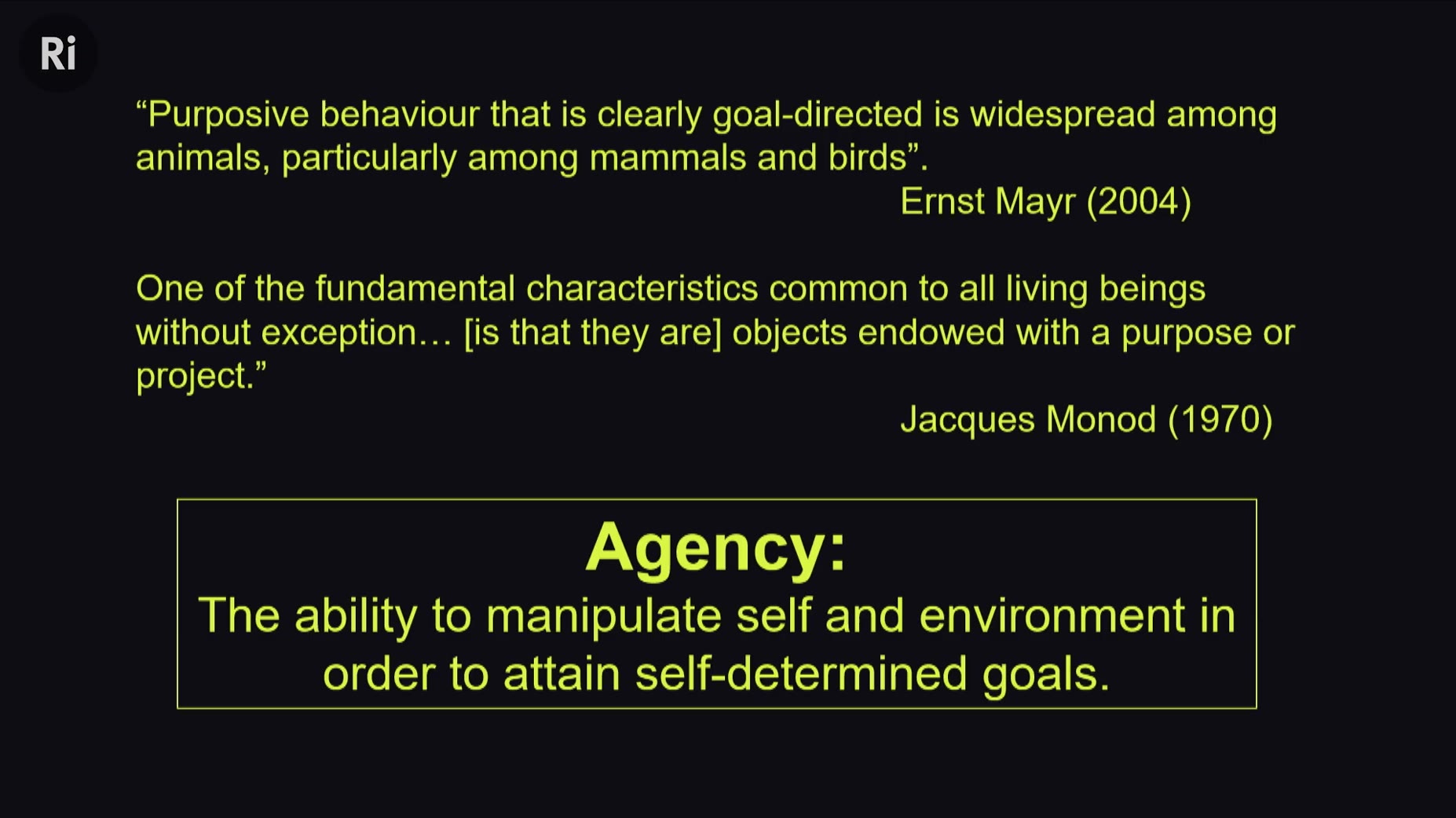
- [43:49] Jacques Monod's 1970 definition of agency: the ability to manipulate self and environment to attain self-determined goals
- [44:18] A paper by DiFrisco and Gawne argues biological agency is 'a concept without a research program,' unexplained by mechanism or natural selection
- [45:44] A proposed scientific basis for genuine agency requires a boundary from the environment, internal complexity, and the capacity to predict consequences of actions
- [46:21] A rigorous theory of agency could help assess how much real agency current agentic AI systems actually have
- [49:16] Mitochondrial proton pumping creates a field of about 30 million volts per meter, comparable to lightning, across roughly four football pitches' worth of membrane in the human body
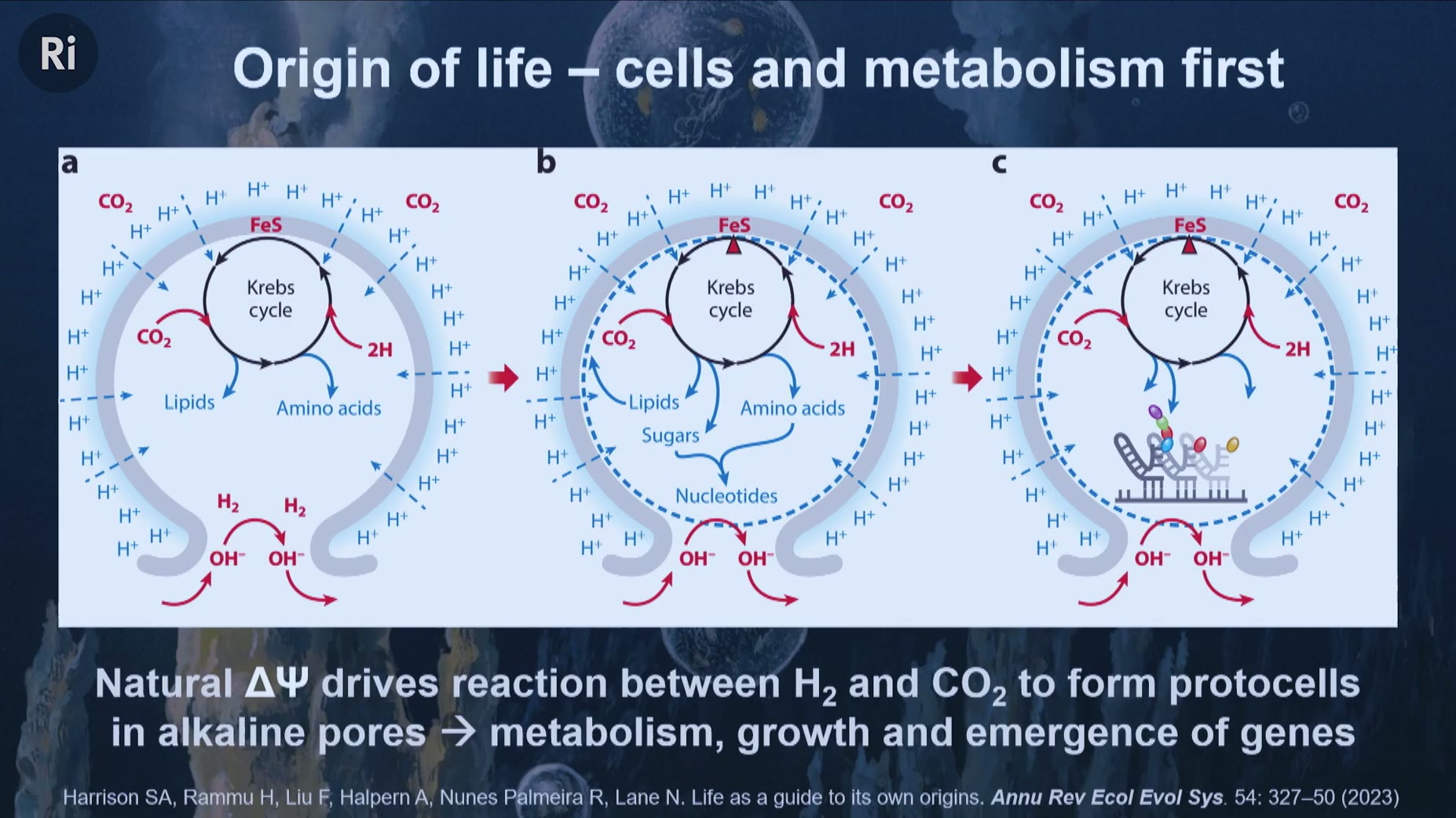
- [50:29] Hypothesis: natural proton gradients in hydrothermal vent pores could have driven the hydrogen-CO2 reaction that builds life's molecules, and the speaker's lab is testing this
- [53:22] Patterns in the genetic code suggest genes arose from metabolism, meaning metabolism and cell structure predate genes
- [01:01:43] Eukaryotic cells arose only once in life's roughly 4-billion-year history on Earth
- [01:03:19] By absorbing mitochondria and shedding redundant genomes, eukaryotes ended up with about four to five times as many genes as most bacteria
- [01:06:04] Mike Levin's xenobots are clusters of thousands of frog cells that, instead of forming frogs, self-organize into swimming, cilia-driven organism-like entities
- [01:08:10] The panel argues the genome should be understood not as a stored program but as a source of molecular resources cells use to build their form
"Psyche is the first actuality of a natural body which has life potentially."
Aristotle, De Anima (On Psyche)
"These natural automata are the animals."
René Descartes, letter to Henry More, 5 February 1649
"The aim of modern biology is to interpret the properties of the organism by the structure of its constituent molecules."
Francois Jacob (1970)
"If ensuring the survival of the body proper is what the brain first evolved for, then, when minded brains first appeared, they began by minding the body..."
Antonio Damasio, Descartes' Error: Emotion, Reason and the Human Brain
"For years, contemporary theory in the humanities has left the body and biology out of their discussions. I think the body is coming back."
Siri Hustvedt