
Unknown Cosmic Phenomenon Confirmed in 20-Year-Old Data
This video explains a 2026 Nature Astronomy paper reporting 84 extremely bright but previously overlooked objects found by re-examining archival NASA Chandra X-ray telescope data collected between 1999 and 2017 across six nearby galaxies, including the spiral pinwheel galaxy M101 and Andromeda. Researchers Mustafa Muhibullah and Jimmy A. Irwin (University of Alabama) and Rosanne DiStefano (Harvard) classify these as 'hypersoft X-ray sources' (HSS) because they emit almost entirely between 0.15 and 0.3 keV, a band most X-ray surveys filter out, which is why the objects went undetected for at least two decades. The video covers how the sources were verified (cross-checked against years-apart observations and confirmed in part by the XMM-Newton telescope), candidate explanations (accreting white dwarfs, black holes, or neutron stars pulling gas from a companion star), and implications for the missing Type Ia supernova progenitor population and galactic ionization. This is a science explainer built on narration and the published paper, not a coding or software tutorial, so there are no installs, accounts, or commands involved.
Background: [00:08] Chandra is an X-ray space telescope that observes the night sky only in X-rays.
- Discovery: [00:23] A study using Chandra data found 84 mysterious, extremely bright objects scattered across nearby galaxies that had been overlooked for at least 20 years.
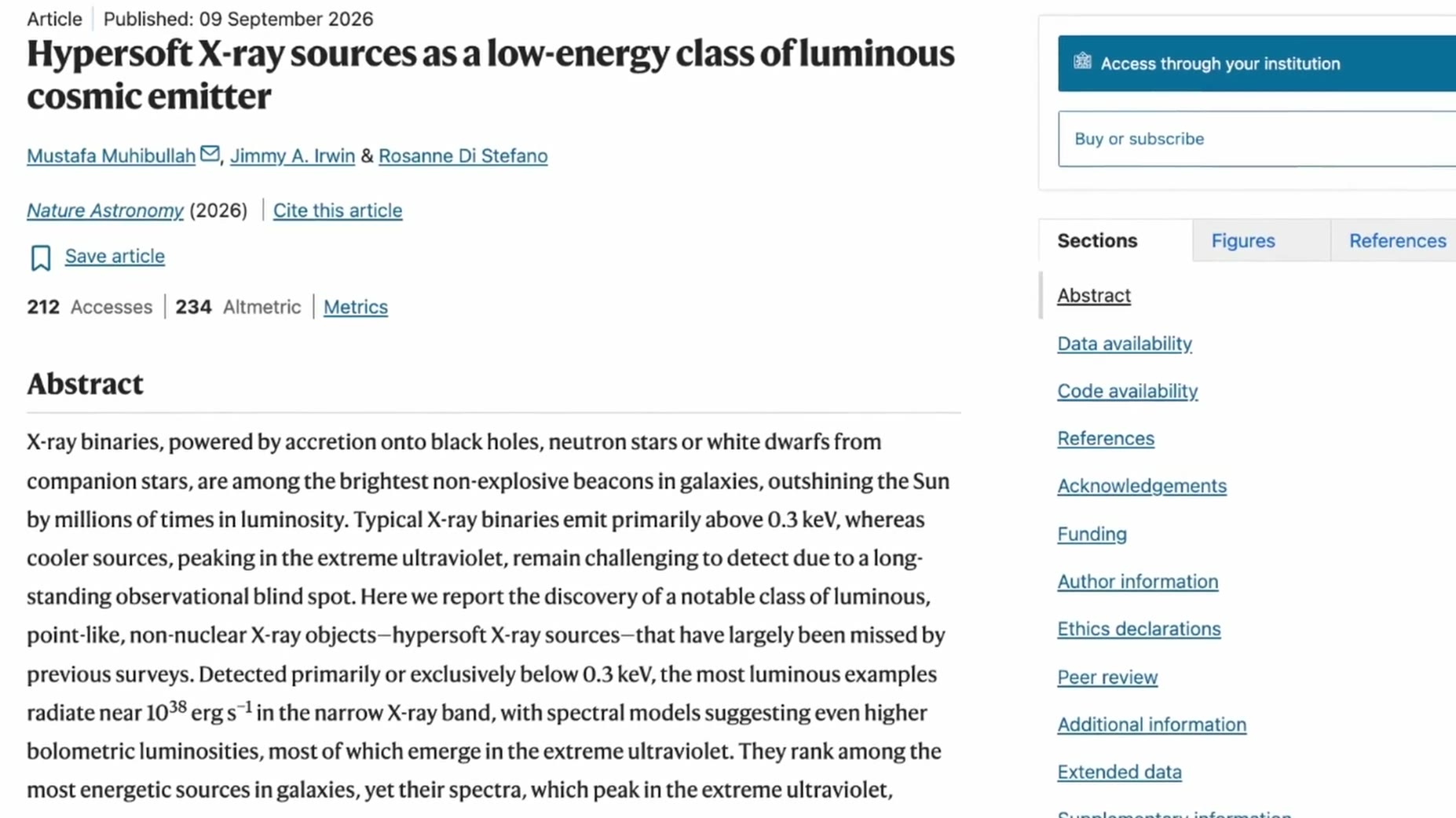
- Research: The paper, titled 'Hypersoft X-ray sources as a low-energy class of luminous cosmic emitter,' is by Mustafa Muhibullah, Jimmy A. Irwin and Rosanne DiStefano, published in Nature Astronomy (2026).
- Research: [01:19] Mustafa Muhibullah and Jimmy Irwin are from the University of Alabama, and Rosanne DiStefano is from Harvard.
- Method: [01:36] The scientists re-examined archival Chandra data collected between 1999 and 2017.
+ 31 more takeaways
- Method: [01:56] The team focused on archival data from 6 nearby galaxies, including the spiral pinwheel galaxy M101 and Andromeda.
- Method: [02:06] After removing artifacts and noise, the team was left with 84 distinct point sources.
- Definition: [02:47] The team officially classified these objects as Hypersoft X-ray sources (HSS).
- Why overlooked: Typical X-ray binaries emit primarily above 0.3 keV, while these newly identified hypersoft X-ray sources are detected primarily or exclusively below 0.3 keV.
- Why overlooked: [03:15] Most known stellar X-ray sources like X-ray binaries emit radiation above 0.3 keV, but hypersoft sources emit only between 0.15 and 0.3 keV with zero emission at higher energies.
- Why overlooked: [03:02] Soft X-rays are low-energy X-rays, while hard X-rays are the high-energy type usually detected from black holes and neutron stars.
- Luminosity: The most luminous hypersoft X-ray sources radiate near 10^38 erg/s in the narrow X-ray band, with spectral models suggesting even higher bolometric luminosities that mostly emerge in the extreme ultraviolet.
- Luminosity: [00:50] Many of these objects radiate hundreds of thousands to millions of times more energy than the sun, and in some cases are the brightest X-ray objects in their entire galaxy.
- Temperature: [04:41] Spectral models show these objects are not hotter than roughly 280,000 Kelvin, with some around 170,000 to 200,000 Kelvin, placing most of their emission in the extreme ultraviolet range absorbed by interstellar gas before reaching Earth.
- Verification: [02:16] None of these sources were found in the Milky Way, mainly because interstellar gas causes absorption that makes detection there extremely difficult.
- Verification: [02:28] To rule out detector glitches, the objects were checked across multiple observations made years apart, and several were confirmed by the XMM-Newton telescope.
- Context: [05:05] Interstellar gas and dust, especially neutral hydrogen, acts as a cosmic fog that absorbs most UV light before it reaches Earth.
- Context: [05:27] What Chandra picks up represents just a tiny tail of the entire energy spectrum, only the light that escapes the fog.
- Caveat: [05:49] Scientists emphasize that hypersoft is just an observational description, not a definition of a single type of object.
- Mechanism: [06:01] Scientists think HSS are a mix of different compact stellar remnants pulling gas from a binary companion star.
- Mechanism: [06:20] The three candidate object types are accreting white dwarfs, black holes, and neutron stars.
- Evidence: [06:54] At least seven HSS objects in the Andromeda galaxy correspond to known optical novae observed in the past.
- Pattern: [08:50-09:03] Normal X-ray binaries containing black holes are usually concentrated inside globular clusters because gravitational interactions there easily capture companion stars, but out of 84 of these objects only one was located inside a cluster.
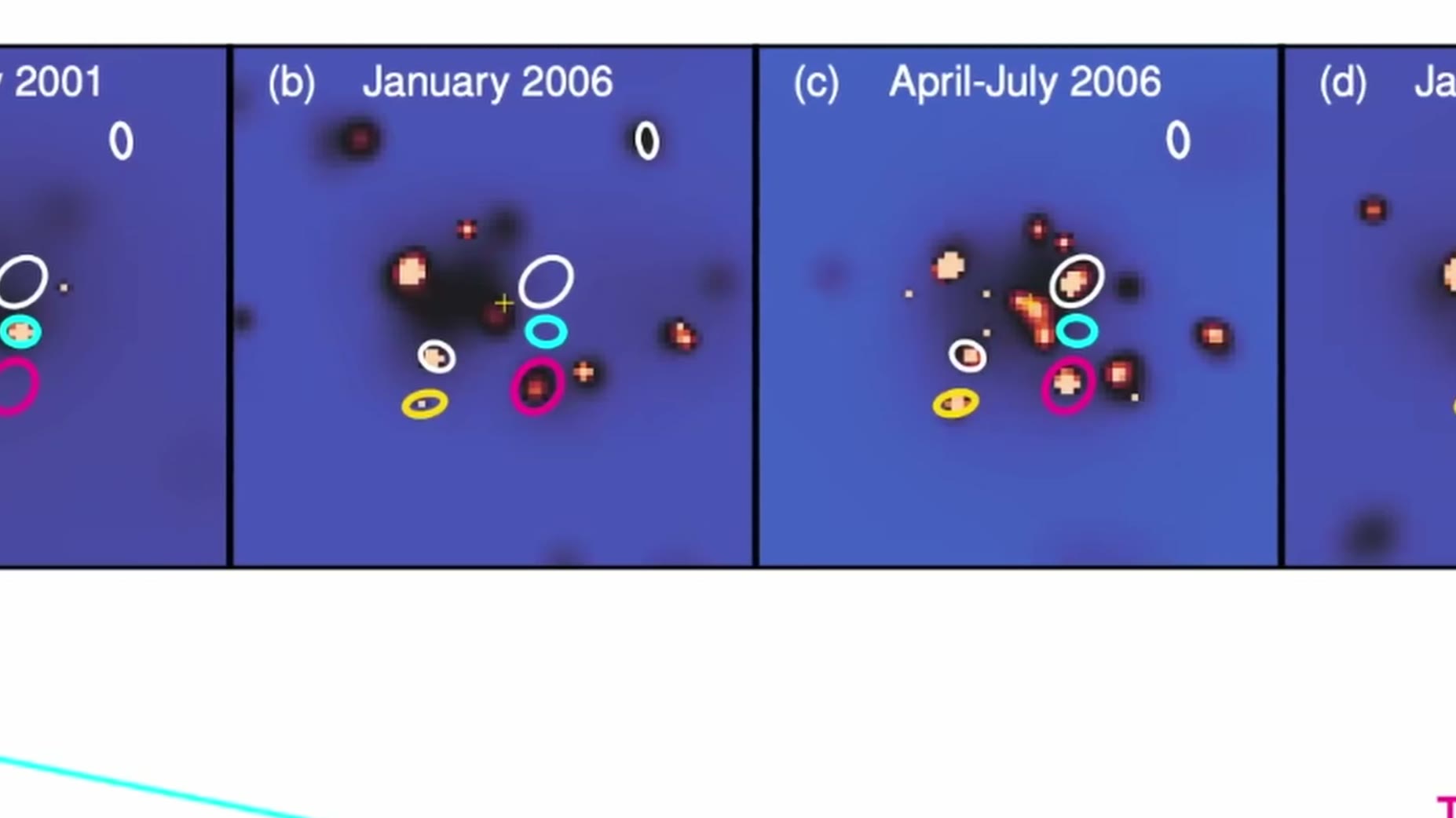
- Pattern: [09:21-09:30] Chandra tracked sources in the galaxy NGC 3379 and observed major changes, with some bright in 2006 but completely vanished by 2007.
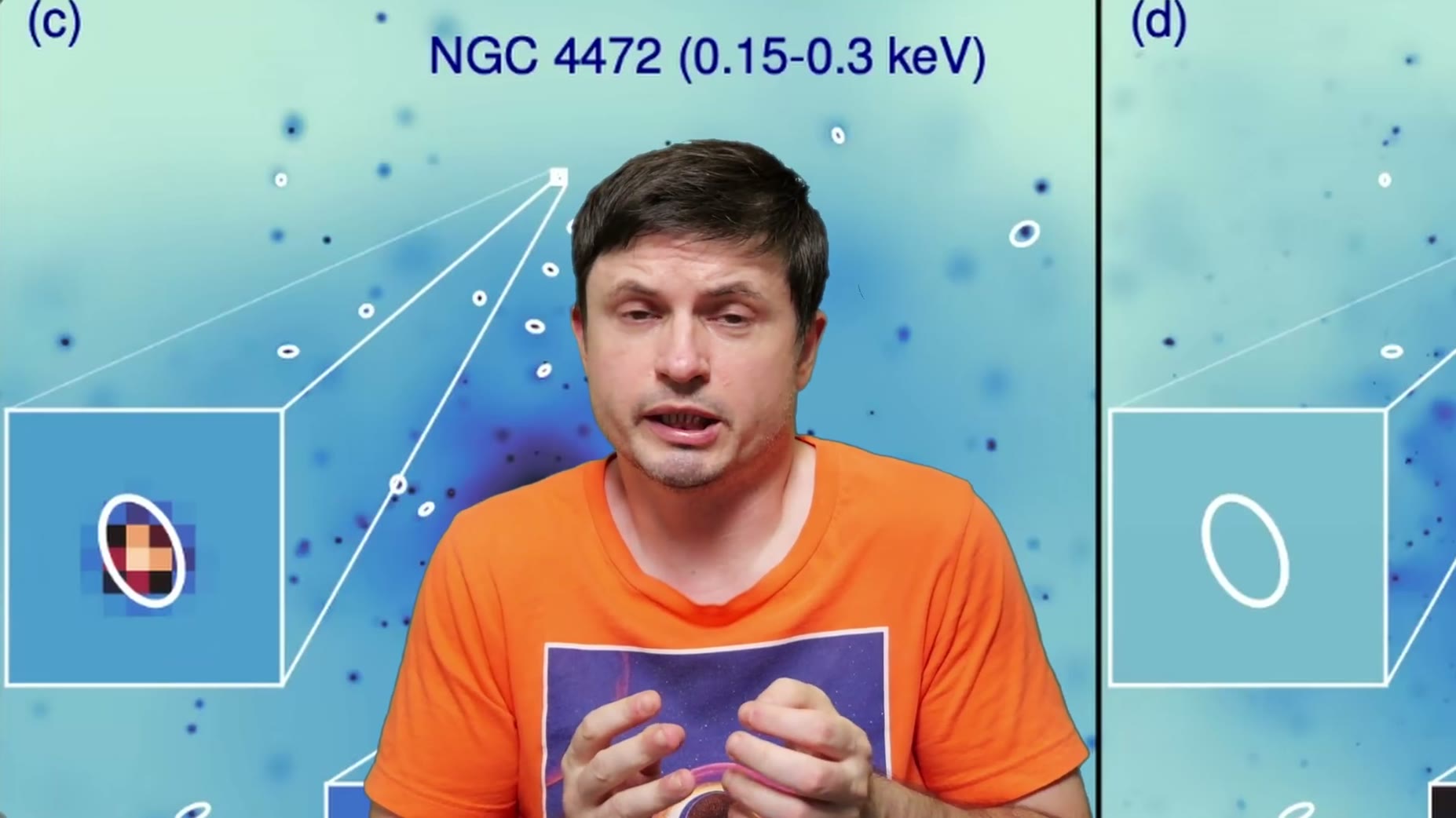
- Pattern: [09:35-09:43] In the galaxy NGC 4472, two sources were seen in 2000, disappeared 10 years later, then surprisingly reappeared in 2011.
- Open question: [09:46-09:59] It's unknown whether these sources are truly cycling or if Chandra's sensitivity simply fails to detect them during certain observations, and nobody currently knows what's happening.
- Background: [10:14-10:34] Type Ia supernovae occur when a white dwarf approaches its critical mass limit of approximately 1.4 solar masses and explodes, releasing roughly the same brightness each time, making them useful as standard candles.
- Paradox: [10:40-11:00] A long-standing paradox exists where pre-explosion white dwarf progenitors, especially gas-accreting ones expected to emit lots of x-rays, are found far too rarely despite Type Ia supernovae being common.
- Implication: [11:07-11:28] The discovery of hypersoft X-ray sources could point to these missing white dwarf candidates, and since many emit UV light invisible to us, the true population could be larger than 84 objects, with the combined predicted number matching Type Ia supernova expectations well.
- Implication: [11:33-12:21] The hidden hypersoft source population may also explain unexplained helium-2 emission (ionized helium gas) seen in galaxies lacking active supermassive black holes, where normal stellar populations can't account for the ionization.
- Implication: [12:11] Detecting a hidden population of hypersoft sources, especially ones containing highly energetic ultraviolet emitters, might explain the missing source of ionization and where the gas is coming from.
- Implication: [12:26] These powerful beacons may also be reshaping entire interstellar environments inside galaxies.
- On-screen graphic: [12:11] A graphic was shown labeled NGC 4472 (0.15-0.3 keV), with panels (c) and (d) comparing a pixelated detection patch to a plain oval outline.
- Takeaway: [12:41] Hundreds of powerful cosmic objects are potentially still hidden inside the archives, with some data being at least two decades old.
- Takeaway: [12:49] These objects were mostly ignored by other astronomers because nobody expected anything like this to exist.
- Final: [13:00] The discovery could lead to a much deeper understanding of how compact stars evolve, how various types of supernova are triggered, and how certain objects inside galaxies ionize the surrounding environment.
How this brief was shaped: Deep-Dive (coding / tutorial / how-to) · confidence Medium
Single narrator systematically unpacks a published discovery, what hypersoft X-ray sources are, why they were missed for 20 years, and the energy thresholds involved, with no course context and no personal argumentative thesis, matching the comprehensive-explanation spine. OCR confirms a real Nature Astronomy paper abstract backing the explanation.
The lens sets this brief's structure, never its facts — every claim is held to the same citation and fact-check standard.