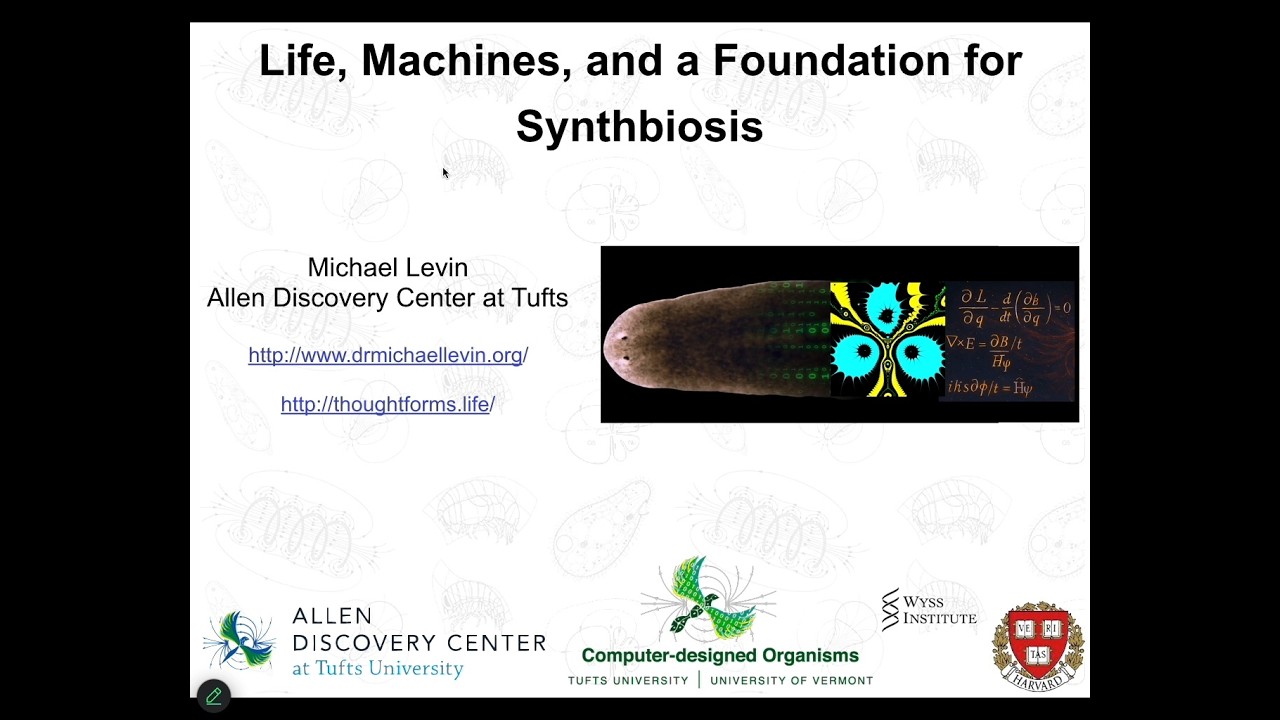
"Life, Machines, and a Foundation for Synthbiosis" by Michael Levin
What this video is
⚡ a 22-minute video, readable in 60 secondsMichael Levin of the Allen Discovery Center at Tufts surveys research on diverse intelligence, arguing that goal-directed problem-solving competencies exist at every level of biological organization, from single cells to tissue collectives, and can be read, rewritten, and even engineered into novel living forms like xenobots and anthrobots. The talk connects bioelectric signaling, minimal computational models, and lab-made organisms to argue that intelligence and memory are not unique to brains or evolved lineages. It closes by proposing that as humans create and encounter new kinds of minds, they will need to rethink what counts as a being at all.
[01:39] Lacrymaria, a single-celled organism with no brain or nervous system, is highly competent at physiological and morphological problem-solving.
Key takeaways
- [02:15] An early blastoderm of about a million cells shares a single collective goal state (set point) in anatomical space.
- [04:15] Using optogenetics, Levin's group rewrote bioelectric set points to create two-headed flatworms.
- [05:23] No individual cell in an axolotl knows what a finger is, yet the cell collective enforces the correct number and regrows it if disrupted.
- [05:57] Researchers experimentally induced a frog to grow a fifth limb, showing the anatomical goal state can be rewritten.
+ 7 more takeaways
- [07:34] Xenobots are made by liberating skin cells from a frog embryo with no genome changes, synthetic biology, scaffolds, or nanomaterials.
- [08:51] Applying neuroscience causal emergence metrics to xenobot calcium signaling found a difference from null models no smaller than that seen in human fMRI data versus its null models.
- [09:39] Adult human tracheal cells, confirmed 100% Homo sapiens by sequencing, become 'anthrobots' with surface cilia when placed in a new environment.
- [10:18] Anthrobots differentially express about 9,000 genes (roughly half the human genome) versus their cells of origin, appear younger, and can heal neural wounds next to scratched neural tissue.
- [12:22] Federico Pigozzi's gene regulatory network models (4-20 nodes) show an 'asymmetric ratchet': learning raises causal emergence, and forgetting does not erase those gains.
- [13:15] The same molecular pathway networks can form at least six kinds of memories, including Pavlovian conditioning, and can count to small numbers.
- [18:35] 'Mombot' is introduced as the first system to run closed-loop experiments in morphospace, using AI to form hypotheses, apply stimuli to frog cells, and revise hypotheses based on results.
Their links, sorted & clickable
🔗 Other links2
This is a ~21-minute talk titled "Life, Machines, and a Foundation for Synthbiosis" that I gave to the Santa Fe Institute (This is a ~21-minute talk titled "Life, Machines, and a Foundation for Synthbiosis" that I gave to the Santa Fe Institute (https://santafe.edu/) conference on "Symbiogenesis in the Age of Machine intelligence" (Was this brief useful?