WHAT IF SPACE IS PIXELATED? Weyl’s Pixel Triangle Paradox
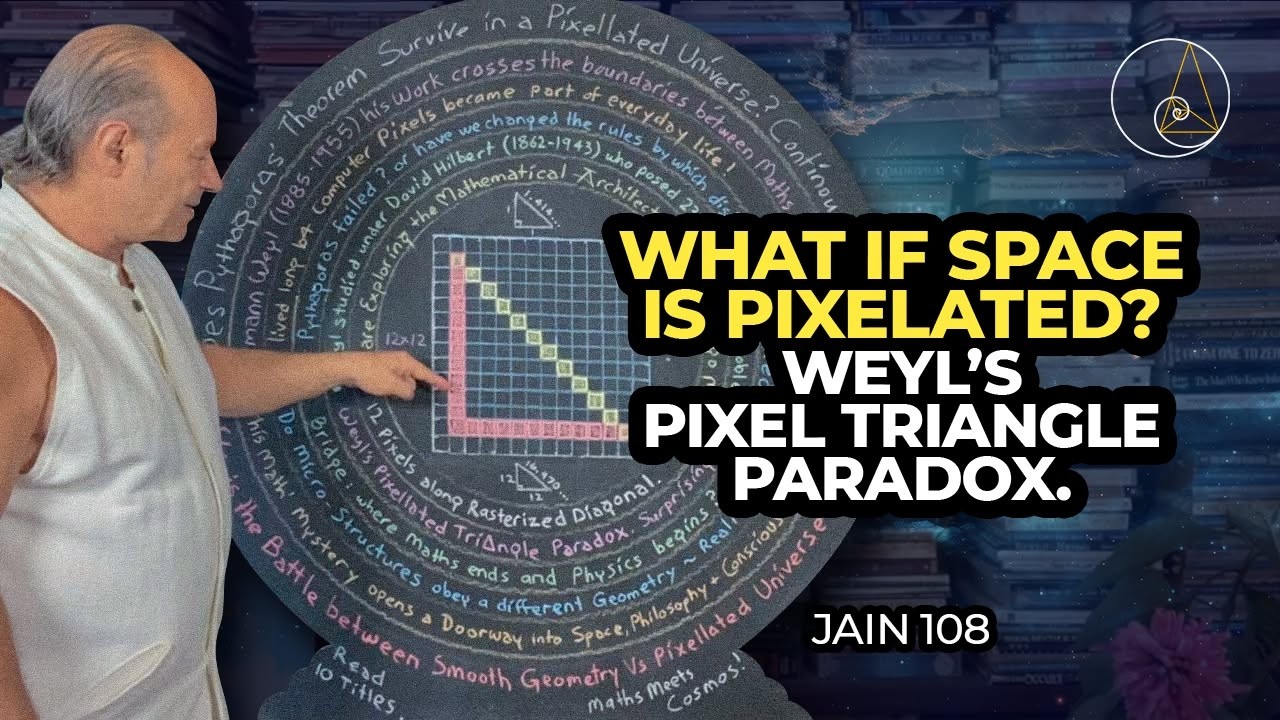
A speaker examines a pixelated or rasterized right triangle image that appears to contradict Pythagoras' theorem, tracing the puzzle to German mathematician Hermann Weyl's (1885-1955) 'tile argument' about whether space could be discrete rather than continuous. Using a 12x12 pixel grid, he shows the diagonal counts the same as the sides when it should be mathematically longer, and uses this to question whether Pythagoras' theorem survives in a pixelated universe. The piece matters because it sits at the boundary of math, physics, and philosophy, touching on the Planck length, fractality, and atomic structure, though the speaker repeatedly frames himself as a researcher rather than a physicist. It also drifts into AI, consciousness, and ancient culture as the speaker connects the geometric anomaly to broader claims about technology and awareness.
[00:28] The video centers on a pixelated or rasterized right triangle described as not making sense.
- [01:55] The named question is whether Pythagoras' theorem survives in a pixelated universe.
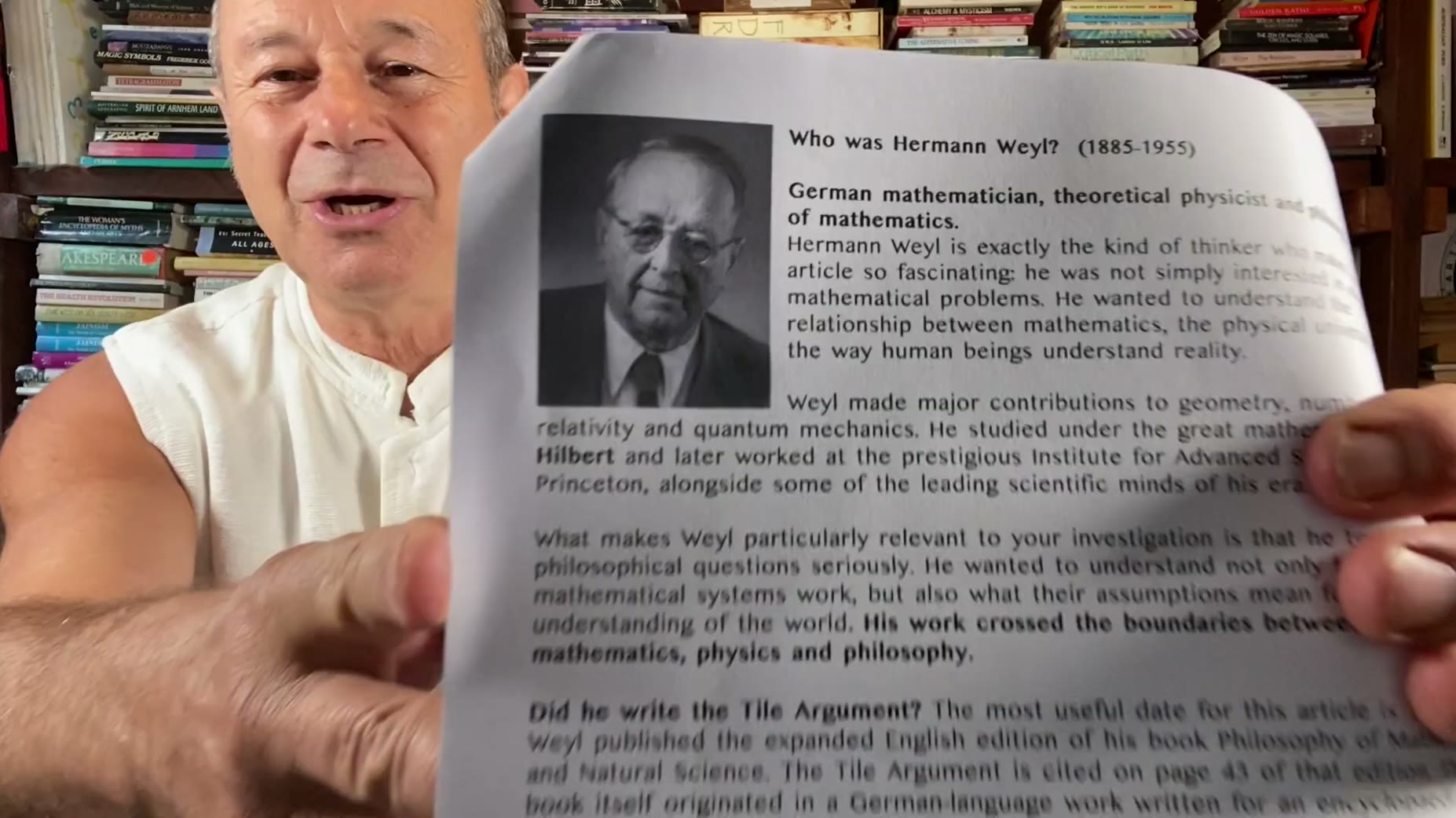
- [01:13] The triangle diagram is credited to German mathematician Hermann Weyl (1885-1955), who worked across mathematics, physics, and philosophy.
- [02:52] Weyl's Tile Argument is cited on page 43 of his book Philosophy of Mathematics and Natural Science.
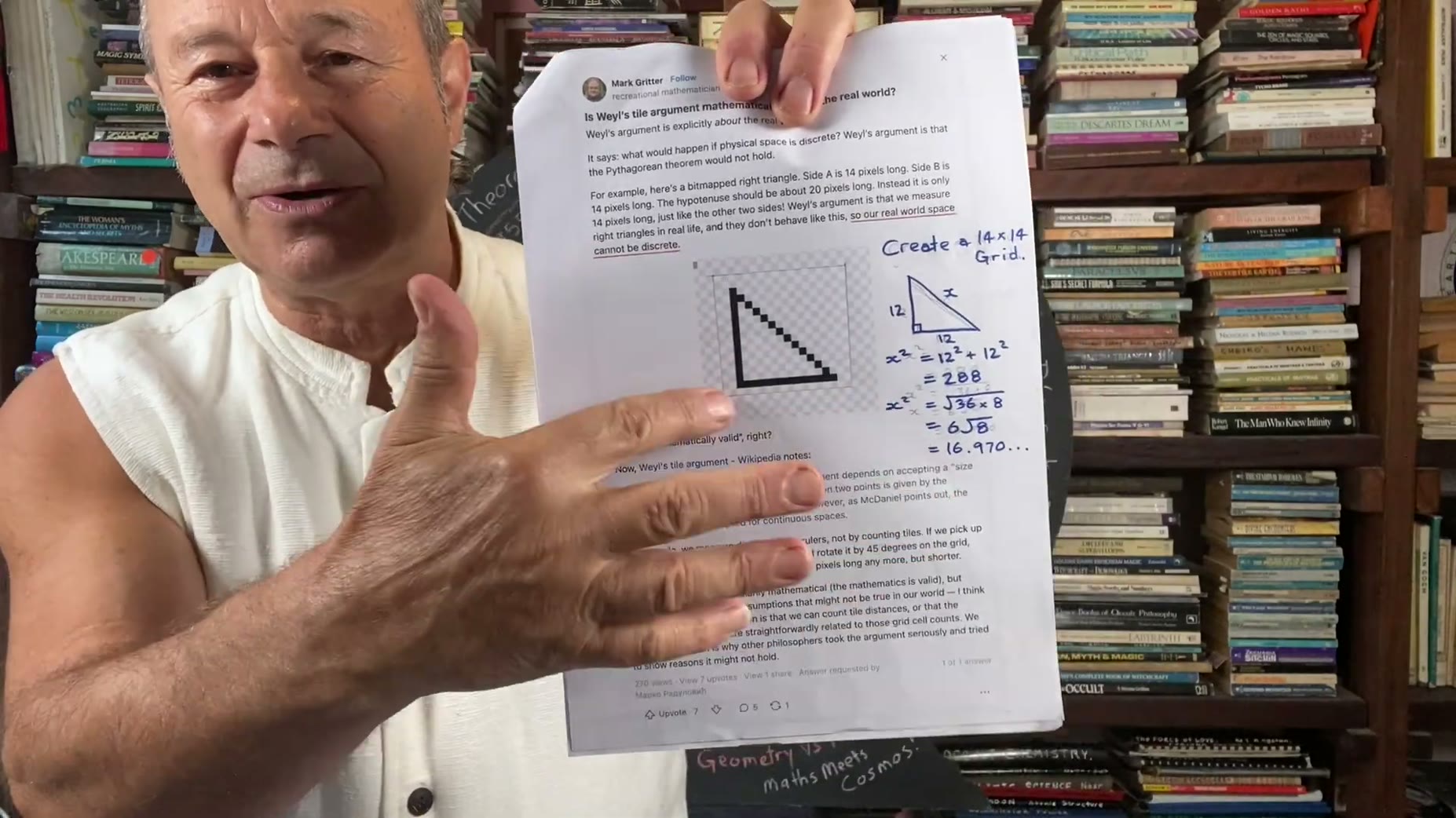
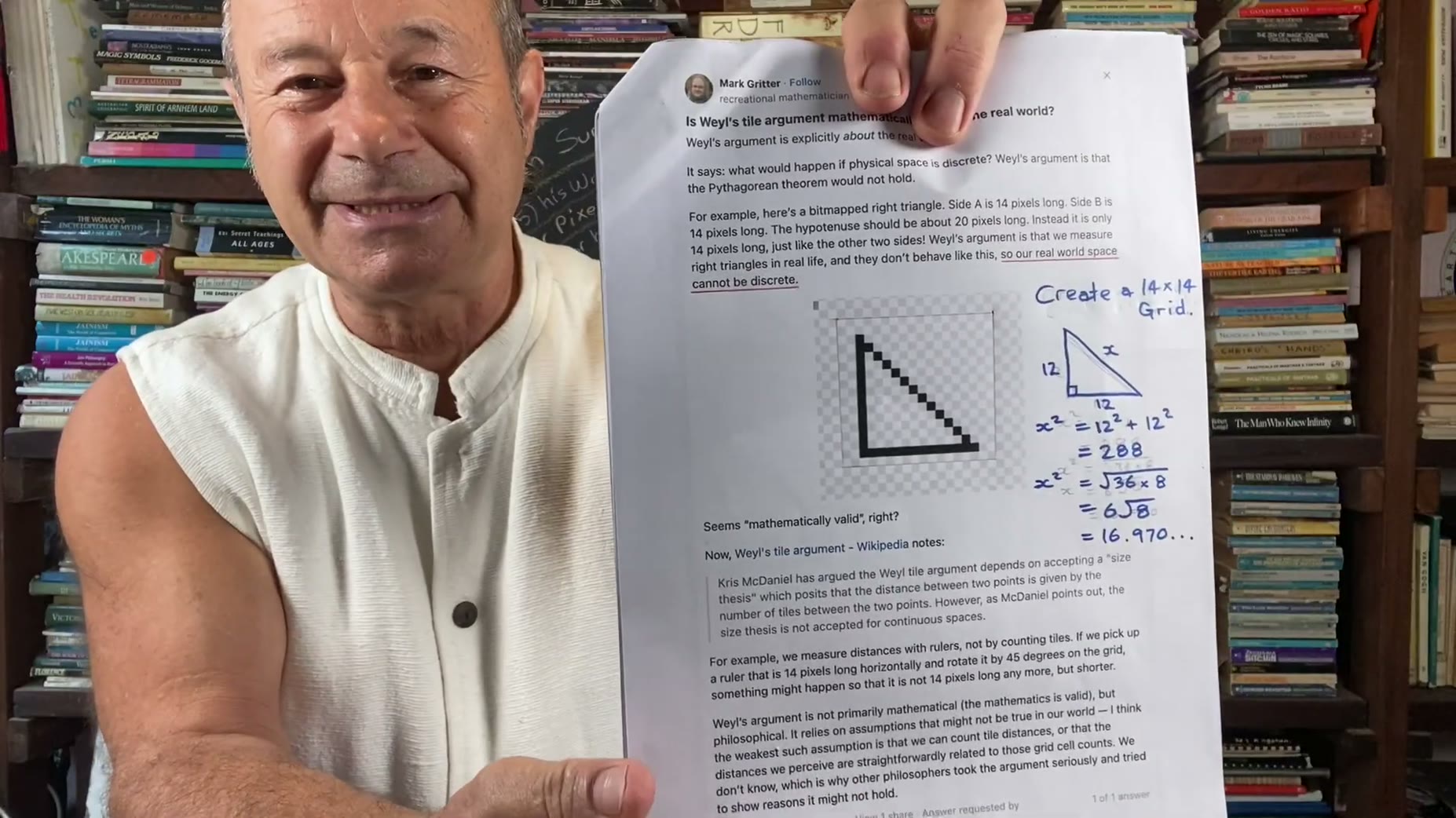
- [04:33] The grid shown is 14 by 14 pixels, with 12 pixels making up each of two sides of the triangle.
+ 12 more takeaways
- [05:19] For a 1 by 1 right triangle, the hypotenuse length is 1.414, the square root of two.
- [05:46] Counting the rasterized diagonal pixel by pixel gives 12, the same count as the sides, called 'the immense shocking contradiction' since the diagonal should be mathematically longer.
- [06:30] For the classic 3-4-5 triangle, 3 squared plus 4 squared (9 plus 16) equals 5 squared (25).
- [06:09] The 3-4-5 right triangle is commonly credited to Pythagoras but actually traces back to Babylon, Sumeria, India, and China.
- [07:18] For a 12 by 12 right triangle, 12 squared plus 12 squared equals 288, so the hypotenuse should be 16.970, not 12.
- [08:02] The true result is almost 17 units long but shows as 12 in the pixelated grid, which the speaker calls an impossibility.
- [09:01] The speaker says scientists now call the universe the 'impliverse,' with implosion as key to how fractality works.
- [11:34] The speaker frames the 12x12 triangle anomaly as the bridge where mathematics ends and physics begins.
- [16:09] The Planck length, the smallest measurable scale, is given as approximately 1.6 times 10 to the minus 35.
- [20:26] The speaker's opening thesis questioned whether there is something wrong with a 12 by 12 by 12 structure, stating 'you cannot have a 12 by 12 by 12.'
- [19:55] He links this to the carbon atom, which has six neutrons, six protons, and six electrons, a six-six-six configuration.
- [25:35] He credits David Hilbert, comparing him to Einstein, as the teacher of Hermann Weyl who carried on Hilbert's work on problems of space.