
How Life May Have Started on Earth 4.33 Billion Years Ago
What this video is
⚡ a 17-minute video, readable in 60 secondsThis video explains new research into how life began on Earth, challenging the assumption that the early Hadean Eon was too hostile for life to start. A 2026 Nature Communications study modeled Earth's early thermal and impact history to pinpoint when conditions became stable enough for the RNA World hypothesis, while separate ribozyme and volcanic-chemistry studies show how simple self-replicating RNA could plausibly have formed. Together these findings push back the earliest possible window for life's origin and even raise the possibility that early Mars was more hospitable than Earth.
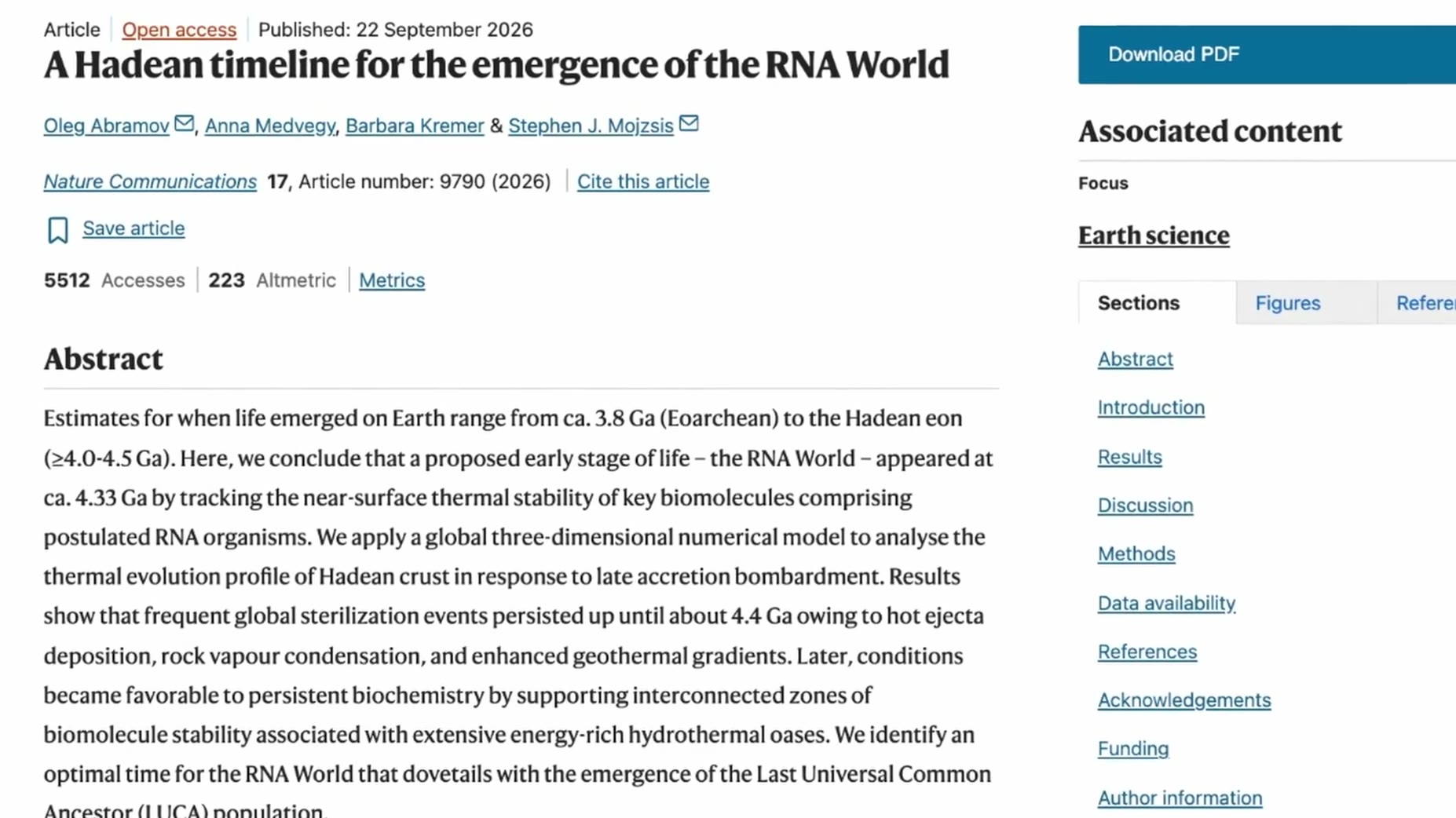
A 2026 study by Abramov, Medvegy, Kremer, and Mojzsis (Planetary Science Institute) in Nature Communications concludes the RNA World appeared around 4.33 Ga, with global sterilization persisting until about 4.4 Ga [02:38]
Key takeaways
- Researchers built a 3D thermal model calibrated using the Moon's preserved impact crater record to reconstruct Earth's early bombardment history [03:06]
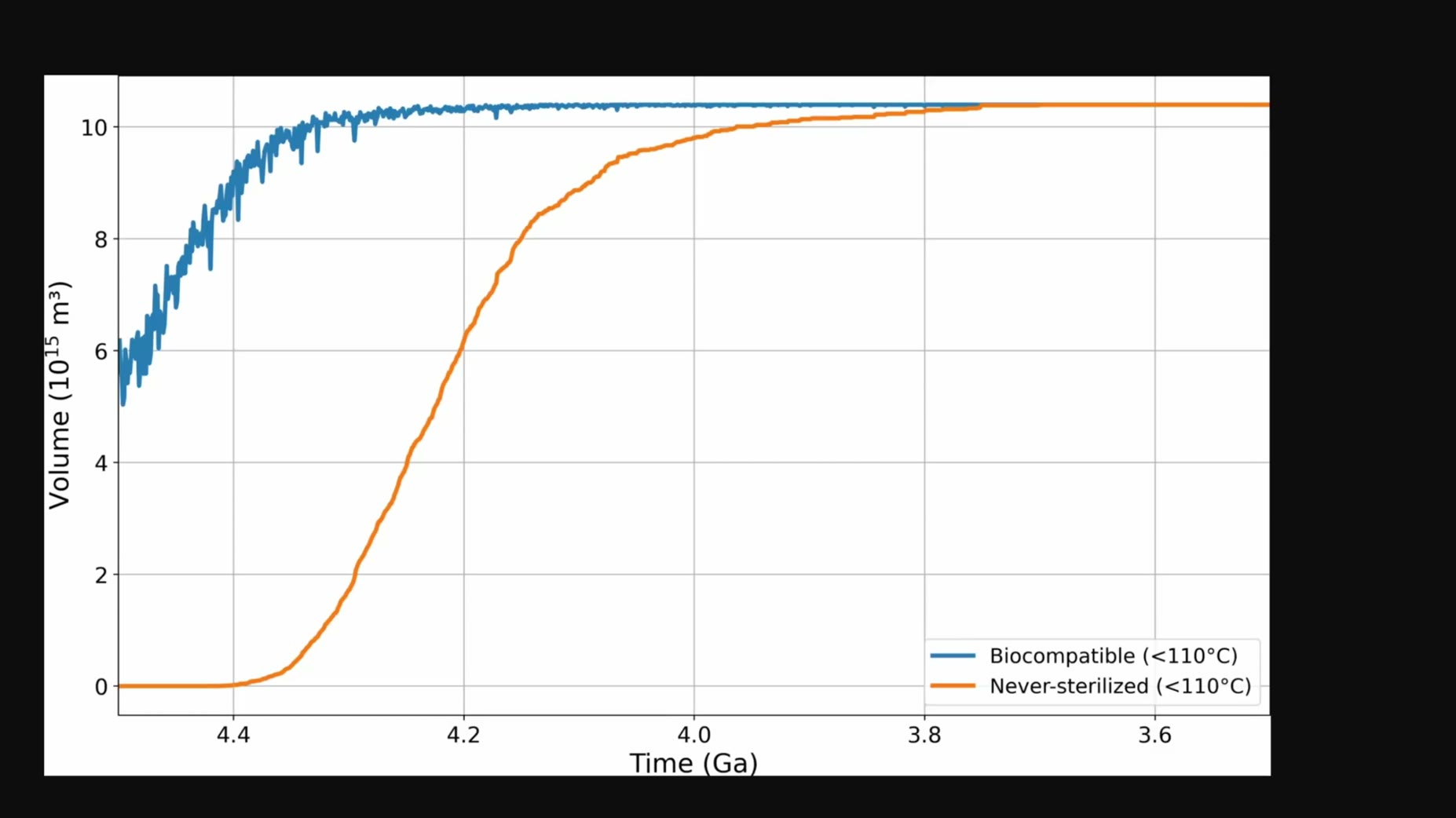
- The model tracked shallow crust regions staying below 110°C, the approximate thermal limit for RNA stability, across the first billion years [03:42]
- For the first 100 million years Earth was likely too hot, with frequent global sterilization events resetting any potential chemical progress [04:04]
- Around 4.4 billion years ago impacts subsided enough for 'never-sterilized' regions to persist below 110°C [04:29]
+ 6 more takeaways
- By 4.25 billion years ago, hydrothermal/habitable zones expanded to cover more than half of Earth's crustal volume [05:01]
- The Chicxulub impact crater's hydrothermal system lasted at least a million years, illustrating how impacts can sustain long-term chemical environments [06:28]
- The model identifies an optimal sweet spot for impact-driven hydrothermal systems at 4.33 billion years ago, about 160 million years after Earth formed, roughly 100 million years before LUCA and 200 million years before the oldest life evidence in 4.1 Ga zircons [06:53]
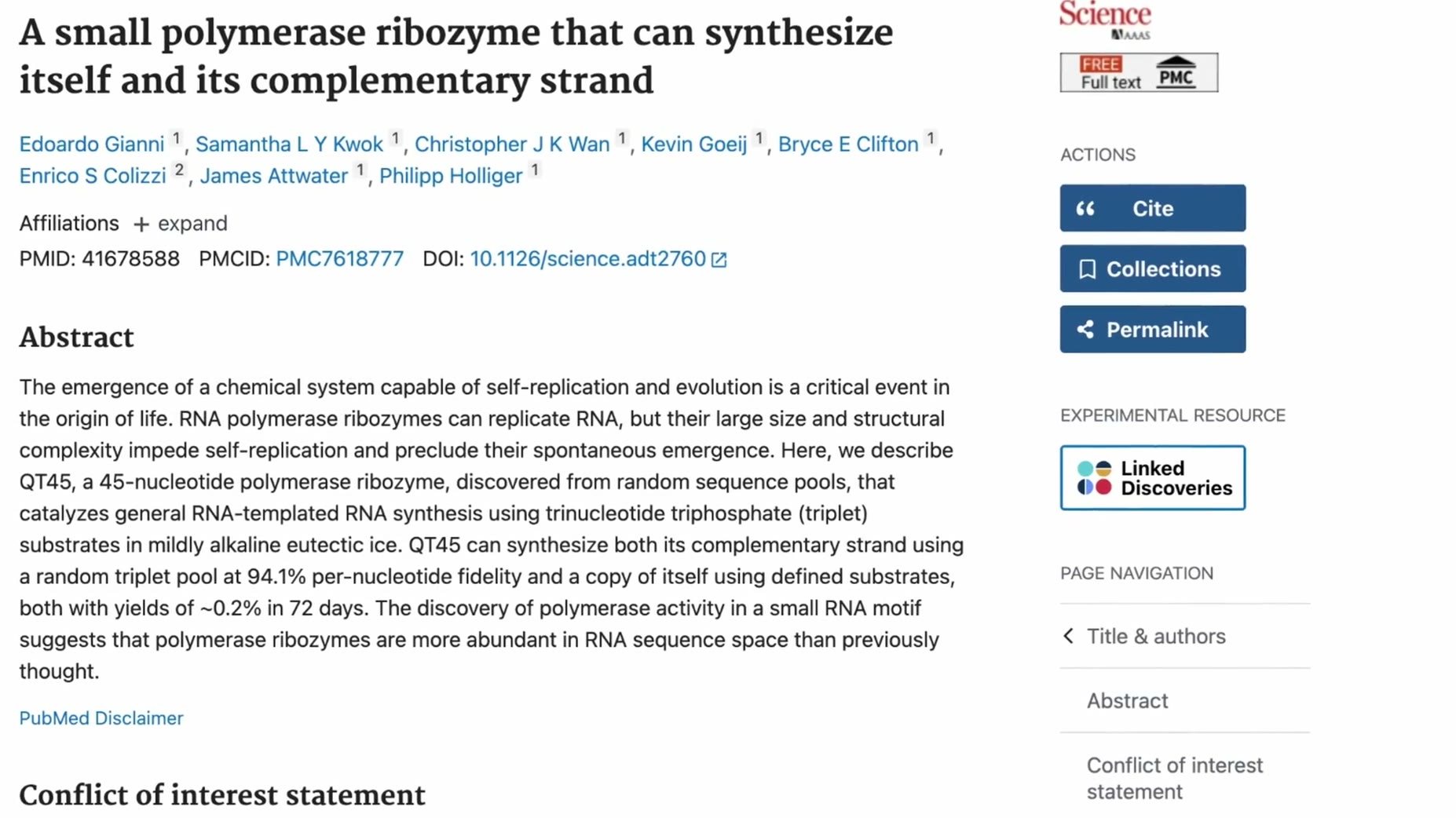
- A Science study by Gianni and Holliger identified QT45, a 45-nucleotide ribozyme from alkaline eutectic ice that copies a complementary strand at 94.1% fidelity and can self-copy with ~0.2% yield over 72 days [09:09]
- A separate study by Hirakawa and Banner proposes volcanic island chemistry where borates catalyze sugar formation and volcanic glass builds long RNA-like chains [10:58]
- Curiosity rover data confirmed concentrated borate deposits on Mars (Gale Crater), leading some geochemists to argue Noachian Mars may have been more hospitable to RNA origin than early Earth [14:12]
Jump to a moment
0:00How did life start on Earth?2:25Perfect time for life to start?4:05What Earth was like and what probably happened5:15Impact are not just destructive! Creates life7:48How did molecules assemble into RNA?10:30Natural formation in volcanic environments12:00How RNA survived and repaired12:50Overall picture13:50Implications for Mars15:00Conclusions
Their links, sorted & clickable
🏛️ Communities & courses1
Support this channel on Patreon to help me make this a full time jobWas this brief useful?