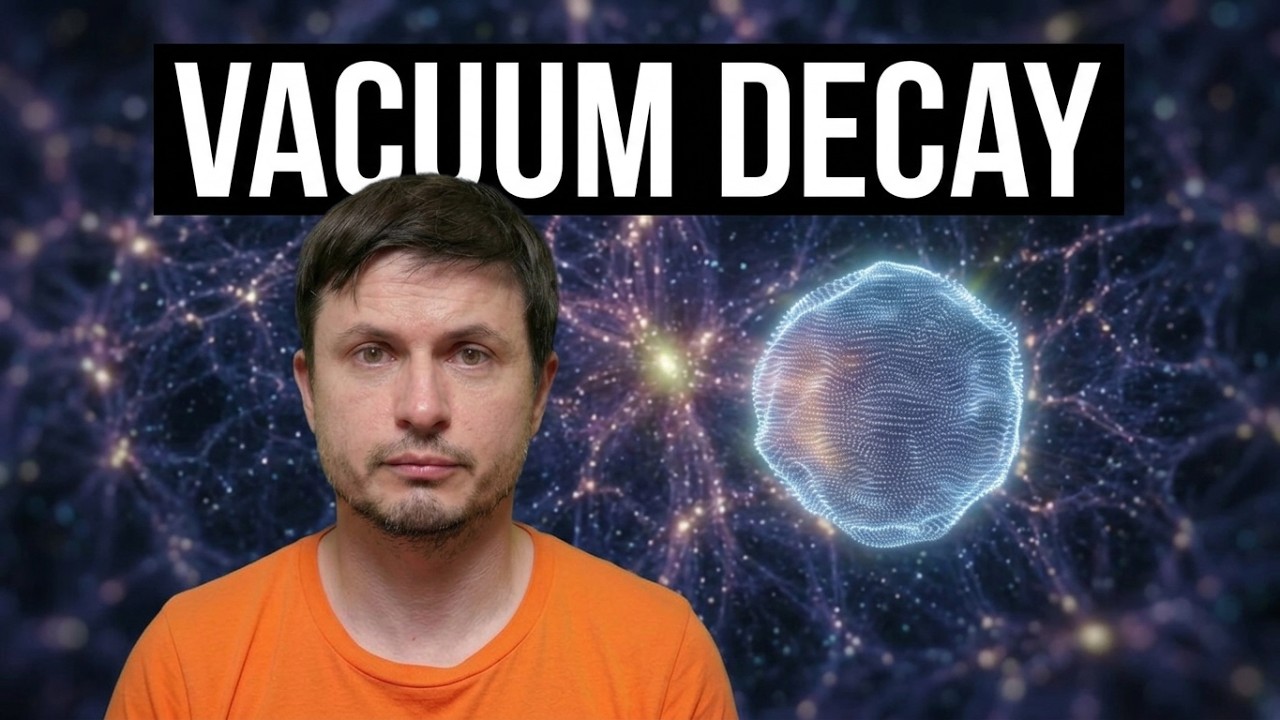
The Universe Will Not Get Destroyed by False Vacuum After All
This video is narrated by a host referred to as Anton; no institution, course, or academic credential is stated for him. The organizing framework is false vacuum decay in quantum field theory: the idea that the universe's quantum fields may currently sit in a false vacuum (a stable but not lowest-energy state) rather than the true vacuum, separated by a potential barrier, and that quantum tunneling could in principle trigger a bubble of true vacuum that destroys the present structure of matter. The video builds on this with a 2026 study on decoherence and a 'cosmic lockdown' effect that may prevent such tunneling, plus recent cold-atom and Rydberg-atom tabletop experiments testing related dynamics, and closes by tying the whole topic to the 2012 Higgs boson discovery and current mass measurements. Per the video, the stated significance is that if this decay occurred, it would destroy the universe before anyone could see it happen, which is why physicists have studied the possibility since 2012.
Concept: the video frames false vacuum decay as a theoretical possibility in which the universe's physical laws could suddenly change, building from the idea that modern quantum field theory holds empty space is filled with quantum fields determining particle masses and forces, that systems naturally settle into a lowest-energy 'ground state,' that the false vacuum is a temporarily stable valley (not the absolute minimum) separated from the true vacuum by a potential barrier, and that Higgs boson measurements suggest the universe may currently sit in that false vacuum rather than the true one.
- Mechanism: quantum tunneling is explained as allowing a particle to pass directly through an energy barrier rather than rolling over it. [00:02:00]
- Mechanism: if the universe's quantum fields tunneled into the deeper true vacuum valley, it would create a bubble of true vacuum that nucleates and expands outward at nearly the speed of light. [00:02:14]
- Mechanism: these hypothetical true vacuum bubbles would alter the structure of matter and chemistry inside them, changing the universe almost instantly as they expand at the speed of light. [00:02:30]
- Context: the video notes this bubble-expansion idea comes from quantum field theory and has been around for a long time. [00:02:47]
+ 36 more takeaways
- Why it matters: the video states this process would basically lead to the end of the universe, though technically also the beginning of a new one. [00:02:58]
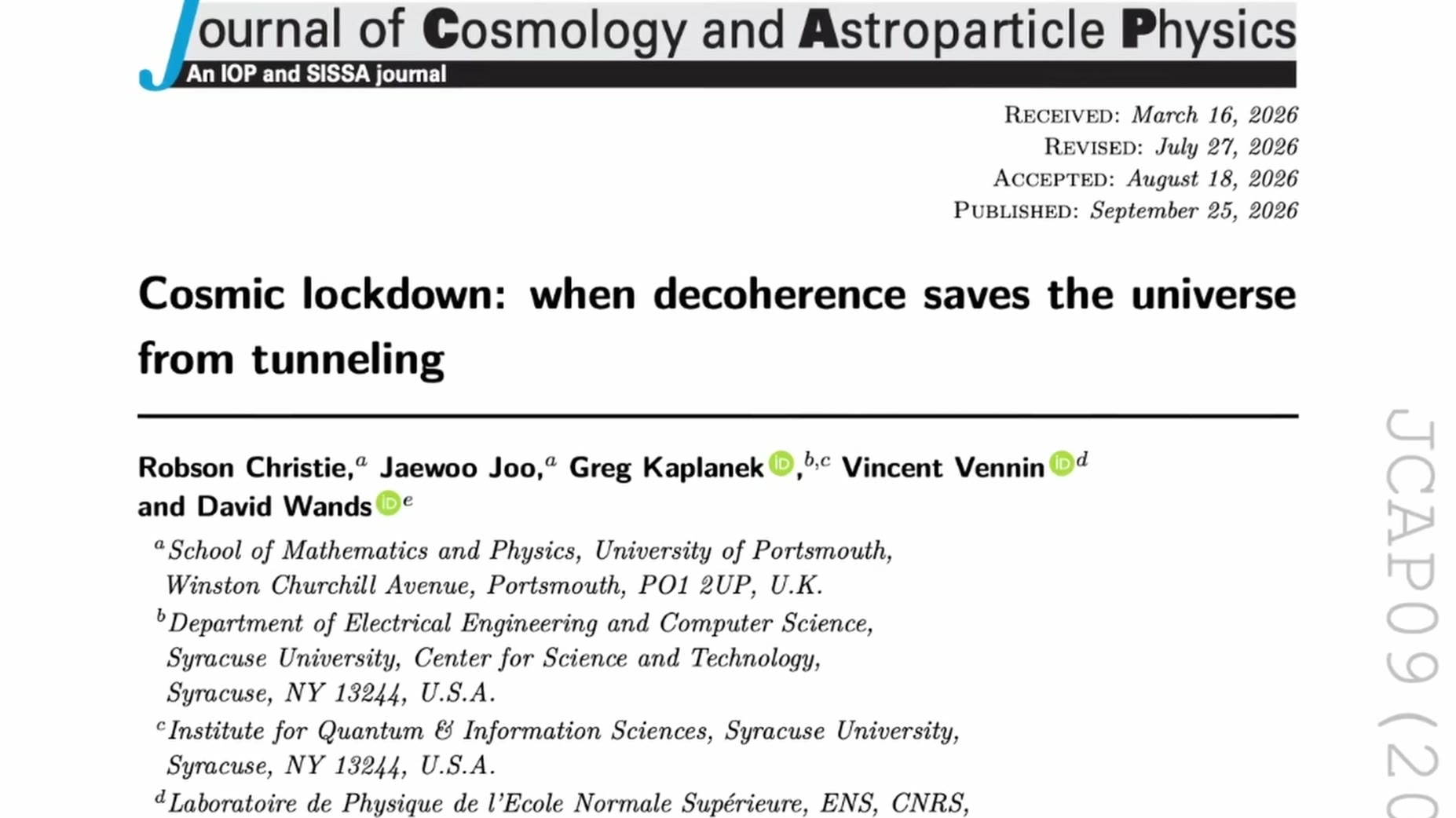
- Named study: a study titled 'Cosmic lockdown: when decoherence saves the universe from tunneling,' authored by Robson Christie, Jaewoo Joo, Greg Kaplanek, Vincent Vennin, and David Wands, was published in the Journal of Cosmology and Astroparticle Physics. [00:03:23]
- Named finding: the study's researchers found that when quantum fields interact with their surrounding environment in the expanding universe, quantum interference is destroyed and the system becomes dynamically trapped in its current state, a result the authors call the 'cosmic lockdown.' [00:03:40]
- Context: physicists calculating vacuum decay probability typically treat the quantum field as existing in complete isolation, governed only by a single equation. [00:04:26]
- Named finding: the study's authors proved this isolation assumption is too idealistic and essentially hypothetical. [00:04:40]
- Mechanism: quantum fields in the early universe are surrounded by other fields, such as gravitational fluctuations and fields that produce other particles. [00:05:01]
- Concept: decoherence is defined as the process by which a quantum field interacting with its surroundings has its quantum superpositions and interference washed away. [00:05:13]
- Named study/method: researchers Robson Christie and cosmologist David Wands simulated a field evolving in a double well potential that could have happened during early cosmic inflation. [00:05:25]
- Mechanism: they found the surrounding environment acts as a continuous observer, continuously collapsing the quantum state and preventing tunneling. [00:05:41]
- Comparative example: the video likens this continuous monitoring to the quantum Zeno effect, named after the philosopher Zeno of Ilya and summarized as 'a watched pot never boils.' [00:05:53]
- Mechanism: surrounding spectator fields continuously observe the primary field, suppressing the quantum coherence needed for it to tunnel through the potential barrier, locking the system into a local minimum and preventing the true vacuum from forming. [00:06:20]
- Comparative example: using a marble-in-a-valley analogy, the video states the math shows this effect is also influenced by the Hubble rate (the universe's expansion speed): if expansion is slow the marble can reach the true vacuum, but if expansion is too fast the marble gets locked in the false vacuum. [00:07:04]
- Mechanism: the host notes it is not just field interactions but also extremely fast cosmic expansion that can lock the field (the 'marble') in the false vacuum if the universe expands faster than the field can keep up. [00:07:29]
- Context: the video states that in the last 24 months, experimental physics achieved breakthroughs simulating these dynamics inside tabletop universe experiments using lasers and extremely cold atoms. [00:08:01]
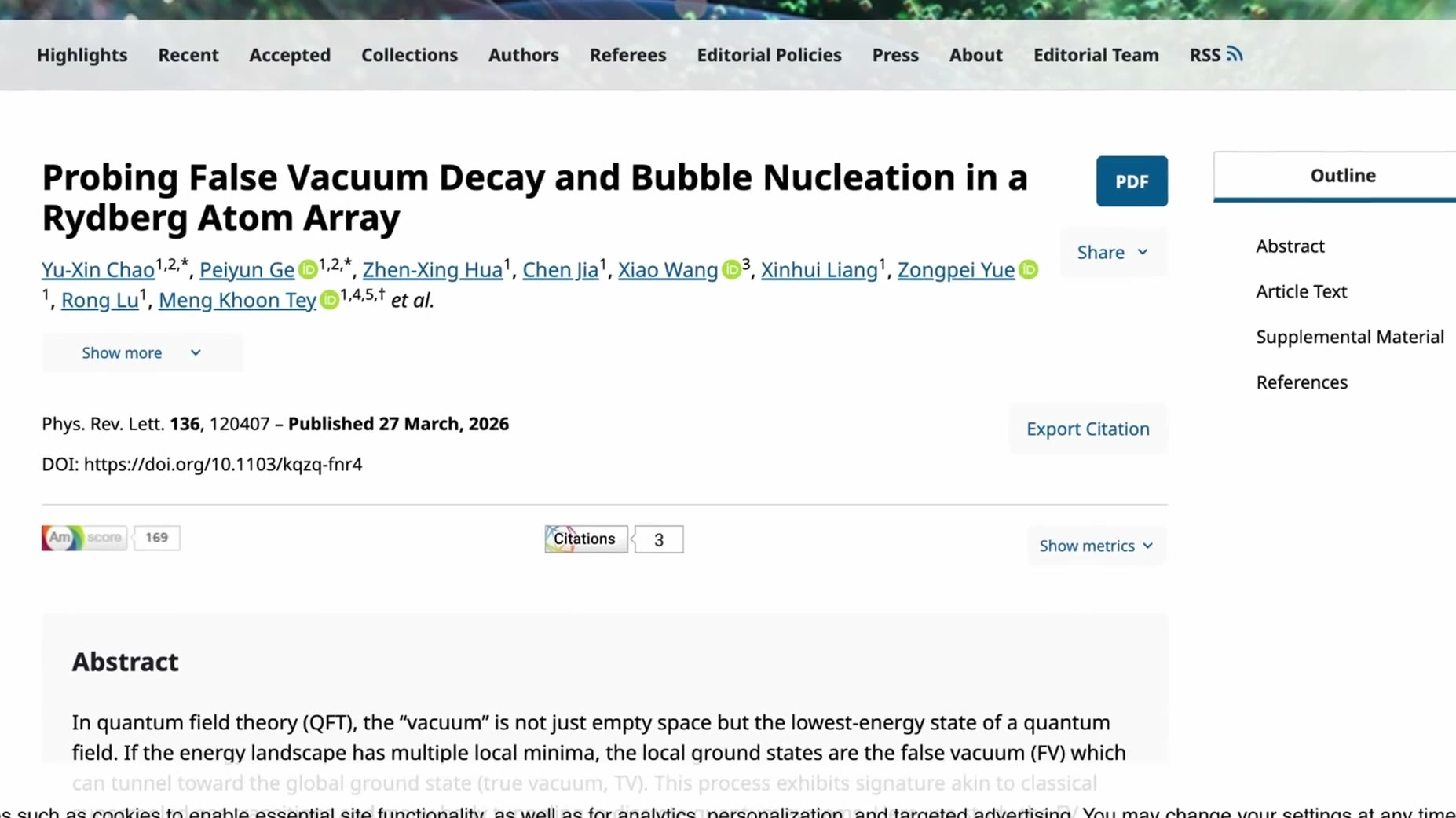
- Named study: a paper titled 'Probing False Vacuum Decay and Bubble Nucleation in a Rydberg Atom Array,' by Yu-Xin Chao, Peiyun Ge, Zhen-Xing Hua, Chen Jia, Xiao Wang, Xinhui Liang, Zongpei Yue, Rong Lu, Meng Khoon Tey, et al., was published in Physical Review Letters 136, 120407, on 27 March 2026. [00:08:25]
- Named study: a Nature Physics paper by a team from the University of Trento and Newcastle University emulated these fields using clouds of sodium atoms a fraction of a degree above absolute zero, in a ferromagnetic superfluid state. [00:08:33]
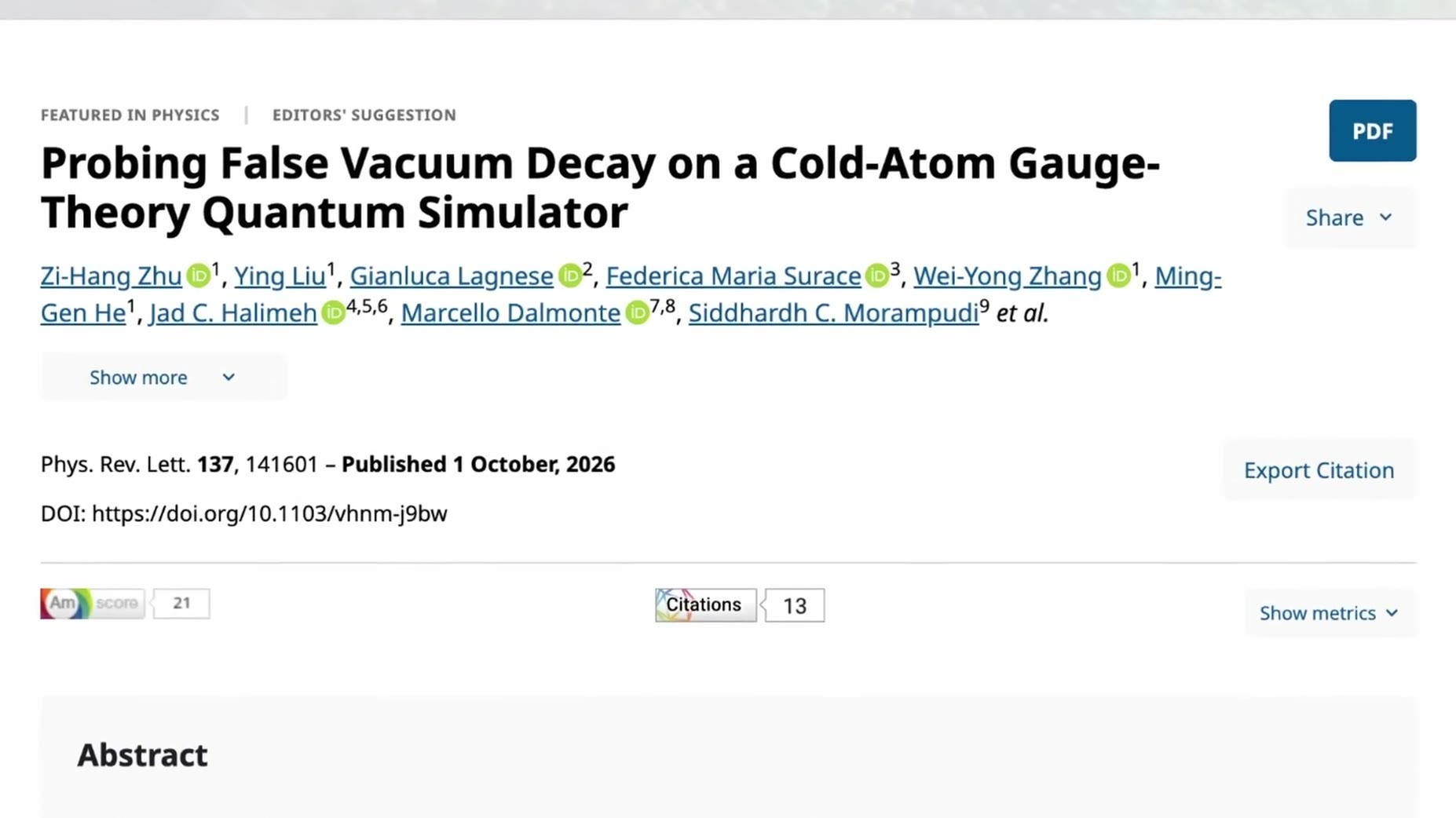
- Named study: a related paper, 'Probing False Vacuum Decay on a Cold-Atom Gauge Theory Quantum Simulator,' by Zi-Hang Zhu, Ying Liu, Gianluca Lagnese, Federica Maria Surace, Wei-Yong Zhang, Ming-Gen He, Jad C. Halimeh, Marcello Dalmonte, Siddhardh C. Morampudi, et al., was published in Physical Review Letters 137, 141601, on 1 October 2026. [00:08:33]
- Named finding: by adjusting external magnetic fields and shifting atomic gas into a metastable false vacuum state, researchers physically observed false vacuum decay inside the atomic state for the first time. [00:08:53]
- Named finding: localized spin bubbles spontaneously nucleated inside the gas and expanded outward, matching mathematical predictions from quantum field theory. [00:09:09]
- Why it matters: the video states this bubble nucleation experiment was the first physical test of a process that might have played a role in the extremely early universe during the Big Bang. [00:09:22]
- Named study: a separate experiment, published in Physical Review Letters, used a ring of Rydberg atoms (atoms whose outer electrons are excited to extremely high energy levels) to study false vacuum decay. [00:09:46]
- Quantified fact: the Rydberg atom cores used in that experiment had n=150. [00:09:54]
- Context: the video states that false vacuum decay involves both quantum tunneling and relativistic fluid dynamics, with bubbles expanding at basically the speed of light, which makes it notoriously difficult to model. [00:10:02]
- Mechanism: researchers used strong Van der Waals interactions between Rydberg atoms to build what the video calls 'a tiny universe in a box' to watch the false vacuum break down. [00:10:18]
- Named finding: by watching bubble growth rates and reactions to symmetry breaking fields, researchers confirmed that the math equations physicists use to describe the birth and evolution of the universe seem accurate. [00:10:45]
- Named finding: the 2012 discovery of the Higgs boson confirmed the existence of the Higgs field, described as an invisible background energy field that exists everywhere in space. [00:11:13]
- Mechanism: particles like electrons and quarks get slowed down by interacting with the Higgs field, acquiring inertia. [00:11:32]
- Mechanism: this interaction with the Higgs field is what gives particles their mass. [00:11:44]
- Why it matters: without mass from the Higgs field, atoms and the chemistry of life would be impossible, per the video. [00:11:57]
- Named finding: plugging the masses of the Higgs boson and the top quark into the standard model equation indicates the current electroweak vacuum seems to be metastable. [00:12:03]
- Quantified fact: the experimental data points used are a top quark mass of 173.34±0.55 GeV/c2 and a Higgs mass of 125.25±0.18 GeV/c2. [00:12:09]
- Concept: the video states the Higgs field can curve down into a much deeper energy minimum that it has not reached yet. [00:12:16]
- Why it matters: the video states this math confirms the universe is not in a true vacuum but in a false vacuum. [00:12:26]
- Mechanism: if the Higgs field underwent false vacuum decay, it would form an expanding bubble of true vacuum that would physically alter particle masses and likely break all atomic bonds inside it. [00:12:32]
- Why it matters: this vacuum decay would destroy the universe before anyone could even see it happen, per the video. [00:12:57]
- Why it matters: the video states this hypothetical possibility of vacuum decay has kicked off many studies since 2012 trying to determine if and when it could happen. [00:13:04]
How this brief was shaped: Lecture / Educational Explainer · confidence Medium
Single narrator explains a named peer-reviewed paper (Cosmic lockdown: when decoherence saves the universe from tunneling, with visible authors and journal dates in OCR) and teaches the underlying mechanism (false vacuum decay, quantum decoherence, dynamical trapping) using analogies, with no course context and no contested personal thesis.
The lens sets this brief's structure, never its facts — every claim is held to the same citation and fact-check standard.