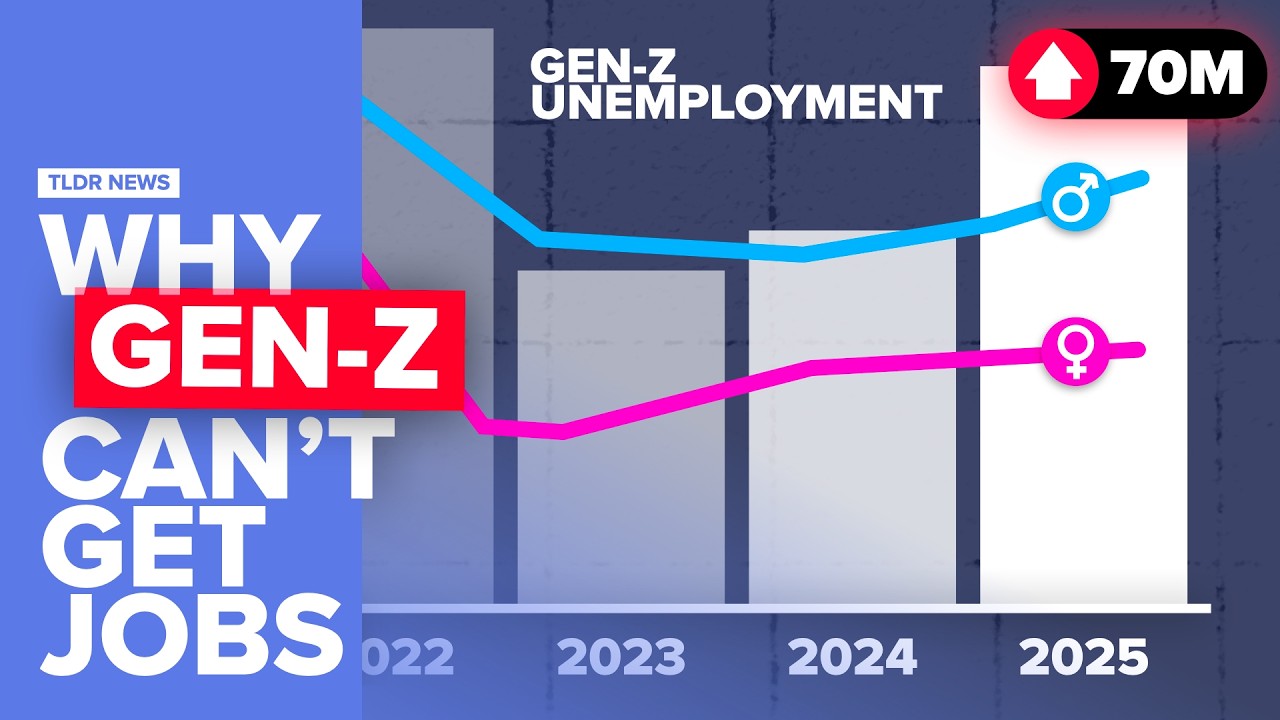
The Gen-Z Unemployment Crisis Explained
The International Labour Organization published a new report last week, "Global Employment Trends for Youth 2026: Back to the future," reporting that global youth unemployment is rising again after reaching its lowest level in over two decades following the pandemic, with the report citing a global youth unemployment rate of 12.4% in 2025 (up from 12.3% in 2023) and a NEET population that grew by 9 million to 257 million, with Arab States (26.2%) and Northern Africa (22.6%) posting the highest regional rates. The video also displays an on-screen figure of 20% for 2025 that is never reconciled with the 12.4% figure used in narration. The creator argues the downturn stems from three combined factors, economic uncertainty, rising "experience inflation" in hiring, and the growing displacement of entry-level jobs by AI, and predicts conditions could worsen further, while conceding that concrete government solutions remain unclear.
Confirmed: The ILO published a new report last week, "Global Employment Trends for Youth 2026: Back to the future," finding that global youth unemployment is rising again after reaching its lowest level in over two decades following the pandemic [00:09]
- Confirmed: The report is titled "Global Employment Trends for Youth 2026: Back to the future" [00:10]
- Confirmed: The ILO reports around 67 million young people aged 15-24 are unemployed worldwide, a rate of 12.4% [01:04]
- Confirmed: The youth unemployment rate was 12.3% in 2023, meaning 2 million more young people became unemployed over the past two years [01:14]
- Confirmed: The NEET rate (not in employment, education or training) rose by 9 million to reach 257 million in 2025, about 1 in 4 young people [01:50]
+ 30 more takeaways
- Confirmed: Youth unemployment and NEET rates hit their lowest point in 20 years in 2023 after recovering from pandemic highs, but that recovery has since ended, with the biggest increases in North Africa, North America and Northern/Southern/Western Europe [01:58]
- Confirmed: While youth unemployment rose, the overall unemployment rate declined slightly, making a young person now four times more likely to be unemployed than an adult aged 25 or over [02:23]
- Confirmed: The Arab States have the world's highest youth unemployment rate at 26.2%, with a NEET rate of 32.4% [00:16]
- Confirmed: Northern Africa's youth unemployment rate is 22.6%, with a NEET rate of 30.1% [00:16]
- Confirmed: Sub-Saharan Africa's youth unemployment rate was 8.4% in 2025, 4 percentage points below the global rate, though informal and insecure work remains widespread there [00:16]
- Confirmed: Youth population growth outpaced total employment growth in Eastern Asia, Eastern Europe, Northern America, and Northern, Southern and Western Europe as of 2024 [00:18]
- Unverified: On-screen text at 00:12 showed a global youth unemployment rate of 20% in 2025 (up from 19.7% in 2023), which conflicts with the 12.4% (up from 12.3%) rate cited elsewhere in the video's narration [00:12]
- Confirmed: The report says the global economy has been roiled by wars, trade wars, energy shocks and geopolitical tension, generating persistent economic uncertainty [02:51]
- Confirmed: The narrator cited global GDP growth of around 3% in 2026, down from 3.5% the year before, while the report's on-screen text instead showed 3.1% for 2026 versus 3.4% for 2023 [03:17]
- Confirmed: Despite economic uncertainty through 2025, overall employment growth had proved fairly resilient except for young people [03:24]
- Confirmed: Entry-level jobs increasingly require prior experience, a trend the report calls the experience barrier or experience inflation [04:11]
- Confirmed: The report likens this to diploma inflation, the decline in a degree's value driven by a rise in graduates [04:28]
- Confirmed: Employers argue requiring more prior experience lowers hiring risk, especially as digital recruitment has increased applicant volume [04:49]
- Confirmed: The report finds middle-skilled occupations, including clerical support, service and sales, skilled agricultural work, craft trades, and machine operators, are most persistently affected by shrinking youth employment, overlapping with occupations most exposed to AI disruption (timestamp not stated)
- Source cited (PwC): Since 2019, postings for AI-exposed entry-level roles demanding traditionally senior skills grew 35% [05:00]
- Unverified: Postings that stayed genuinely entry-level were cited in narration as shrinking 10% but shown as -5% on an on-screen chart, for the 2019-2025 period [05:12]
- Confirmed: A report cited in the video finds that jobs which historically served as entry points for young workers, including manufacturing, office/admin and sales roles, are declining, partly due to AI [05:40]
- Source cited (Brynjolfsson, Chandar and Chen, 2025): A 16% relative drop in US employment among 22-25 year olds in highly AI-exposed fields [05:55]
- Source cited (Klein Teeselink, 2025): UK workforces at companies with high AI exposure shrank by an average of 4.5%, concentrated almost entirely in junior positions [06:03]
- Source cited (Anthropic, 2026): A null effect to date on AI-exposed occupations (timestamp not stated)
- Confirmed: The ILO report's own modelling estimates 6.1% of jobs currently held by young people fall into categories most exposed to AI [06:14]
- Prediction (ILO report modelling): If even 10% of those exposed jobs disappear, roughly 5.6 million young workers, mostly in high-income countries, could face unemployment, job changes, or exit from the labour force entirely [06:22]
- Prediction (report, per narrator): Labour markets often react to economic conditions with a lag, so a slowing economy today could translate into weaker hiring, stagnant wages or rising unemployment months later, especially for young people [03:47]
- Prediction (narrator): Global ripple effects from Middle East turmoil, constrained energy supplies and Trump's trade wars could mean next year's youth employment figures reflect turbulence not yet visible in current numbers [03:58]
- Take (narrator): The video frames the tough conditions for young people as driven by three combined factors, the economy, experience inflation, and the continued rise of AI [02:40]
- Take (narrator): Experience inflation combined with the disappearance of entry-level jobs is described as becoming the new norm given the rapid rise of AI [06:46]
- Unverified: The narrator claims high youth unemployment is unsustainable long-term because it is strongly correlated with political instability, without citing a source for this claim [06:55]
- Take (narrator): While solutions to the systemic problems outlined remain unclear, the video argues it is a problem governments have no choice but to address [07:02]
- Open question: The video does not specify what policy solutions could improve youth unemployment, leaving whether conditions will improve unresolved
- Confirmed: The video closes with a sponsored segment promoting an 84-page issue of Too Long magazine, offering subscribers 20% off with code SUMMER26 [07:18]
How this brief was shaped: News Analysis / Commentary · confidence High
Transcript frames a specific news event, a new ILO report published last week, and walks through its stated numbers on youth unemployment and NEET rates. OCR confirms the source is the actual Global Employment Trends for Youth report with executive summary text, and the narrator is explaining what the report found and why, not arguing a personal thesis.
The lens sets this brief's structure, never its facts — every claim is held to the same citation and fact-check standard.