Why Egypt and Ethiopia are Fighting Over the Nile (Again)
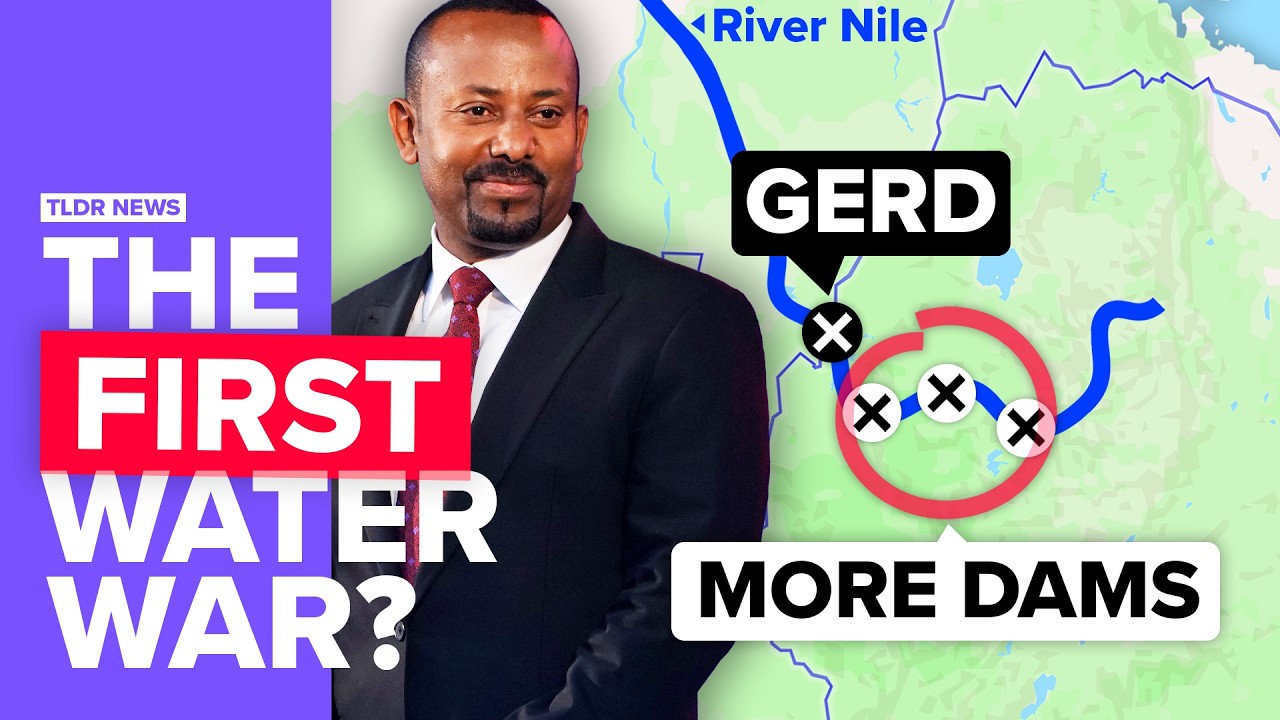
The creator reports that Ethiopia's completed Grand Ethiopian Renaissance Dam, which already supplies over 50% of the country's electricity, and new plans for three more upstream dams (Mandaya, Beko Abo, Karadobi) have reignited tension with Egypt, whose foreign and irrigation ministers have warned Egypt will defend its water security under international law and with Chinese diplomatic backing. In the creator's reading, an outright water war remains unlikely but the risk could rise if Egypt uses regional proxies like Eritrea or Somalia to pressure Ethiopia, or if drought conditions worsen.
Confirmed: The 1929 Anglo-Egyptian treaty guaranteed Egypt 48 billion and Sudan 4 billion cubic metres of the Nile's roughly 80 billion cubic metre flow [01:50]
- Confirmed: In 1959 Egypt and independent Sudan signed a treaty guaranteeing Egypt 55.5 billion and Sudan 18.5 billion cubic metres of Nile water plus veto power over upstream developments [02:03]
- Confirmed: The Nile today accounts for 90% of Egypt's freshwater [02:19]
- Confirmed: Ethiopia has averaged about 10% annual GDP growth since 2004 [02:37]
- Confirmed: Ethiopia consumes barely a third as much energy per capita as Kenya or Sudan, and barely a quarter that of Nigeria [02:50]
+ 19 more takeaways
- Confirmed: Last year Ethiopia became the first country in the world to ban the import of petrol and diesel cars [03:08]
- Confirmed: The GERD was first announced in 2011 on the Blue Nile near Ethiopia's border with Sudan [03:23]
- Confirmed: The GERD's wall stretches over a mile across a valley and stands 145 metres high, creating a new lake called Lake Naigat [03:32]
- Confirmed: At full capacity the GERD can generate more than 5,000 megawatts, more than double Ethiopia's prior generation capacity [03:41]
- Confirmed: Ethiopia began filling the GERD reservoir without Egypt or Sudan's permission in 2020 and inaugurated the dam in September of last year [03:58]
- Confirmed: The GERD already accounts for more than 50% of Ethiopia's national electricity generation [04:19]
- Confirmed: Egypt's foreign minister warned last month that if any harm interrupted the flow of water, Egypt has the right to defend itself under international law, citing Article 51 of the UN Charter [06:06]
- Confirmed: Article 51 states nothing in the UN Charter shall impair the inherent right of individual or collective self-defence if an armed attack occurs against a member state, until the Security Council acts [06:19]
- Confirmed: Egypt and China issued a joint statement in which Beijing recognized Egypt's legitimate right to safeguard its water and food security and called on all Nile Basin states to comply with international law [06:22]
- Confirmed: In the joint communique Egypt reaffirmed its rejection of interference in China's internal affairs and its commitment to the One-China principle regarding Taiwan [06:25]
- Confirmed: Egypt's irrigation minister Hani Sewilam described the GERD as illegitimate and said Egypt will not turn a blind eye to its existential interests in the Nile [06:38]
- Confirmed: Sewilam said Egypt will use all procedures and measures permitted under international law to protect its water security and the rights and interests of its people [06:49]
- Take (creator): an outright water war is considered unlikely but not impossible if the region suffers a particularly dry period soon [06:58]
- Take (creator): it's easy to imagine Egypt getting back at Ethiopia by supporting one of its regional nemeses [07:06]
- Confirmed: Cairo has made diplomatic overtures to Eritrea, which has frosty relations with Ethiopia, and offered security support to Somalia over Ethiopia's port deal with Somaliland [07:13]
- Take (creator): Egyptian interference could supercharge tensions between Ethiopia's federal government, its neighbours, and regional militias including in Tigray and Amhara [07:27]
- Confirmed: tensions in Tigray and Amhara have simmered for months without escalating into full war, largely because the balance of force favors Ethiopia's federal government [07:41]
- Prediction (creator): if Egypt tipped that balance even slightly, the risk of conflict would significantly increase [07:52]
- Open question: the video does not state whether Ethiopia's new Mandaya, Beko Abo, and Karadobi dam proposals have moved beyond planning, and their specific specifications are not stated
IF ANY HARM HAPPENED THAT COULD INTERRUPT THE FLOW OF WATER, WE HAVE THE RIGHT TO DEFEND OURSELVES UNDER INTERNATIONAL LAW - BADR ABDELATTY
EGYPT WILL NOT TURN A BLIND EYE TO ITS EXISTENTIAL INTEREST IN THE NILE - HANI SEWILAM
WE WILL USE ALL PROCEDURES AND MEASURES PERMITTED UNDER INTERNATIONAL LAW TO PROTECT OUR WATER SECURITY AND THE RIGHTS AND INTERESTS OF OUR PEOPLE - HANI SEWILAM
How this brief was shaped: News Analysis / Commentary · confidence Medium
Transcript is a single narrator explaining the GERD dam dispute, tracing history, treaties, and current tension between Ethiopia Egypt and Sudan with the creator framing how neighbours might react. The OCR sample is unrelated magazine content (Sanchez, Le Pen, Japan succession, UN Charter) and appears to be misaligned or from a different segment, so it is discounted and confidence is lowered accordingly.
The lens sets this brief's structure, never its facts — every claim is held to the same citation and fact-check standard.