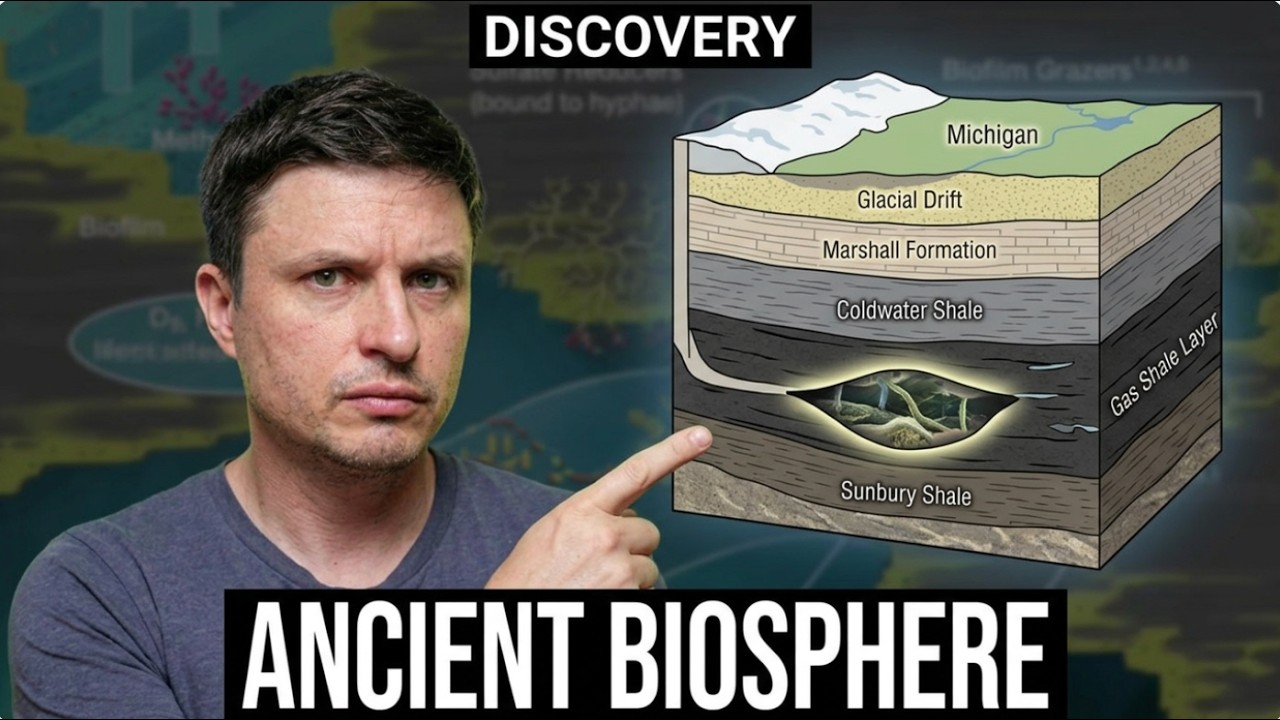
11,000 Year Old Ancient Biosphere Found in Michigan Shale
This video explains findings from a study published in The ISME Journal (article wrag184, 29 July 2026), led by ecologist Quinn Moon of the University of Michigan, documenting fungi, worms, and tardigrades living in groundwater isolated for over 11,000 years inside Michigan's Antrim Shale, 247 to 556 meters below the surface. It covers how researchers sampled water from existing natural-gas wells operated by a local energy company, used epifluorescence microscopy and PCR to count and identify cells (4.2 x 10^2 to 6.8 x 10^3 fungal cells per mL, fungal:bacterial ratios of 1:7028 to 1:713), and identified 690 fungal species across 6 phyla, growing 200 in petri dishes with 13 new to science. It also explains the proposed mechanism by which these fungi digest ancient carbon in the shale to produce biogenic methane, and the broader implication that Earth's deep subsurface, and possibly other planets, could host similar isolated ecosystems. This is a science-explainer video, not a coding tutorial, so there are no installs, commands, or on-screen code to transcribe.
Study: The paper documents an ecosystem isolated for at least 11,000 years beneath the Midwestern United States, since the last glaciation period (not tied to a spoken timestamp).
- Citation: Published in The ISME Journal, article wrag184, 29 July 2026, led by ecologist Quinn Moon of the University of Michigan (not tied to a spoken timestamp).
- Numbers: Study range is 4.2 x 10^2 to 6.8 x 10^3 fungal cells per mL in methane-producing organic-rich shale 247 to 556 meters deep (not tied to a spoken timestamp).
- Numbers: Fungal to bacterial cell ratios in the shale ranged from 1:7028 to 1:713 (not tied to a spoken timestamp).
- [00:13] Background: For decades biologists assumed complex eukaryotic cells could not survive deep underground due to lack of oxygen or extreme energy limitations.
+ 37 more takeaways
- [00:53] Background: Bacteria and possibly archaea have previously been found surviving in underground sediments for extremely long periods, sometimes millions of years.
- [01:54] Finding: Researchers discovered rock-eating fungi, active miniature worms, and tardigrades in water that had not seen light for over 11,000 years.
- [02:28] Site: The site is the Antrim Shale, an organic-rich deposit formed in the late Devonian period roughly 350 million years ago, originally a shallow sea with plankton and algae.
- [03:08] Site: The Antrim Shale is one of the largest US natural gas fields, producing billions of cubic feet of biogenic methane generated by microbes breaking down organic matter rather than purely geological heat.
- [03:32] Method: Scientists partnered with a local energy company to collect water from wells in Antrim County, Michigan, at depths of about 250 to 556 meters (over 1800 feet).
- [03:54] Method: The wells had been pumping this water almost daily for at least 10 years, confirming it genuinely came from deep within the shale rather than pipes or shallow sources.
- [04:12] Finding: At least 20% of the biomass was not bacteria but complex cells, including organisms resembling mushrooms.
- [04:32] Background: Prokaryotes like bacteria are tiny and simple and lack organelles, while eukaryotes (fungi, plants, animals) have complex internal structures requiring more support.
- [04:51] Background: Eukaryotes are much larger and more complex than prokaryotes, normally requiring far more energy and very specific conditions to survive.
- [04:59] Caveat: Scientists initially assumed all the biomass and DNA would come from either bacteria or archaea.
- [05:10] Caveat: Eukaryotes are believed to be too fragile to survive in these extreme underground conditions.
- [05:17] Method: Quinn Moon's team used two parallel methods, filtering water for epifluorescence microscopy and PCR to count and identify DNA fragments.
- [05:36] Numbers: Every milliliter of pumped water contained 40,000 to 70,000 microbial cells and at least 4,000 to 7,000 fungal cells.
- [05:48] Numbers: Fungal cells account for roughly 20% of total biomass despite lower numbers, meaning every drop of groundwater holds at least 250 fungal cells and several thousand bacteria.
- [06:05] Finding: This microbial to fungal ratio is remarkably similar to other environments, including the open ocean and frozen soils in Antarctica.
- [06:41] Numbers: DNA analysis identified 690 fungal species across 6 phyla; 200 were grown in petri dishes, and 13 were new to science.
- [07:12] Finding: The two dominant fungal classes were Agarizomycetes and Dothidiomycetes; Agarizomycetes normally form surface mushrooms but here likely grow without caps or stems inside rocky pores.
- [07:49] Mechanism: On the surface, fungi like these are known for consuming decaying wood on dead tree trunks, helping forests recycle material.
- [08:06] Mechanism: Wood contains lignin and cellulose, which are extremely tough to digest and which bacteria are basically unable to break down.
- [08:18] Mechanism: Over millions of years these fungi evolved a powerful, very acidic enzyme that lets them digest nearly everything in the forest.
- [08:35] Site: The ancient shale is packed with fossilized organic matter, including ancient algae and woody remains millions of years old.
- [08:46] Mechanism: These deep fungi likely have a similar digestive tool for consuming rock carbon, dissolving tough molecules into simpler dissolved organics other nearby life can consume.
- [09:05] Finding: A second fungal class, Basidiomycetes, likely does something similar, though the exact mechanism is unknown, and they're known to form symbiotic relations with other species.
- [09:27] Finding: Genetic signatures were also found for rotifers, segmented worms, roundworms, and tardigrades (water bears), organisms known for surviving extreme conditions.
- [09:51] Finding: Intracellular parasites were found, including Rosellimyxa (a fungus parasitizing other fungi) and Ichthyosporea (normally parasitizing animals and fish), suggesting more complex animals may be present.
- [10:42] Summary: Hundreds of meters beneath the Michigan site lies a complete multi-tiered food web dominated by fungi, untouched for 11,000 years.
- [10:59] Ecosystem: Fungi feed off ancient carbon in the rock, bacteria feed on the byproducts, and worms and tardigrades graze on everything else, with parasites also playing a role.
- [11:15] Ecosystem: Tardigrades potentially represent a kind of apex predator in this microscopic ecosystem.
- [11:29] Method: Stable isotope analysis of hydrogen and oxygen in the water found a signature matching late Pleistocene subglacial meltwater.
- [11:48] Origin: Roughly 11,000 to 20,000 years ago, melting continental ice sheets fractured the bedrock, forcing water hundreds of meters into the shale and carrying life with it, isolated ever since.
- [12:29] Origin: The ancestors of these tardigrades were swept underground when woolly mammoths still roamed the surface and ancient humans were still hunter-gatherers.
- [12:54] Caveat: Actual tardigrades and worms have not been captured yet, only their genes.
- [13:24] Implication: 90% of Earth's organic carbon is stored in deep subsurface environments, and the paper suggests fungi digest it into organic acids, ethanol, and CO2 that feed methanogenic archaea, which convert it into methane.
- Visual: Sulfate-reducing bacteria and biofilm grazers appear labeled in the on-screen visuals during this segment (not tied to a spoken timestamp).
- Implication: If many deep subsurface ecosystems like this exist, buried carbon could convert to methane and CO2 much faster than previously thought (not tied to a spoken timestamp).
- Implication: Similar locations elsewhere in the solar system and beyond could possibly host comparable ecosystems, and if life evolved elsewhere it could be expected in similar subsurface locations since these organisms don't require sunlight or fresh surface organic inputs (not tied to a spoken timestamp).
- [14:46] Conclusion: The paper underscores how little is known about what's under our feet, with a largely unmapped biosphere existing down there.
How this brief was shaped: Deep-Dive (coding / tutorial / how-to) · confidence Low
Single narrator systematically unpacks a newly published deep subsurface fungi study, walking through well depths (250 to 556 meters), a decade of pumping to confirm sample validity, and biomass ratios, while OCR shows the actual paper abstract with named authors and the ISME Journal doi. There is no course context and no argued personal thesis, just evidence and mechanism laid out in order, which fits the comprehensive-explanation spine over a narrative or discourse shape.
The lens sets this brief's structure, never its facts — every claim is held to the same citation and fact-check standard.