The many pluses and minuses of Alexa Plus | The Vergecast
This episode of The Vergecast opens with a 90 Seconds on the Verge news roundup covering ICANN's new top-level domain applications, GTA 6 leaks, the Joe Rogan-Spotify deal, and Amazon's hardware launches, before the hosts turn to a secondhand discussion of Jennifer Pattison Tuohy's year-long review of Alexa Plus, titled 'Alexa Plus is better at running my home, but it's not ready to run my life.' The center of gravity is Tuohy's verdict, as relayed by the hosts: Alexa Plus has become a strong smart home controller but remains an unfinished, sometimes frustrating general personal AI agent compared to tools like ChatGPT or Claude. The hosts and a guest extend this into a wider discussion of Amazon's new $500 Alexa tablet, stalled third-party integrations such as Expedia and non-Whole-Foods grocery shopping, and whether Amazon should stay focused on smart home control rather than chase broader personal-assistant ambitions. The episode closes by weighing Alexa Plus's current limits against an anticipated Apple smart home push, with speakers debating what an ideal AI-driven home interface should look like and raising privacy trade-offs around AI cameras.
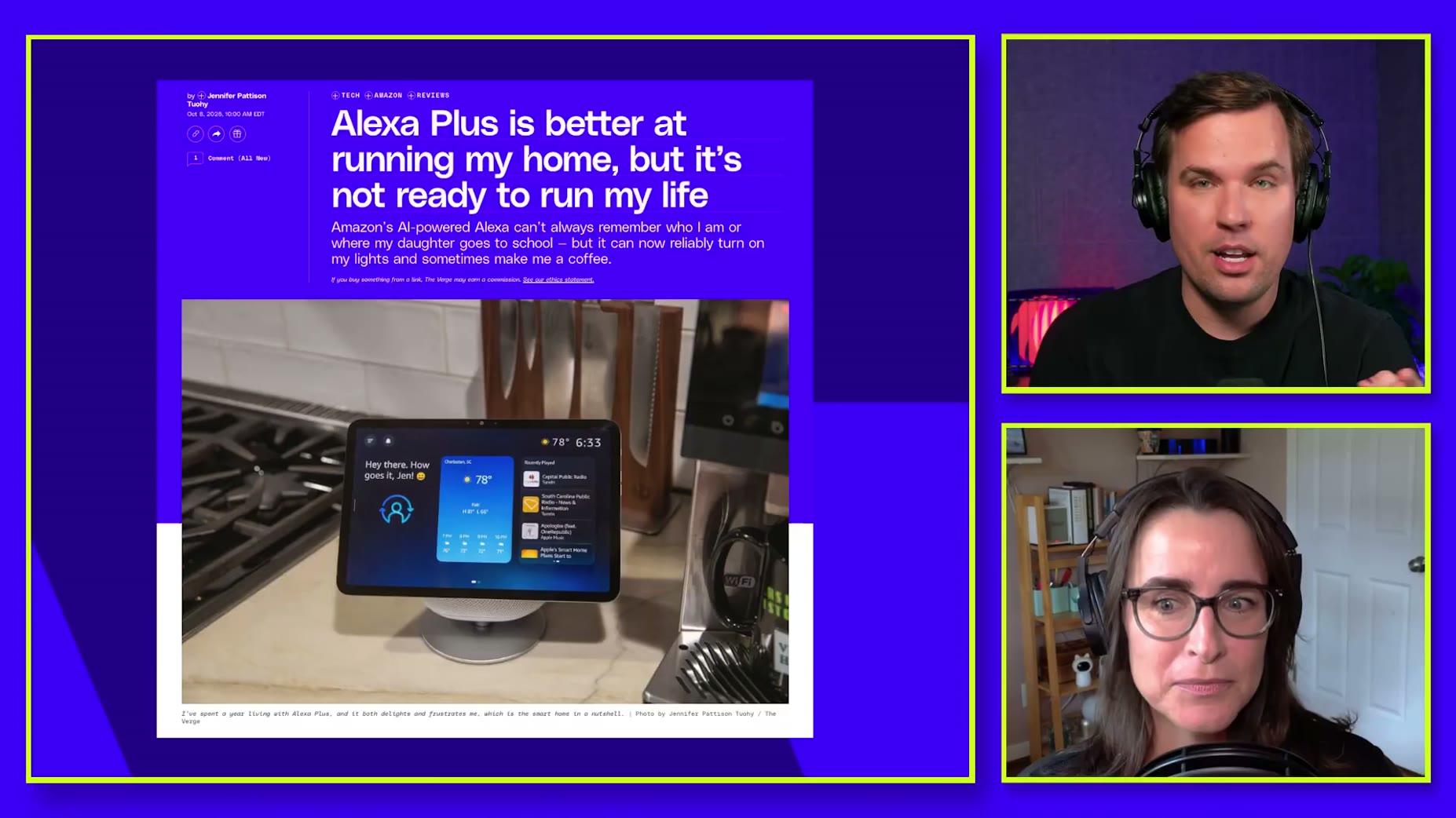
The episode centers on a secondhand discussion of Jennifer Pattison Tuohy's year-long review of Alexa Plus, titled 'Alexa Plus is better at running my home, but it's not ready to run my life' [04:09].
- The 90 Seconds on the Verge news segment reported that ICANN released a batch of 1,600 applications for new top-level domains [00:49].
- The news segment reported that Meta and OpenAI are among companies fighting to own the .agent and .agi domains [01:09].
- The news segment reported new GTA 6 leaks including a gameplay video showing a main character running naked through Vice City [01:40].
- The news segment reported that Rockstar's website lets fans listen to six in-game radio stations and fictional in-game podcasts ahead of GTA 6's release [01:48].
+ 51 more takeaways
- The news segment reported that Joe Rogan and Spotify signed a new podcast deal worth around $250 million [02:03].
- The news segment reported that Amazon was mid-launch on a slew of hardware, including new Kindles, new Ring products, and a new Alexa tablet released that same day [04:05].
- Tuohy's piece concludes that Alexa Plus is better at running the home than at running her personal life [04:20].
- Alexa Plus has been tested for over a year, starting in beta around July and launching properly in February, per the review [06:32].
- Alexa Plus costs $20 a month or is included with a Prime membership [06:38].
- Tuohy says Alexa Plus has not sold her on being a general personal AI agent like ChatGPT, Claude, or Muse [04:58].
- Tuohy says Alexa Plus's attempts to go beyond smart home control are frustrating and often unfinished [05:51].
- As a smart home assistant specifically, Alexa Plus has steadily improved over the past year, according to the review [06:11].
- Amazon's original promise for Alexa Plus was more conversational, syntax-free control of smart home devices [07:01].
- Amazon's original promise also included more complex routines delivered through a simplified interface [07:36].
- Tuohy says Amazon is only halfway to delivering on that more powerful, simplified interface [07:47].
- A host calls being able to set up routines by voice, such as telling an Echo Show to turn on lights and lock the door nightly, a game changer [07:53].
- A host says what they are still missing and hoping for next is deep integration with connected devices, not just on/off control [08:28].
- A host says they can tell the assistant to turn all office lights purple and it works, and to turn lights to a sunset-y glow and it works [08:58].
- A host says they still cannot get the assistant to set their washing machine to the delicate cycle because the integration isn't deep enough [09:10].
- A host says Amazon should stay in the smart home lane and let a separate personal assistant work alongside it [09:43].
- A host noted that Google Home has launched an MCP (Model Context Protocol) integration so users can use Claude to control their Google Home [09:55].
- A host says they often hit roadblocks using Alexa for agentic tasks like ordering from Uber Eats, booking trips, or booking tickets [10:26].
- A host calls Alexa Plus the best smart home voice assistant available today in terms of functionality and understanding intent [11:06].
- A host describes trying and failing to get Alexa to listen for their washing machine's finish noise and alert them, calling connected washing machines made for this purpose expensive and wonky [12:14].
- The hosts say they lock their door only at night and set a routine so that locking the front door automatically turns off the inside and outside lights [13:17].
- A host notes Alexa can be set to listen for a beep, such as a dryer, but this requires placing an Echo device close enough in that room to detect it [13:37].
- New Alexa Plus improvements let users feed it data, such as a daughter's school schedule added to a calendar or a recipe uploaded to a cooking library [14:11].
- With Ring integration, a doorbell ring triggers an alert on the Echo Show smart display [15:19].
- A host notes asking 'Alexa, when did the package get delivered?' pulls up the relevant video and identifies package contents if it's from Amazon [15:33].
- The hosts note that every company's AI business plan involves shopping in some way, citing Mark Zuckerberg's stated goal of capturing a portion of money spent, often at places like Amazon [16:06].
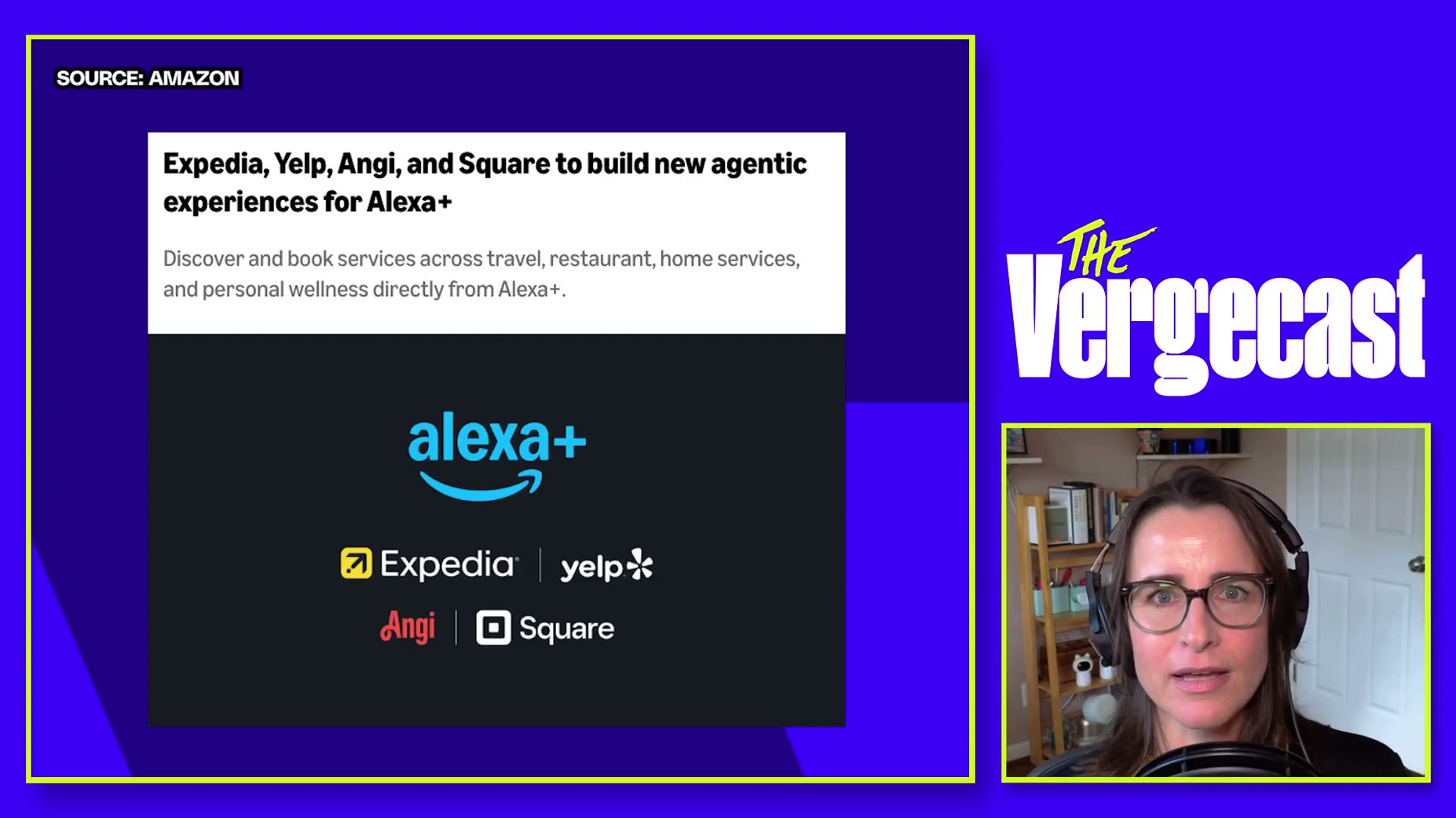
- Since the Alexa+ launch, Amazon promised integrations like Expedia for hotel booking that have not materialized, per an on-screen source citing Expedia, Yelp, Angi, and Square building agentic experiences for Alexa+ [17:04].
- A host describes manually transferring items from an Alexa shopping list to a Harris Teeter shopping app, including trying unsuccessfully to have Claude take a screenshot to help with the transfer [17:23].
- Amazon will fully handle shopping orders only if done through Whole Foods [17:44].
- A host says if everything is locked down into walled gardens for AI, it will be a bad experience for everyone [18:16].
- A host says Amazon's Alexa was originally the open smart home platform and needs to lean back into being an open platform to be useful and successful [18:30].
- A statistic cited in the episode states that in 2026, non-human identities with access outnumber human identities 109 to 1 [19:56].
- The new Amazon Alexa tablet costs $500 and is a full Android tablet, not a Fire tablet [23:39].
- A host says the tablet is designed to be a true iPad competitor, which surprised them from Amazon [23:44].
- A host believes Alexa Plus can, with permission, read your screen, comparing it to Siri or Gemini baked across the operating system [24:50].
- A guest notes tablets are generally companion devices to computers and questions how this one fits into workflows [25:18].
- A host notes Amazon has been early to hardware trends before, doing rings and glasses before they were popular [26:08].
- A speaker argues Alexa Plus, despite its flaws, remains the best and most complete home assistant system due to its plug-and-play, broad compatibility [27:56].
- A speaker says Amazon still struggles with the core question of what people actually want to do with voice assistant technology, despite the new Alexa Plus revision [28:27].
- Reporting cited in the episode suggests an Apple launch event is expected next Tuesday, the 13th, with leaks showing LG-made but Apple-blessed smart home devices resembling a Nest thermostat [29:01].
- A speaker says the biggest thing to watch for is Siri AI for the home, arguing no company has yet created an ideal smart display and that Amazon's Echo Show is currently best in class but still just an interface, not an embodiment of AI [29:46].
- A speaker states the Pixel tablet was the correct idea for a home display and that everyone should be copying it [30:14].
- A speaker predicts Apple's differentiator will be that the interface itself is the AI, deeply embedded into the smart home rather than just a touchscreen [30:22].
- A piece referenced from a couple weeks prior covered how Apple Intelligence's new video description features in HomeKit Secure Video can describe what it sees in the home [31:49].
- A speaker noted leaks from Bloomberg reportedly include a new Apple camera that could capture data without recording video [32:04].
- A host notes that if you feed Apple more data you get better results, but people don't want cameras watching their everyday lives [32:22].
- The hosts compare Apple Home's AI camera privacy trade-off to Gmail, noting the convenience benefit versus the privacy cost [34:36].
- A host notes the new HomeKit Secure Video AI features use the cloud, unlike the old HomeKit Secure Video, which did not [35:07].
- A host says they believe smart home processing will eventually need to run entirely locally rather than in the cloud [35:17].
- A host joked that 'Amazon does not acknowledge the existence of other grocery stores' [17:44].
- A host described Panos as 'the tablet guy' tied to the new Amazon tablet effort [24:11].

How this brief was shaped: Discourse (interview / podcast / video essay) · confidence Low
floor demotion: 'evaluation' 0.58 < 0.65 floor -> classifier fallback 'discourse'. OCR shows a verdict-style headline (Alexa Plus is better at running my home but not ready to run my life) with explicit pros and cons, and the transcript has a host who tested Alexa Plus for a year sharing thoughts on what it can and cannot do, matching an evaluation structure even though it is delivered in two-host podcast banter.
The lens sets this brief's structure, never its facts — every claim is held to the same citation and fact-check standard.