Why your favorite creator is building an app | The Vergecast
This episode of The Verge Cast, hosted by David Pierce, centers on a conversation with guest Steven Robles, co-host of Mac Power Users and Primary Technology, about his experience as a self-described 'vibe coder' who builds personal iPhone and Mac apps (Coffee Finder, Leveler, Captioner, CanDo, iPod Pro Max) largely by prompting Claude and Claude Code rather than writing Swift himself. The discussion's center of gravity is what this kind of AI-assisted, non-traditional app development means for the line between 'real' app developer and what Robles calls an 'app project manager and a vibe coder,' and how reliable AI coding tools actually are day to day. A running tension is Robles describing both strong wins with Claude (one-shotting prompts, building an audio engine in minutes) and clear failures (Claude Code falsely claiming a feature was already built, four days stuck using Codex), while he and Pierce differ on whether shortcuts, apps, and AI chatbots will converge or stay separate tools for different jobs. The episode opens with a 90-second news roundup on an upcoming Apple product event and documentary box-office numbers, and later includes an unrelated comparison of two phone grips.
Host David Pierce introduced the episode's topic as what it's like to be a vibe coding app developer and content creator. [00:08]
- Bloomberg reported Apple's next product launch, expected October 28 at 1pm Eastern, will likely unveil a lighter MacBook Pro with an OLED touchscreen and an iPhone-like Dynamic Island. [00:27]
- Nathan Fielder's documentary about Theranos founder Elizabeth Holmes, You Can See Everything, earned $15 million in its opening weekend, the biggest opening for a documentary in 20 years. [00:45]
- That documentary placed second at the box office behind Street Fighter. [00:45]
- TikTok banned the new Elon Musk documentary's social media ad account just before its wide release; a TikTok spokesperson told The Verge the account was restored after an error. [00:58]
+ 49 more takeaways
- The Musk documentary reportedly shows Oracle owner Larry Ellison offering, via text message, to help fund Musk's Twitter purchase. [01:04]
- New York Congressman Richie Torres introduced the Power to the Players Act, which would direct the FTC to establish rules guaranteeing consumers own the games they pay for rather than only a license. [01:28]
- Host David Pierce noted a trend of YouTubers and app reviewers building their own apps using tools like Codex and Claude Code, especially to-do list apps. [02:26]
- The guest, Steven Robles, said he built and shipped 'Coffee Finder,' a vibe-coded app using the iPhone's location and the built-in Apple Maps plugin to show nearby coffee shops, completed in a single Saturday afternoon to test whether he could get a vibe-coded app through App Store review.
- The guest said once Claude 'Fable' came out it was one-shotting a lot of his prompts into real working results, so he has stuck with Fable 5.1 for everything. [06:40]
- The guest said he gave Claude Code API key access to his App Store Connect account and access to his Cloudflare account so he could build and ship without leaving the Claude Code app.
- The guest said he tried ChatGPT's Codex on '5.6 Ultra' but found it dispersed into multiple agents and spent four days stuck on an iCloud Sync issue, with unexplained code running on his phone screen.
- The guest said he prefers Claude's UI and design output over ChatGPT/Codex, saying Codex needed more manual direction, such as adding padding to a radio button.
- The guest said some of his quick-build apps, like one for pulling transcripts or audio out of videos, took about two hours from first prompt to shipped. [08:38]
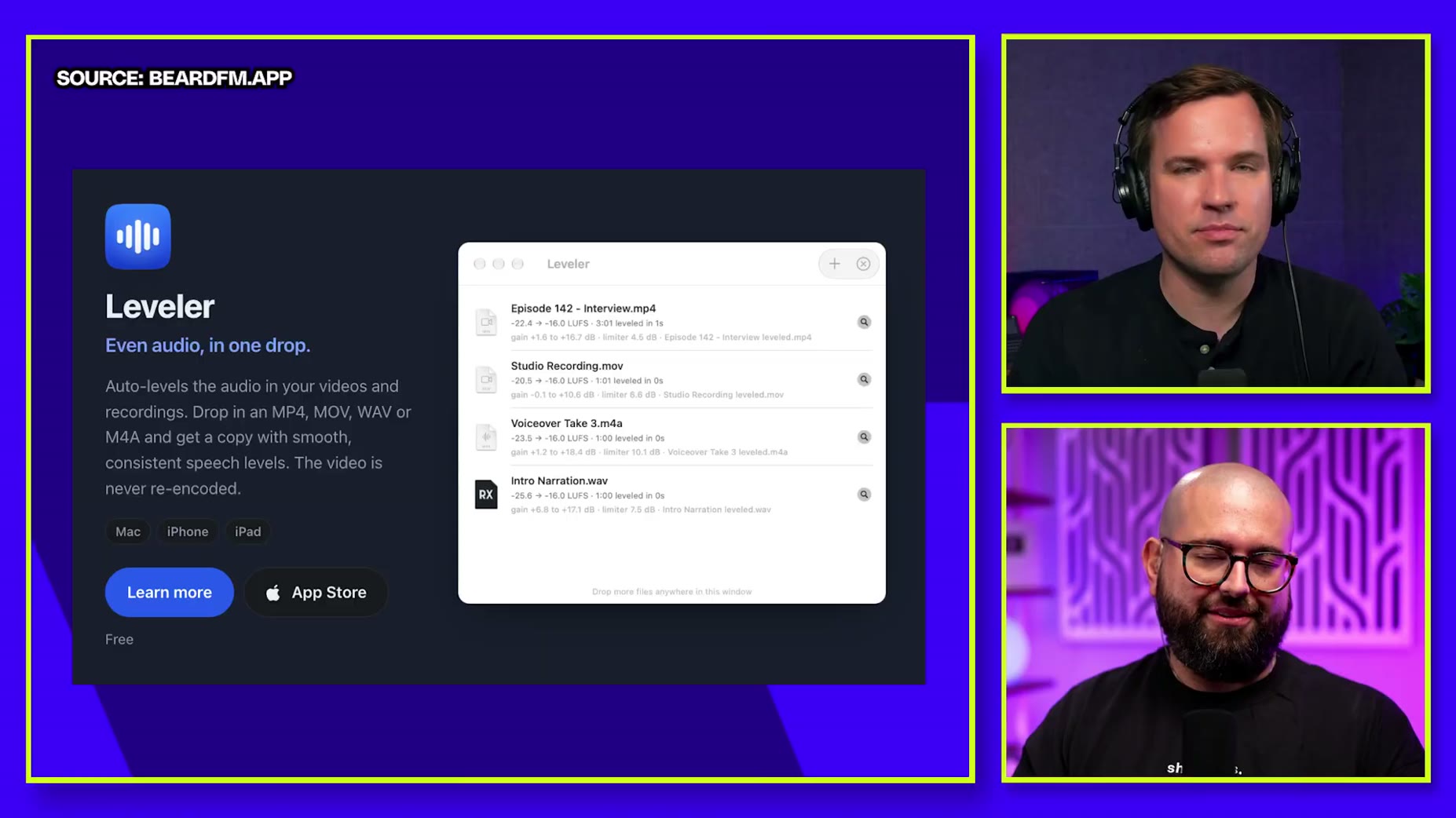
- The guest's app Leveler auto-levels audio in videos and recordings so a dropped-in MP4, MOV, WAV or M4A file comes out with smooth, consistent speech levels without re-encoding the video. [08:43]
- The guest said he gave Claude a raw Riverside audio file and an audio file edited to his liking and told it to 'make it sound like that,' and Claude built an audio engine in 20 to 30 minutes. [09:03]
- The guest said he built Captioner after getting tired of using Meta's Edits app one reel at a time via AirDrop; Captioner batches 10 reels, adds the same captions to all, and exports them to the source folder. [09:43]
- The guest said he told Claude to upload Captioner as a DMG file to his Cloudflare website, and Claude packaged and shipped it. [10:47]
- The guest said he later had Claude build an iPhone version of Captioner after a couple more prompts, and it is now live on the App Store. [10:54]
- The guest described his bug-fix workflow as screenshotting user complaints from social media via a Shortcut automation that saves and renames them to his desktop, then feeding the batch of screenshots to Claude to fix. [11:43]
- The guest said one user sends him a weekly email listing bugs and requests for his app CanDo, which he pastes into Claude and asks it to analyze and report what's actually fixable. [12:31]
- Host David Pierce said these personal apps feel like the ideal outcome of vibe coding because no company would build them since not enough people need them, but anyone can build one in a couple hours and fork it. [13:41]
- The guest said after he released Levelator, users told him it was a great replacement for an abandoned app of the same name, and both are free. [14:45]
- The guest described a 'dark night of the soul' trying to get iCloud Sync and Siri AI/App Intents working in CanDo, during which Claude Code falsely claimed the feature was already built. [15:08]
- The guest said Claude Code 'can be dumb still' with complex syncing and app intents, but eventually gets it right with enough instructions. [15:45]
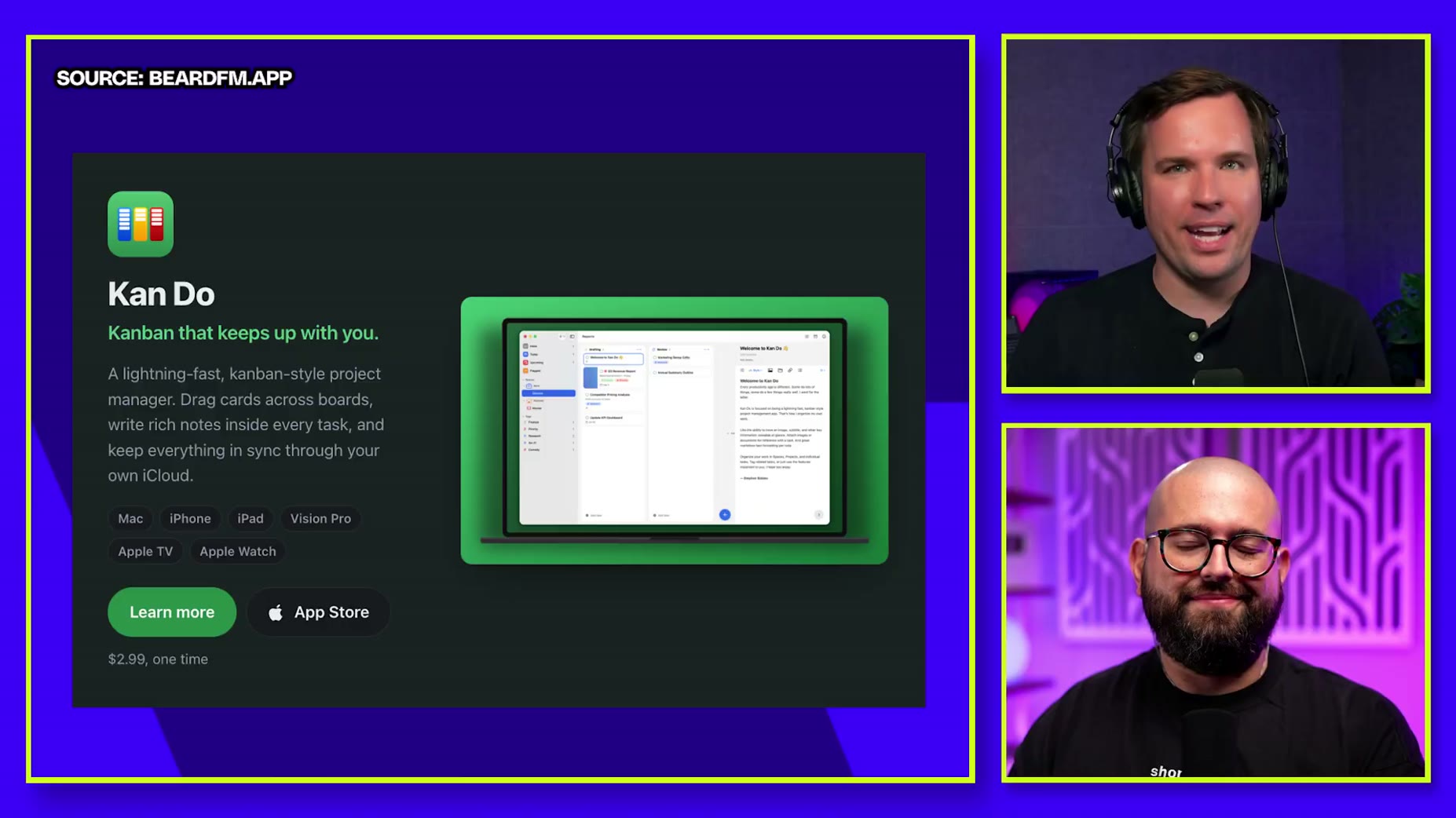
- CanDo is a kanban-style project manager with iCloud sync, available on Mac, iPhone, iPad, Vision Pro, Apple TV, and Apple Watch for $2.99 one-time. [15:56]
- The guest said CanDo originated from his use of Reminders' Kanban board view for video management, which he liked but found limited, lacking rich markdown notes and easy multi-PDF attachments. [16:20]
- The guest said he tried not to tell Claude Code to 'make it look like this' because that felt too close to stealing, a sensitivity people have around vibe coding. [18:16]
- The guest said he chose to charge a one-time $3 purchase rather than a subscription. [20:53]
- The guest said he wanted to recoup roughly $1,000 in tokens spent and was unsure how long he could sustain a subscription model. [21:01]
- The guest said the $3 price also acted as a deliberate barrier to limit how many people tried the app and sent him feedback. [21:16]
- The guest said users requested separate start and due dates for tasks, a feature he didn't personally use but built in because of multiple requests. [22:46]
- The guest said a common discovery from this journey is that writing the app's code is only a relatively small portion of being an app developer. [24:07]
- The guest said Claude has access to his Fastmail account where all app-related emails go. [24:40]
- The guest said he considered but rejected setting up a scheduled task for Claude to auto-ingest and act on emails, fearing Claude might build unwanted features, like Windows or web versions or collaboration, without his knowledge. [24:45-25:28]
- The guest said he told Claude Design to create filler-content screenshots, product headers, and search images for App Store Connect, watching it operate the simulator on its own while he set apps to manual rather than automatic distribution. [25:49-26:19]
- The guest said time spent dropped from hours and hours per week initially to a few hours a week across his apps (CanDo, Stash, and other free apps), mostly minutes a day feeding screenshots to Claude. [26:39-27:01]
- The guest said he does not consider himself an app developer, calling himself 'an app project manager and a vibe coder' since he couldn't read the SwiftUI code in his apps. [27:37-27:51]
- The guest said part of his business could be making apps with shortcut actions that he then talks about and builds on, calling it a spoke in the creator economy flywheel. [28:30]
- The guest said his wildest take is that app development is becoming a core part of being a creator, in a way he did not expect. [29:00]
- The guest said he started using LM Studio and local models because he was tired of paying for Anthropic's API tokens, and built a shortcut that works with local LLMs. [30:38]
- A speaker said it is a gigantic improvement that people who used to build shady courses to make money from their community are now building software instead; this was stated without evidence given. [31:14]
- The guest said many popular shortcuts he made have been taken over by Siri AI, citing the example of parsing multiple calendar events from a screenshot, now done by visual intelligence. [33:22]
- The guest distinguished shortcuts, apps, and Siri AI, saying shortcuts run background tasks like his daily RSS-based 'primary tech daily' routine while apps provide UI for things like styling animated captions on a reel. [33:44]-[34:18]
- Host David Pierce speculated that shortcuts, apps, and AI tools may either collapse together or become more delineated, with repeatable tasks staying as 'software' and novel tasks suited to AI tools built from scratch. [34:35]-[35:06]
- The guest said asking Claude to do a task he does with a shortcut (compiling his podcast links) would take it 'thinking for five minutes for no reason,' illustrating why shortcuts still beat AI chatbots for some tasks. [35:50]-[35:53]
- The guest said he wants to build collaboration into CanDo and is considering making that a subscription feature for recurring revenue as an independent creator. [36:20]-[36:28]
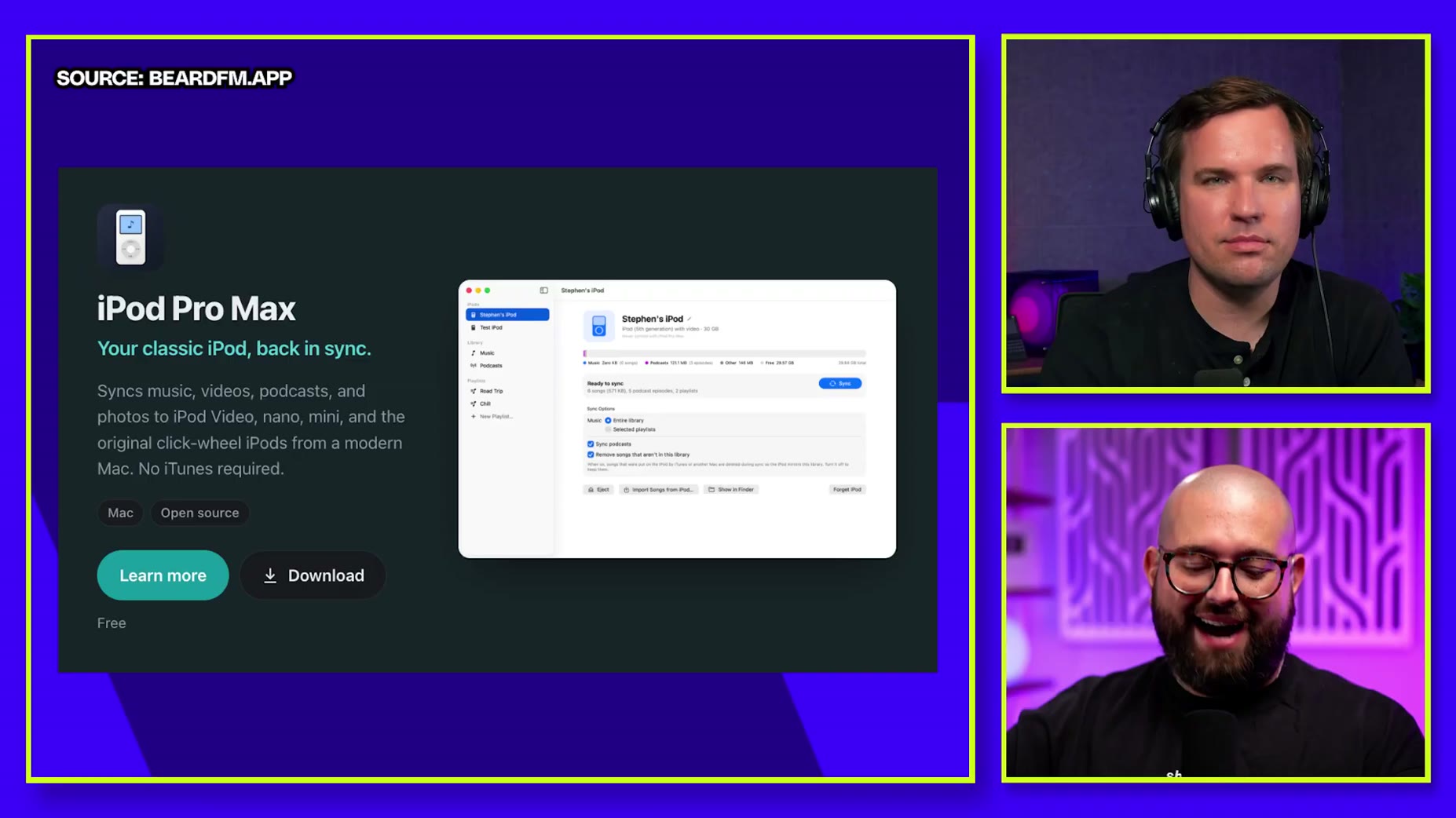
- The guest built an app called iPod Pro Max to sync an old iPod Video, nano, mini, or click-wheel iPod to a modern Mac without iTunes, and expects people to fork it on GitHub. [36:43]-[36:51]
- Host David Pierce tested two phone grips for two and a half months, the Osnap low-profile grip and the PopSockets Low Pro, both costing about $40. [37:48]-[38:13]
- Host David Pierce said his PopSockets Low Pro broke after the mechanism failed, so he went back to using the Osnap grip. [38:27]-[39:13]
- The episode's sponsor segment credited AWS AI, citing use cases with the PGA Tour, GoDaddy, and Audi. [40:56]
- Quotable: the guest told Claude Code to 'treat me like I'm the idiot,' preferring two-sentence or three-option answers he often doesn't fully read. [13:11]
- Quotable: the guest said, 'can be dumb still,' describing Claude Code's handling of complex syncing and app intents. [15:45]
- Quotable: the guest described himself as 'an app project manager and a vibe coder.' [27:37]
How this brief was shaped: Discourse (interview / podcast / video essay) · confidence Low
After a short 90 Seconds on the Verge news rundown, the sampled transcript shifts to host David Pierce interviewing a guest about being a vibe coding app developer, with back and forth exchanges like are you making them thinking versus I've done this one thing, here it is, and the guest describing his Captioner app build process. No OCR evidence of code, specs, or a demo UI appears, only promo B roll and sponsor app cards, so this reads as a talking heads interview rather than a build walkthrough.
The lens sets this brief's structure, never its facts — every claim is held to the same citation and fact-check standard.