
I Tested Claude Motion vs. Claude Code for Motion Design
The video compares Claude Motion against the narrator's own custom Claude Code video-editing system, giving both tools identical prompts for an explainer, a promo, and a face-and-voice reel. The comparison turns on speed, default style quality, ease of post-build editing, plan availability and cost, and audio handling, with Claude Motion needing a Team or Enterprise plan and running 10 to 30 minutes per video versus the Claude Code system running about 4 minutes per video once built but requiring months of setup. The creator calls round one (the explainer) a win for Claude Motion and round two (the promo) a tie, then splits the overall pick by use case rather than naming a single winner: Claude Motion for quick graphics like title cards and short explainers, and a Claude Code system for full reels, especially ones involving voice and face.
Options: Claude Motion, Anthropic's new /motion feature [01:21]
- Options: the narrator's own custom Claude Code video-editing system, built in his 'Lux/Luxe' visual style [04:04]
- Criteria: speed, default style quality, ease of editing, plan availability and cost, and audio handling, as compared by the creator
- Test: both tools were given the same written prompt for a 30 second explainer teaching beginners what a Claude Code skill is, ending on 'write it once, use it forever' [03:59]
- Round 1 (explainer) result: Claude Motion wins, its output read 'Write it once. Use it forever.' and taught the idea better, while the Claude Code system's output came out dark and empty because its rules were built for face videos, not explainers [05:37]
+ 34 more takeaways
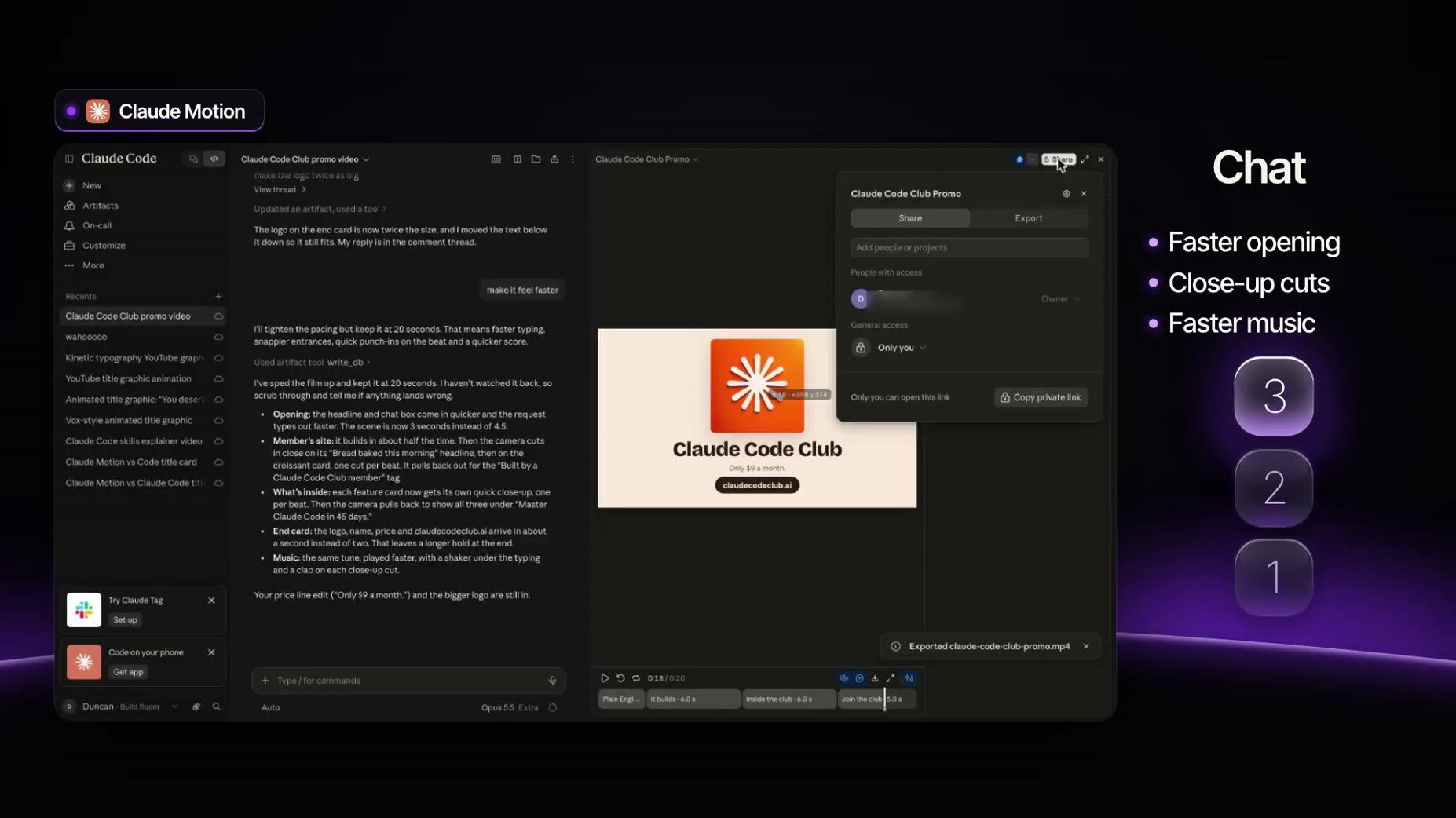
- Test: both tools were given the same prompt for a 20 second promo for the Claude Code Club using an attached logo, website screenshot, and orange brand color [05:59]
- Claude Motion vs Claude Code system on speed (promo): Claude Motion took about 30 minutes [06:21]
- Claude Motion vs Claude Code system on speed (promo): the Claude Code system took about four and a half minutes [06:23]
- Claude Motion vs Claude Code system on style (promo): Claude Motion's text was small, the frame mostly empty cream, with price shown only in tiny letters at the end [06:21]
- Claude Motion vs Claude Code system on style (promo): the Claude Code system gave every selling point its own scene, including 45 days counting up on screen and a big dedicated card for $9 a month [06:23]
- Round 2 (promo) verdict: a tie, the creator says his Claude Code system made the better ad but Claude Motion had the better idea and easier editing [07:45]
- Claude Motion on editing ease: a Tweaks panel applies word, length, and speed edits instantly [06:44]
- Claude Motion on editing ease: comments placed on elements made the logo twice as big in about 40 seconds [06:44]
- Claude Motion on editing ease: a chat request to 'make it feel faster' took about 4 minutes and returned a listed set of changes [06:44]
- Claude Code system on editing ease: has no buttons, edits are made by typing a single request that Claude turns into code [07:39]
- Claude Motion on audio: video clips are always silent with no way to re-enable sound, including in the export [08:07]
- Claude Motion on audio: getting voice back into a 9 second clip took about 25 minutes and three fixes, which the creator calls 'a workaround, not a button' [08:25]
- Reel test: a reel made entirely by the narrator's Claude Code system has had over 60,000 views across Facebook, YouTube, and TikTok [08:37]
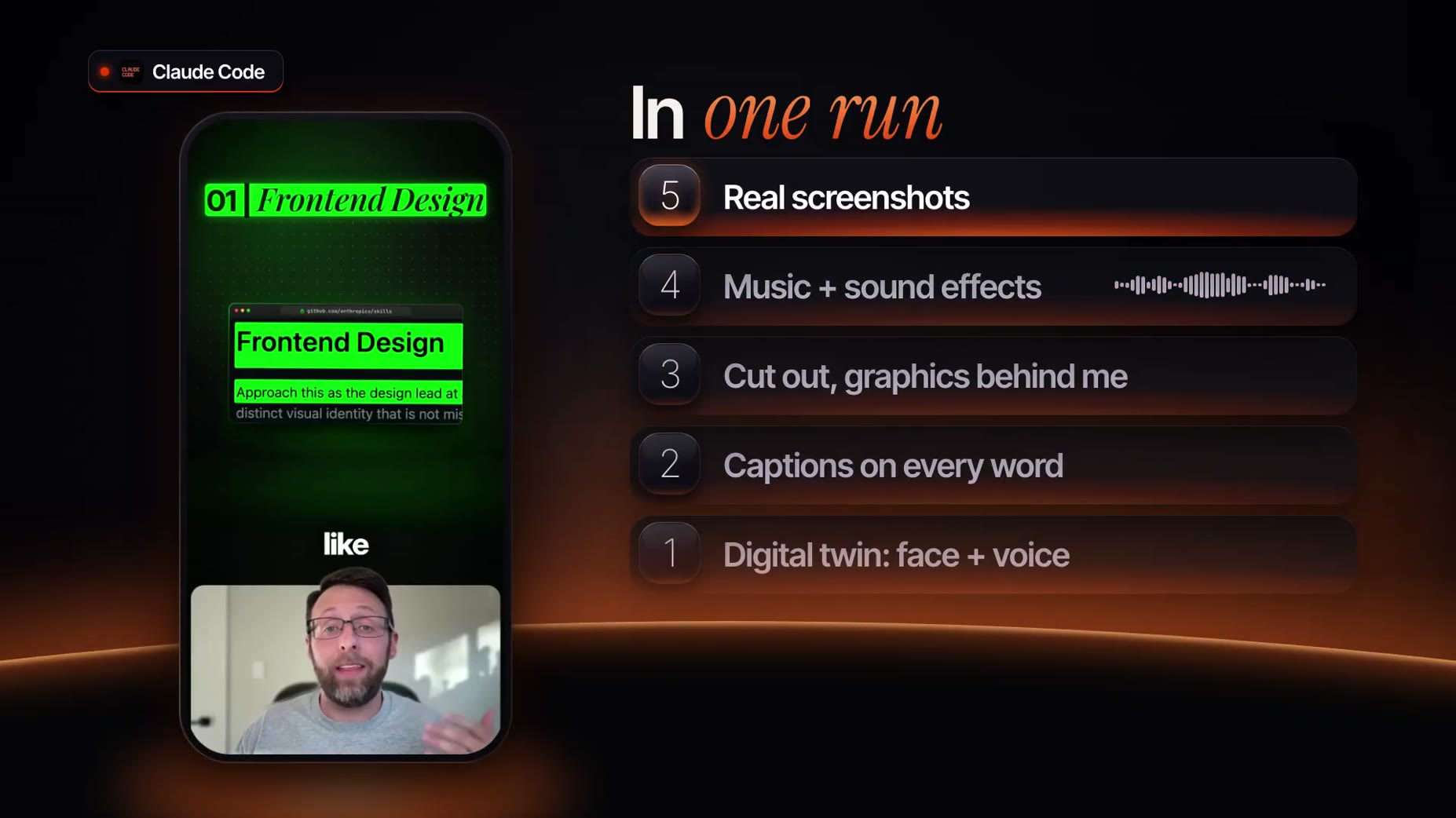
- Reel test: that Claude Code system produced a digital twin with the narrator's face and voice, word-timed captions, graphics behind him, music, sound effects, and real screenshots, then posted a different caption per platform [08:47]
- Reel test: not compared, Claude Motion was not run through this face-and-voice reel test [08:37]
- Claude Motion plan: only available on Team or Enterprise plans, not Pro or Max, so the presenter bought a Team plan just to test it [01:50]
- Claude Motion plan: no extra charge per video but usage counts against plan limits, and the presenter hit his session limit halfway through testing [02:05]
- For Pro or Max plan users, the creator states Claude Code is the only way to do any of this right now [10:10]
- Claude Motion's standout strength: nothing to set up, it asks smart clarifying questions, and it can match almost any style from one screenshot [09:12]
- Claude Motion strength: because the video is code, you can change one word in a finished video without remaking the whole thing [01:41]
- Claude Motion style test: produced a Vox-style look with cutout photos, torn paper, and yellow highlighter [00:49]
- Claude Motion style test: produced a flat illustration style with big bold shapes and warm colors, which the creator called 'a little plain' on the first try [00:55]
- Claude Motion style test: produced a retro poster-letter style with Bauhaus shapes drawing its own letters, and a futuristic style with sci-fi readouts and a melting chrome blob [01:03]
- Claude Motion's biggest weakness: slow at 10 to 30 minutes per video [09:23]
- Claude Motion weakness: first tries are often plain [09:23]
- Claude Code system's standout strength: once built it's fast, about four minutes per video [09:31]
- Claude Code system strength: every video looks like him [09:31]
- Claude Code system strength: it handles face, voice, and captions on any plan [09:31]
- Claude Code system weakness: it took months to build [09:41]
- Claude Code system weakness: it only knows one look well [09:41]
- Best for: Claude Motion is best for graphics around a video, like title cards, overlays, charts, and short explainers [09:51]
- Best for: a Claude Code system is recommended for the whole reel start to finish, especially when voice and face are involved [09:56]
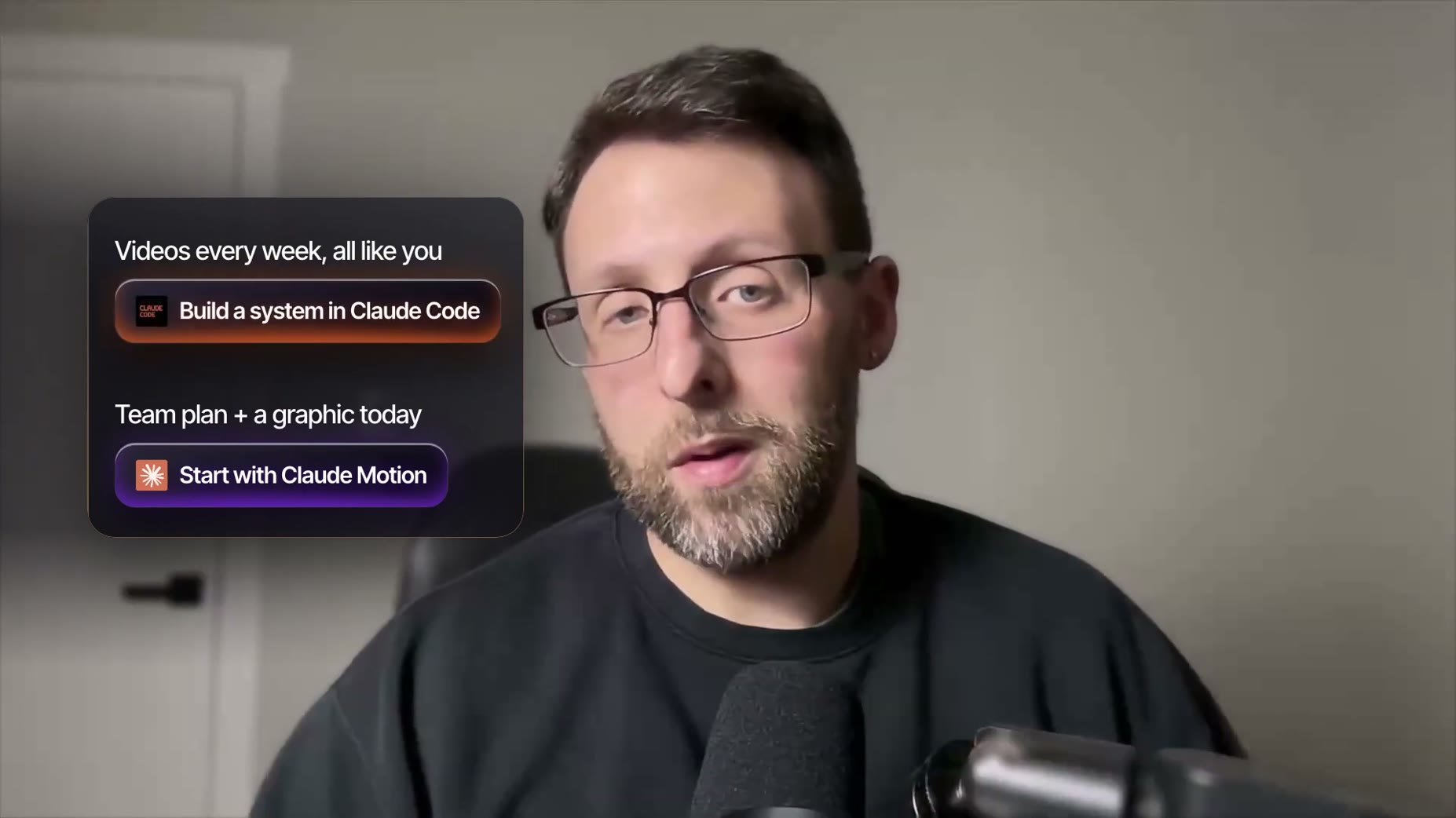
- It depends: if you're on a team plan and need a graphic today, start with Claude Motion, but if you make videos every week and want them to all look like you, build a system in Claude Code [10:01]
- Note: the creator promotes the Claude Code Club, his paid community, costing $9 a month with over 8,000 builders, aimed at mastering Claude Code in 45 days [10:18]
Make a thirty-second explainer video that teaches beginners what a Claude Code skill is. Show one example: a skill that turns a YouTube video into a LinkedIn post. Use simple words and big text. End on the line: write it once, use it forever.
Make a 20-second 16:9 promo video for the Claude Code Club. It's an online community where people learn to build real things with Claude Code, even if they have never coded. Inside, you get a step-by-step classroom, ready-made skills you Claude Code in 45 days. It costs $9 a month. Use the attached logo and the attached screenshot of a website. The brand colour is orange. End on the logo and "claudecodeclub.ai".
Create a 6-second, 16:9 (1920x1080, 30fps) animated YouTube title card that reads "CLAUDE MOTION vs CLAUDE CODE"
OVERALL STYLE
- Huge, ultra-condensed, ultra-heavy black display type that fills most of the frame and is the hero of the composition.
- A single glossy-but-fuzzy 3D tube (think a thick cobalt-blue foam pipe with a fine flocked, sugar-crystal surface texture and soft subsurface highlights) snakes in big S-curves through the whole frame.
- Small chunky 3D "sticker" objects with thick black outlines and flat cel-shading float around the words in the midground, bobbing and rotating gently.
- Tube: saturated cobalt #1E7BE6 with highlights #6FB4FF and shadows #0B4FB0.
PALETTE (use only these colours)
- Poster red #E8442E
- Cream #FAF6E8
- Bauhaus yellow #F6EC7A
- Muted blue #6A7FB9
- Ink black #2B2A2C
TYPEFACES
- Line 1 ("MONTHS OF BUILDING."): an ultra-condensed, all-caps display sans with very tall, narrow letters, straight vertical stems and tight rounded corners (e.g. Six Caps or League Gothic, condensed further with horizontal scale ~70%). It is used in two treatments: SOLID (cream fill) and OUTLINE (no fill, 3px cream stroke).
- Line 2 ("OR ONE BUTTON?"): a heavy geometric stencil display face with circular counters split by visible stencil bridges and blunt rounded terminals (e.g. Big Shoulders Stencil Display Black, or a similar geometric stencil). All caps, black or cream depending on the ground.Create a 6-second, 16:9 (1920x1080, 30fps) animated title card for a YouTube video. PALETTE [...] - Motion accent: terracotta #D9774B, with a lighter peach #F2B48C for highlights. - "Claude Code": a monospaced face such as JetBrains Mono or IBM Plex Mono, medium weight, same visual height as the serif. BEAT-BY-BEAT 0.80-2.20s: "Claude Motion" flows in. 1.40-2.80s: "Claude Code" is typed in (overlapping the previous beat). MOTION PRINCIPLES - Motion side: springs, overshoot, organic curves, nothing linear. - Code side: linear timing, hard cuts, frame-precise snaps, no easing on characters.
How this brief was shaped: Comparison / Buyer Guide · confidence Medium
Transcript explicitly frames a head to head test of Claude Motion against the narrator's own Claude Code system using the exact same prompts for an explainer, a promo, and a face and voice reel, closing with which tool wins for each video type. OCR shows dense verbatim prompt text for specific styles like the Vox look, which supports the comparison but is secondary to the stated goal of declaring a winner per use case.
The lens sets this brief's structure, never its facts — every claim is held to the same citation and fact-check standard.