
Something Hidden in Our Galaxy Has Been Emitting Radio Waves for 20 Years
This video explains the mystery of a radio source in the Milky Way, first spotted by the Very Large Array (VLA) in October 2017 and cataloged as VT J1906+0849 (named VTG1906+0849 at first mention), which brightened by at least a factor of six since a 1996 survey and has stayed radio-bright with no X-ray signal for over 20 years. It walks through the instruments and data used to study it, including NASA's Swift X-ray telescope, the Very Long Baseline Array (VLBA), the CACA Observatory, Keck Observatory, VLASS, ASKAP, and MeerKAT, and the theories ruled out along the way (supernova, flare star, nova, pulsar wind nebula), before presenting the study's leading hypothesis that it is a young galactic microquasar, a black hole or neutron star feeding on a companion star and confined by ram-pressure from its own disk wind. There are no prerequisites, accounts, installs, or code involved; it is a narration-driven explainer that ends without a confirmed answer, pending future X-ray follow-up observations.
Goal: A study discussed by Jesse Miller (Caltech) investigates why a persistent, unexplained radio source defies conventional explanation. [01:51]
- Discovery: In October 2017, astronomers using the Very Large Array (VLA) spotted an unexpected bright radio signal, now called VTG1906+0849. [00:27]
- Step: The source was invisible in a 1996 radio survey but appeared in radio images from 2005 and 2017. [00:49]
- Finding: Comparing radio surveys back to 1996, scientists found the source brightened by at least a factor of six. [00:56]
- Early theories: Researchers initially suspected a typical cosmic explosion, a flare, a supernova, or a pulsar. [01:17]
+ 32 more takeaways
- Timeline: The object has emitted radio signals since at least 2005, peaked in brightness in 2014, faded slightly, then brightened again in late 2025. [01:36]
- Finding: The object has actively beamed radio energy for at least 20 years. [01:51]
- Mystery: The object is completely invisible in X-rays, which is unusual since powerful radio emissions typically come from electrons accelerated near light speed around a dense object like a black hole, neutron star, or white dwarf. [02:15]
- Step: Scientists pointed NASA's Swift X-ray telescope at the object to check for X-ray emissions. [03:05]
- Result: Swift's observations showed complete X-ray silence, with only radio waves visible. [03:05]
- Finding: The object sits off the decades-old correlation charts astronomers use to compare X-ray and radio emissions in X-ray binaries. [03:20]
- Finding: Unlike a typical supernova, this object refuses to expand. [03:35]
- Measurement: The Very Long Baseline Array (VLBA), a network of telescopes forming a virtual telescope thousands of kilometers across, measured the object as very compact, at most a few astronomical units across, about the size of a solar system. [03:41]
- Measurement: The CACA Observatory in Hawaii measured gas inside the object moving at approximately 2,000 km per second, about 4.5 million miles per hour. [04:07]
- Finding: Images taken 15 years apart show the radio source expanded at less than 1 km per second, essentially standing still, despite the fast internal gas motion. [04:40]
- Location: By analyzing how cold interstellar hydrogen gas absorbs radio waves, astronomers placed VT J1906+0849 inside the Milky Way's warped outer disk, 49,000 to 104,000 light years away. [05:22]
- Finding: The object's radio brightness temperature is estimated between 100 million and 10 billion Kelvin, ruling out thermal processes and instead resembling synchrotron radiation from high energy electrons spiraling around a magnetic field at relativistic speeds. [05:42]
- Theory ruled out: A binary or flare star was excluded because the object is a million to a billion times more luminous than a typical stellar flare and does not produce X-rays like a binary would. [06:50]
- Theory ruled out: A nova explosion was ruled out because stellar novae fade within months or years with expanding gas and specific chemical lines, whereas this object stayed bright for 20 years with only one simple spectral line. [06:59]
- Theory ruled out: A pulsar wind nebula like the Crab Nebula was considered but ruled out because classic pulsar nebulae evolve over thousands of years without a rapidly changing radio spectrum, and pulsars usually produce at least some X-rays. [07:31]
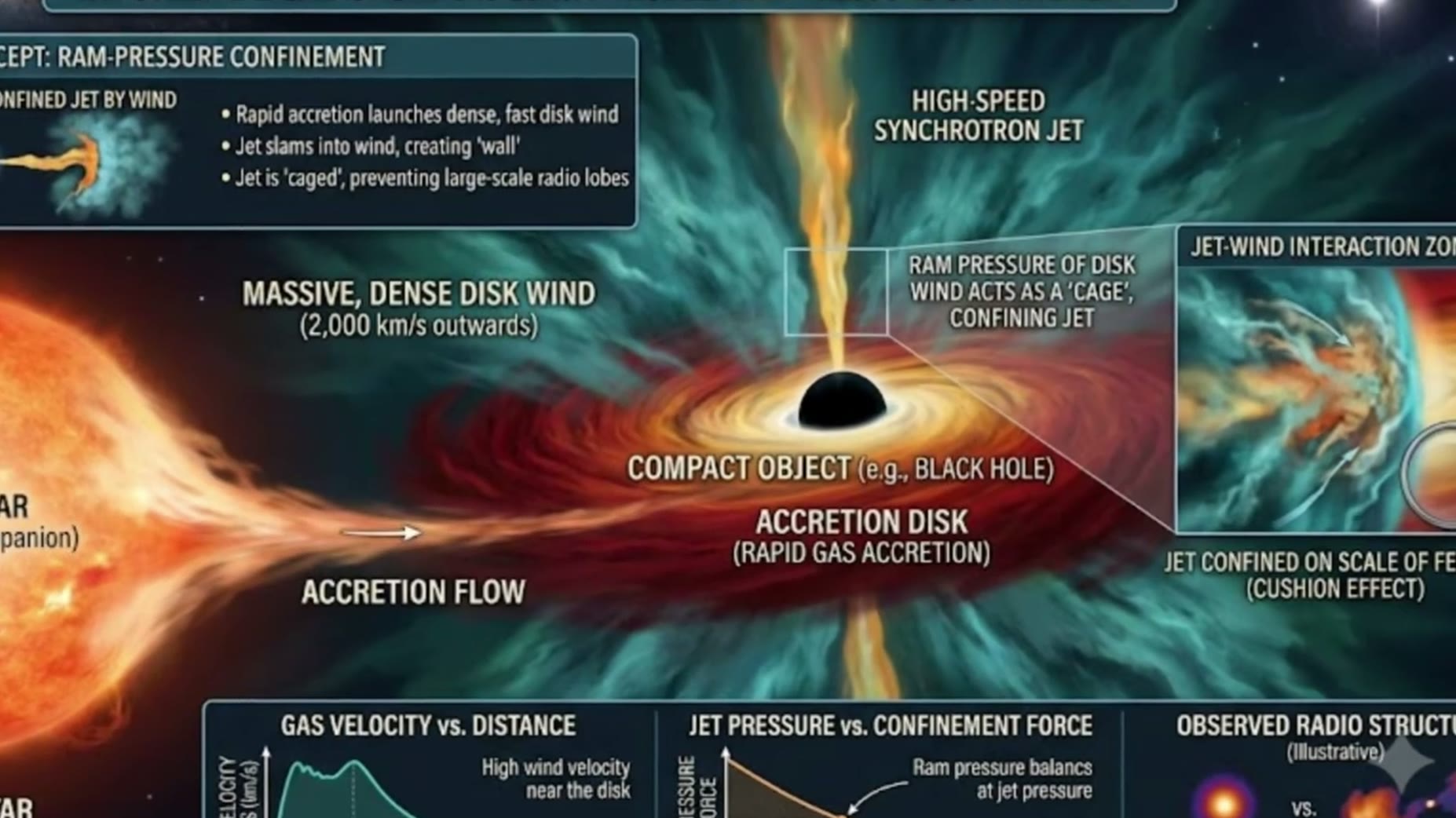
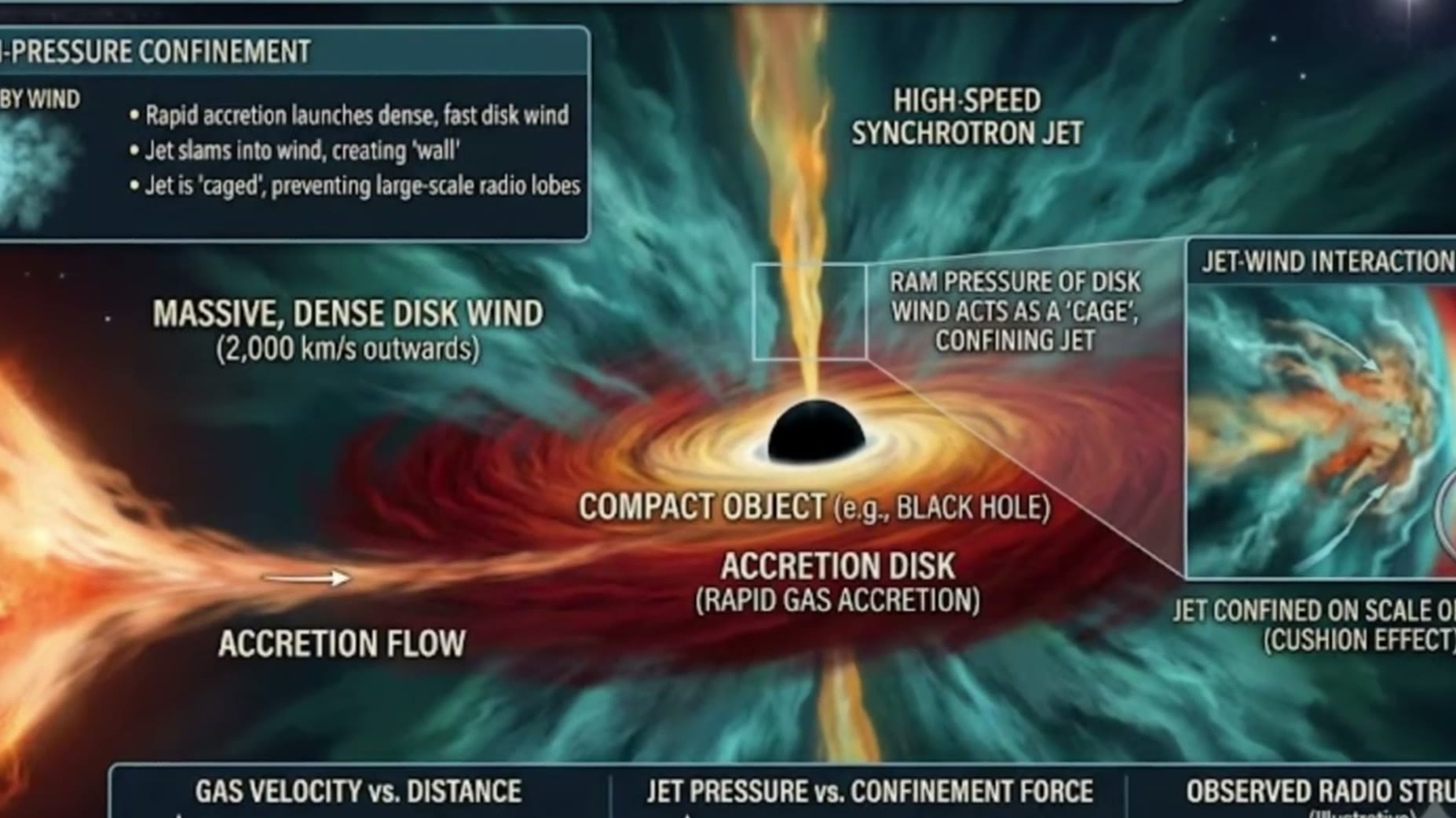
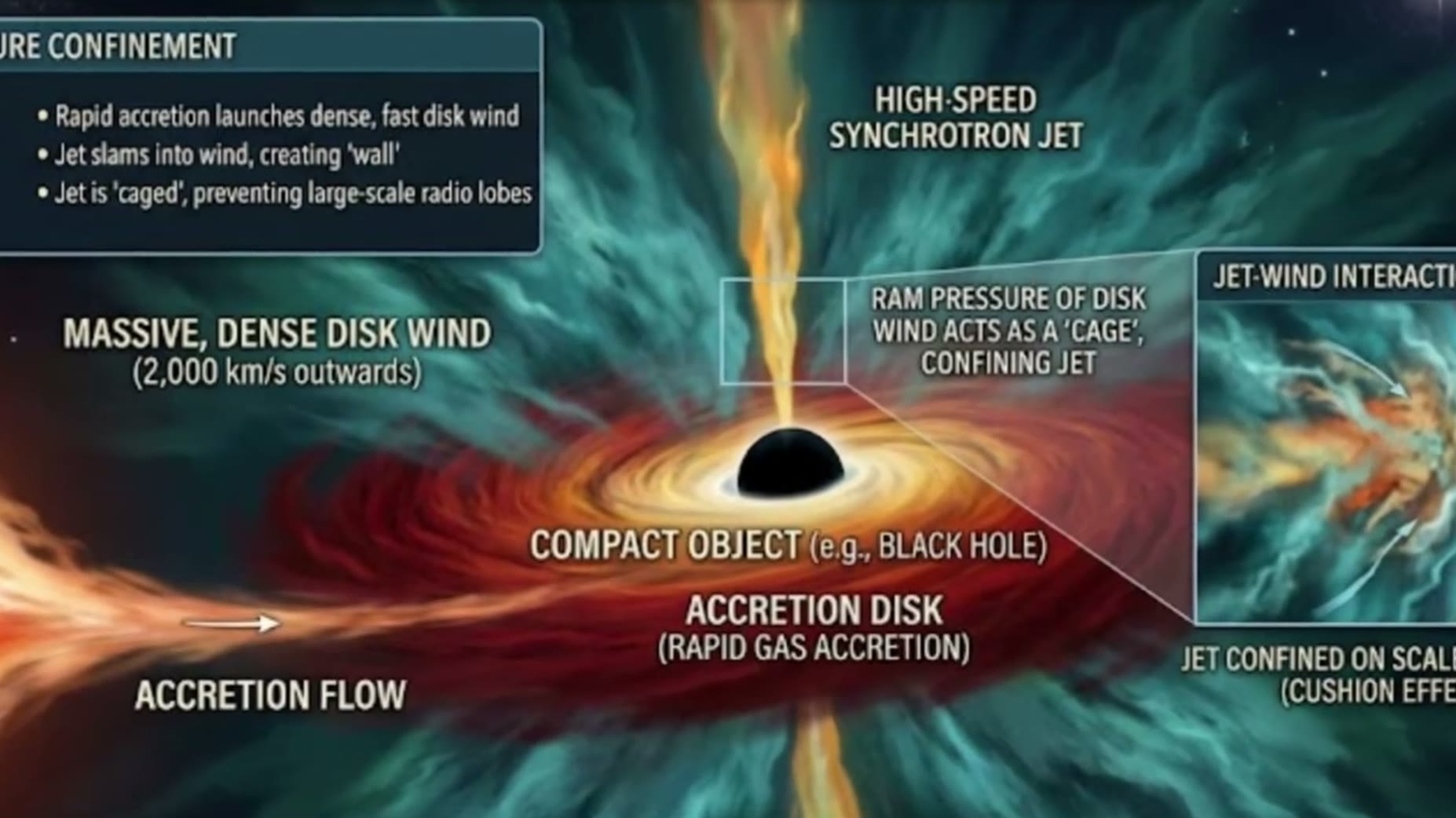
- Leading hypothesis: The study's authors propose the object is a young galactic microquasar, a binary system where a black hole or neutron star feeds on a companion star's mass via an accretion disk. [08:21]
- Mechanism: As gas falls into the accretion disk, strong magnetic fields launch a narrow high-speed jet in two directions. [08:39]
- Mechanism: The compact object accretes gas so rapidly that the accretion disk launches dense disk winds outward at 2,000 km per second, and the jet slamming into this wind confines the radio-emitting jet to a scale of just a few astronomical units via ram-pressure confinement. [08:58]
- Mechanism: Even though the disk wind moves at 2,000 km per second, the jet itself stays trapped inside this wind 'cushion,' which explains why the radio signal does not expand over time. [09:14]
- Observation: Keck Observatory detected a single blue-shifted infrared hydrogen line, likely from a lopsided or asymmetric wind. [09:30]
- Finding: Only one side of this wind appears to blow directly at us at very high velocities, while the other side is hidden. [09:40]
- Hypothesis: The central engine near the black hole or neutron star, where X-rays are generated, seems shrouded by a dense stellar wind layer, explaining the missing X-rays. [09:53]
- Hypothesis: Soft X-rays are likely still present but absorbed by gas before reaching telescopes, while radio waves generated farther away escape more easily. [10:10]
- Comparison: The object is compared to SS 433, called the most famous microquasar, with scientists suggesting this could be a younger, smaller sibling of that type of object. [10:26]
- Instruments: The study used the VLASS (Very Large Array Sky Survey) telescope along with ASKAP in Australia and MeerKAT in South Africa, part of a new generation of surveys revealing long period radio transients. [11:14]
- Context: Some unusual pulsating radio objects with timescales of minutes to hours have been explained as exotic magnetic white dwarfs (white dwarf pulsars), but most remain unexplained. [11:59]
- Summary: Piecing together the discovery required radio data from VLA and VLBA, infrared spectroscopy from Keck, and X-ray observations from the Swift telescope. [13:08]
- Next steps: Astronomers need follow-up observations and might have to wait a few more years for the object to change again before confirming the find. [13:30]
- Decision point: If X-rays are detected from the object, it means it was a young microquasar after all. [13:39]
- Decision point: If X-rays are not detected, the object could be a completely new type of cosmic object never seen before. [13:45]
- Closing: The presenter says this case shows there is still a lot to discover in astronomy, with many mysteries hiding in plain sight. [13:51]
- Reference: The presenter points viewers to a study linked in the description and previous related videos for more detail. [14:02]
How this brief was shaped: Deep-Dive (coding / tutorial / how-to) · confidence Medium
Single narrator systematically unpacks a specific astrophysical mystery (VTG1906+0849) using VLA and VLBA observation data, brightening factors, and size measurements, with no course context and no real contested personal thesis. OCR shows a detailed mechanism diagram labeled KEY CONCEPT: RAM-PRESSURE CONFINEMENT explaining jet-wind physics step by step, matching a comprehensive-explanation spine.
The lens sets this brief's structure, never its facts — every claim is held to the same citation and fact-check standard.