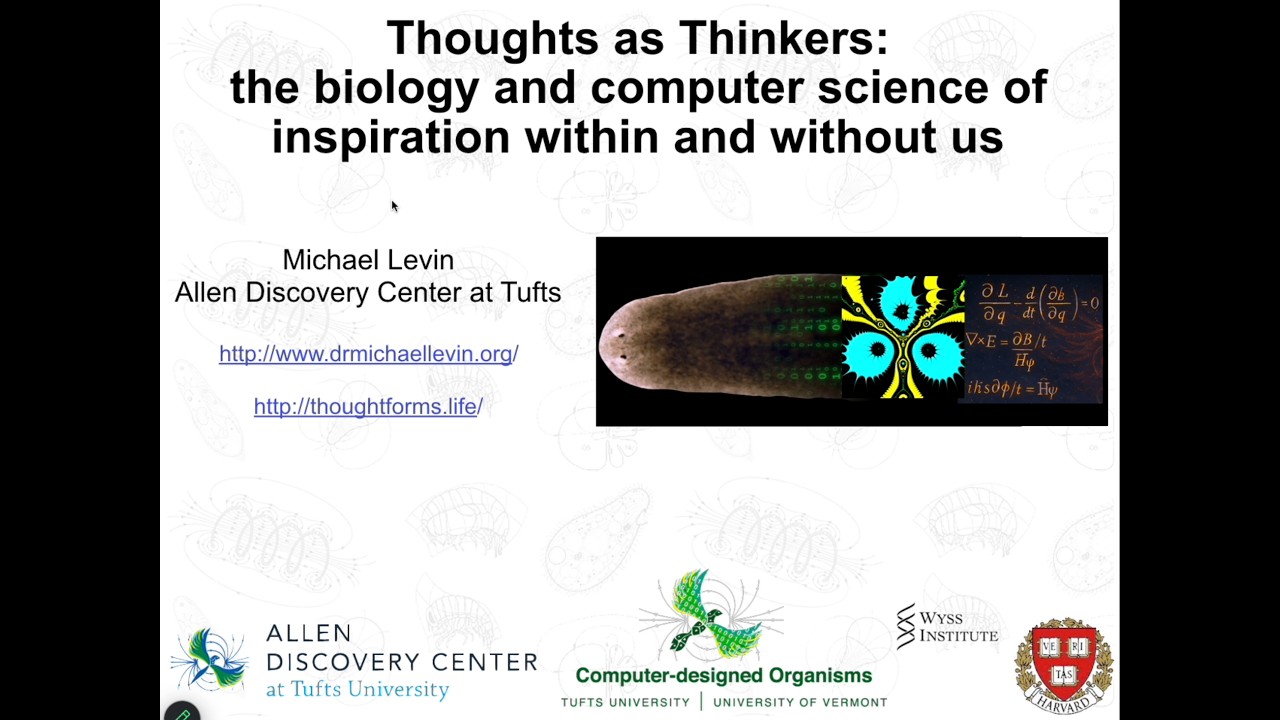
Thoughts as Thinkers: biology & computer science of inspiration within & without us by Michael Levin
This video is a presentation by guest Michael Levin, of the Allen Discovery Center at Tufts, delivered alongside host Chris, on where cognitive-like competencies come from in novel biological and synthetic beings. Levin's central thesis is that the three conventional explanations for competency, design, evolutionary selection, and learned training, fail to predict or explain the problem-solving abilities he documents in systems such as xenobots, anthrobots, chemical networks, and even sorting algorithms, and he argues these patterns should be treated as navigable policies in an ordered latent space rather than dismissed as unexplained emergence. The extracted material is built almost entirely around Levin's own examples and framework, and does not capture Chris offering a counter-position, so no explicit disagreement between the two speakers is documented.
Levin argued that the three conventional ways of paying for competencies, design, selection, and training, do not predict or explain the competencies he observes and fail to suggest the needed research programs. [01:00]
- Levin framed behavioral and biological patterns as policies for navigating spaces beyond ordinary 3D behavior, including anatomical morphospace, physiological state space, gene expression space, metabolic space, and linguistic space. [00:42]
- Levin described a spectrum of unexplained order running from emergence at the low end, through unexpected problem-solving competencies at the medium level, to inspiration at the high end. [01:28]
- Levin predicted the next decade will blur the distinctions between living things, machines, humans, and robots, with people needing to understand minds that have different Umwelts and sensors. [02:19]
- Levin recounted that poet Ruth Stone described inspiration as a thunderous train of air she had to outrun to paper, catching poems by the tail and writing them backward if she succeeded, an anecdote offered without further evidence. [03:34]
+ 47 more takeaways
- Levin recounted that Michael Jackson reportedly said that if he did not immediately record a musical idea, God would give it to Prince instead, an anecdote offered without further evidence. [04:20]
- Levin defined "degree of free lunch" as a system's competency minus the effort put into it via design, evolution, or training. [04:40]
- Levin noted that Darwin and Paley agreed order is rare and requires extraordinary effort, even though they disagreed on whether the source was natural selection or design by God. [05:21]
- Levin cited Stu Kaufman's work in the 1990s on why random networks have interesting order properties for free. [05:46]
- Levin quoted Valentino Braitenberg's claim in Vehicles that there is nothing in his simple robotic vehicles that was not put in by the builders, and argued this is a wrong assumption rather than a demonstrated result. [06:09]
- Levin said standard neuroscience predicts that drastically reducing human brain tissue should cause drastically reduced performance. [06:52]
- Levin cited a reviewed paper documenting rare clinical cases where most brain tissue is missing yet the patient has normal or above-normal IQ, which he said reveals a gap in understanding neural real estate versus functionality. [07:17]
- Levin described Blackiston's design of a tadpole with an eye on its tail that sees without connecting to the brain and without triggering cell death. [07:47]
- Levin said the ectopic tail eye works zero-shot with no lengthy adaptation needed, with the optic nerve stopping somewhere such as the spinal cord or gut without reaching the brain. [08:22]
- Levin said tadpoles with the ectopic tail eye can be trained on visual cues and can see out of that eye. [08:44]
- Levin said putting a turtle on a skateboard unlocked playful, cat-like speed behavior, with the turtle keeping up with a cat. [09:34]
- Levin posed designing a chemical network that learns from experience and increases its Phi, or causal emergence, when learning, without losing those gains when forced to forget. [10:22]
- Levin said many molecular networks, modeled as coupled ordinary differential equations, can learn via roughly six behavioral paradigms, including associative or Pavlovian conditioning. [11:22]
- Levin said forcing these networks to forget does not reduce causal emergence, creating an asymmetric ratchet in which learning raises integration permanently. [11:54]
- Levin said this creates a positive feedback loop between learning and integration pointing toward higher agency and intelligence, occurring even in random, undesigned networks. [12:15]
- Levin said random networks, not designed or selected by anyone, already show this ratchet property and are close to optimal for it. [12:25]
- Levin argued the properties of this ratchet are a free gift from mathematics, not from physics or a history of biological selection, and precede replication and Darwinian processes. [13:09]
- Levin posed a thought experiment: build an autonomous, motile, neuron-free organism that can self-copy from environmental cells and has hearing, using only wild-type frog cells with no genetic modification or synthetic biology. [14:28]
- Levin said almost no bioengineering was needed; freeing skin (epithelial) cells from a frog embryo produces a xenobot that collects loose epithelial cells into balls, which become the next generation of xenobots, work he credited to Douglas Blackiston. [15:09]
- Levin said xenobot cells express many genes differently than in the embryo, including hearing-related genes, and respond to sounds played from a speaker placed under the dish. [15:53]
- Levin said that without adding any memory circuit or sensory machinery, xenobots already have learning capacity and can form at least two different kinds of chemical-experience memories, retained for at least 24 hours. [16:14]
- Levin said that to make xenobots swim in more complex patterns, researchers shoved neural cells into them, which formed some kind of nervous system and produced more complex swimming patterns. [17:00]
- Levin said liberating adult human tracheal epithelial cells, rather than embryonic cells, causes them to form a similar motile creature on their own. [18:08]
- Levin said the resulting creature has a wild-type human genome, so sequencing it shows nothing but normal human DNA. [18:19]
- Levin said Gizem Gumuskaya's Anthrobots, placed on a scratched layer of neurons, formed a "super bot cluster" that began healing the neurons across the gap, visible four days later. [18:25]
- Levin said there had never been any Xenobot before and no creature has ever been selected for kinematic self-replication. [19:18]
- Levin showed an 83-day-old Xenobot turning into something unidentified, compared to a week-old Xenobot. [19:28]
- Levin said reverse-engineering the Xenobot transcriptome to infer the environment that would produce those gene expressions points to a world that is not this one, a claim offered without further evidence. [19:44]
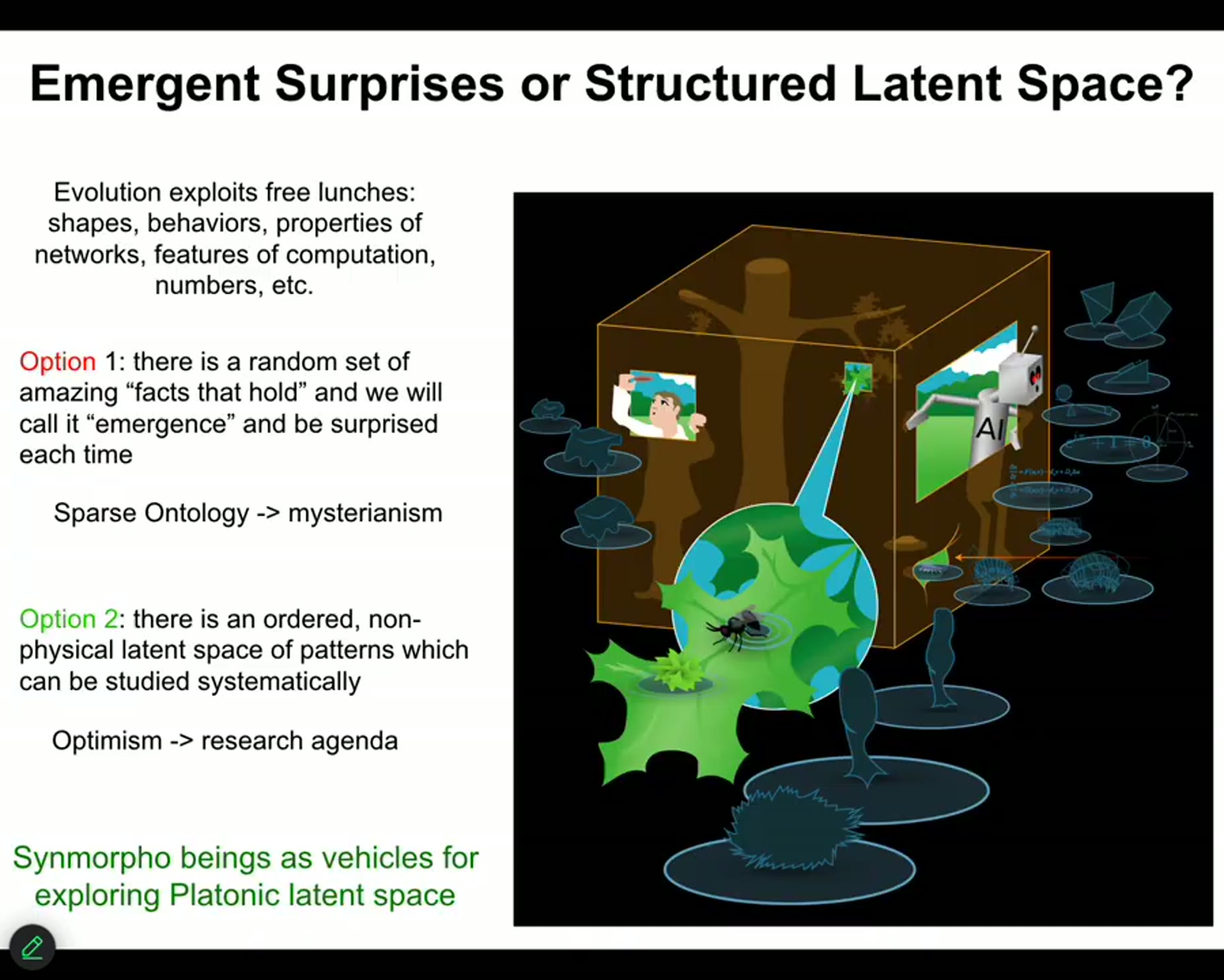
- Levin framed the core puzzle as explaining specific features such as "600 genes" and specific competencies, arguing standard predictive methods fail, and posed two options: calling it unexplained emergence (a sparse, mysterian ontology) or positing an ordered, nonphysical latent space of patterns that can be studied systematically (an optimistic research agenda). [20:40]
- Levin said some patterns are simply emergent, meaning there is no upstream set of facts that explains them, though he said he does not favor this view. [21:20]
- Levin said everybody wants monism, avoiding positing another 'realm,' which keeps the ontology sparse. [21:41]
- Levin said he prefers the optimistic assumption, which he takes as the basis of all science, that there is an ordered, structured, latent space of patterns rather than random emergent facts. [22:12]
- Levin said he uses computer science examples in his research program because biological examples, though impressive, are too complex to fully prove mechanisms for. [23:26]
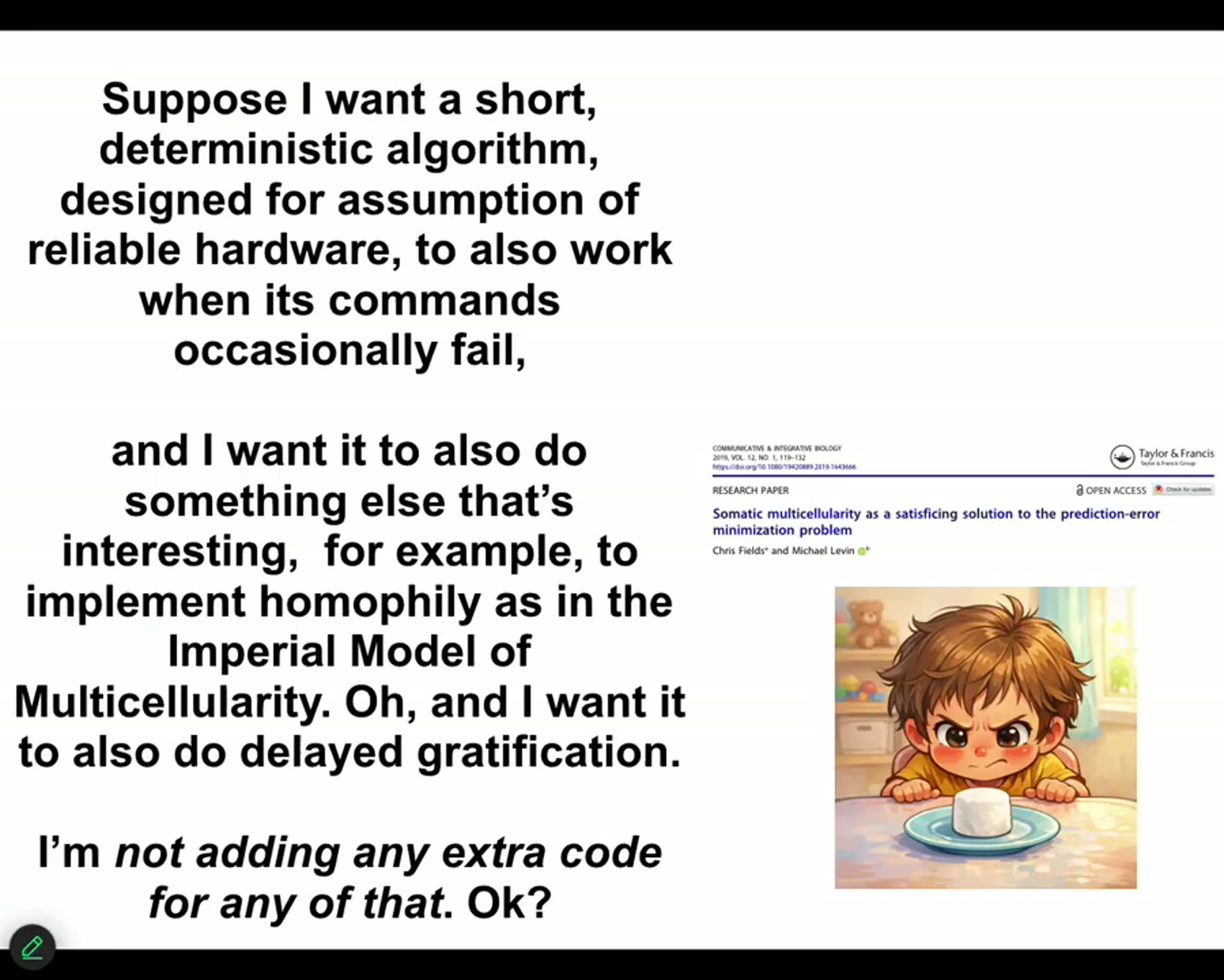
- Levin posed a hypothetical of a boss asking for a short deterministic algorithm built for reliable hardware that must also work when commands fail, implement homophily from the Imperial Model of Multicellularity he wrote with Chris Fields, and perform delayed gratification, all without extra code. [24:35]
- Levin said bubble sort already exhibits these properties, and a first paper in a series shows classic sorting algorithms work on unreliable media with no code checking whether commands were carried out, while also displaying unrequested 'side quests' such as delayed gratification. [25:49]
- Levin said the project asks what kinds of behavioral policies or intelligent minds can be frozen in data patterns that lack a body, then gives them a body to see what they do. [26:38]
- Levin argued we should study the latent space of these systems rather than call it mysterious. [27:33]
- Levin criticized the popular view that humans have intuition and inspiration while machines are just algorithms that will never do that. [27:37]
- Levin said neither formal chemistry or biology models nor formal machine models fully describe what minds are doing, since these are models of the front end only. [28:09]
- Levin identified mathematics as a well-known source of patterns beyond physics and biology, illustrated by a Halley map of the function z = z^3 + 7, whose specifics are not given by physical constants and were not selected by anybody. [29:27]
- Levin said groups of ordinary differential equations are mathematical objects that already exhibit Pavlovian learning, which he said interests cognitive scientists. [31:47]
- Levin summarized the invariant across biology, cognitive science, and computer science as patterns that function as policies for problem solving. [32:56]
- Levin said five or six people are working on this research program. [33:18]
- Levin referenced Darwin's 'endless forms most beautiful' as covering only a tiny region of the possible space of embodiments from evolved systems, engineered machines, and software. [34:00]
- Levin called for understanding other beings toward an "ethical synthbiosis," since humans will have to live together with them. [34:24]
- Levin said that if the conventional evolutionary and physics story is insufficient to explain these beings, it probably is not sufficient to explain humans either, a claim offered without further evidence. [34:36]
- Levin disclosed that three or four companies have licensed some of their inventions. [34:56]
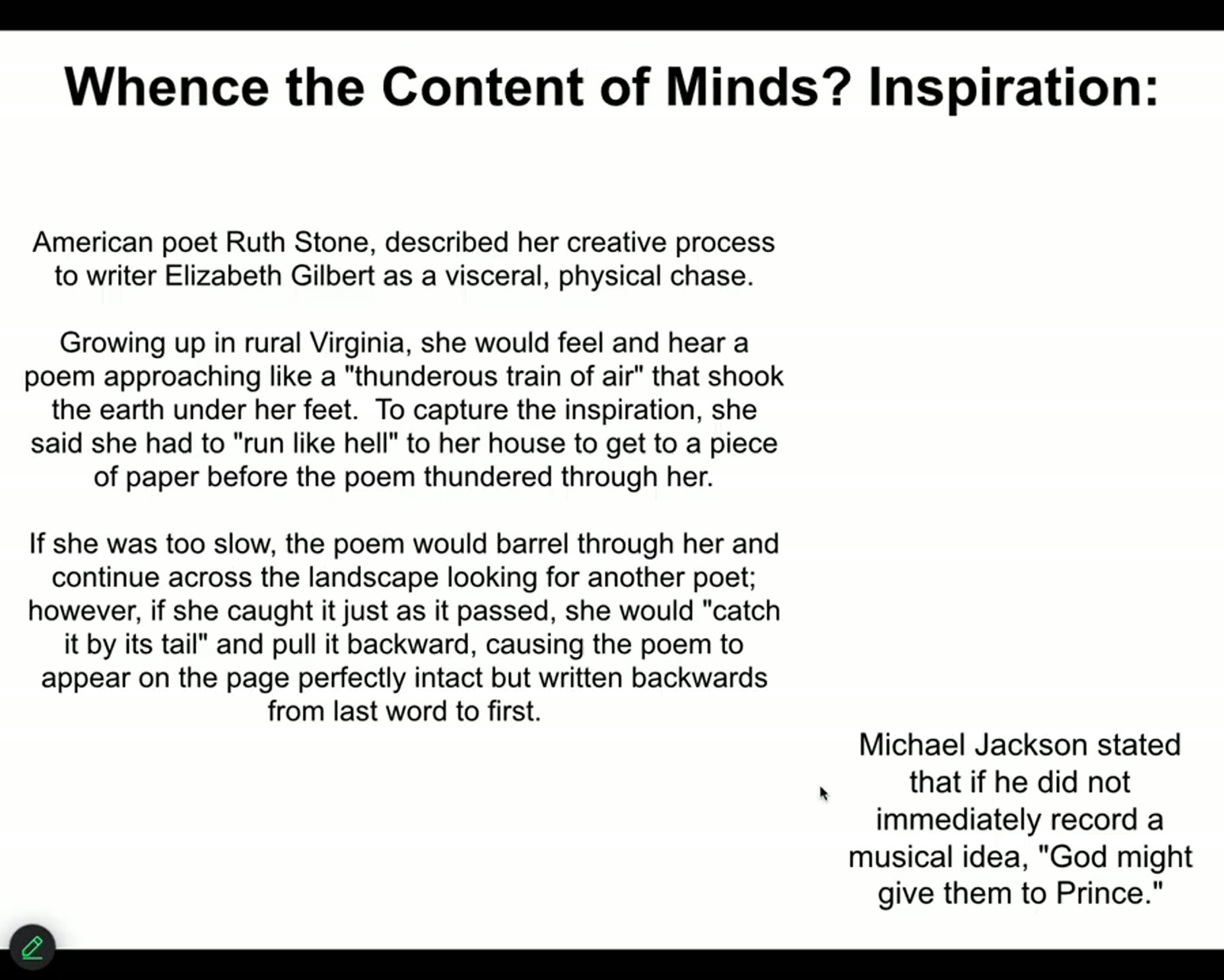
American poet Ruth Stone, described her creative process to writer Elizabeth Gilbert as a visceral, physical chase. Growing up in rural Virginia, she would feel and hear a poem approaching like a "thunderous train of air" that shook the earth under her feet. To capture the inspiration, she said she had to "run like hell" to her house to get to a piece of paper before the poem thundered through her. If she was too slow, the poem would barrel through her and continue across the landscape looking for another poet; however, if she caught it just as it passed, she would "catch it by its tail" and pull it backward, causing the poem to appear on the page perfectly intact but written backwards from last word to first. Michael Jackson stated that if he did not immediately record a musical idea, "God might give them to Prince."
"We will [...] tempted, then, to use psychological language in describing their behavior. And yet we know very well there is nothing in these vehicles that [...] we have not put in ourselves. This will be an interesting educational game." - V. Braitenberg, [...], Cambridge, MA: MIT Press, 1984
How this brief was shaped: Discourse (interview / podcast / video essay) · confidence Low
Transcript opens with two named speakers framing a joint thesis-driven talk arguing against design, selection, and training as full explanations of cognitive origins, and OCR shows slide text with research citations and named concepts like Braitenberg vehicles. The argumentative, interpretive spine with a stated personal claim fits discourse better than a neutral comprehensive explainer, though the slide density also pulls toward lecture_explainer.
The lens sets this brief's structure, never its facts — every claim is held to the same citation and fact-check standard.