Why Regional Defence Pacts Are on the Rise
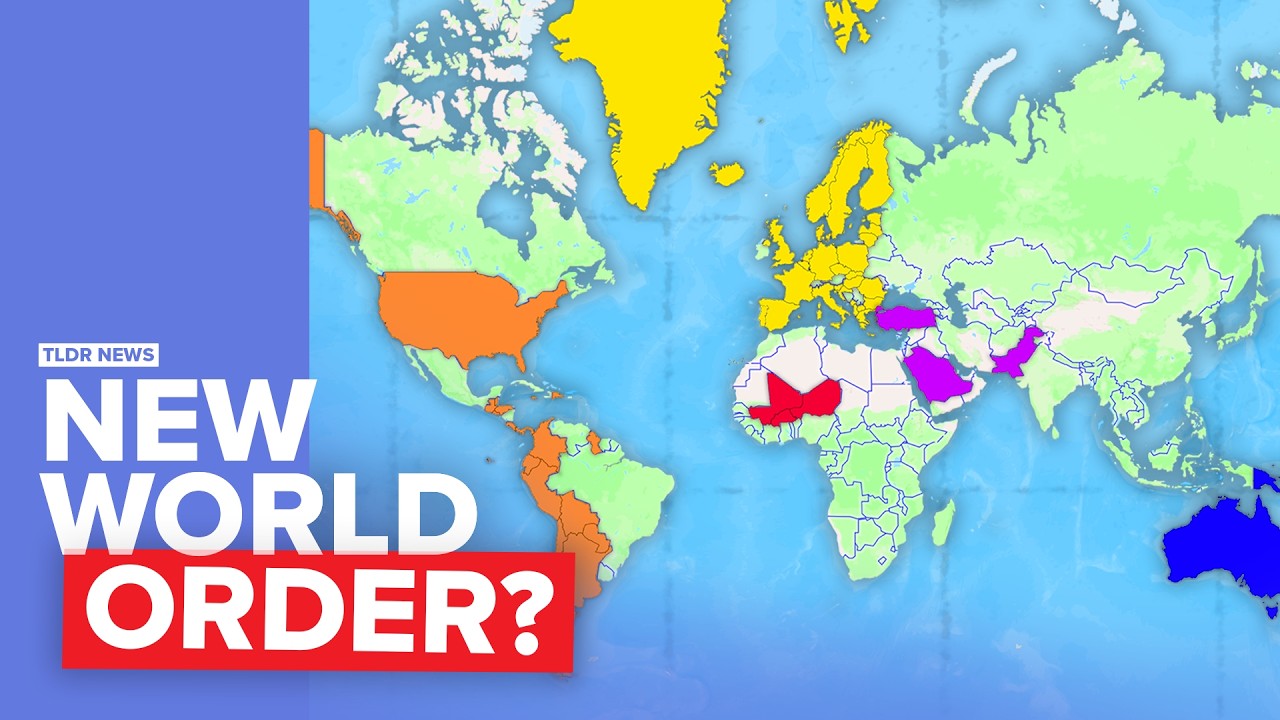
TLDR News' video argues that global security is quietly regionalising: as the US-led order contracts and specific regional powers grow more assertive, blocs like Australia's Pacific pacts (the Pukpuk Treaty and the Ocean of Peace Alliance/Veitacini Treaty), the Turkey-Saudi Arabia-Pakistan Mecca Defence Alliance, and Europe's push to 'Europeanise' NATO are emerging or strengthening. The thesis rests partly on named, dated agreements and quoted statements (Trump on the Mecca alliance, Pakistan's Defence Minister Khawaja Asif, and Ground News' sourced bias breakdown of Yemen-related coverage), and partly on the narrator's own unsourced causal claims, such as tying the Mecca alliance's formation to fallout from the US attack on Iran. The video also raises a counterpoint: total US withdrawal still looks unlikely, and new pacts like Mecca's are framed as supplementing rather than replacing US security ties.
Thesis (00:03): The narrator (TLDR News) argues there has been a quietly building rise in regionalised defence pacts worldwide as the US-led security order shrinks, specific actors grow more assertive, and regions take greater charge of their own security.
- Argument 1 (01:00): Australia has been signing bilateral defence and security pacts with several smaller Pacific Island neighbours.
- Sourced claim (01:09): The most notable Pacific pacts are the Pukpuk Treaty with Papua New Guinea and the Ocean of Peace Alliance (Veitacini Treaty) with Fiji, which entered into force on 12 December 2024.
- Argument (01:14): Both Pacific agreements establish a bilateral mutual defence commitment, meaning an attack on one country obliges the other to act.
- Prediction (01:22, no timeframe stated): The Ocean of Peace Alliance allows other Pacific states to join and could evolve into a NATO-style regional alliance, with New Zealand and Tonga cited as likely candidates alongside Papua New Guinea.
+ 32 more takeaways
- Argument 2 (01:52): The Mecca Defence Alliance, signed in August, brings together Turkey, Saudi Arabia and Pakistan and has been dubbed an 'Islamic NATO,' featuring a mutual defence clause similar to NATO's Article 5.
- Argument 3 (02:10): Saudi Arabia launched a regional multi-country maritime alliance this summer aimed at keeping the waterways around the Arabian Peninsula open.
- Argument 4 (02:20): There is a notable push to 'Europeanise' NATO rather than build a new defence alliance from scratch.
- Argument (02:27): Europeanising NATO means strengthening the European pillar by boosting defence spending, improving military capability, and taking on new leadership roles in NATO's command structure.
- Argument (02:47): The South Pacific pacts, the Mecca Defence Alliance, and NATO's Europeanisation are cited as three examples of an increasingly regionalised global security architecture.
- Argument (03:00): The narrator identifies two main drivers of this trend: the increasing assertiveness of specific regional actors and the contraction of the American security order.
- Evidence, unsourced claim (03:15): In Europe, the assertive regional power named is Russia, still fighting its war against Ukraine and engaged in what some call a hybrid war across the continent.
- Evidence, unsourced claim (03:28): In the Middle East, a hardened Iran has launched attacks across the region while Israel has conducted military action in Palestine, Lebanon, Syria and Iran, and heightened rhetoric against Turkey.
- Evidence, unsourced claim (03:58): China's recent short-notice intercontinental ballistic missile test is said to have sparked friction with Pacific island states.
- Argument (04:33): The narrator frames the Mecca Defence Alliance's emergence as reflecting the US's waning decades-long leadership role in the Middle East.
- Evidence, unsourced claim (04:39): The narrator attributes the alliance partly to instability from the US's attack on Iran and its failure to win that war, which left Saudi Arabia, Turkey and Pakistan seeking to bolster their own security and regional influence.
- Sourced claim (04:53): Trump welcomed the Mecca alliance, calling it 'a big, bold and important first step,' and posted that he was happy Saudi Arabia, Turkey and Pakistan signed the Mecca Joint Defence Agreement.
- Evidence, unsourced claim (05:02): The narrator attributes Europe's push to bolster NATO's European pillar to Trump's regular criticism of NATO allies and doubts about America's commitment to Europe's security.
- Argument (05:14): Australia is presented as a middle power taking on greater regional security responsibility, becoming the South Pacific's principal security actor while still countering China on behalf of the US.
- Argument (05:41): Trump's 'Shield of the Americas' initiative aims to build a new US-led regional coalition to tackle cartels and transnational crime.
- Sourced claim (06:01): In 2023, the post-coup governments of Burkina Faso, Mali and Niger broke from ECOWAS to form the Alliance of Sahel States and signed their own mutual defence pact.
- Counterpoint (06:27): Despite this shift, the narrator says total US withdrawal still looks unlikely, and the Mecca alliance is more likely to supplement rather than substitute security ties with Washington.
- Counterpoint (06:52): Australia is simultaneously boosting military ties with the US, including an expansion of US military presence in Australia, even as it leads security efforts in the South Pacific.
- Sourced claim (07:07): Ground News reports that coverage of the Yemen war's impact on the Mecca Defence Alliance comes from 96 sources.
- Sourced claim (07:07): Ground News' breakdown of that coverage shows 8 sources leaning left, 18 leaning right and 6 center, a bias distribution of 56% right.
- Evidence (07:25): Most sources reporting on this story come from the right, per Ground News.
- Evidence (07:36): Left-leaning sources reportedly question whether the Mecca Alliance could be activated, while right-leaning sources suggest Pakistan has 'U-turned' and won't get involved in Yemen.
- Sourced quote (07:31): Pakistan's Defence Minister Khawaja Asif described the Houthis as 'non-state actors' and said: 'There should be no doubt about this. We are bound by the terms and conditions of this pact and, God willing, we will honour them in case there is a need.'
- Ask (07:46): The video credits Ground News as its sponsor partner since 2023.
- Anecdote (08:12): The narrator says they appreciate Ground News and are fans of all its features, especially the Blind Spot feed.
- Sourced claim (08:16): A sample Ground News Blind Spot daily briefing showed 9 stories and 2,027 articles in a 9-minute read.
- Sourced claim (08:16): One example story in that briefing noted 80% of sources were Original Reporting.
- Sourced claim (08:17): Another example story showed 39% Left coverage across 26 sources.
- Evidence (08:19): The Blind Spot feature is described as letting users discover everything disproportionately reported by one side of the political spectrum, whether local or on the other side of the world.
- Sourced claim (08:22): One 'For the Left' blindspot example had 9 sources with a 0% Left, 11% Center, 89% Right split, citing a story on Iran using oil-for-goods deals with China to bypass sanctions.
- Sourced claim (08:22): A 'For the Right' blindspot example was a story about 25 years since 9/11 and Canada's progress on tackling Islamophobia, with 7 sources.
- Ask (08:35): Viewers are directed to subscribe via the link in the description, ground.news/tldr, or by scanning the on-screen QR code, to get 40% off Ground News' Vantage plan.
How this brief was shaped: Trend Commentary / Opinion Essay · confidence Low
Single narrator opens by stating a thesis (world security architecture shifting to regionalised defence pacts) and builds it out with sourced examples across the Pacific, Middle East, and Europe, with OCR confirming a real treaty document (Puk Puk Treaty) rather than a debate or how-to. No second voice, procedure, or product appears, and only the opening and 25% slices are available so the mid/late shape is unconfirmed.
The lens sets this brief's structure, never its facts — every claim is held to the same citation and fact-check standard.