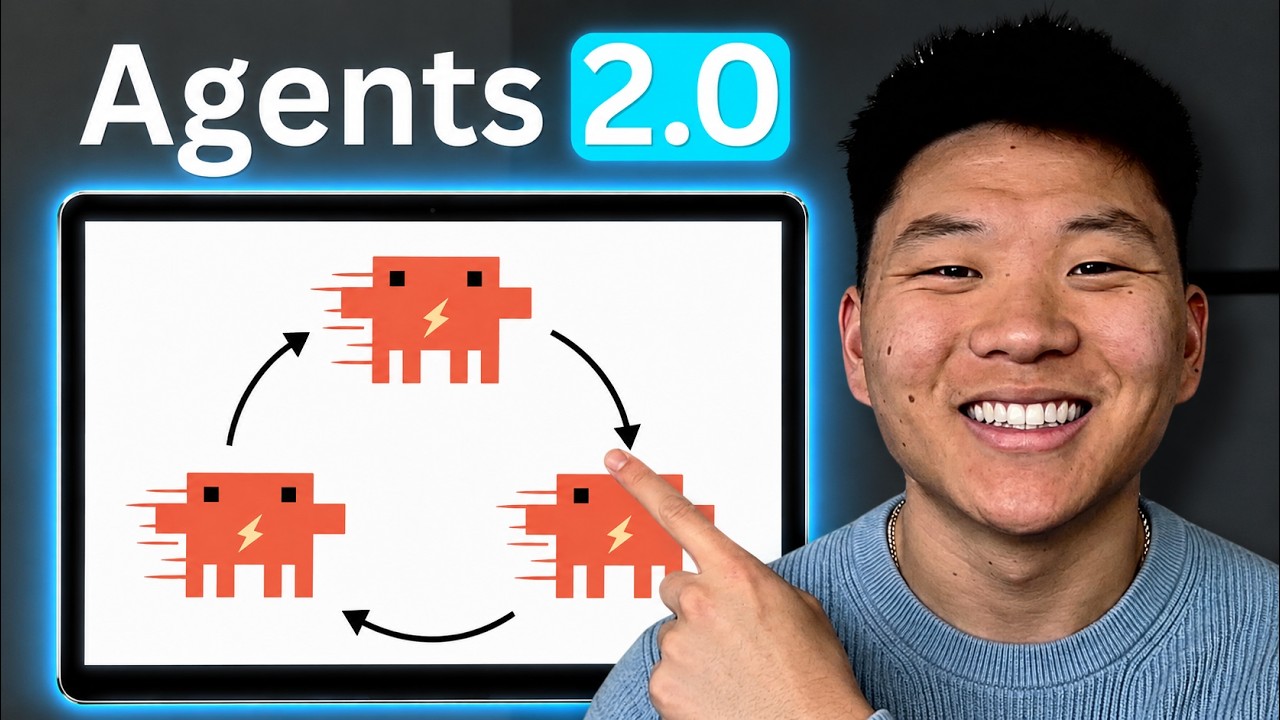
Finally. Agent Loops Clearly Explained.
Nate Herk cuts through the hype around "agent loops" and "loop engineering" with a plain definition: a loop is three things, a trigger, an action, and a stop condition, and loop engineering just means you stop being the person who prompts the agent and instead design the system that prompts it for you. He frames a loop as a recursive goal where you set an objective and the AI keeps reasoning, acting, and checking its own work until that stop condition is met, and he stresses the two pillars that actually make it work: a clear, objective goal and a real way to verify when it is done. He also pushes back on the "you need five agents running 24/7 or you are falling behind" narrative, calling it mostly false and arguing most people get more from agents that fire on a cadence or an event than from agents grinding around the clock. He shows it in practice with a loop that built an HTML page by checking 45 sources and self-iterating to roughly version seven before it decided it was done, then covers three ways to build loops and how to tell whether this even applies to you.
A loop is just three parts: a trigger, an action, and a stop condition. If you can name those three for a task, you can hand it to an agent instead of babysitting it.
His free Skool community and AI OS course, where the agent-loop build style shown in this video is taught end to end.
Join Nate's free AI OS course →- Loop engineering means replacing yourself as the prompter. Instead of typing prompts to the agent, you design the system that decides what to prompt and when, then let it run. Nate notes Claude Code's own Boris Cherny and Peter Steinberg have said they no longer prompt their coding agents, they write loops.
- Two things make or break a loop: a clear, objective goal (not a vibe) and verification, a concrete way for the agent to check its own work and know when to stop.
- The "you need five agents running 24/7 or you are falling behind" hype is mostly false. Most people get more value from agents that run on a schedule or on an event trigger than from agents working around the clock for no real reason.
- The payoff is iteration, not one-shots. His demo loop built an HTML page by pulling from 45 sources and reworking it to about version 7, screenshotting and reviewing each pass, because AI rarely one-shots and quality climbs with every attempt.