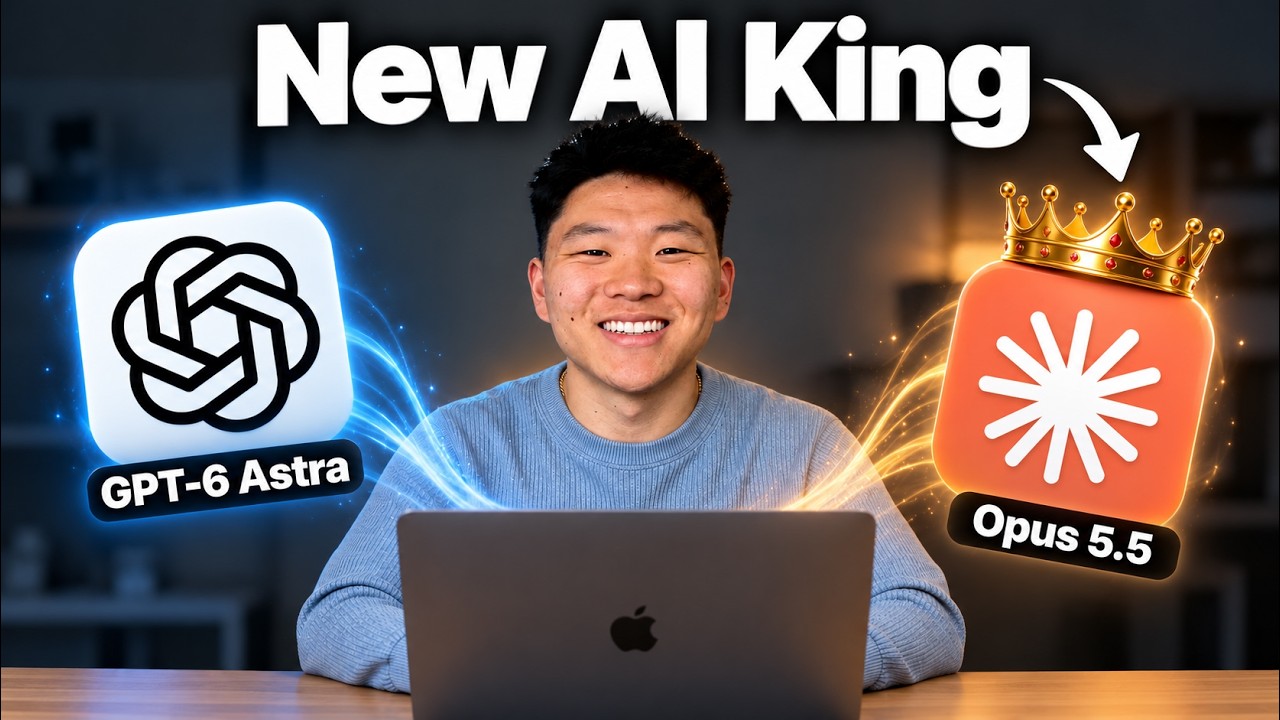
I Tested Opus 5.5 vs. GPT-6 Astra on 12 Real Use Cases
The creator ran his own 12-task benchmark pitting Claude Opus 5.5 against GPT-6 Astra (websites, decks, spreadsheets, video edits, 3D games and worlds), and doesn't land on one product to buy or skip: Opus 5.5 won 8 of the 12 tasks and Astra won 4. Astra bills 2.5x more expensive than Opus 5.5 per token via API, yet across all 12 tasks it ran about 45% faster and 38% cheaper overall (6h01m/$132.43 vs Opus's 10h54m/$214.54). The creator's closing take is that Opus/Claude behaves like a 'wise old owl' with better judgment, creativity, and taste, while GPT/Astra behaves like an 'obedient worker' that needs very specific direction, and that the choice depends on the task rather than one model being flatly better.
Verdict: Mixed, no single overall winner declared; final tally was Opus 5.5 winning 8 of 12 tasks and GPT-6 Astra winning 4 [40:45]
- For: Creators comparing Claude Opus 5.5 against GPT-6 Astra across websites, decks, spreadsheets, video edits, and 3D-world/game creation tasks [00:06]
- Price: Astra's API billing runs 2.5x more expensive than Opus 5.5's per token [00:59]
- Spec: Across all 12 tasks, Opus 5.5 totaled 10h53m57s and $214.54 [40:54]
- Spec: Across all 12 tasks, Astra totaled 6h01m05s and $132.43 [40:54]
+ 21 more takeaways
- Spec: Astra was about 45% faster and 38% cheaper than Opus overall despite costing 2.5x more per token [41:08]
- Pro: Opus 5.5 won the PERKFORM website test, judged higher quality since Astra's hero section looked cheaper [03:38]
- Con: Astra built the same PERKFORM website faster and cheaper ($11.33/32m23s vs $18.32/40m21s) even though it lost on quality [03:40]
- Pro: Opus 5.5 also won round two (the sizzle reel test), putting it ahead 2-0 [07:16]
- Pro: Opus 5.5 won the Instagram reel test, judged more engaging with better B-roll and animations than Astra's 'bland, vanilla' result [09:09]
- Con: The creator believes Astra's editing and drawing quality has degraded since Opus and Sonnet (Soul) launched [09:30]
- Spec: On the BrightPath investor deck/landing page task, Opus finished about six to seven minutes faster (39m20s vs 46m15s) but cost about a dollar more ($17.50 vs $16.61); no explicit quality winner was stated for this task [17:24]
- Pro: Astra won the museum escape-game test for being fast, cheap, and easy to iterate, though Opus was praised for immersive quality and vision [21:52]
- Con: Opus cost far more on the rover/agent-loop task, $60.53 over 1h44m versus Astra's $12.43 over 45m, though Opus's output quality was judged better [26:20]
- Pro: Opus 5.5 won the agent-loop rover task on output quality despite the higher cost [26:34]
- Pro: Astra won the travel-itinerary 3D world test, judged 'cleaner' than Opus's version [29:50]
- Con: On the codebase challenge, Opus took 2h29m and cost $17.48 versus Astra's 35m13s and $9.14, a gap the creator called 286% [30:07]
- Pro: Opus 5.5 won the Nate biography reel test, preferred partly for its progress-bar timeline versus Astra's harder-to-follow chapter structure [34:12]
- Con: Astra's Canva portrait attempt badly botched facial elements despite adding shirt texture and zipper details [35:02]
- Pro: Opus 5.5 decisively won the Canva portrait-drawing task and was also cheaper for that output, called a no-brainer win [35:54]
- Pro: Astra won the Instagram carousel task based on taste and judgment, even though both models used the same skill [37:54]
- Pro: Opus 5.5 was again picked as the winner on the book landing page test, telling a better overall story [40:19]
- Vs: Creator sums up the difference as Opus/Claude feeling like a 'wise old owl' with judgment, creativity, and taste, versus GPT/Astra feeling like a 'really good, obedient worker' that needs very specific goals [41:32]
- Now we're up to $32,000 with them.
- And Astra took about $8, where Opus took $31.
- Opus ran for 31 minutes and cost $10, whereas Astra ran for 39 minutes and $21, almost $22.
How this brief was shaped: Evaluation (review / comparison / unboxing) · confidence High
Transcript is a head-to-head benchmark of Opus 5.5 vs GPT-6 Astra across 12 use cases with explicit cost and time comparisons, and OCR shows generated deliverables like an investor deck and financial spreadsheet being judged as outputs rather than taught as steps.
The lens sets this brief's structure, never its facts — every claim is held to the same citation and fact-check standard.