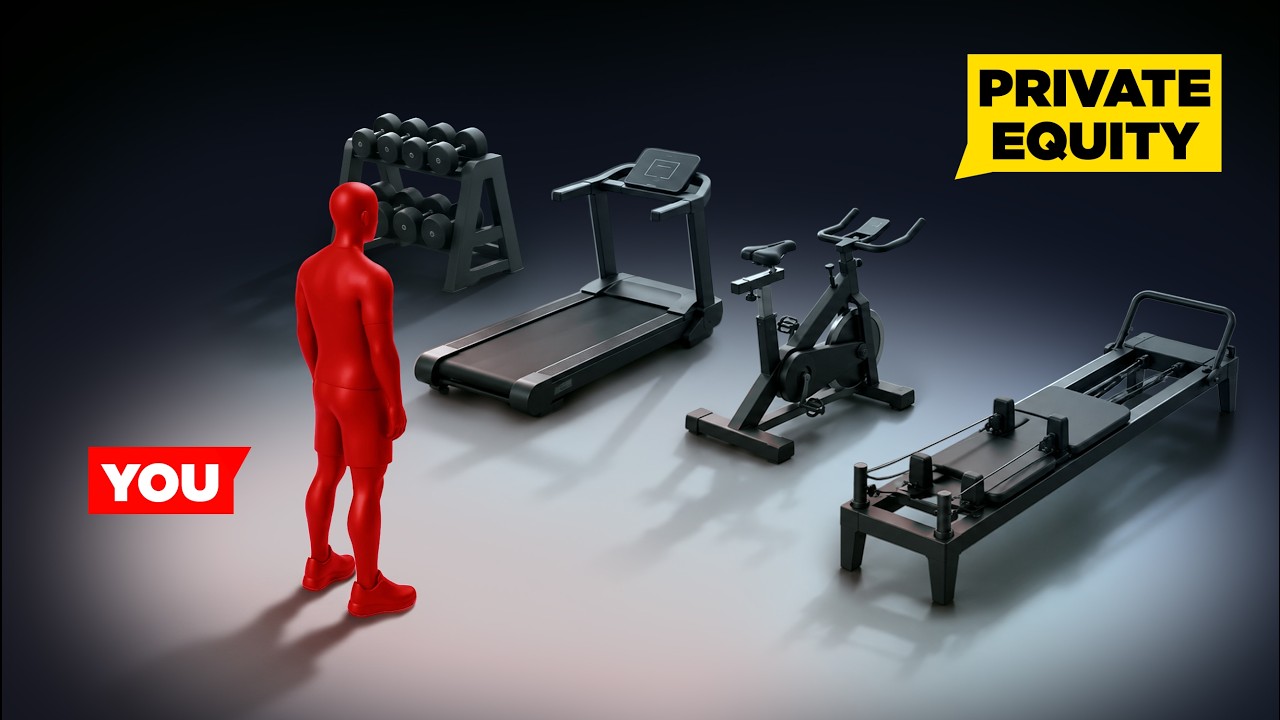
How Private Equity Bought Every Gym in America
This video, as told by the creator, traces how private equity has owned and operated nearly every major U.S. gym chain for the past 30 years, starting with Bally Total Fitness pioneering the three-year membership contract and accounting practices that let it book future dues as immediate revenue, which the creator says led to Bally concealing over $1.8 billion in losses and going bankrupt by the late 2000s. The creator says the same borrowing-against-member-dues mechanism was then applied to 24 Hour Fitness, Gold's Gym, Planet Fitness, Lifetime, Equinox, and boutique brands like SoulCycle and Club Pilates, with each owner borrowing to fund the chain's own purchase and flipping it to the next buyer. Outcomes varied: 24 Hour Fitness and Gold's Gym both went bankrupt (Gold's after being sold to a Texas oil tycoon for triple the purchase price), Planet Fitness's founders took $400 million in cash from a leveraged buyout, and Equinox was downgraded to 'SD' (Selective Default) by S&P when Covid hit. The creator closes without a single resolved industry ending, arguing the only gym left that no bank will lend against is the independent local gym.
Subject: The video covers the pattern of private equity ownership across the U.S. gym industry, named chains include Planet Fitness, 24 Hour Fitness, Gold's Gym, Equinox, Lifetime, Bally Total Fitness, SoulCycle, Flywheel, Anytime Fitness, CorePower, Xponential Fitness, Club Pilates, and SolidCore.
- Situation: The creator says almost every gym chain has been bought, funded, and controlled by a small circle of private equity firms for the past 30 years, who pass the same chains back and forth between each other.
- [00:20] The creator says consumers can't switch their way out of this because the same PE firms own every price point and format.
- Strategy: [00:29] The creator says private equity is drawn to the gym business because of the recurring monthly payment.
- [00:47] The creator's stated mechanism: if a gym gets enough people paying monthly dues, it can borrow against all of it, making the membership collateral on a loan that only gets repaid as long as members keep paying.
+ 102 more takeaways
- [01:30] The modern gym is about 40 years old and private equity has run it for 30 of those years, with 2020s Pilates as the latest example, per the creator.
- Background: [01:54]-[02:51] The creator recaps that no gym industry existed in the 1960s (YMCA swim, annual health-spa memberships), schools were pushed toward real fitness testing in the 1970s, and the 1980s aerobics boom became the first fitness trend to make money at scale via VCR tapes and books.
- Case: Bally Total Fitness. [03:01] In 1983 Bally, a company that had made its fortune on slot machines and arcade games, bought the country's biggest health spa chain, with 280 locations and a million paying members.
- [03:12] The creator says memberships beat gaming machines for Bally because a machine sells once while a membership locks in recurring monthly money under contract.
- Number: [03:27] Bally charged nearly $1,000 as an initiation fee plus $8 to $9 a month in dues.
- [03:34] Bally split the upfront cost into payments over three years with interest added on top of monthly dues, since most members couldn't afford it upfront.
- [03:43] Each contract was a binding three-year loan; members who quit or moved still owed every payment, and Bally booked the full contract amount as revenue the day it was signed, years before collecting the cash.
- [04:11] Bally sold member contracts to investors before the cash came in and used the advance to fund new clubs and signups, which the creator calls a house-of-cards model.
- [04:25] When a member finished their three-year loan, Bally immediately raised their dues, and members often stayed because they had already sunk so much money.
- [07:23] Bally bundled thousands of members' monthly payments into a bond, sold it to investors years before the money came in, and investors were repaid monthly with interest as members paid their bills.
- [06:05] The creator says Bally executives committed accounting fraud for six years, booking initiation fees as immediate income, counting renewals from churned members, and capitalizing sales commissions instead of expensing them.
- Number: [06:19] By the end, Bally had concealed over $1.8 billion in losses, per the creator.
- [06:27] Consumers resented Bally's three-year contracts and most defaulted, forcing Bally to keep opening new clubs funded by selling against old contracts.
- [06:45] Rival chains won over Bally's members by offering no three-year contracts, no thousand-dollar initiation fees, and no consumer financing.
- Result: [06:50] By the late 2000s Bally had gone bankrupt and was forgotten in the industry it had invented.
- Case: Gold's Gym. [04:38] Gold's Gym rode its fame from a Schwarzenegger documentary by franchising its name loosely, letting any gym use the logo while running operations independently.
- Number: [04:58] The Gold's Gym name alone grew the brand from one Venice Beach location to more than 500 locations within 20 years.
- [10:15] Its PE owners announced a thousand new franchises, licensed the brand to equipment makers, quadrupled owned gyms, then flipped the company to a Texas oil tycoon for triple what they paid.
- [10:28] The new owner tried to impose standards and royalties, but most Gold's franchisees had run gyms before licensing the name, and the chain shrank as franchisees walked away.
- Result: [10:50] By the late 2010s the oil tycoon tried to sell Gold's Gym multiple times with no buyer, and Gold's went bankrupt after Covid hit two years later.
- Number: [11:01] The creator says the average Gold's Gym today grosses less than it did a decade ago, with earnings well below inflation.
- Case: 24 Hour Fitness. [05:06] It started as a single Bay Area club open around the clock and grew by owning and running every location itself, unlike Gold's franchising model.
- [11:07] It kept all its gyms and was passed from one PE firm to another over 26 years, growing from 30 to 300 locations while PE owners paid very little of the expansion costs themselves.
- Strategy: [11:21] The creator describes the play as three steps: buy, expand, and harvest, all done using borrowed money.
- [11:46] When PE bought 24 Hour Fitness, the bank lent against the hundreds of thousands of members already paying dues, who became the collateral, and the debt never showed up on the PE firm's own books.
- [13:23] Three different PE funds each bought 24 Hour Fitness at a higher price than the last, with the gym itself borrowing a big chunk of the price each time.
- Number: [13:53] 30 gyms became 60, then 300 under PE ownership by the late 1990s.
- Number: [14:00] In 1997 the gym borrowed a third loan of $225 million and sent most of it straight to its PE owners as profit.
- Number: [14:11] By the 1998 IPO attempt the company had a net worth of negative $109 million, so the IPO was cancelled.
- Number: [15:33] The second fund bought the chain in 2005 for $1.6 billion, with $700 million of that borrowed by 24 Hour Fitness itself.
- Number: [15:44] The chain was flipped a third time in 2014 for $1.9 billion, with $1.4 billion borrowed as an entirely new loan.
- Number: [16:05] By 2019 the chain had over 400 locations and over $1.4 billion in debt, keeping only about 13 cents of every dollar before rent.
- Result: [16:12] When Covid hit, revenue went to zero while every lease and loan was still due, and 24 Hour Fitness declared bankruptcy.
- [16:19] Customers got a gift card and the last owner lost every dollar it had put in, while the two prior PE funds had already walked away with proceeds of their sales.
- Number: [08:43] Staffing per club varied by chain: Townsports about 50, 24 Hour about 60, Equinox about 150, and Lifetime more than 250 staff, per the creator.
- [12:17] Using a car wash analogy, the creator contrasts borrowing in your own name, where you owe the debt, with Wall Street's way where the business itself borrows against its members to fund its own sale, leaving the buyer the upside without the debt risk.
- Case: Planet Fitness. [09:13] Two brothers running a failing Gold's Gym in a small New Hampshire town found $35 a month too expensive and the gym intimidating, so they cut price to $10 a month, removed squat racks, added treadmills and machines, cut staff to 10-15, and branded it a judgment-free zone, calling it Planet Fitness.
- Strategy: [16:31] The creator says Planet Fitness perfected the trick of getting other people to build and run the gyms, moving the business model up one level.
- [16:45] Unlike other gyms selling to end consumers, Planet Fitness's customers were its franchisees, who paid royalties monthly and bought machines regardless of attendance.
- [17:10] The founding brothers priced royalties well below 5% to attract many franchisees and grow fast, making money elsewhere.
- [17:21] Franchisees had to buy all equipment exclusively from Planet Fitness, with cardio machines replaced every 5 years, strength equipment every 7, and stores remodeled every 10.
- Number: [17:46] By the early 2010s Planet Fitness made more money selling equipment at a markup than from royalties, and required franchisees to hit store-opening quotas or lose the territory.
- Number: [18:20] By the mid-2010s the average Planet Fitness had a 40% operating margin, more than double a fast food restaurant, and 50% of paying members never showed up, letting the chain keep its $10 price for decades.
- [19:04] The creator says Planet Fitness's entire strategy was selling a gym to people who had never been and would rarely go.
- Number: [19:14] By the early 2010s Planet Fitness had over 600 locations and Wall Street took notice.
- [19:20] PE firm TSG Consumer Partners bought Planet Fitness for nearly a billion dollars, the creator says applying the same play used on 24 Hour Fitness a decade earlier.
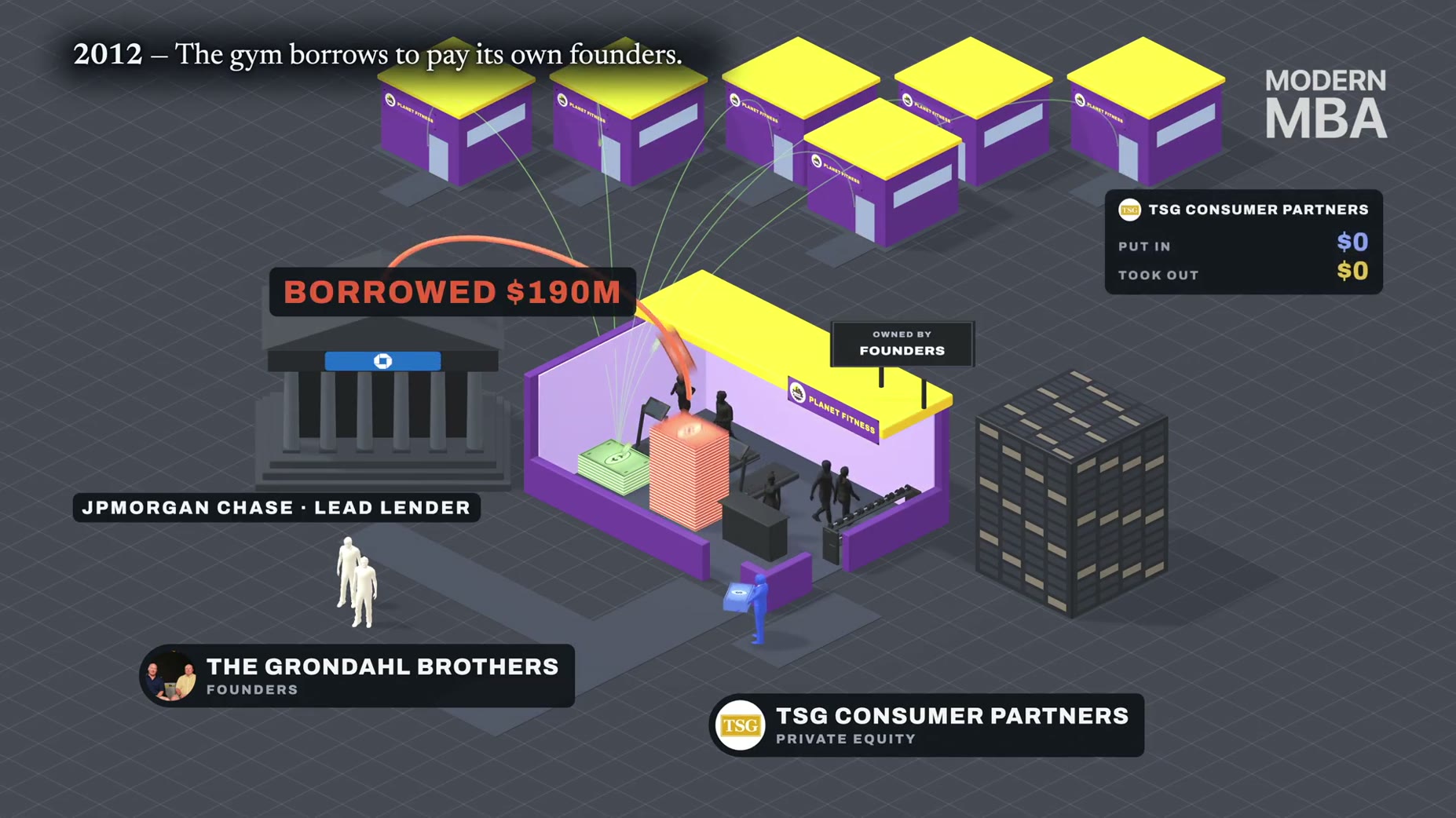
- Number: [19:25] In 2012 Planet Fitness borrowed $190 million from JPMorgan Chase to pay a cash distribution to its founders.
- Number: [19:33] The two founding brothers walked away with $400 million in cash.
- [19:47] At Planet Fitness the bank loan was against franchisees' royalties, unlike 24 Hour Fitness where it was against monthly memberships.
- Number: [20:15] Franchisees paid a share of gross sales into a national ad fund, and the company spent $100 million a year on marketing.
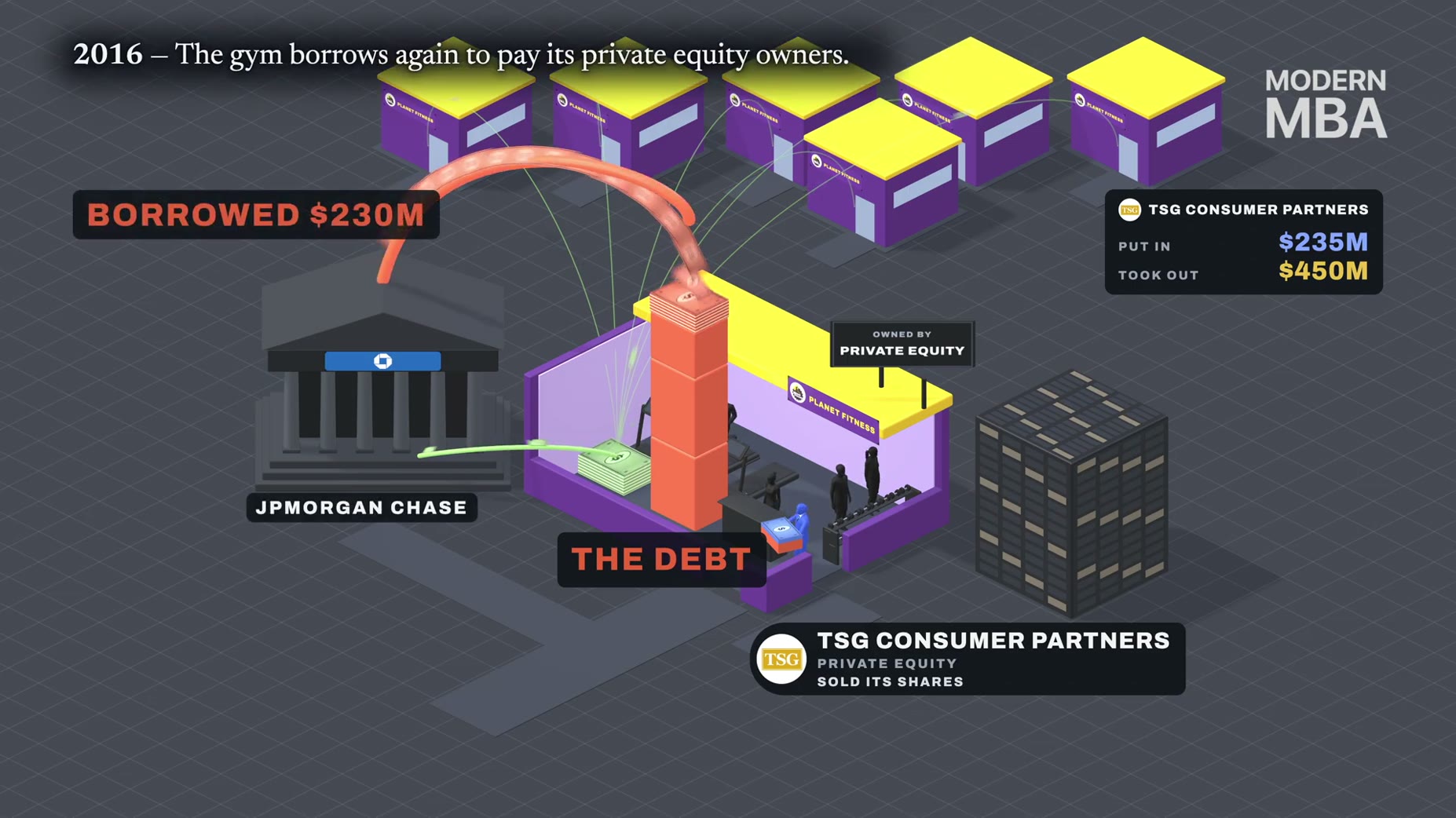
- Number: [22:45]-[23:24] Planet Fitness borrowed $390 million in 2014 and $120 million in 2015, paying owner dividends along the way, then borrowed $230 million in 2016 to pay a $271 million special dividend to TSG, plus a $136 million IPO raise to buy back TSG's shares, totaling nearly $600 million in owner payouts in under three years, none earned by the business, per the creator.
- [23:38]-[24:13] The creator contrasts the three chains: Bally sold members' payments to investors, 24 Hour Fitness borrowed against payments but still lost everything covering leases and payroll, and Planet Fitness avoided running gyms via franchisees, borrowed to fund its own sale, extracted cash three more times, then sold the company to the public for a profit.
- [24:13] The creator calls this pattern 'Paul robbing Peter to pay himself and then leaving Peter's name on the bill,' a twist on 'robbing Peter to pay Paul.'
- Number: [24:31] The PE fund borrowed against future franchisee payments and walked away with $1.6 billion, more than Planet Fitness had earned in its entire existence, per the creator.
- Number: [39:06] Planet Fitness's $10 monthly price, frozen since the 1990s, has risen to $15, and franchisees have stopped signing up to open new locations.
- [39:19] By 2026 member count has stopped growing, so the creator says all new revenue comes from charging existing members more.
- Case: Lifetime. [24:51] Since the 2000s, Lifetime has built gyms like resorts with 100,000 square feet of pools, courts, and climbing walls in expensive zip codes.
- Number: [25:13] In 2004 a single Lifetime club cost about $20 million to build, and by the early 2010s that cost had more than doubled, with the company paying for it.
- Number: [25:32] In 2015 two PE funds bought Lifetime for $3.9 billion, with Lifetime borrowing $1.7 billion against its own members to pay for most of its own sale.
- Number: [25:53] Lifetime sold the land and buildings under 29 of its clubs for $900 million and became a tenant on all of them the day the deal closed, covering two-thirds of its own sale price.
- Number: [26:05] Six years later the PE funds took Lifetime public again, turning their $1.1 billion out-of-pocket investment into $3.2 billion over the next five years.
- Case: Equinox. [26:30] Equinox has been private equity owned since 2000, leases and operates every club itself, owns none of its buildings, and was downgraded to 'SD' (Selective Default) when Covid hit because it had nothing to sell or borrow against.
- [26:39] S&P downgraded Equinox Holdings to 'SD' from 'CCC', calling the transaction distressed and tantamount to default.
- [26:41] Equinox was lowered to 'SD' a second time, with S&P again calling an amendment distressed and tantamount to default, downgrading from 'CCC-'.
- [26:41] The chain has defaulted twice, fallen behind on rent, and survived on a $1.8 billion loan from private lenders led by Sixth Street and Silver Lake, with Ares Management, HPS Investment Partners, and L Catterton.
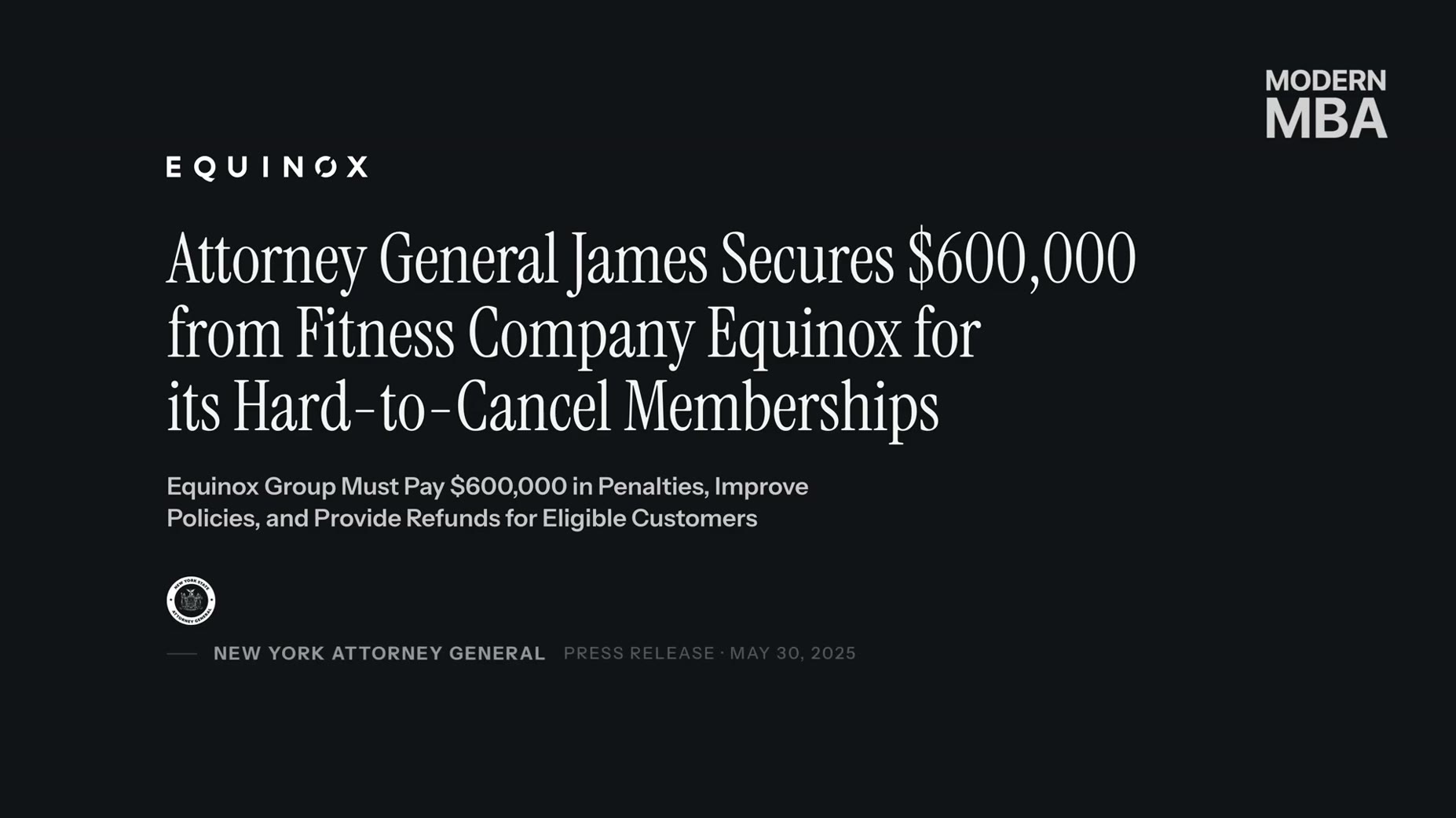
- Number: [26:53] New York Attorney General James secured $600,000 from Equinox for its hard-to-cancel memberships, requiring penalties, improved policies, and refunds for eligible customers.
- Lesson: [27:09] The creator argues private equity didn't build better car washes but borrowed against existing customers, paid itself, then sold to the next buyer who repeated the cycle, naming this pattern at 24 Hour Fitness, Planet Fitness, and Life Time.
- [27:47] By the 2010s private equity ran out of legacy chains to buy and instead built new boutique brands like Orangetheory, Barry's, SoulCycle, and SolidCore.
- [28:50] Boutique studios could be sold like startups on future growth multiples rather than present earnings, and indoor cycling (SoulCycle and Flywheel) was the first category to break out, per the creator.
- Case: SoulCycle/Flywheel. [29:19] By 2014 the average SoulCycle studio was grossing $3 million out of just 2,500 square feet.
- [29:40] The PE fund behind Equinox bought SoulCycle in 2011 and, four years later, bought out all the founders.
- [29:52] The founders got their payout while the startup took on the debt, and the new owners paid for the acquisition with borrowed money.
- [29:59] SoulCycle borrowed more to sell itself than the company had ever earned, an amount the creator says would take seven years of profit to repay.
- Number: [30:08] The new PE owners filed to take SoulCycle public and projected at least 250 locations by 2020.
- Number: [30:17] Flywheel, the number two spin chain, grew to 25 corporate-owned studios in under five years.
- Number: [30:30] Peloton offered the same ride at home for $39 a month, killing the growth story for Flywheel and SoulCycle and reaching a $4 billion valuation.
- Result: [30:46] When Covid hit, Flywheel went bankrupt and SoulCycle withdrew its IPO plan, continuing to lose locations and franchisees since.
- Case: Anytime Fitness. [32:31] Anytime Fitness charged twice as much as Planet Fitness for a quarter of the space, and the average location grossed a fifth as much.
- [32:37] With rising interest rates, every Anytime Fitness franchisee who renews must remodel their locations with new carpet and new machines.
- Number: [33:06] Between 2021 and 2026 the two chains combined borrowed about $1.7 billion against their monthly royalties and kicked up $600 million of that straight to their PE owners.
- Case: CorePower/YogaWorks. [33:26] CorePower repackaged yoga into a studio model and called itself the Starbucks of yoga, with 60-minute classes, heated rooms, free weights, and monthly memberships.
- Number: [33:36] By 2013 private equity had invested more than $100 million to grow CorePower from 95 to 200 locations, but YogaWorks killed the entire market before the five-year flip.
- Result: [33:56] YogaWorks stock fell below a dollar within 14 months of IPO, got delisted in under two years, and went bankrupt the year after; the creator says no other yoga chain has IPO'd since.
- Case: Xponential Fitness. [34:30] A rolled-up bundle of 11 brands went public in 2021 and within four years had sold or shut down six of them, including Rumble and Cyclebar.
- Number: [34:40] Xponential paid Stride Fitness's buyer about $265,000 in transition support after it was sold to its own executive for no consideration.
- Number: [34:40] Xponential divested CycleBar and Rumble for total consideration of $7 million, as $2 million in cash and a $5 million note per the Q3 2025 10-Q.
- Number: [34:40] Lindora was bought for $8.5 million in December 2023 and sold 21 months later for up to $6 million, paid as 7% of the clinics' monthly revenue.
- [34:41] The creator says the aggregation approach had no economies of scale because the brands and studios shared nothing between themselves, so nothing got cheaper under the same owner.
- [34:51] The holding company only made money when a franchisee signed up rather than when a studio sold a membership, making it one step behind demand and removed from the end consumer.
- Result: [35:11] The creator says the stock today is a third of what it was three years ago, the company is up for sale, and its largest shareholder argues its Pilates brand is worth more than the rest of the company.
- [36:08] The creator says brands like SoulCycle, Rumble, Orange Theory, and SolidCore were manufactured as much as discovered, since a trend only lasts as long as someone funds, builds, and markets it, with demand driven by money and boredom rather than a love of exercise.
- [37:05] A studio is built around one workout, and when that workout goes out of style, you can't convert a spin room into something else without ripping everything out and starting over, per the creator.
- Lesson: [37:28] When the big box gyms went bankrupt, it was their debt that killed them, not boredom, per the creator.
- [37:48] The creator says private equity's lesson from the 2010s was the opposite of the 2000s playbook: hype a studio to its peak and sell at the highest valuation, rather than holding and harvesting with borrowed money.
- Case: Club Pilates. [38:09] A local San Diego chain taken over by private equity in 2015 and rebuilt as a mass-market national franchise; by 2018 it was the fastest-growing fitness franchise in the country, and by 2025 it had surpassed 1,400 studios and a billion dollars in sales.
- [38:28] Club Pilates same-store sales have turned negative and parent Xponential Fitness is being shopped for a buyer, with its largest shareholder arguing Club Pilates alone is worth more than the whole company.
- Case: SolidCore. [38:46] Founder Anne Mahlum sold her stake for $88 million (reportedly borrowed), despite SolidCore never having earned $88 million in profit, and it has since been owned by three separate private equity funds in four years, the latest the same fund that backed Flywheel and CorePower.
- [39:33] The creator says the same handful of private equity firms since the 1990s have passed gym chains back and forth, pushing the industry to two price extremes, about $10 a month for the masses or about $300 a month for the few, squeezing independents in the middle.
- Lesson: [39:51]-[40:05] The creator's summary of the playbook: a PE fund borrows against members' monthly payments to buy a gym chain in the gym's own name, borrows again to open more locations, borrows a third time to pay itself, then sells the chain to the next fund before the debt comes due, and when chains ran out it repeated the same borrowing on new studios like SoulCycle.
- [40:20]-[40:23] The creator restates that a member's monthly payment functions as collateral banks loan against, regardless of whether the member actually shows up.
- Lesson: [40:26]-[40:39] The creator closes by arguing the only honest gym left in America is the local independent gym, which can't compete with Wall Street on price, marketing, or real estate, but is exactly the one gym no bank will ever lend against, so a membership there is just a membership, nothing more.
- By 2024, the average studio was down to grossing just $850,000, the largest franchisee had collapsed, and their number of locations continues to shrink every year.
How this brief was shaped: Case Study Breakdown · confidence Low
Transcript frames a strategy and result: PE firms buy gym chains, load debt collateralized by membership payments, then flip or rename brands, and the OCR shows a real 10-K comparison table (Bally Total Fitness financing, interest rates, renewal rates) as evidence for that mechanism. The 25% slice shifts into a decade-by-decade history of chain ownership, so the spine blends argument with chronology rather than being a pure thesis essay.
The lens sets this brief's structure, never its facts — every claim is held to the same citation and fact-check standard.