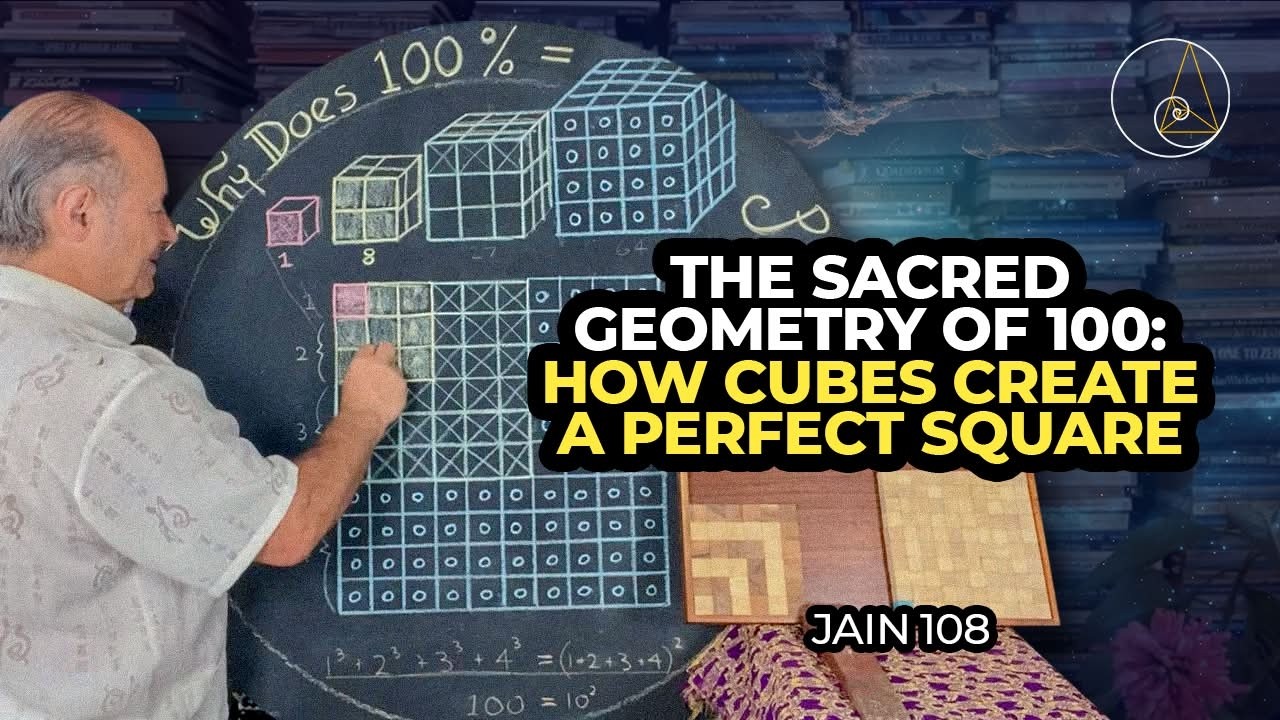
THE SACRED GEOMETRY OF 100: How Cubes Create a Perfect Square
This lesson on sacred geometry and sacred mathematics is presented by a teacher who introduces herself as Jane 108 of Australia. The lecture builds around Nicomachus's Theorem, credited to Nicomachus of Gerasa, a student of Pythagoras from nearly 2,000 years ago, who connected cubic numbers to squared numbers using nested L-shaped tile arrangements called gnomons. The presenter demonstrates with cube and tile models that the sum of consecutive cubic numbers (1 cubed through 4 cubed) equals a squared number, 100. She frames the lesson as giving a numerical answer to why the phrase '100% equals perfection' holds true.
Concept: Nicomachus of Gerasa, a student of Pythagoras from nearly 2,000 years ago (Gerasa being in modern day Jordan), is introduced as the source of the lesson's theorem. [00:19]
- Concept: Nicomachus revealed an amazing connection between cubic numbers and squared numbers. [00:26]
- Concept: cubic numbers 1 cubed, 2 cubed, 3 cubed, and 4 cubed are drawn on the board to open the demonstration. [00:36]
- Concept: the lesson is framed as the question 'why does 100% equal perfection,' with the presenter promising a numerical answer. [00:51]
- Mechanism: 100 wooden cubes, called cubelets, are arranged into a 10 by 10 square to demonstrate squared numbers. [01:26]
+ 44 more takeaways
- Mechanism: ten times ten equals a hundred, illustrating the squared number concept. [01:40]
- Concept: gnomon is defined as an L-shape, also referring to a carpenter's square with a 90 degree angle. [02:11]
- Comparison: the presenter states she is a bricklayer by trade who uses a carpenter's square (gnomon) for building structures. [02:24]
- Mechanism: a 6x6 square built from dark, brown, and white cubes is used to show gnomon L-shapes nested within the square. [02:46]
- Concept: the word gnosis is said to derive from the ancient Greek word meaning to know. [03:33]
- Concept: the word knowledge (gnosis) is said to have originated from the word gnomon. [03:39]
- Concept: the gnomon is described as the key to the nesting of perfect geometries. [03:44]
- Concept: the gnomon is most commonly known as the pointer on a sundial. [03:49]
- Mechanism: the sundial's gnomon casts an L-shaped shadow, the same shape as a carpenter's square. [04:02]
- Named source: Nicomachus of Gerasa, writing about 1,900 years ago, is credited as first to put the knowledge of gnomons together; the only known portrait of him is described as a sketch. [04:23]
- Named source: Nicomachus's first surviving book concerned the Epiphany of Pythagoras, tied to the Pythagorean Hammers and a theory of music inspired by a blacksmith's anvil. [04:30]
- Named source: the Pythagorean community, based in Crotona, northern Italy, is said to have viewed mathematics as a timeless expression of natural order and beauty rather than mere calculation. [04:30]
- Named source: Nicomachus also wrote works on music and celestial harmony. [04:30]
- Mechanism: the video attributes to Nicomachus a summation formula, the sum of numbers 1 to n equaling n multiplied by (n+1), then divided by 2, shown with the sigma symbol. [04:30]
- Why it matters: the theorem discussed reveals a numerical relationship between squared numbers and cubic numbers. [04:30]
- Mechanism: 1 cubed is shown as a single cube, one cell. [05:04]
- Mechanism: 2 cubed equals eight cells. [05:10]
- Comparison: the presenter references children's puzzles called Magic Diamond and Folding Magic Cube as related to these cube shapes. [05:14]
- Mechanism: 3 cubed (27) is explained as three rows of nine. [05:28]
- Mechanism: 4 cubed is explained as 4 squared (16) taken four times, totaling 16+16+16+16=64. [05:43]
- Comparison (presented without cited evidence): the presenter states cubic numbers have a lot to do with DNA codons. [05:52]
- Concept: cubic numbers to memorize are listed as 5 cubed=125, 6 cubed=216, 7 cubed=343, 8 cubed=512, 9 cubed=729, and 10 cubed=1000. [06:00]
- Mechanism: the presenter transforms the 3D cubic number 27 into a flat 2D gnomon/L-shape, calling it a transduction from 3D down to 'Flatland' 2D. [07:49]
- Mechanism: 4 cubed (64) is shown arranged as four layers of 16. [08:24]
- Mechanism: the 64 small squares are placed in a grid pattern going down and across the diagram. [08:44]
- Mechanism: 1 plus 2 plus 3 plus 4 equals 10. [09:15]
- Mechanism: 10 squared is shown to equal 100. [09:25]
- Mechanism: a red square representing 1 cubed is placed at the bottom of the diagram, followed by 8 yellow tiles as the next gnomon around it. [09:56]
- Mechanism: the next gnomon, 3 cubed, is made of 27 green tiles, described as three nines equaling 27. [10:36]
- Mechanism: the 64 tiles are arranged as 16, 16, 16, and two lots of 8 making another 16. [11:16]
- Why it matters: 1 cubed plus 2 cubed plus 3 cubed plus 4 cubed equals a squared number, 10 by 10 (100), which the presenter calls a geometric description of the theorem based on nesting gnomons. [11:42]
- Concept: the Greek symbol Sigma, resembling a capital E but more angular, means 'the sum of,' with formula n(n+1)/2. [13:02]
- Mechanism: as a worked example, summing 1 to 10 means 10 multiplied by 11, then halved. [13:02]
- Mechanism: that resulting formula squared (10x10) equals the sum of cubes 1 cubed plus 2 cubed plus 3 cubed plus 4 cubed. [13:02]
- Aside: the presenter states it is all about formulas, and the different phrasings are saying the same thing. [13:07]
- Mechanism: the 8 cubelets forming an L-shape gnomon can be rearranged into a 2x2x2 cube. [13:22]
- Mechanism: the next gnomon is composed of 27 cubelets, i.e. 3x3x3. [13:22]
- Why it matters: adding the first four gnomons (1+8+27+64) sums to 100, itself a squared number (10x10), a pattern known over 2,000 years as Nicomachus's Theorem. [13:22]
- Speculative claim (presented without cited evidence): the presenter suggests the nesting L-shaped gnomon structures based on 90 degree angles may hint at understanding dimensions, referencing a rumor that 'Archons' could enter and exit the 3rd dimension via a 90 degree Phase Shift of Consciousness. [13:22]
- Speculative claim (presented without cited evidence): the carpenter's square (gnomon) is presented as a hint about the quadrature of the circle. [13:31]
- Concept: a circle with a cross in it is described as based on four lots of 90 degrees. [13:39]
- Speculative claim (presented without cited evidence): the presenter states an ancient race called 'the elders race' could allegedly enter and exit dimensions via a 90 degree phase shift angle of consciousness. [13:45]
- Named source: the presenter calls her book 'The Art of Number,' her legacy, published in 2012, describing it as translating numbers into pictures. [14:47]
- Speculative claim (presented without cited evidence): the presenter states the pictures derived from numbers in her book are not random but represent atomic structures. [15:01]
How this brief was shaped: Lecture / Educational Explainer · confidence High
Single teacher presenting an established historical theorem (Nicomachus, Pythagorean sum of cubes equals square of triangular number) using a board, physical cube tiles, and on-screen formula overlays, with named historical figures and terms like gnomon explained systematically rather than argued or applied to a project.
The lens sets this brief's structure, never its facts — every claim is held to the same citation and fact-check standard.