
The BUDDHA'S Truth About IMPERMANENCE (And Why It Scares You)
The video is a solo narration (identity not stated) on the Buddhist teaching of impermanence, built around three threads: the Buddha's first teaching in the deer park near Varanasi and his final words, the story of the grieving mother Kisa Gotami, and sayings attributed to the Thai forest teacher Ajahn Chah. Its center of gravity is the Pali term anicca (impermanence) and the claim that nothing experienced holds still, with the narrator moving between retelling canonical teachings/stories and adding personal interpretive commentary and a guided breathing exercise. There is no second speaker and no stated disagreement between parties; the tension the piece explores is conceptual, between the human wish to hold things as fixed or certain and the teaching that loosening that grip is itself the path to ease. The narrator does not always mark clearly where canonical source ends and personal framing begins.
[00:43] The narrator states that the Buddha's name for what cannot be made to stop is impermanence.
- [00:49] The narrator recounts that a Thai forest master who spent more than 40 years as a monk, later identified as Ajahn Chah, said impermanence was the one thing he found.
- [00:59] The narrator says the wise still hold things, but 'not fast, not locked on.'
- [01:31] The narrator recounts that 25 centuries ago, in a deer park outside Varanasi, the Buddha gave his first teaching to five men.
- [01:45] The narrator says one of the five men realized that whatever begins, ends.
+ 38 more takeaways
- [01:56] The narrator says the Buddha called this man Kondanna, meaning 'who knows.'
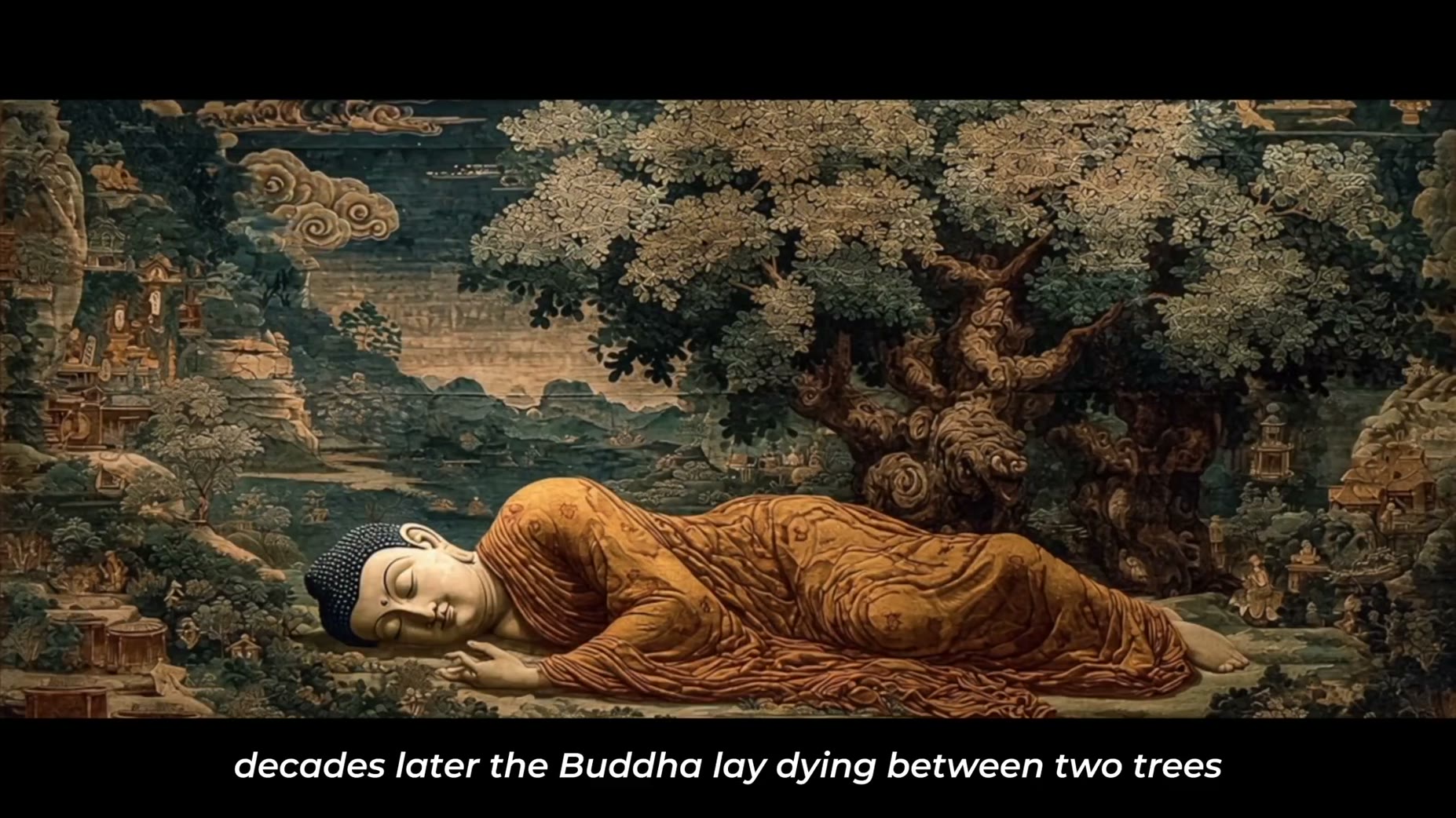
- [02:03] The narrator states that decades later the Buddha lay dying between two trees, and his last words returned to that same truth with one instruction added.
- [02:32] The narrator tells the story of Kisa Gotami, a young woman from a poor family in Savatthi nicknamed 'the thin one.'
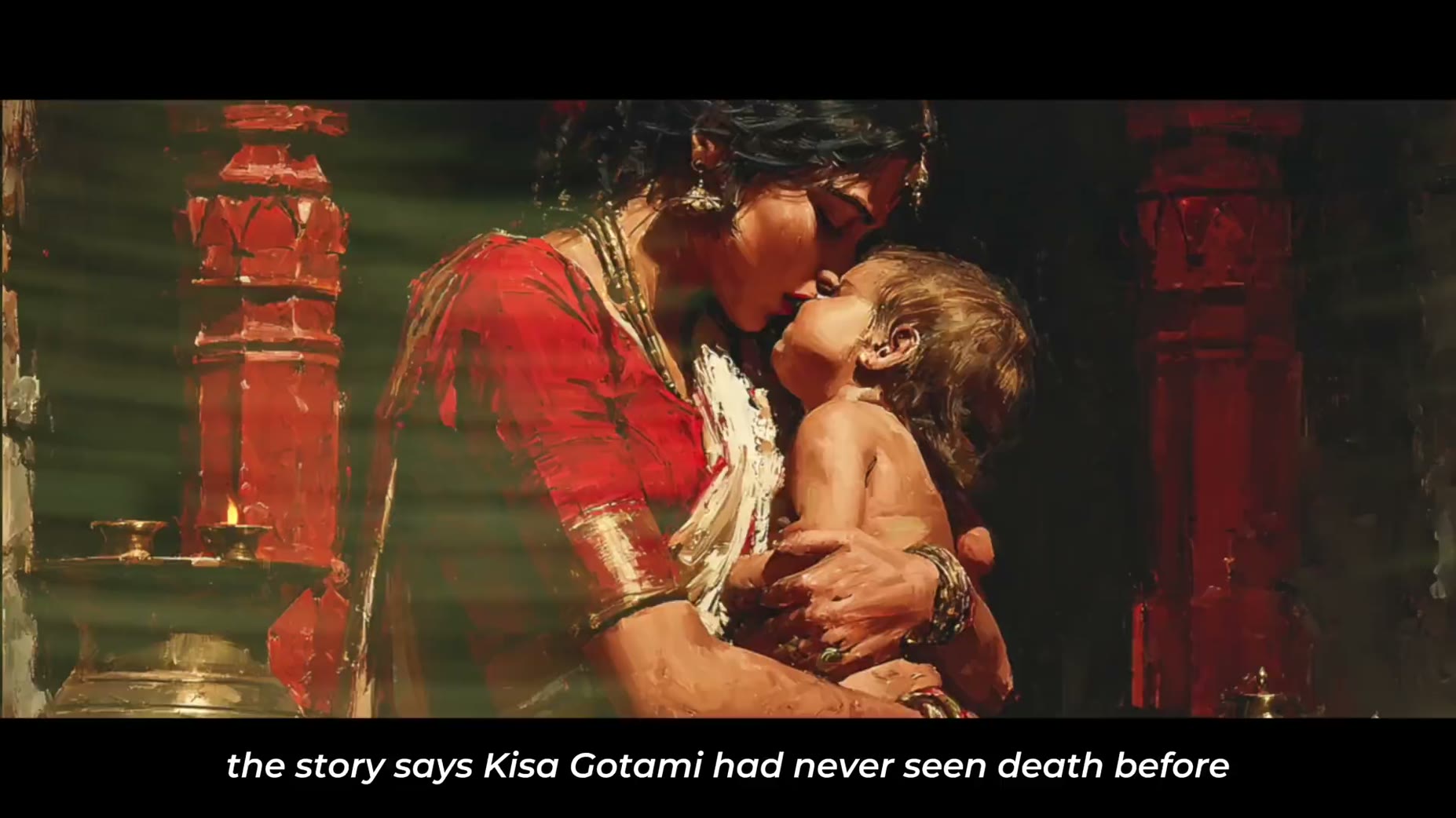
- [02:45] The narrator recounts that Kisa Gotami married into a rich merchant's house, had a son, and the boy died when he was old enough to walk.
- [02:52] The narrator says Kisa Gotami had never seen death before and would not let people take her son's body for the funeral fire.
- [03:05] The narrator recounts that Kisa Gotami carried her son from house to house asking if anyone knew a cure, until a wise man told her to ask the Buddha.
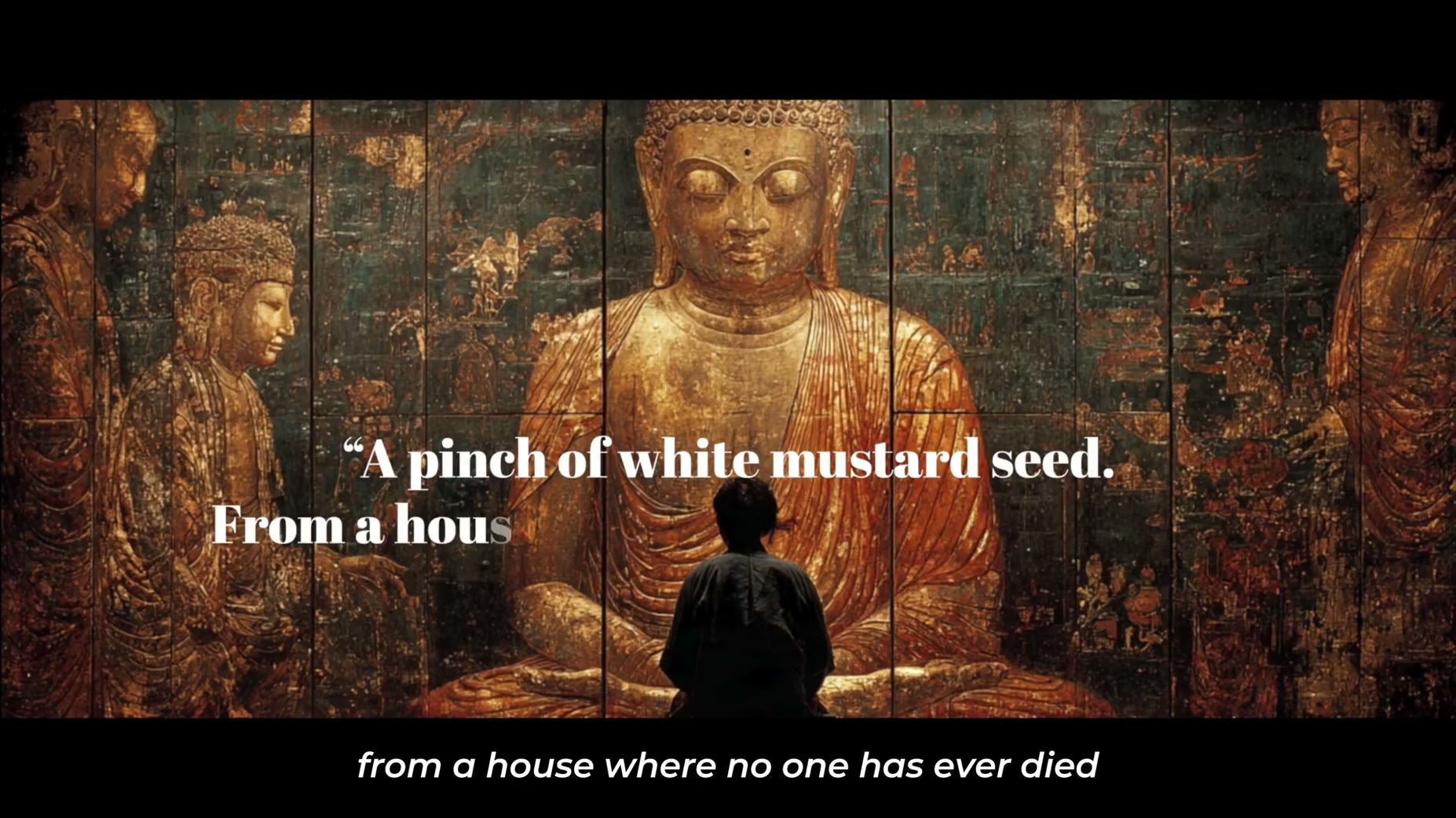
- [03:39] The narrator recounts that the Buddha told Kisa Gotami to bring a pinch of white mustard seed from a house where no one has ever died, and that at the first house she was given seed but told 'the living are few, the dead are many,' so she handed it back and kept walking.
- [04:49] The narrator says the Buddha's word for impermanence is anicca, meaning nothing you experience holds still.
- [05:15] The narrator recounts that on the banks of the Ganges, the Buddha described feelings as bubbles in autumn rain, each drop throwing up a bubble that appears and is gone with nothing inside to hold.
- [05:48] The narrator suggests, as his own interpretation, that a small ache felt inside happiness may be the sense of watching the bubble of feeling while still enjoying it.
- [06:24] The narrator states that Buddhist teaching gives causes rather than reasons, saying things happen because conditions come together, without promising every loss happened for your good; this is stated without evidence given.
- [06:35] The narrator says Kisa Gotami wanted more than a reason, she wanted a way out, so she kept walking looking for a house the rule had skipped.
- [07:02] The narrator quotes Kisa Gotami's thought from the story: 'I thought I alone had lost a child.'
- [07:10] The narrator recounts that Kisa Gotami carried her son into the forest and laid him down after keeping him on her hip all day.
- [07:30] The narrator recounts that the Buddha asked Kisa Gotami, 'Did you find the mustard seed?' and she answered no, explaining that in every village the dead are more than the living.
- [08:50] The narrator says Kisa Gotami's story continues beyond the forest: she asked to join the Buddhist community of nuns, and as a nun used lamp-lighting duty to watch flames flare up and flicker out as a meditation subject that led her to see living beings the same way.
- The narrator says the Buddha's breathing instructions have 16 steps, with the first ones focused on noticing the breath and feeling the body, and the last four beginning with watching the breath change (no on-screen or spoken timestamp given for this point).
- The narrator offers a guided practice: follow one breath in and out, pick one sensation such as coolness at the nose tip or the belly rising and falling, and watch it change (no timestamp given for this point).
- The narrator says Buddhists count impermanence as the first of three marks of existence, raising two further questions: whether something that keeps changing can ever fully satisfy us, and whether it can be called 'me' or 'mine' (no timestamp given for this point).
- The narrator states that the Buddha traced much of suffering to craving, the wish for changing things to stay as they are (no timestamp given for this point).
- The narrator recounts that Ajahn Chah summed up his decades of teaching in two words, 'not sure,' alongside anicca and patience, and advised using it when the mind wants to grab something as certain, including with loved ones, plans for the year, or anger at a stinging message, pausing one breath before responding (no timestamp given for this point).
- [13:05] The narrator suggests giving a feeling one natural breath to see if anything has shifted before deciding what to do.
- [13:19] The narrator recounts that Ajahn Chah told a story about visiting old temples with friends where cracked walls made a friend sigh at the shame of it, and that Chah said he felt sad about it too, then said, 'If walls never cracked, there would be no Buddha.'
- [13:55] The narrator reasons that if nothing could ever change, the Buddha himself would have stayed exactly who he was and nobody could heal or wake up.
- [14:22] The narrator says the story of Kisa Gotami never asks her to stop loving her son; what she let go of was the hunt for an exception to death.
- [14:50] The narrator says Kisa Gotami walked all day believing she was alone, and every door she knocked on told her otherwise.
- [15:41] The narrator recounts that the Buddha was 80 years old and lay on his right side between two sal trees near a small town, surrounded by gathered monks.
- [15:53] The narrator recounts that the Buddha's attendant Ananda, who had served him a long time, walked off, leaned against a door frame, and wept as the end drew close.
- [16:12] The narrator quotes the Buddha telling Ananda not to grieve, reminding him, 'everything dear to us changes and one day separates from us,' and asking, 'What else is there to expect?'
- [16:32] The narrator says the Buddha thanked Ananda for his long, kind service and told him that if he kept up his effort, he too would soon be free.
- [16:40] The narrator states that later that night, the Buddha spoke to his monks for the last time.
- [16:47] The narrator quotes the Buddha's last instruction: 'all fabrications are subject to decay.'
- [16:51] The narrator says the Buddha added: 'bring about completion by being heedful.'
- [17:07] The narrator notes that at the start, in the deer park, the Buddha gave a truth, and at the end, the same truth with an instruction attached.
- [17:49] The narrator asks viewers to comment on what ordinary moment they will pay closer attention to today.
- [17:57] The video ends with the phrase 'stay curious, stay wise.'
- No points of disagreement are present in this piece; it is a single narrator's retelling and commentary rather than a dialogue between opposing speakers, so no side-taking applies.
- An on-screen title card reading 'IMPERMANENCE' was flagged as a priority but could not be confirmed from the extracted points; on-screen details unavailable.
All fabrications are subject to decay. Bring about completion by being heedful.
If walls never cracked, there would be no Buddha.
How this brief was shaped: Discourse (interview / podcast / video essay) · confidence Low
A single narrator interprets the Buddhist concept of impermanence through quotes from a forest master and the Buddha's first teaching story, building toward a thesis about how to hold things without grasping, which is meaning-making rather than a neutral how-to. OCR shows a stylized title card reading IMPERMANENCE plus painterly historical vignettes, supporting narrated essay rather than tutorial or lecture-hall framing.
The lens sets this brief's structure, never its facts — every claim is held to the same citation and fact-check standard.