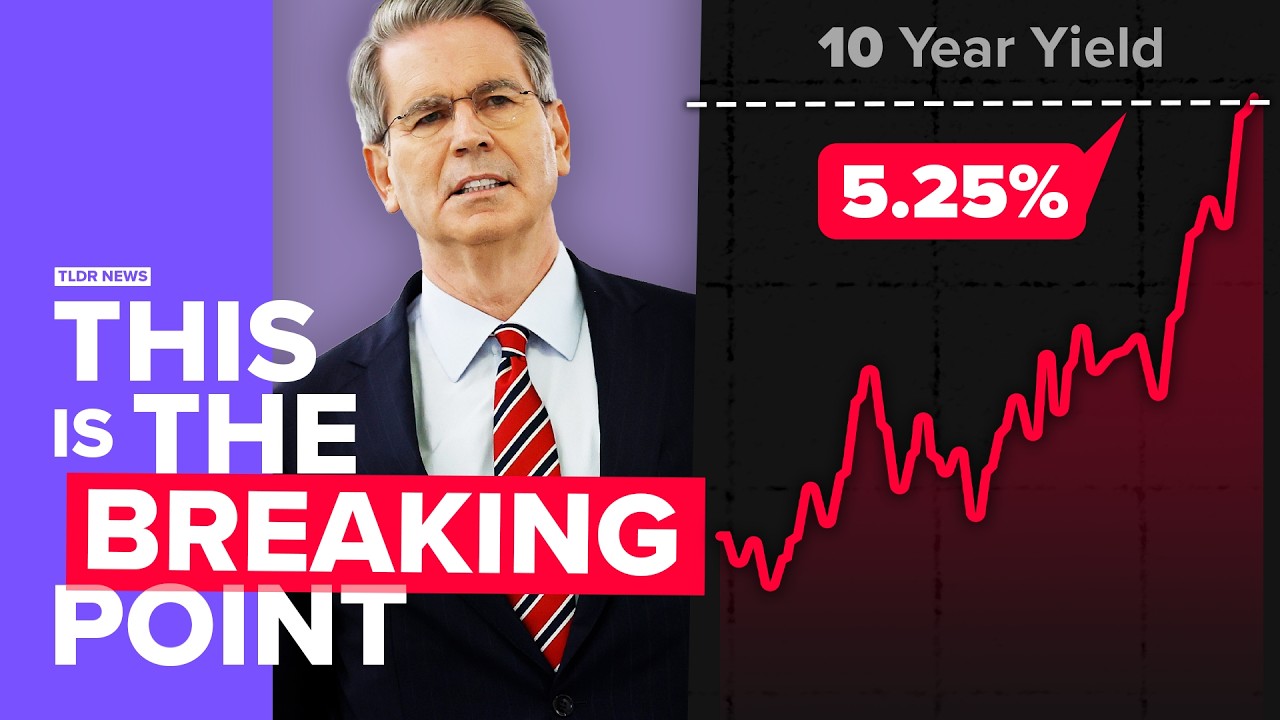
Why 5.25% is the Bond Market’s Tipping Point
This TLDR News explainer breaks down why global bond yields have surged and what that means for the stock market, walking through the mechanics of bond price versus yield using a $1,000 10-year US Treasury bond example before citing Bloomberg analyst Simon White's finding that the usual inverse stock-bond relationship breaks down once the 10-year US yield passes 5.25%. It covers the yield touching a 24-year high of 5.24% amid $108 oil tied to the Iran war, and lays out the risk of a feedback loop between falling stocks (33% of US household wealth) and rising yields. There are no installs, accounts, or code involved; this is a narrated market analysis segment, with the outlet also disclosing its sponsor firewall and editorial policy.
Framing: Bond markets have been under strain, with government bond yields surging worldwide in a sell-off that appears to have started in the US, while stocks have kept ticking up.
- Artifact: A 10-Year Bond Yields chart compares France, the UK, the US, and Germany from Oct 2025 to Sep 2026, showing a recent spike.
- Thesis: The video sets out to explain the relationship between the stock and bond markets and why history suggests trouble once the 10-year Treasury yield passes 5.25%.
- Title: The segment is titled 'Why 5.25% is the Bond Market's Breaking Point,' from TLDR News.
- Policy: TLDR states it maintains a strict funding policy and sponsor firewall so sponsorships do not influence editorial decision-making or content.
+ 31 more takeaways
- Policy: Per its manifesto, only TLDR's internal editorial team determines topics, and no platform, sponsor, or government may dictate, review, or veto reporting.
- Policy: Sponsorship helps fund the work but does not buy access to editorial decisions, and a wall is maintained between business partnerships and journalism.
- Policy: Sponsors are not allowed to review content before it is published.
- Policy: TLDR's review process includes fact-checking, review by the Editor-in-Chief or Deputy Editor-in-Chief for accuracy and neutrality, and a final check by the original writer before publication.
- Policy: TLDR commits to open corrections, reposting corrected videos with an on-screen note explaining what changed rather than quietly editing or deleting.
- Policy: TLDR states it will not use AI to write scripts or articles or to generate voices for its content.
- Policy: Permitted AI uses include background/sky removal in Photoshop with human review, transcription, and finding additional sources to back an argument.
- Reference: [01:01] The manifesto document is linked in the description of every video, at tldrnews.co.uk/manifesto.
- Mechanism: [01:05] Under the tagline 'Real News, Real Humans,' the video states that when bond yields go up, the actual value of the bond goes down.
- Example: [01:12] Example given: buying a $1,000 US Treasury bond with a 10-year maturity and an annual yield of 5%, meaning $50 in interest each year.
- Example: [01:18] The bond's $1,000 face value is repaid in full after its 10-year maturity.
- Example: [01:24] A 5.0% yield on the $1,000 bond means $50 of interest is paid per year.
- Example: [01:28] If the bond can be sold for its full $1,000 value, its yield stays the same.
- Example: [01:32] If the bond can only be sold for $900, the buyer effectively gets a higher yield.
- Example: [01:38] Since $50 is more than 5% of $900, the effective yield in that case is about 5.5%.
- Mechanism: [01:57] When bond yields go up, it means the actual value of the bond is going down.
- Mechanism: [02:20] Stocks and bonds usually move inversely because they are the two main options for investors, so money rotates from one into the other.
- Mechanism: [02:36] Someone worried the AI bubble will pop might move money out of AI-exposed tech stocks and into US government bonds offering a nominal return of about 5% a year.
- Finding: [03:13] Per an analysis of historical market data by Simon White at Bloomberg, the inverse stock-bond relationship breaks down once the 10-year US bond yield passes 5.25%.
- Data: [03:29] Bloomberg data shows the positive stock-bond correlation jumps from 34% in the 5%-5.25% yield bucket to 64% in the 5.25%-5.5% bucket.
- Current situation: [04:16] On Monday morning the 10-year bond yield touched a 24-year high of 5.24%, with both bonds and stocks slumping at market open.
- Current situation: [04:26] Oil opened at $108 a barrel amid the ongoing war in Iran, which the report says shows no end in sight.
- Mechanism: [04:33] Higher energy prices are seen as bad for stocks, especially energy-intensive AI companies, and bad for bonds because they raise inflation and likely interest rates.
- Data: [05:07] A 1-year bond is shown yielding 4.54%.
- Risk: [05:29] The report describes a potential doom loop: a stock slump could hurt consumer spending, lower tax revenues, widen the budget deficit, and push yields even higher, which could hurt stocks further.
- Data: [05:34] Stocks account for an unprecedented 33% of all household wealth in the US, the highest percentage ever by some distance.
- Risk: [06:06] This could be partly offset if weaker consumer spending lowers inflation and interest rates, but the report says inflation will likely stay above target without an Iran deal and a fall in global energy prices.
- Framing: [06:23] The report frames this rise in bond yields as adding another risk factor to an already long list, even though the US and global economies have held up well during the geopolitical turmoil.
- Sponsor break: [06:52] The video transitions to a sponsored segment for ProtonMail, describing it as a private, encrypted email alternative with an Easy Switch tool and a proton.me/TLDR sign-up link.
- If you can sell it on for $1,000, its yield stays the same.
- And after 10 years, the new bondholder would get an extra $100, because the Treasury would still pay back the full $1,000 face value.
![Example: [01:24] A 5.0% yield on the $1,000 bond means $50 of interest is paid per year.](assets/JFTeh7lZ9Cw/frame_85.jpg)
![Example: [01:28] If the bond can be sold for its full $1,000 value, its yield stays the same.](assets/JFTeh7lZ9Cw/frame_107.jpg)
![Current situation: [04:16] On Monday morning the 10-year bond yield touched a 24-year high of 5.24%, with both bonds and](assets/JFTeh7lZ9Cw/frame_297.jpg)
How this brief was shaped: Deep-Dive (coding / tutorial / how-to) · confidence Low
The narrator states an explicit teaching goal, to explain the relationship between stock and bond markets and why history suggests trouble once 10-year treasury yields pass 5.25%, then walks through bond yield mechanics step by step with a worked example. This is a comprehensive-explanation spine with no contested personal thesis, so it maps to deep_dive even though the OCR shows finance tickers rather than code.
The lens sets this brief's structure, never its facts — every claim is held to the same citation and fact-check standard.