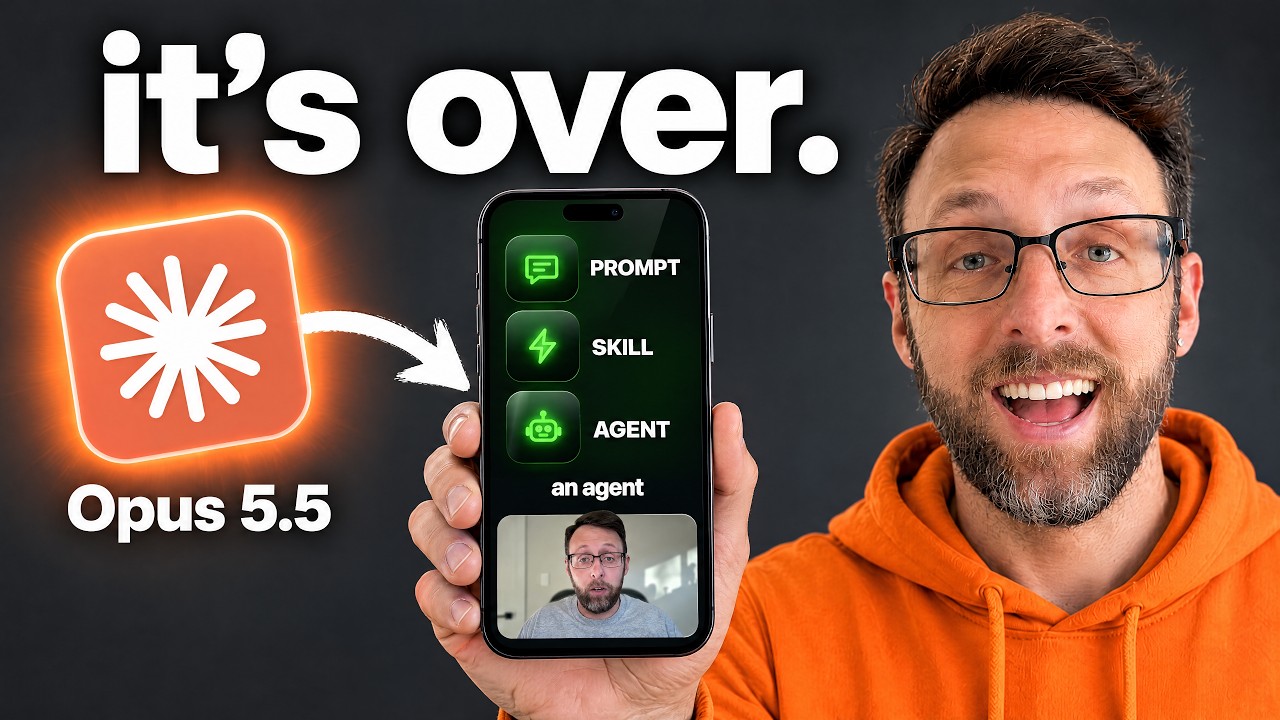
Opus 5.5 Just Changed Video Editing Forever (free guide)
Duncan Rogoff describes a system that automates production of vertical AI-avatar short-form videos for Instagram, handling script writing, an AI avatar's voice and face, motion graphics, captions, music, and scheduling so he no longer pays human editors. The stack as narrated includes Claude Opus 5.5 and Claude Code (via a skill called Shortify) for scripting and orchestration, HeyGen for the AI avatar, FFmpeg for editing, the open-source Hyperframes toolkit for motion graphics, Suno through kie.ai for music, GPT Image 2.5 for thumbnails, and Blotato for cross-platform scheduling and comment-to-DM automation. This is shown as a working system: the creator says he published his first fully AI-generated video from it on the day of recording and reviews its real early performance stats on screen. No OCR or vision pass of on-screen prompts or configs is indicated in the source, so this brief reports narration only.
System does: Automates end-to-end production of vertical AI-avatar short-form videos, graphics, captions, and music to run an Instagram account with less manual editing. [00:20]
- Status: Creator says he published his first fully AI-generated video from this system on the day of recording. [02:18]
- Status: That video reached about 2,500 views roughly four hours after posting. [02:26]
- Status: The video's stats were 80 likes, 85 comments, 119 saves, and 25 shares. [02:31]
- For: Instagram shorts are used to funnel viewers to YouTube and ultimately to the paid Claude Code Club community at $9 a month. [03:08]
+ 42 more takeaways
- Stack: Claude Opus 5.5 is the model used for the video-building workflow. [00:00]
- Stack: Shortify is described as a Claude Code skill that turns one topic into one vertical short with the creator's face, voice, captions, motion graphics, and a comment-to-DM ending. (no timestamp given in source)
- Stack: All video editing is done locally for free using FFmpeg. [07:18]
- Stack: Claude can be instructed to install FFmpeg to trim silences, zoom in and out, and stitch pieces together. [07:25]
- Stack: The cutout effect uses a free service called Apple Vision. [07:36]
- Stack: The AI avatar was built using HeyGen from about 15 seconds of talking-head footage. [07:49]
- Stack: Motion graphics use a free open-source repo called Hyperframes, at hyperframes.dev/design. [08:55]
- Stack: Hyperframes is made by the HeyGen team, the same team behind the AI avatar tool. [09:00]
- Stack: Music is generated with Suno through a platform called kie.ai. [09:29]
- Stack: Content is scheduled through a third-party platform called Blotato, described as his favorite MCP for publishing everywhere. [12:08]
- Stack: Blotato also runs comment automations that DM people who comment a specific word. [12:15]
- Stack: Thumbnails are generated using GPT Image 2.5. [11:36]
- Stack: Creator pays for the Claude Max (20X) subscription plan rather than paying per-API-call rates. [12:43]
- On-screen prompts and config unavailable (narration only); no verbatim prompt or system-instruction text was extracted from this source.
- Wiring: The overall process follows an 8-step system: choose what to build, find hooks that work now, write three scripts, have the AI twin say it, draw each moment, grab the best moments, render the short, then watch/fix/repeat. [04:48]
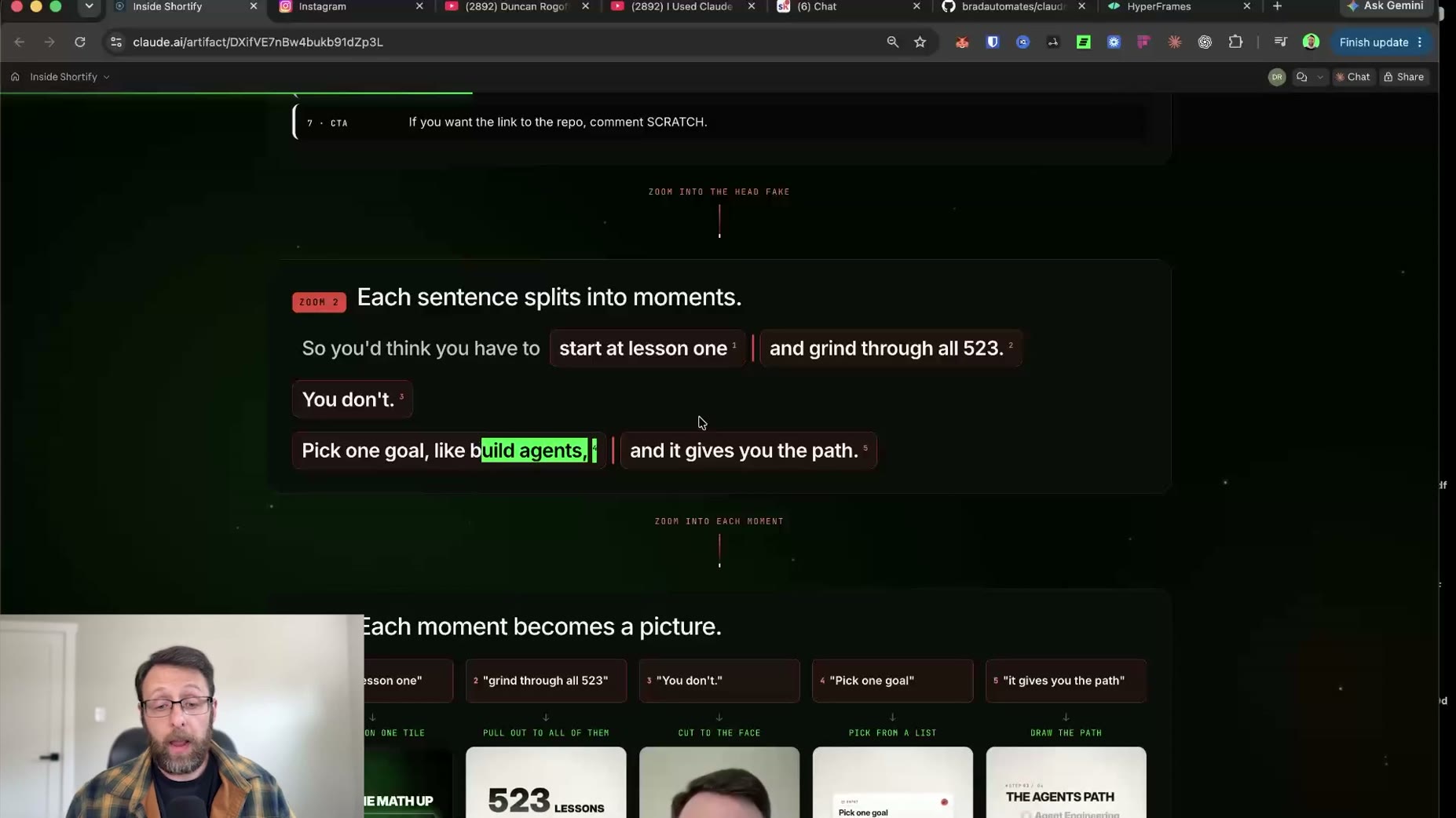
- Wiring: Opus 5.5 analyzes each sentence and splits it into distinct visual moments, e.g. turning 'start at lesson one, grind through all 523' and 'pick one goal' into separate graphics. [06:35]
- Wiring: The script itself is broken into parts: hook, lock-in, head fake, re-hook, list of 3, and payoff. [05:33]
- Wiring: Research is split into three parallel streams, each taking about 2-3 minutes, analyzing other accounts' topics, scripts, and lead magnets. [10:53]
- Wiring: A sub-agent built a topic engine that fetches new topics daily (adjustable to weekly or other intervals). [11:09]
- Wiring: The topic engine researched the Claude Code Club community for existing lessons to draw topics from. [11:15]
- Wiring: Separate sub-agents build free resources, write scripts, and create the digital avatar, while other sub-agents check final output and render music. [11:25]
- Wiring: If a new tool launch is covered, a custom thumbnail is created; otherwise the system reuses the opening graphic from the idea or lesson. [11:40]
- Wiring: Captions are written for every platform, including Instagram, TikTok, X, YouTube Shorts, and LinkedIn. [12:00]
- Wiring rule: the hook segment never cuts, the graphic builds instead, with the first cut delayed until the opening sentence finishes. [09:49]
- Wiring rule: proof that the thing is valuable is given before any explanation. [10:01]
- Wiring rule: a cut happens anytime the idea changes, mixing a bottom-crop shot with a full-frame shot. [10:06]
- Wiring rule: one idea per picture, avoiding too much on screen so viewers aren't confused. [10:16]
- Wiring rule: a technique borrowed from another creator alternates dark-mode and light-mode styling to keep viewers engaged. [10:25]
- Cost: The AI twin render is the most expensive single piece, at $4.84. [12:23]
- Cost: The cover image costs about 14 cents at 2K resolution (1K would be about half the price). [12:29]
- Cost: Topic research costs about 12 cents. [12:37]
- Cost: Full API-rate usage for a script, plan, edit, graphics, and caption checks would run about $13.30. [12:43]
- Cost: Scheduling posts and sending DMs via Blotato costs about $3. [12:59]
- Cost: Music generation costs less than a penny per track. [12:59]
- Cost: One short under the Claude subscription plan totals $8.34, with each music track reused about 5 times. [13:05]
- Cost: Without a Claude subscription, API costs would run about $21 per short. [13:10]
- Cost: Publishing one reel a day costs about $250 a month for 30 reels. [13:12]
- Cost: Publishing three shorts a day costs about $550 a month at higher volume. [13:33]
- Cost comparison: Creator previously paid about $100 per video and produced 15 videos a month, about $1,500 total, one video every two days. [02:09]
- Limitation: Creating the AI avatar is called by far the most expensive piece of the whole system. [08:03]
- Limitation: Earlier posts using the creator's old (pre-Opus 5.5) video style got horrible engagement and he stopped posting them. [02:47]
- Limitation: Instagram grows reach but does not convert well to paying customers; most paying customers come from YouTube instead. [03:12]
![Wiring: The script itself is broken into parts: hook, lock-in, head fake, re-hook, list of 3, and payoff. [05:33]](assets/Juhkw0tL-L0/frame_339.jpg)
![Wiring: Captions are written for every platform, including Instagram, TikTok, X, YouTube Shorts, and LinkedIn. [12:00]](assets/Juhkw0tL-L0/frame_721.jpg)
How this brief was shaped: Personal AI Build / System Demo · confidence Medium
Creator walks through the full pipeline he built to auto-generate AI avatar shorts, and OCR shows a named skill Shortify with a ten-stage system, subagent usage, and starter prompts, matching a system-demo/build shape over a generic tutorial.
The lens sets this brief's structure, never its facts — every claim is held to the same citation and fact-check standard.