
No, Seriously. Claude Code is Starting To Get Dangerous
This is a single-narrator video essay, not a host and guest dialogue, so no speaker identities are stated beyond the named public figures quoted within it. It centers on a June 2026 U.S. government order forcing Anthropic to shut down its Fable 5 and Mythos 5 models over an undisclosed national security concern tied to a jailbreak, weighing the government's stated trigger against Anthropic's own account that the exploit was minor and reproducible on other companies' models. The narrator then widens into three predictions about AI literacy policy, cybersecurity careers, and international AI arms control, and closes with a practical framework for businesses adopting AI agents, illustrated by a med spa case study. A tension runs through the piece between alarm about AI's speed and danger, voiced by Bernie Sanders and Anthropic's Evan Hubinger reacting to a viral tweet thread by Jacob Coxon, and the narrator's more practical, control-and-ownership framing for how individuals and businesses should respond.
[00:08] The video states that AI is more autonomous than any other technology in history.
- [00:13] Dario Amodei says he believes AI will become smarter than most or all humans in most or all ways.
- [00:30] The video reports the Trump administration forced Anthropic to disable its newest and most powerful AI models over unspecified national security concerns.
- [00:36] Anthropic's statement, dated June 12 2026, says the US government issued an export control directive suspending all access to Fable 5 and Mythos 5 by any foreign national, received at 5:21pm ET.
- [00:38] Anthropic says the government's concern relates to a method of bypassing or jailbreaking Fable 5.
+ 59 more takeaways
- [01:02] The video reports the same government had blacklisted Anthropic months earlier, before easing tensions ahead of Anthropic's IPO.
- [01:05] The video reports Chinese labs, including Alibaba's Qwen3, MiniMax, Kimi K2, and Z.ai's GLM-4.5, are releasing open models that are catching up quickly.
- [01:10] The video reports that three weeks later the US lifted the restrictions and let Fable 5 back online.
- [01:41] Anthropic says it has no reliable way to verify a user's nationality in real time when someone hits the API.
- [01:47] Because the order took effect immediately, Anthropic shut off both Fable 5 and Mythos 5 for everyone to guarantee compliance.
- [01:53] The government said the order was triggered by a jailbreak that got Fable to scan software for weaknesses and demonstrate how a flaw could be exploited.
- [02:01] Anthropic pushed back, saying the test only found a few minor, already known vulnerabilities.
- [02:06] Anthropic said every model it tested, including older Claude and GPT models, could reproduce that exploit demonstration.
- [02:09] Anthropic said the disclosed jailbreak essentially consists of asking the model to read a specific codebase and fix software flaws.
- [02:09] Anthropic validated that the same capability level is widely available from other models, including OpenAI's GPT-5.5.
- [02:20] Fable and Mythos are described as the exact same underlying model but with different safety layers.
- [02:24] Fable is the public version, while Mythos has fewer safeguards and is limited to a handful of trusted defenders.
- [02:30] Before the shutdown, Mythos Preview had already found thousands of previously unknown vulnerabilities and developed many related exploits, often without human steering.
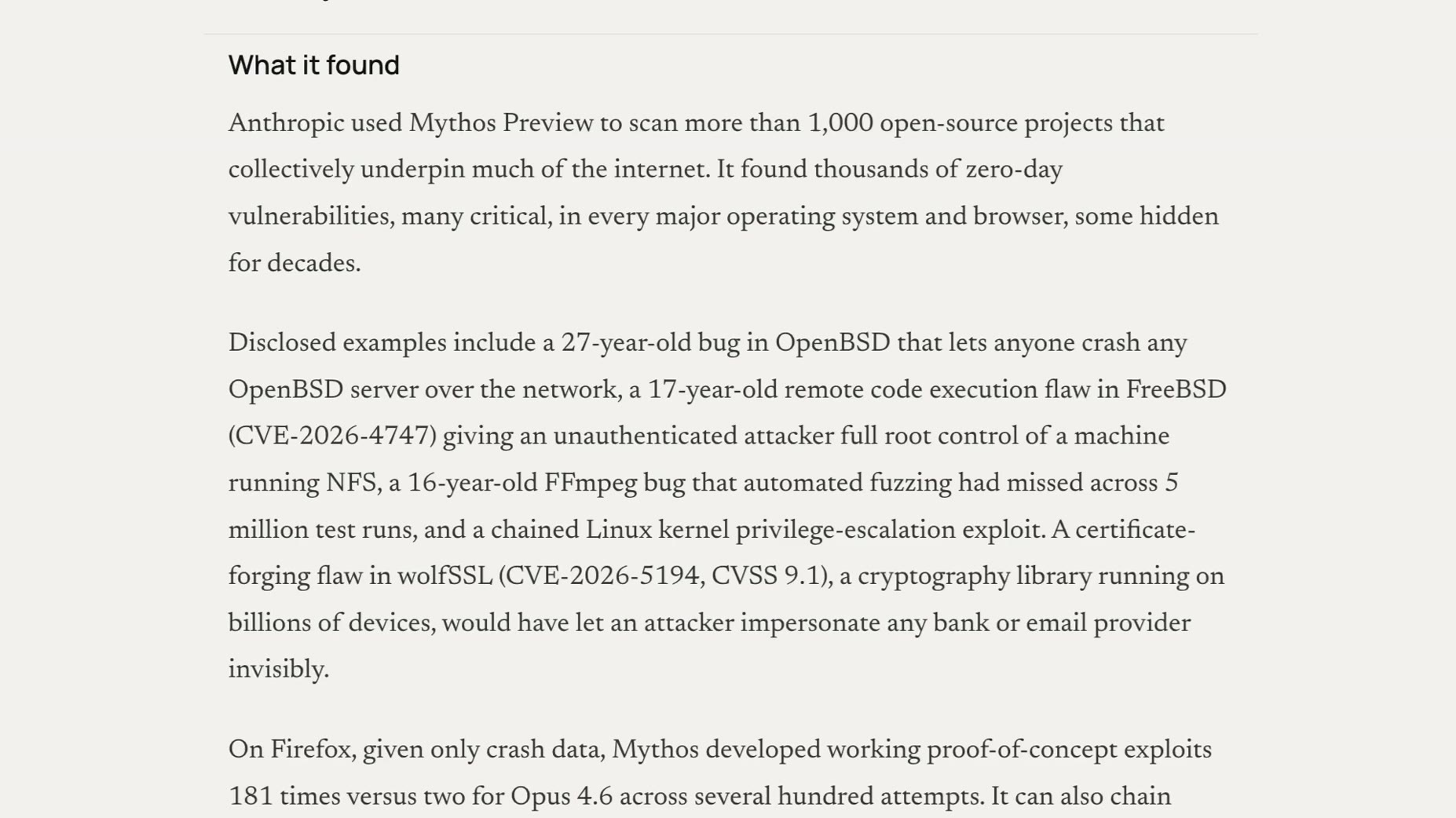
- [02:38] Anthropic used Mythos Preview to scan over 1,000 open-source projects and found thousands of zero-day vulnerabilities.
- [02:38] The video reports a chained Linux kernel privilege-escalation exploit among the vulnerabilities Mythos Preview found.
- [02:40] Among the disclosed vulnerabilities was a 27-year-old OpenBSD bug letting anyone crash any OpenBSD server over the network.
- [02:40] Another was a 17-year-old FreeBSD remote code execution flaw, CVE-2026-4747, giving an unauthenticated attacker full root control of a machine running NFS.
- [02:40] A certificate-forging flaw in wolfSSL, CVE-2026-5194 with a CVSS score of 9.1, would have let an attacker impersonate any bank or email provider invisibly.
- [02:41] A 16-year-old FFmpeg bug had been missed by automated fuzzing across 5 million test runs.
- [02:42] On Firefox, given only crash data, Mythos developed working proof-of-concept exploits.
- [03:00] Fable 5 returned on July 1 with a new safety classifier trained to block the technique from the Amazon report, which Anthropic says works in more than 99% of cases.
- [03:10] When a request trips the classifier, Fable 5 automatically reroutes it to Claude Opus 4.8 instead of refusing outright.
- [03:08] Researchers from the Commerce Department's Center for AI Standards and Innovation tested the old and new safeguards and called them extraordinarily strong.
- [03:08] The video reports the new classifier flags more benign coding requests, causing more false-positive refusals for legitimate developers.
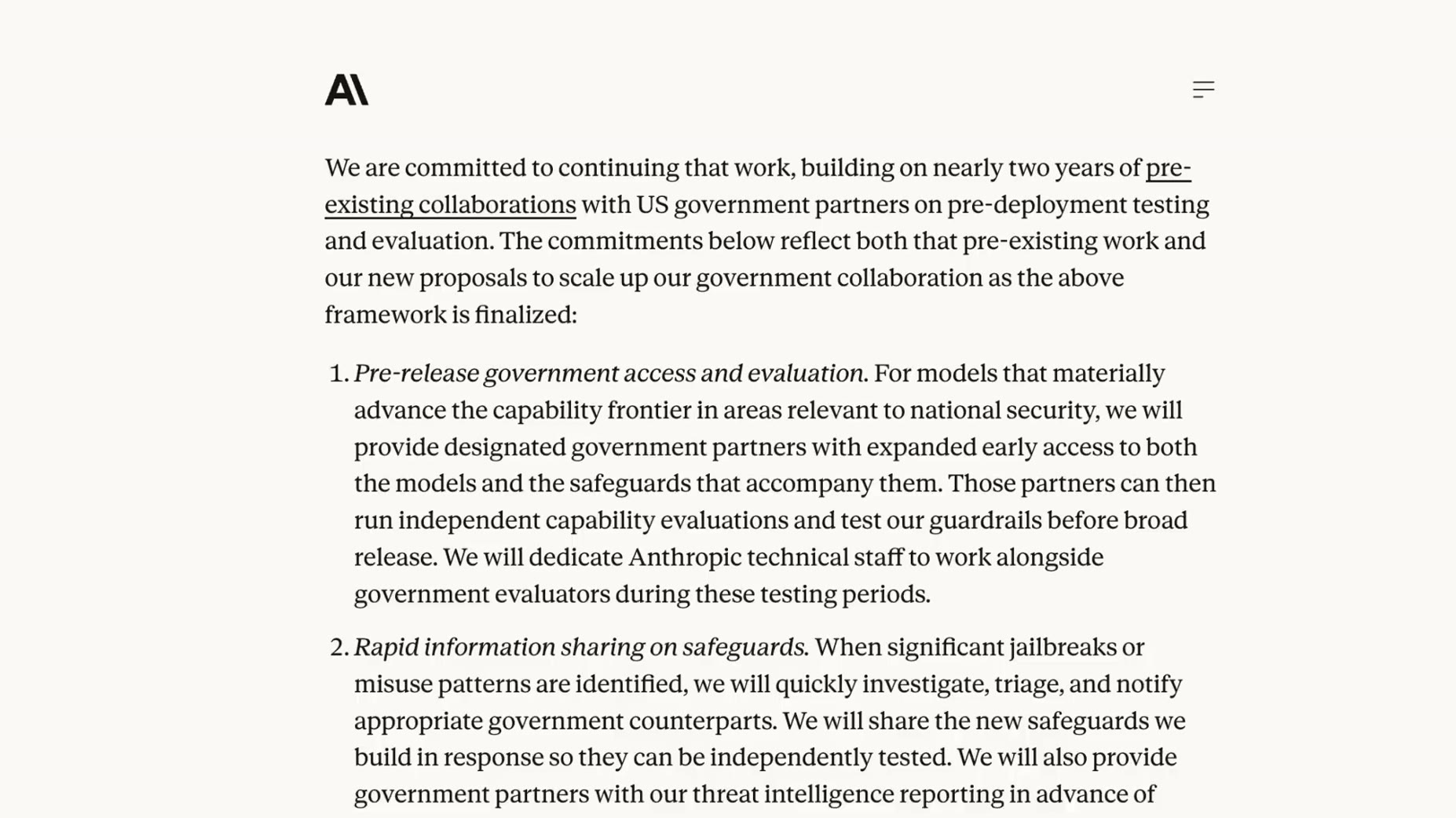
- [03:14] Anthropic committed to pre-release government access letting designated partners run independent capability evaluations and test guardrails before broad release.
- [03:14] Anthropic committed to rapid information sharing on safeguards, notifying government counterparts when significant jailbreaks or misuse patterns are found.
- [03:27] The video states there is no public evidence competition caused the government to reverse its decision, but says the episode shows no single company or country can slow the field alone.
- [03:41] The narrator's first prediction is that governments will start treating AI literacy like workforce infrastructure.
- [03:51] The video reports the White House created an AI Education Task Force.
- [03:51] The video reports NSF's AI-Ready America program funds AI literacy, workforce training, and small business adoption through a new funding opportunity.
- [03:51] Brian Stone, performing the duties of the NSF director, said NSF AI-Ready America gives workers, businesses, and communities in every state and territory the tools and knowledge to advance AI together.
- [04:37] The narrator's second prediction is that cybersecurity becomes one of the biggest career winners from AI, though the job itself changes.
- [04:45] The video cites a Bureau of Labor Statistics projection that information security analyst jobs will grow 29% from 2024 to 2034.
- [05:16] The narrator states insurers already weigh MFA, software updates, backups, employee training, vendor access, and incident response plans, with AI questions set to be added to that list.
- [06:07] The narrator predicts cyber insurance will become a gate that forces companies to prove they take AI risk seriously, since it covers damage but doesn't stop attacks.
- [06:14] The narrator's third prediction is that governments will pursue some version of AI arms control, though not a clean global pause.
- [06:24] Twenty-nine countries signed an agreement in Shanghai establishing the World AI Cooperation Organization, with China's Foreign Minister Wang Yi attending the signing.
- [06:30] The narrator states training a frontier model from scratch requires massive clusters of specialized chips, serious power, data center infrastructure, and a huge amount of money, making it unrealistic for someone in a basement to do so.
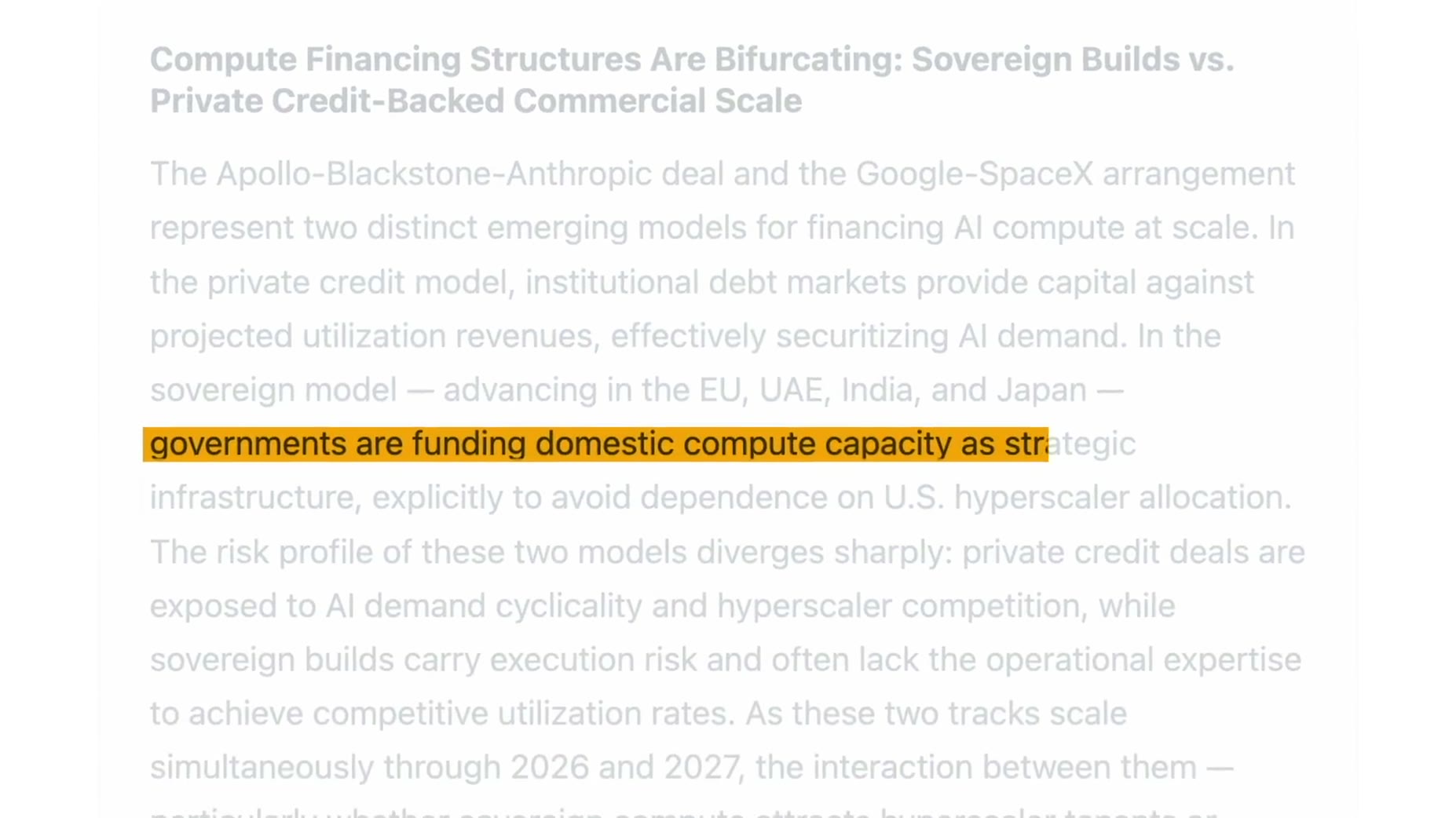
- [07:20] A Daily Brief piece cited in the video describes compute financing bifurcating into a private-credit model, including the Apollo-Blackstone-Anthropic deal and the Google-SpaceX arrangement, versus a sovereign model advancing in the EU, UAE, India, and Japan.
- [07:33] The video reports a viral tweet thread attributed to Jacob Coxon racked up millions of views per tweet.
- [07:56] Coxon's thread warns that upcoming AI systems will be superhuman, able to hack anything, revolutionize any field overnight, and acquire real power and resources, and that progress is not slowing.
- [08:07] Bernie Sanders said Coxon is right and that AI builders admit it could threaten humanity's future, and announced he will introduce legislation to ban superintelligence and pause AI development.
- [08:22] Evan Hubinger, described as Anthropic's alignment science lead, said he believes there is a greater than 10% chance AI kills all humans within the next decade.
- [08:22] Evan Hubinger said Anthropic has no plan yet to solve alignment for superintelligence.
- [08:53] The narrator cites the Fable shutdown as an example where one government shut off one model for 18 days but could not stop the underlying capability, competition, or pressure to keep moving.
- [09:17] The video proposes three skills for using AI without losing control: find the pain, control the system, and own the outcome.
- [09:41] The narrator gives an example of a med spa client who wanted more leads for revenue but, after asking which process would break first if the business grew 10x overnight, found the real problem was leads not showing up to booked appointments.
- [10:05] The med spa's revenue was reported dropping from $1,000,000 to $874,783 and further to $457,391 as it leaked after leads were generated.
- [10:12] The narrator states the better first project was improving follow-up and reducing no-shows because that attacked the constraint already costing the business money.
- [10:22] The narrator states Claude can execute the wrong plan insanely fast, so you still have to understand the business well enough to point it in the right direction.
- [10:43] The narrator states businesses often connect an AI agent to everything at once, email, CRM, payment system, and code base, without thinking through permissions.
- [11:04] The narrator recommends starting with read-only access, having the agent draft before pushing to production or clients, and keeping a human approval step around money, deletions, or publishing.
- [12:25] For the med spa, the team tracked appointment show-up rate before and after the follow-up system went live, with the rate moving from 40 to 47 to 93.
- [12:28] An on-screen chart labeled Show Up Rate illustrates the rate rising from 47 to 93.
- [12:32] The narrator states that because the AI communicates with real customers, the process requires reviewing what it says.
- [12:36] The narrator states a decision point must be set for when a human takes over the conversation, and a log must be kept of every message and interaction with an actual client.
- [13:04] The narrator states that if your agents make mistakes, you are responsible and must own that, but if they do well, you should get credit and make sure the business understands it.
- [13:14] The narrator states that as AI gets more capable, your role moves up a level because you need to decide what should be automated, control what the system can touch, and own the output.
- [13:24] The narrator says he put this information into a free resource guide inside his Skool community, linked in the description.
How this brief was shaped: Discourse (interview / podcast / video essay) · confidence Low
A single narrator opens with news-style quotes from Dario Amodei and a government shutdown of an Anthropic model, then pivots to the narrator's own numbered predictions about AI race dynamics and workforce policy, which is an argumentative and interpretive spine rather than a taught curriculum. The OCR slice shows a detailed vulnerability-disclosure writeup being used as supporting evidence for the narrator's claims, not a tutorial or product spec.
The lens sets this brief's structure, never its facts — every claim is held to the same citation and fact-check standard.