Study Suggests a Bizarre Cause for the Biggest Extinction, But Could It Happen?
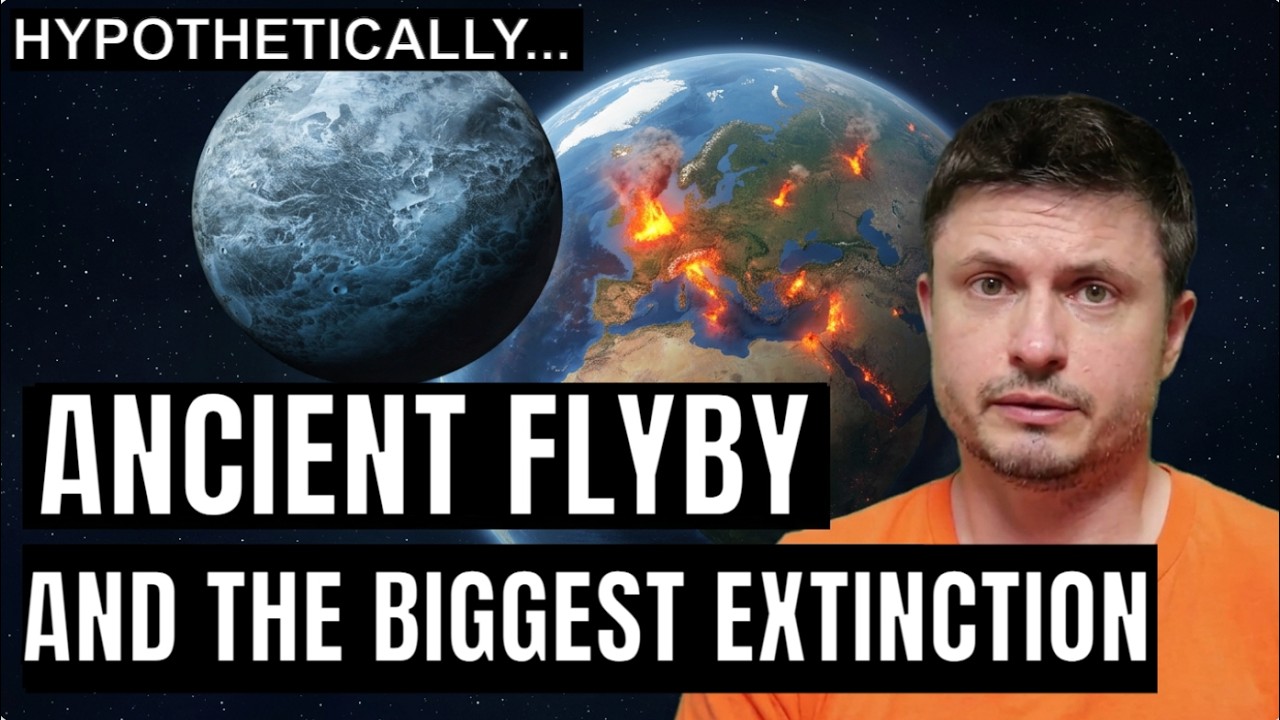
This video, from a science-focused channel whose host's name and credentials are not stated, covers the Permian-Triassic extinction event, known as the Big Dying Event, which occurred roughly 250 to 252 million years ago. The established framework it builds around is the Siberian Traps theory: a massive, long-lasting volcanic eruption in Russia that released carbon dioxide and sulfur, driving global warming, ocean acidification, and anoxia. The video then presents a newer, speculative theory from Daniele Fargion of Rome University (La Sapienza), which proposes gravitational tides from a passing dwarf planet as a contributing cause, while noting there is no evidence such a flyby actually occurred. It closes by linking Fargion's speculation about recurring tidal extinctions to the Fermi Paradox, as a possible reset button for life.
Concept: The video covers the Permian-Triassic extinction event, known as the Big Dying Event, which occurred approximately 250 million years ago and whose cause is still not well understood. [00:36]
- Named study: Daniele Fargion of Rome University (La Sapienza) proposes gravitational tides from a dwarf planet passing close to Earth as a possible cause of the extinction. [00:54]
- Concept: The Great Dying, dated to 252 million years ago, wiped out approximately 90 to 95 percent of all species in the oceans. [01:38]
- Concept: The Great Dying also wiped out at least 70 percent of animal species on land. [01:38]
- Concept: Insects, usually very resilient, suffered their largest mass extinction to date during this event. [01:49]
+ 30 more takeaways
- Concept: The long-standing explanation for the Great Dying involves the Siberian Traps, a massive stair-like volcanic rock formation stretching across a large part of Russia. [02:11]
- Mechanism: The Siberian Traps were produced by a volcanic eruption spanning about 7 million square kilometers, making it one of the largest known volcanic events in the last 500 million years. [02:22]
- Mechanism: The Siberian Traps eruption is dated to around 251.9 million years ago and very likely lasted at least 2 million years. [02:35]
- Caveat: The video notes that the exact cause of the Siberian Traps eruption itself is still debated. [02:43]
- Mechanism: The eruptions very likely released huge amounts of carbon dioxide and sulfur, changing the climate within a few thousand years, first causing global warming and ocean acidification and eventually anoxia. [02:46]
- Mechanism: This anoxia, or lack of oxygen, very likely caused much of ocean life to suffocate. [03:06]
- Comparative example: The fossil Claraia clarai is cited as an example of ocean life killed by this anoxia. [03:06]
- Concept: Average global temperature rose by about 8 degrees Celsius, or about 14 degrees Fahrenheit, during the event, making survival on the surface extremely challenging. [03:17]
- Mechanism: Proposed additional causes include an extra release of methane from the seafloor. [03:37]
- Comparative example: The Araguainha Crater in Brazil, about 40 kilometers wide and much smaller than the crater from the impactor 65 million years ago, formed around the same time as the extinction but is considered too small to explain it on its own. [03:37]
- Named study: The new paper's premise is that many dwarf planets, unknown when earlier extinction theories were proposed, have since been discovered, including many in the Kuiper Belt, with many more still undiscovered. [04:16]
- Mechanism: Dwarf planets with unstable orbits can get gravitational nudges toward the inner solar system. [04:53]
- Comparative example: This kind of gravitational nudge is known to have happened at least once, when Neptune captured its moon Triton via a nearby flyby, which destroyed other moons and created Neptune's rings. [04:53]
- Mechanism: Direct collisions between such objects and planets are extremely rare according to orbital dynamics, but a flyby is statistically at least 100 times more likely. [05:16]
- Mechanism: Because tidal strength grows with the inverse cube of distance, an object 10 times closer than the Moon would create tides a thousand times higher, not ten times higher. [05:16]
- Named study: Fargion's calculations suggest a close flyby involving Earth could create oceanic waves over one kilometer in height, a megatsunami rivaling one from an actual impact. [06:06]
- Mechanism: The video states that energy deposited by tidal forces grows with the inverse sixth power of distance, so a close flyby could release energy equivalent to 10 billion Hiroshima bombs in just one hour. [06:27]
- Mechanism: That energy could dramatically deform Earth's crust, causing massive earthquakes and powerful volcanic eruptions triggered by frictional heating of the planet's interior, according to this theory. [06:40]
- Named study: Fargion argues that effects of similar gravitational flybys may be visible on other planets, possibly explaining their axial tilts, while Earth's own axial tilt is believed to result from a direct collision with Theia. [06:57]
- Comparative example: Jupiter shows a slight tilt and an unexplained internal heat source that the video cites as possible evidence of a past collision. [07:21]
- Comparative example: The coral fossil record shows Earth's rotation suddenly slowed at the end of the Devonian period, about 360 million years ago, suggesting something acted on the Moon or Earth to slow its spin. [07:44]
- Caveat: Despite being an intriguing proposition, the video states there is no evidence for a close flyby event and no known object in the inner solar system could have had such an effect on Earth, so the dwarf planet theory is presented without cited confirming evidence. [08:09]
- Mechanism: According to a study referenced in the video but not named, mega El Ninos during this period were far stronger than any today and possibly lasted decades instead of months. [08:49]
- Mechanism: Computer models suggest weather patterns became much stronger and more destructive, leading to major forest decrease and killing land animals. [08:58]
- Mechanism: Runoff into the oceans from these extreme weather events is proposed to have killed off ocean life. [09:11]
- Caveat: Some studies cited in the video suggest land-based animals might not have experienced a mass extinction, with most surviving. [09:32]
- Why it matters: The video concludes that volcanic eruption remains the best explanation for the Great Dying despite decades of research, unlike the extinction event 65 million years ago, which is well understood. [09:51]
- Why it matters: Fargion suggests that if astrophysical tidal extinctions happen every few hundred million years, they could act as a reset button for life, which he connects to the Fermi Paradox. [10:49]
- Why it matters: Unlike an asteroid, which could theoretically be diverted, a passing dwarf planet represents a different kind of threat. [11:22]
- Why it matters: Because of its total mass, a passing dwarf planet would be practically impossible to divert or stop and would have dramatic effects on the entire surrounding neighborhood. [11:29]
How this brief was shaped: Lecture / Educational Explainer · confidence Medium
Transcript is one narrator systematically explaining an established scientific topic, the Permian extinction and its causes, citing named research and mechanisms like Siberian traps and anoxia rather than arguing a personal thesis. OCR sample is just an end-credits supporter list, so it adds nothing and confidence leans on transcript alone.
The lens sets this brief's structure, never its facts — every claim is held to the same citation and fact-check standard.