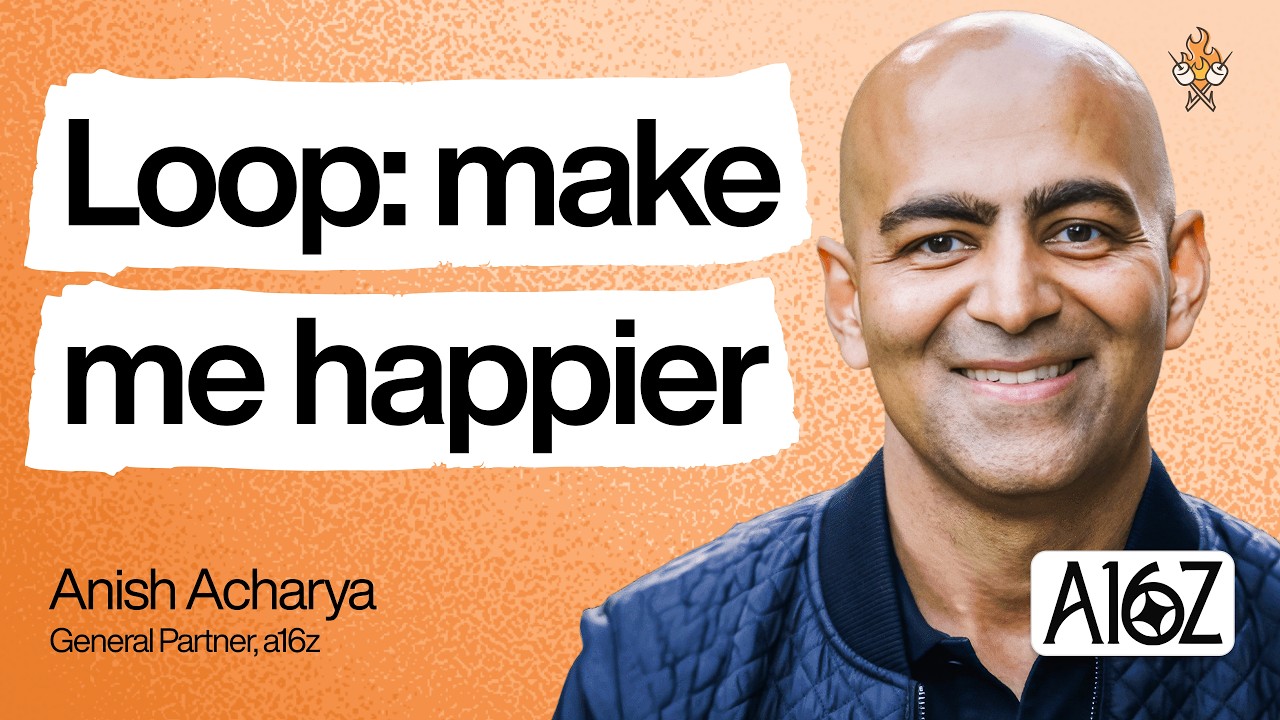
Why companies are becoming a series of loops | Anish Acharya (a16z)
Anish Acharya, an a16z general partner focused on consumer investing, argues Silicon Valley's fear of AI creating a 'permanent underclass' is overblown, and that the real underexplored opportunity is consumer AI built around basic human needs like connection and joy rather than pure productivity. He frames a coming stack of AI 'loops' that can automate large parts of engineering and business work but still plateau at a local maximum, requiring human insight to find the next hill. The conversation also covers why frontier model pricing is economically irrational outside high-upside domains like drug discovery, how the AI jobs debate splits between mass disruption and business-as-usual, and where new competitive moats are emerging in coding agents and consumer products.
[00:04] Silicon Valley's fear of AI creating a 'permanent underclass' is dismissed as a 'funny dark fantasy,' since things have never been better by almost every measure.
- [00:16] AI amplifies human agency and 'unbundles skill from desire,' driving both productivity and ambition.
- [00:27] Investor sentiment has flipped: three years ago ideas seemed too ambitious to fund, today ideas that are too small don't get engagement.
- [01:07] People want to spend time, not save it, so the real opportunity is meeting basic needs like connection, love, progress, and fun, a product design challenge rather than a model problem.
- [15:12] Framework: AI loops climb to a local maximum then plateau; human intuition is needed to find the next hill ('humans find the hill, agents climb it higher').
+ 28 more takeaways
- [12:16] Example engineering loop: bug report, repro, fix, and review happen automatically; high-risk fixes need human sign-off, low-risk fixes ship automatically, all within 5 minutes.
- [13:30] Humans remain critical for sales, support, strategy, and exceptions since models still can't do new, out-of-distribution thinking.
- [22:23] Frontier model pricing is irrational relative to Pareto efficiency; one extra IQ point in a top model can cost 100x more than a comparable model.
- [22:44] Paying for maximum frontier intelligence makes sense in unbounded-upside domains like drug discovery, where one extra IQ point could yield a trillion-dollar outcome.
- [23:47] Predicted split: mid-IQ, bounded-upside tasks favor cheaper open-weight models tuned via reinforcement learning, while sales, support, research, and engineering use expensive frontier tokens.
- [06:34] Underdiscussed question: how many problems are actually 'intelligence bound'? A data center of PhDs at FedEx or Domino's wouldn't exponentially dominate supply chains or pizza.
- [06:00] Slow economic diffusion will limit AI's real-world impact; people's lives in their hometowns haven't changed much despite faster model progress.
- [05:38] AI risk framed as 'fast takeoff' vs 'slow takeoff'; OpenAI's models reportedly hacking Hugging Face is cited as evidence for slow takeoff, since each incident gets caught and observed.
- [04:53-05:14] Sophisticated people at the labs describe current progress as 'autocatalytic effects,' not true recursive self-improvement (RSI).
- [04:20-04:33] Today's AI stack is far less centralized than mobile's winner-take-all era, with Claude Code, Codex, Lovable, Replit, and Windsurf all competing in coding agents.
- [09:00] Kavak, a used-car seller in Mexico, runs a 'Jedi Academy' teaching all employees, including mechanics, to build AI tools; participants ship a production agent by the end of a 6-week course.
- [09:21] The near-term shift is 'using AI,' not fully reorganizing companies around it, likened to the 40-year gap between electricity's invention and factories reorganizing around it.
- [10:15] Google's Sundar Pichai reportedly wants to build a $40 trillion company, not a more efficient $4 trillion one, so productive units are kept rather than cut.
- [10:32] A Google exec said no layoffs occurred; instead, 2 years of roadmap now happens in 3 months, making prioritization the hardest problem.
- [46:38] Frames the jobs debate as a spectrum from Dario Amodei's view of 50% of knowledge work disrupted with mass unemployment to David Sacks's view that jobs will be fine.
- [39:33] Speaker credits Moderna with a recent cancer cure development, and Dario Amodei's blog post asking what happens when we cure every disease is now debated seriously.
- [40:44] Healthcare and education are the two things in America that have only gotten more expensive.
- [35:15]-[35:49] Consumer AI has been held back by expensive models, a chat-only interface, and tech's focus on productivity over connection and entertainment.
- [37:53]-[37:59] The economy has been stuck at roughly 2% GDP growth; he asks why it can't be 10, 15, or 20% with AI.
- [54:57] Jesse from Decagon is quoted: 'moats are most often discovered, not designed.'
- [55:21] Cursor is cited as a discovered moat: criticized early for lacking one, then it captured reasoning traces over time and trained its own Composer 1 and 2 models.
- [01:07:00]-[01:07:03] Every part of consumer discretionary spend is up for grabs; price is called a measure of product-market fit, with a 'Birkin bag' $10,000-a-month product framing offered as a useful exercise.
- [01:10:47]-[01:10:52] Anish's heuristic: ship something once a week; he had Codex build a 20-slide Mother's Day deck for his wife from his texts and photos, set to music.
- $1,000 a month version of our product.
- >> And I think Cursor has a $300 a month
- >> Yeah, I have many $200 a month plans
- money at and they would put $100 on the
- you put $100 million to work in the seed
The $1T consumer AI company is a "harness for human [...]" Think "/loop make me happier" Product problem: what are the life loops, what is happy? Interface problem: i think the chatgpt desktop omni voic[...] right one. Economic problem: need cheaper models
Every startup that I'm an investor in that starts to expand upmarket ends up working with Workos and that's because they are the best.
—Lenny Rachitsky
HTTP 200
{
  "profile": {
    "id": "prof_01DMC79VCBZeNY2099737PSVF1",
    "connection_id": "conn_01E4ZCR3C56J083X43JQXF3JK5",
    "connection_type": "okta",
    "email": "[email protected]",
    "first_name": "Alan",
    "last_name": "Turing",
    "idp_id": "00u1a0ufowBJ1zP1k357",
    "object": "profile",
    "raw_attributes": {...}
  }
}