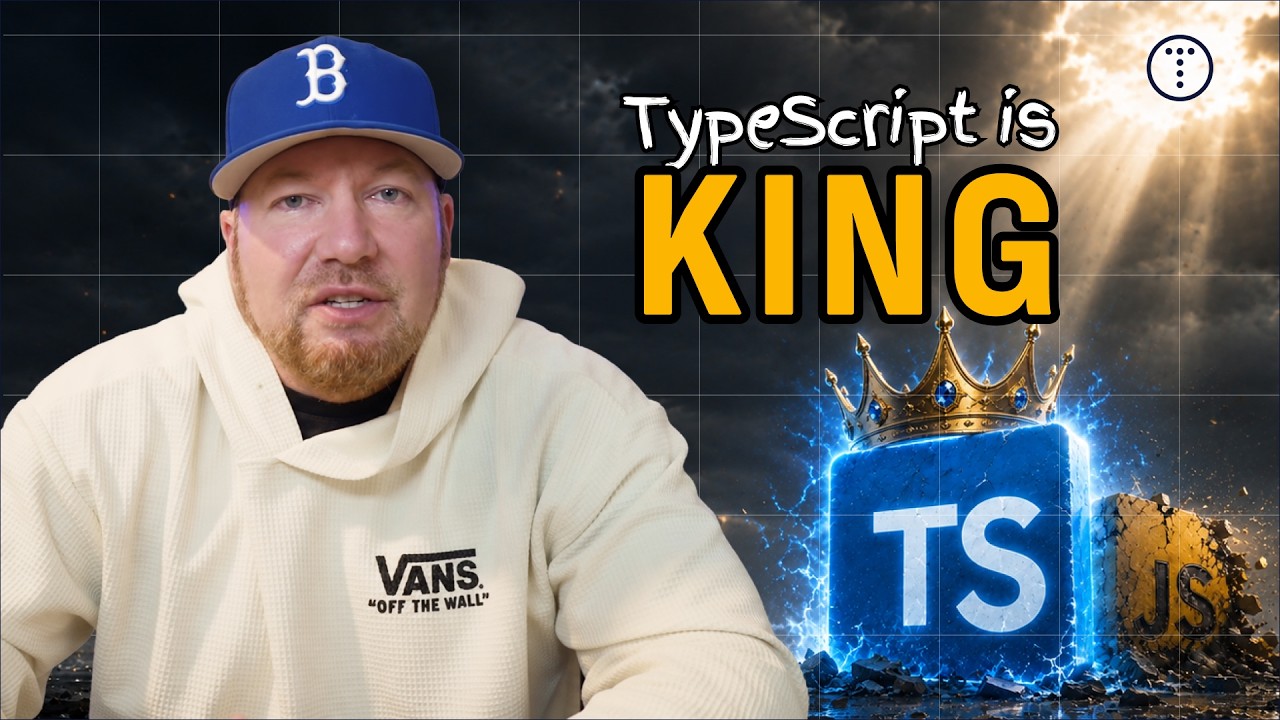
Does Anyone Use JavaScript Anymore?
Brad Traversy argues that JavaScript is not dead, but TypeScript has become the default language across most of today's framework-heavy web ecosystem, a view echoed by a featured guest he calls AB, who still recommends beginners learn JavaScript first. The claim rests on GitHub's 2025 Octoverse report showing TypeScript passed both Python and JavaScript as the top language by monthly contributors, the 2025 State of JS survey finding respondents spent 77% of their JS/TS coding time writing TypeScript, and both speakers' own experience that their current projects are now mostly .tsx/.ts files. Traversy also flags a countervailing GitHub stat, that JavaScript still had more new repositories created overall in the same period, and both speakers maintain plain JavaScript still fits for small scripts and for teaching fundamentals.
Thesis: JavaScript is not dead and still runs pretty much the entire interactive web, but TypeScript has become the default across most of the framework-heavy ecosystem [01:52]
- Ask: video is sponsored by Code Rabbit, a PR review tool shown grouping changes into layers and flagging merge blockers instead of listing files alphabetically [00:58]
- Anecdote: Traversy says his current projects mostly contain .tsx and .ts files rather than .js or .jsx, and TypeScript has become the default for most of the web projects he works on now
- Sourced claim: per GitHub's 2025 Octoverse report, TypeScript became the number one language on GitHub by monthly contributors, passing both Python and JavaScript [02:21]
- Sourced claim: the 2025 State of JS survey found respondents spent 77% of their JavaScript/TypeScript coding time writing TypeScript versus 23% JavaScript [02:34]
+ 24 more takeaways
- Counterpoint (sourced): GitHub still saw more new JavaScript repositories created overall from Sep 2024 to Aug 2025 despite TypeScript's contributor lead [02:48]
- Argument: React, Vue, and Angular all have TypeScript support, with Angular components being TypeScript classes since Angular 2 [03:09]
- Argument: Node can now run TypeScript files directly by stripping out the types and running the JavaScript underneath [03:37]
- Unsourced claim: new React Native projects use TypeScript by default for mobile apps, and Electron has TypeScript templates for desktop apps
- Unsourced claim: the application layer around AI has a lot of TypeScript even though Python remains massive in AI and machine learning
- Unsourced claim: Vercel's AI SDK markets itself as "The AI Toolkit for TypeScript"
- Unsourced claim: prompting Claude or Codex to create a React app will most likely produce TypeScript
- Anecdote: the speaker, a developer for over 15 years, says JavaScript was once seen as a toy scripting language before Node.js and modern front-end frameworks, used mainly for things like form validation and dropdowns [05:32]
- Argument: TypeScript brought static types, interfaces, generics, and compile-time checks, already common in languages like Java, C, and C++, giving the JavaScript ecosystem more structure and credibility
- Evidence: a demo shows renaming a field on a shared User type causes TypeScript to flag errors across every component, API route, and function still referencing the old name, shown as "3 ERRORS IN 3 FILES" [06:44]
- Anecdote: AB says he was against TypeScript for a long time and was criticized online for it, partly because it felt like a lot of extra setup
- Argument (AB): TypeScript makes code more verbose but better defined, with types acting as contracts that explain how pieces fit together
- Argument (AB): frameworks, libraries, and build tools now support TypeScript extremely well and it is the default for most of them
- Argument (AB): TypeScript's inference has improved enough that strong type checking is possible without manually annotating everything
- Anecdote (AB): a lot of his code is now written with AI, and types give one more feedback loop, though typed code can still be "perfectly typed garbage" and should never replace tests or code review
- Opinion (AB): beginners should learn JavaScript first, covering functions, objects, arrays, scope, asynchronous JS, and the DOM, before TypeScript, since JS runtime knowledge helps debug TS issues
- Ask (AB): his team built a TypeScript Fundamentals course, available now on Start.dev, an interactive learning platform for coding languages and stacks
- Ask: the TypeScript Fundamentals course is linked in the description, free to start with a 20% discount for premium membership [09:54]
- Ask: a Validation with Zod course is mentioned as a next step after learning TypeScript [10:09]
- Counterpoint: the instructor says not every project needs TypeScript and he still uses plain JavaScript when it fits, giving an example of a small averaging script, avg.js versus avg.ts with tsconfig.json [10:14]
- Counterpoint: plain JavaScript also makes sense for teaching fundamentals like functions, the DOM, HTTP, Node.js, or runtime behavior, since a type system can add clutter
- Argument: TypeScript adds value but also adds concepts, configuration, and a new category of errors developers must understand [11:00]
- Argument: JavaScript still powers the web and TypeScript depends on it [11:00]
- Argument: TypeScript is now normal across frontend, backend, monorepos, mobile, desktop, tooling, and AI application layers, but this doesn't mean beginners should skip JavaScript [11:00]
type Props = {
  label: string
  onPress: () => void
}
export const Button = ({
  label,
  onPress,
}: Props) => <button onclick={onPress}>
  {label}
</button>import {z} from "zod"
export const signUpSchema = z.object({
username: z.string().min(3, "Username must be at least 3 characters"),
email: z.email("Enter a valid email address"),
password: z.string().min(8, "Password must be at least 8 characters"),
[...]// 1. Declare movieTitle with the type string, give it a movie title, and con[...] const movieTitle: string = "Spiderman"; console.log(movieTitle); // 2. Declare releaseYear with the type number, give it a year, and console.l[...] const releaseYear: number = 2026; console.log(releaseYear); // 3. Declare isStreaming with the type boolean, set it to true or false, and const isStreaming: boolean = true; console.log(isStreaming);
const user = { id: "u_1", name: "Brad", tags: ["admin", "author"] }
const ids = user.tags.map((tag) => tag.toUpperCase())
function total(items: { price: number }[]) {
  return items.reduce((sum, item) => sum + item.price, 0)
}
const cart = [{ price: 12.5 }, { price: 4 }]
const due = total(cart)export function sortAscending(items: number[]): number[] {
return [...items].sort((a, b) => b - a)
}How this brief was shaped: Trend Commentary / Opinion Essay · confidence Low
Single narrator argues a thesis that TypeScript has become the ecosystem default, citing survey time-spent stats and GitHub new-repo counts as evidence while also giving personal opinion on when JS still makes sense; OCR sample is a GitHub PR review screen tied to the CodeRabbit sponsor read, not the video's core content.
The lens sets this brief's structure, never its facts — every claim is held to the same citation and fact-check standard.