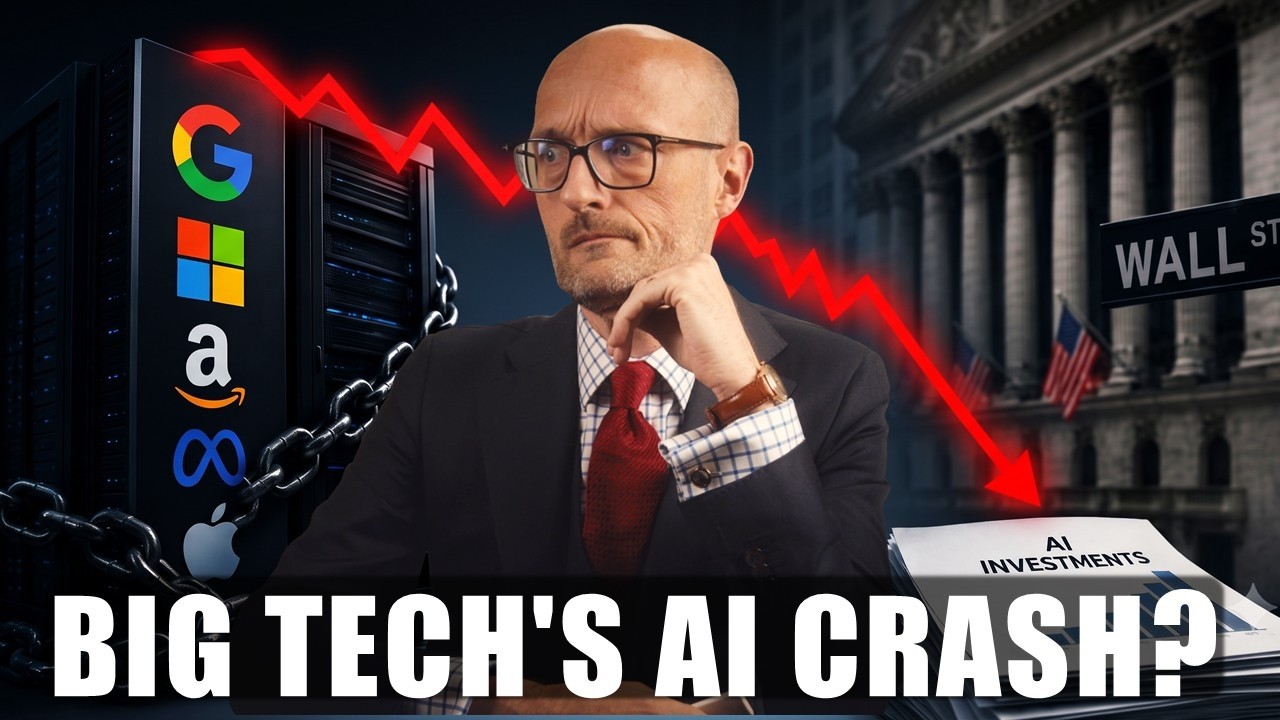
Big Tech's Hidden Debt Problem
The creator reports that Nikkei Asia and the Financial Times found the five biggest US tech companies carrying $1.65 trillion in off-balance-sheet obligations, including a $50 billion Nvidia lease deal for a single Texas data center and nearly $900 billion in new AI commitments signed by three companies in one quarter, while financial YouTube commentators have branded the situation 'Enron all over again.' The creator argues this comparison is wrong: in their view the debt is not hidden fraud like Enron but disclosed long-term purchase and lease commitments that standard accounting rules keep off the balance sheet until goods are delivered or a building is operational. The creator further contends the real risk is not concealment but circular financing, where Nvidia is lending money to the same companies buying its chips, and cites The Economist's estimate that AI would need to generate roughly $2.5 trillion a year in revenue to justify the spending, a figure current AI revenue falls well short of. The creator predicts, per Jamie Dimon's comparison, that AI will eventually pay off similarly to the internet but not on the timetable people currently expect.
Confirmed: Nikkei Asia reported the five biggest US tech companies are carrying $1.65 trillion of debt not on their balance sheets [00:00]
- Source cited: Financial Times found Nvidia signed $50 billion in leases for a single data center (the Beacon Point site) in Texas full of its own chips [00:16]
- Confirmed: Three companies signed nearly $900 billion of new AI commitments in a single quarter [00:38]
- Confirmed: Microsoft signed more than $130 billion of new data centre leases in Q2 and added another $68 billion in July [00:46]
- Confirmed: Amazon has yet to post these detailed disclosures, and executives told analysts AI outlay would continue to sap free cash flow [00:46]
+ 41 more takeaways
- Take (unnamed financial YouTube commentators): the situation is 'Enron all over again' [00:59], later restated as commentators with large followings but no accounting background reaching this conclusion [01:02]
- Take (creator): Enron was a fraud hiding debts in secret off-book entities so investors' visible accounts were fiction, and the charge against Big Tech is that this is deliberate fraud on a criminal scale, the same as Enron [01:58]-[02:32], a framing the creator sets up to rebut
- Take (creator): much of the 'hidden' debt is actually long-term purchase agreements for chips and leases on data centers not yet built, and under standard accounting rules undelivered goods or non-operational buildings are disclosed in footnotes, not recorded as balance-sheet liabilities [02:45]-[03:15]
- Take (creator): this is the same principle as a phone contract, where a $50/month, 24-month deal totals over $1,000 but isn't booked as a lump-sum liability at signing, just paid monthly, and tech firms are doing the same thing with more zeros, like a 15-year Ohio data center lease [03:18]-[03:50]
- Source cited: Wall Street Journal piece 'Investors Circle Largest Corporate Cash Hoard Ever' by Sebastian Pellejero and Paul J. Davies, updated Dec. 4, 2020, referenced by the creator regarding past criticism of tech cash hoarding [03:55]
- Confirmed: Microsoft, Alphabet and Amazon's disclosed cloud-service backlogs totaled roughly $1.45 trillion as of end of March, and AWS CEO Matt Garman called the investments 'not speculative' [06:35]
- Confirmed: Meta formed a joint venture with Blue Owl Capital for a $27 billion Louisiana data center announced in 2025 [06:35]
- Confirmed: In June, Alphabet completed the largest equity raise in corporate history, almost $85 billion, anchored by a $10 billion check from Berkshire Hathaway, reportedly at about a 6% discount to market price [06:42]-[07:09]
- Confirmed: Goldman Sachs, JPMorgan Chase and Morgan Stanley are joint book-running managers for the offering, with Goldman as placement agent for the private placement [07:01]
- Confirmed: Google disclosed its future AI-linked financial commitments ballooned by about $500 billion from three months prior [08:16]
- Confirmed: Meta signed $233 billion in new commitments last quarter, including $96bn in leases, $112bn in purchase commitments, and $25bn in new debt [08:17]
- Take (creator): the reporting tactic isn't Enron-like fraud but camouflage that only works on people not paying close attention, done in plain sight under 'adjusted earnings' [08:56]-[09:08]
- Take (Charlie Munger, cited by creator): replace 'EBITDA' with 'bullshit earnings' in your head every time you read it, since depreciation is a reverse float where cash is paid upfront and expensed later [09:33]-[09:41]
- Confirmed: The four biggest hyperscalers posted their lowest combined free cash flow in a decade, $7 billion between them, and Alphabet went cash negative for the first time since going public [10:05]
- Source cited: Aswath Damodaran of NYU Stern, in a Financial Times piece, called adding back stock-based compensation one of the worst abuses in modern reporting and said 'adjusted earnings' are the two words investors should dread most [10:34]
- Take (creator): stock-based compensation is not a non-cash expense like depreciation but a barter, since if a company sold shares for cash to pay employees everyone would call it a cash expense [10:43]-[10:50]
- Source cited: Warren Buffett has asked for years if options aren't compensation, what are they, and if expenses shouldn't count toward earnings, where should they go [11:05]-[11:23]
- Confirmed: Nvidia is working on a round of AI deals worth more than $750 billion, including talks to backstop $250 billion for OpenAI computing power and financing $350 billion of OpenAI's chip purchases [12:16]-[12:29]
- Confirmed: Nvidia is investing $5 billion in Safe Superintelligence, run by Ilya Sutskever, using Vera Rubin chips [12:35]
- Confirmed: Google agreed to backstop lease payments at five data centers, effectively a $35 billion loan to Anthropic [12:42]
- Confirmed: SoftBank committed $65 billion to OpenAI and took out a $40 billion bridge loan to finance it [12:51]
- Take (Jensen Huang, Nvidia CEO): the suggestion that these AI deals are circular is 'ridiculous,' saying of the CoreWeave investment it's a small percentage of money companies ultimately have to raise [13:38]
- Source cited: Financial Times reported Nvidia's unlisted equity investments hit $42 billion at end of April, up from $3 billion a year earlier, after a $30 billion OpenAI investment and $10 billion in Anthropic [13:56]
- Confirmed: Nvidia has $200 billion in liquid assets and generates roughly $200 billion a year in operating cash [15:10]
- Source cited: Bloomberg (Caleb Mutua and Paula Seligson) reported the cost of insuring Nvidia's debt against default jumped by the most on record in a single day, coinciding with this round of AI deals [15:39]
- Take (creator): the real risk is not that the AI market is smaller than hoped but that buyers and makers of AI chips are increasingly the same people, i.e. circular financing [16:00]
- Source cited: The Economist estimates the AI build out is on track to be the largest investment surge in history, with about $900 billion spent this year on chips, data centers and power, over $400 billion of it borrowed [17:36]-[17:44]
- Source cited: The Economist estimates the AI industry would need to earn roughly $2.5 trillion a year to cover that spending, more than the entire global tech sector currently earns, and the creator notes actual AI revenue is not close to that figure [17:59]-[18:14]
- Source cited: A Bank of England study found the average American executive spends about 100 minutes a week using AI, and 75% of firms are already using AI (versus 58% in 2022), with nine out of ten executives saying AI made no difference to productivity over the past three years [18:27]-[19:13]
- Confirmed: Fintech firm Ramp found the median firm spends $10.66 per employee per month on AI [18:52]
- Confirmed: SpaceX's IPO prospectus claimed a $28.5 trillion total addressable market, 93% ($26.5 trillion) attributed to AI/Grok, shares priced at $135 [20:50]
- Source cited: Raymond James set an $800 price target valuing SpaceX over $10 trillion, despite under $19 billion in revenue and over $37 billion in accumulated losses before its IPO [21:25]-[21:51]
- Confirmed: An analyst totaled SpaceX's disclosed cash commitments through 2030 at roughly $235 billion, leaving a gap of about $170 billion after IPO proceeds, to be filled via more stock and debt [22:02]-[22:20]
- Confirmed: Out of roughly 30 analysts covering SpaceX, only one rated it a sell, from an independent firm with no underwriting business [23:25]
- Source cited: JPMorgan Chase posted its highest quarterly profit in history, Q2 net income of $21.2 billion, driven by trading revenue and a gain on its Visa stake
- Take (Jamie Dimon): companies are still waiting for $20/month subscriptions to add up to the $2.5 trillion a year needed to pay off the AI buildout
- Take (Jamie Dimon): geopolitical instability, persistent inflation and stretched asset valuations are threats shifting below the surface like tectonic plates
- Prediction (Jamie Dimon): the AI investment wave will probably pay off in total like the early internet did, but definitely not on the timetable or in the way people currently expect
- Take (Aswath Damodaran, Columbia Business School): valuation is a story disciplined by numbers, and AI is currently an expensive story told by companies lending each other money to buy their own products [31:49]
- Open question: what happens as Nvidia's guarantees climb into the hundreds of billions and a historically debt-averse company ends up standing behind everyone else's debt [15:20]
- But you don't sit down and record a $1200 liability on your personal balance sheet the day you sign.
How this brief was shaped: News Analysis / Commentary · confidence Low
margin rule: 'trend_commentary' 0.62 vs 'news_analysis' 0.55 (margin 0.07 < 0.08) -> demoted to 'news_analysis'. A single narrator builds a thesis around whether the Enron comparison to Big Tech off balance sheet debt holds, citing Nikkei and Financial Times figures and testing commentator claims against reported numbers like Meta's 233 billion in new commitments. The OCR sample is an unrelated student cell phone contract with no bearing on the video content, so the routing rests almost entirely on the transcript.
The lens sets this brief's structure, never its facts — every claim is held to the same citation and fact-check standard.