Who Really Pays for AI Data Centers?
The video reports on the US data center buildout and the backlash to it: Cleanview puts current capacity at about 65 gigawatts with 413 more planned, a Heatmap Pro/Embold Research poll finds roughly three in four Americans would oppose a local data center, and the video cites specific disputes including an NAACP lawsuit over unpermitted gas turbines at xAI's Memphis/Mississippi site and an NDA-bound rezoning fight in Perry Village, Ohio. It also reports financial-market strain tied to the buildout, including CoreWeave's debt selloff and rising AI-linked credit default swap costs, per Bloomberg, the FT, and Matt Levine. The creator argues the water-use objection to data centers 'mostly falls apart' under scrutiny, but treats noise, electricity costs, and the use of NDAs and front companies as more substantive problems. In the creator's view, and per commentary from Ezra Klein and Liaquat Ahamed that the video relays, the AI industry is repeating the 19th-century railroad boom's pattern of competitive overbuilding whose costs may ultimately fall on towns, ratepayers, and financiers rather than the companies driving it.
Confirmed: America has about 65 gigawatts of data centers built with 413 more gigawatts planned, equal to enough electricity for roughly 330 million new homes in a country of about 135 million households, since a gigawatt powers about 800,000 homes, per energy data firm Cleanview [00:16].
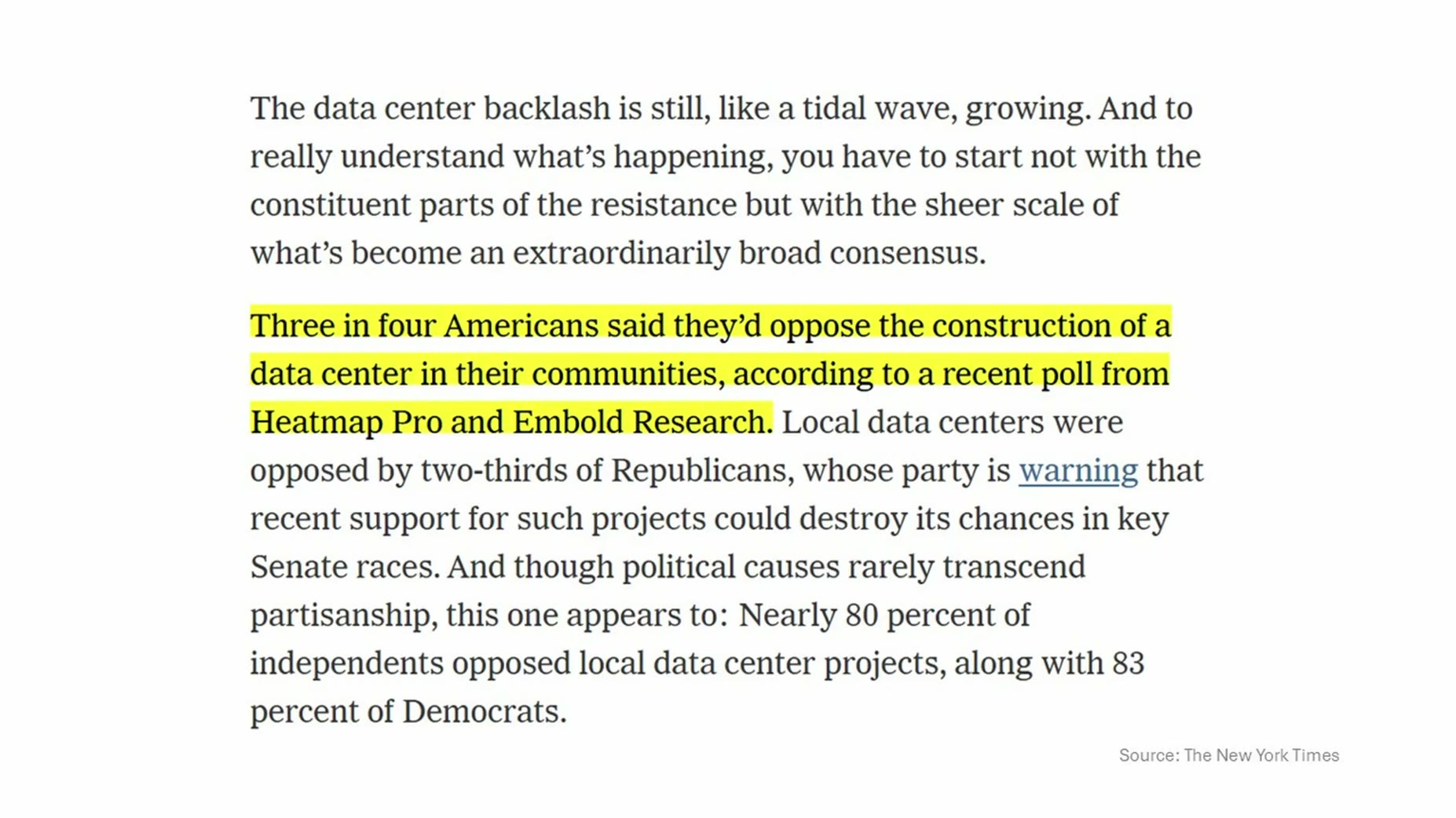
- Confirmed: A Heatmap Pro and Embold Research poll found three in four Americans would oppose a data center being built in their community, with about two-thirds of Republicans, nearly 80% of independents, and 83% of Democrats opposed, and data centers now poll worse than nuclear plants, coal plants, solar and wind farms, Amazon distribution centers, factories, and semiconductor plants [01:09].
- Take (creator): The water-use argument against data centers 'mostly falls apart' under examination [02:33].
- Confirmed: A mid-sized data center uses about as much water as two golf courses, and crop irrigation uses 74 times as much water as data centers, per The Economist [02:39].
- Confirmed: Google calculated the median Gemini text prompt consumes about five drops of water, meaning tens of thousands of AI queries would use less water than a minute in the shower [02:49].
+ 73 more takeaways
- Confirmed: Low frequency rumble from data centers travels farther and passes through walls more than high frequencies, so neighbors feel it as much as hear it [03:07].
- Source cited: The Economist reports many viral videos of 'screaming' data centers are actually crypto mines, thousands of fan-cooled computers in shipping containers each about as loud as a vacuum cleaner [03:22].
- Confirmed: YouTube science creator Ben Jordan studied infrasound at data centers and crypto mines using specialist equipment [03:43].
- Confirmed: In Ben Jordan's pilot study, infrasound was played to over 100 unaware people, and the exposed group reported noticeably more discomfort and dizziness than the control group [04:06].
- Source cited: EPRI, funded largely by the power industry, found that in the typical state, power would have been about 6% more expensive without data centers built between 2019 and 2024 [04:54].
- Confirmed: In PJM, the grid spanning Illinois to New Jersey, the Independent Market Monitor estimates $6.3 billion of future capacity costs stem from planned data centers operating in 2028/2029 [05:25].
- Source cited: Joe Bowring of Monitoring Analytics said this cost 'is not something the data centers are actually paying themselves' but 'a cost being imposed on all customers in the PJM footprint,' which serves over 67 million customers [05:39].
- Confirmed: PJM's Jeffrey Shields declined to comment on the Monitoring Analytics estimate, saying only 'Their numbers are their numbers' [05:39].
- Source cited: A University of Virginia poll found the median payment it would take for a resident to support a local data center is $10,000 [07:45].
- Source cited: The Economist calculated paying every resident of a median-sized American county that amount would cost about $240 million, calling it 'pocket change' for the tech industry [07:59].
- Confirmed: In Richland Parish, Louisiana, revenue from a Meta data center project gave many local teachers a bonus of $51,000, more than most of them earn in a year in salary [08:20].
- Confirmed: Georgia calculated it will lose $2.5 billion in data center sales tax exemptions this fiscal year alone [08:33].
- Source cited: Journalist Jasmine Sun found that in Wisconsin and Michigan, data center developers arrive in small towns behind front companies using friendly project codenames like 'Project Cannoli' and 'The Barn' [09:04].
- Confirmed: xAI's Colossus project underperformed because Grok usage fell short of Elon Musk's expectations, so xAI sold compute capacity to Anthropic, which needed more data centers [09:18].
- Confirmed: Local officials are often asked to sign NDAs so residents don't learn what's being built until it appears on the council's agenda [09:19].
- Confirmed: In Perry Village, Ohio, population 1,600, the mayor and key council members signed NDAs with a California developer before negotiations began [09:29].
- Source cited: Per the magazine Persuasion, the planned Perry Village data center would cover about a sixth of the village and border the school baseball field [09:41].
- Source cited: Commissioner Beverage said the contract required the village to deliver a clean deed free of any referendum, or financial ruin would follow [09:50].
- Confirmed: In Saline Township, Michigan, the board voted four to one against rezoning the land, but the developer sued for exclusionary zoning and the town settled for a few million dollars for the fire department and schools [10:19].
- Take (Ezra Klein): Silicon Valley's worldview is formed by seeing impossible problems proved solvable, while Washington's is formed by seeing possible problems prove impossible [11:21].
- Take (Ezra Klein): The AI industry solved seemingly impossible problems in code but is now finding it hard to put up a large shed in rural Michigan, because a zoning board must be persuaded, unlike code, which either works or doesn't [11:53].
- Take (creator): Musk's solution to slow grid upgrades was to bring his own power plant, a fleet of gas turbines in South Haven, Mississippi, to feed power to the Tennessee data center [12:21].
- Confirmed: Mississippi allows portable equipment to run for up to a year without an air permit [12:57].
- Confirmed: The NAACP sued xAI over the turbines' lack of permits and sought an injunction after learning the number of temporary mobile turbines had risen to 33, which MDEQ later confirmed was actually 46 [12:58].
- Source cited: Lawyers from the Southern Environmental Law Center argue Mississippi is misinterpreting the federal Clean Air Act's definition of a stationary turbine to let xAI bypass the permit process [12:58].
- Confirmed: xAI said in January it was running 27 turbines; MDEQ counted 46 in May, 60 in June, and 69 by July, with 42 added in 2026 under a rolling timetable letting some remain into 2027 and the newest stay through July 2027 [13:11].
- Source cited: Abre' Conner, who leads the NAACP's environmental and climate justice work, said the organization wanted to prevent other tech companies from seeing xAI's approach as a viable option [13:16].
- Confirmed: An acoustics firm found low frequency noise near the plant could be 4 to 16 times louder than background levels in a quiet neighborhood, with residents comparing it to a plane taking off that never leaves [13:34].
- Confirmed: A $7 million sound wall does little to muffle the noise; the data center sits in Memphis's Whitehaven neighborhood north of the Tennessee line while the main power site is across the border in Southaven, Mississippi, so the gas burns in Mississippi while electricity crosses to Tennessee to power Colossus 2 [13:43].
- Confirmed: According to the NAACP's lawsuit, the portable turbine fleet in Southaven could produce about 26 times the smog-forming nitrogen oxides of the nearby TVA gas plant [13:54].
- Source cited: Reuters found xAI installed far more gas turbines without federal permits than it publicly acknowledged, with pollution hitting predominantly Black neighborhoods hardest [13:54].
- Confirmed: Residents filed a class action lawsuit over lost sleep and falling property values, and the NAACP separately sued arguing this is an unpermitted power plant [14:10].
- Source cited: A South Haven alderman said the turbines are unpermitted but not illegal, since the company has one year before it must get a permit [14:28].
- Confirmed: The Justice Department asked the court to dismiss the NAACP suit, arguing keeping Grok running is a matter of paramount national security for the Department of War's military operations [14:36].
- Source cited: DoD chief digital and AI officer Cameron Stanley wrote that Grok Gov Mode enabled US forces to deploy over 2,000 munitions to 2,000 distinct targets within 96 hours during the US-Iran war [14:39].
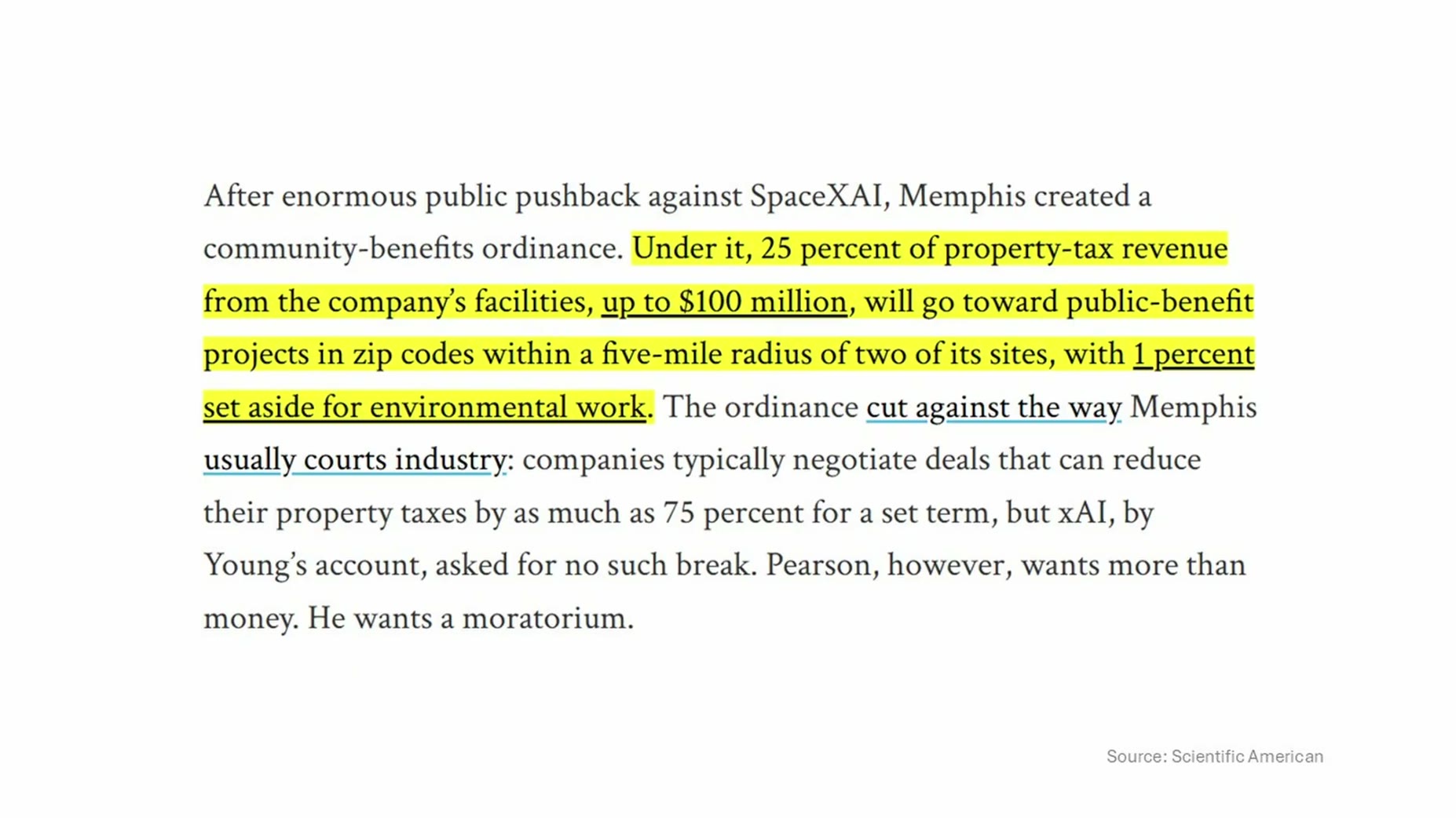
- Confirmed: Memphis passed a community-benefits ordinance sending 25% of property taxes from xAI's facilities, up to $100 million, to neighborhoods within a five-mile radius, with 1% set aside for environmental work, and the mayor says xAI never asked for a tax break [14:50].
- Confirmed: xAI promised Memphis a water recycling plant for cooling, but construction stalled with the plant half built [15:10].
- Source cited: Scientific American notes finishing the recycling plant would cost about $100 million, less than three days of what Anthropic reportedly pays to rent the computers, said to be $1.25 billion a month [15:20].
- Confirmed: Last quarter SpaceX took in $14.6 billion in revenue and spent $19.6 billion on chips, data centers and other costs, with Musk saying spending will roughly double this quarter [15:45].
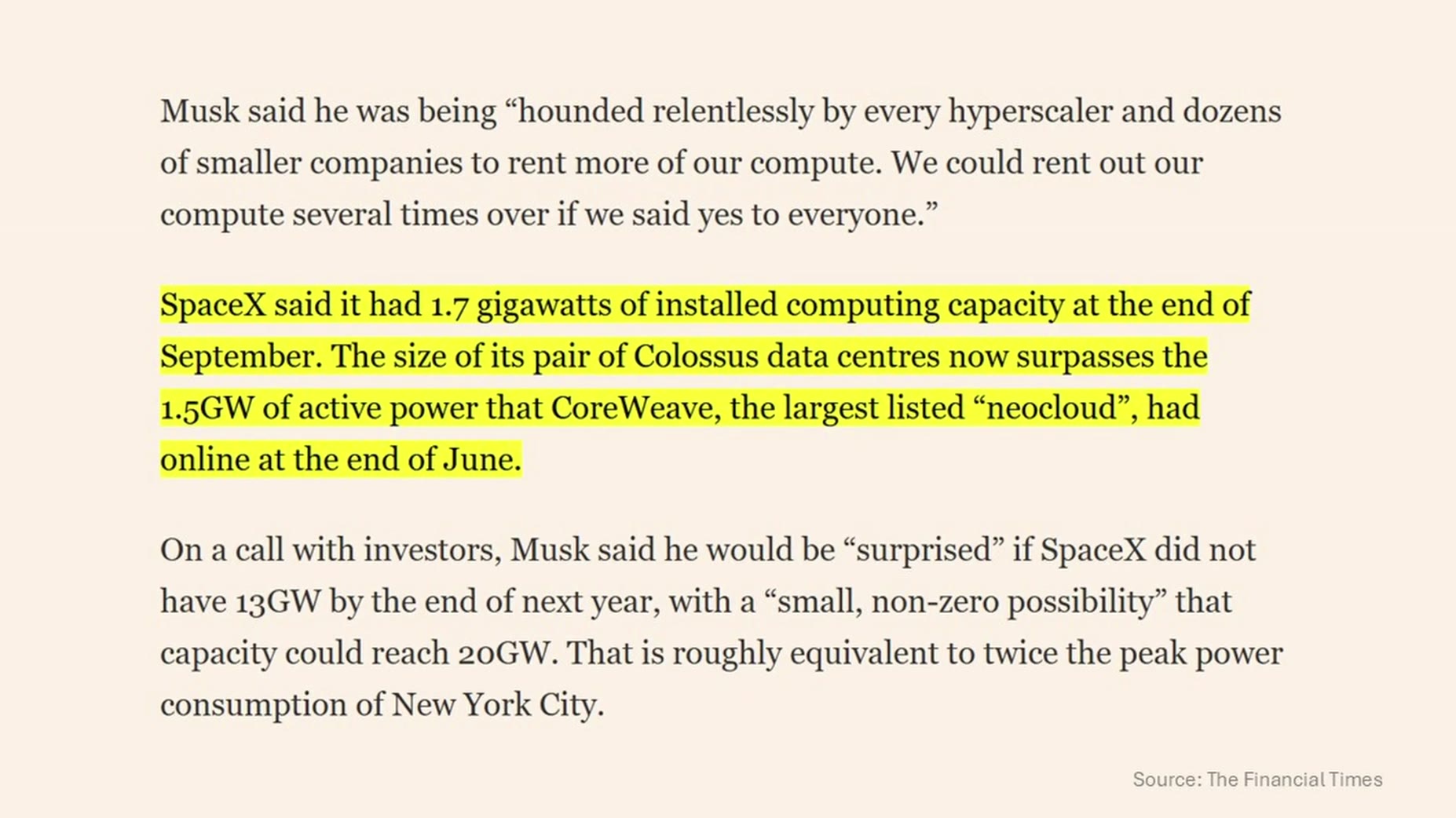
- Prediction: Musk said he would be surprised if SpaceX didn't have 13 gigawatts of capacity by end of next year, with a small non-zero chance of reaching 20 gigawatts, roughly twice New York City's peak power consumption [16:07].
- Confirmed: Data center developer QTS issued $4.6 billion of bonds in April at a 5.7 percent yield partly because Microsoft was the tenant, but investors later found the bonds wouldn't be fully paid off before Microsoft's initial lease ends [17:15].
- Confirmed: By August, when QTS returned to the market, investors demanded a 7.2 percent yield, comparable to junk-rated company borrowing costs [17:47].
- Confirmed: Insuring $10 million of CoreWeave debt for five years via a credit default swap costs $1.95 million upfront plus $125,000 per quarter, about 11% of the insured amount annually [18:48].
- Confirmed: CoreWeave's shares plunged 20% over the first three sessions of the week, including more than 15% on Wednesday, as its debt fell to distressed levels [19:28].
- Confirmed: On Thursday morning, the cost of insuring CoreWeave bonds hit its highest intraday level on record, with swaps pricing in a more than 60% chance of default within five years [19:28].
- Confirmed: By Thursday afternoon the stock rebounded as Nvidia CEO Jensen Huang expressed confidence in CoreWeave and Deutsche Bank called the selloff a buying opportunity [19:28].
- Source cited: CoreWeave co-founder Brannon McBee told the FT insurer capital is effectively 'unlimited,' calling it 'all the money in the world that sits in the insurance tranche' [19:40].
- Source cited: Matt Levine notes five-year CDS on Oracle cost about 0.33% of principal per year five years ago, as an idiosyncratic, cheaply insurable risk [21:00].
- Source cited: Levine says the same Oracle CDS now costs about 3.3% per year since Oracle became strapped into the AI build-out, making the risk systematic rather than idiosyncratic [21:08].
- Source cited: Robert Armstrong wrote in the FT that infrastructure build-out of this size cannot happen without the investment-grade bond market [21:50].
- Source cited: Per Armstrong, the six hyperscalers and big chip makers are now worth about 20% of the entire world stock market, put at $3 trillion [22:27].
- Source cited: So far this year $466 billion in AI debt has been issued, according to Morgan Stanley [22:35].
- Confirmed: In 2017 Foxconn arrived in Mount Pleasant, Wisconsin promising 13,000 high-paying jobs, and the village of 28,000 spent hundreds of millions on roads, water lines, and tax incentives [23:32].
- Confirmed: Foxconn changed its mind, the village ended up with about a thousand jobs and the infrastructure bill, and the cleared land is now home to a Microsoft data center where neighbors are suing over the hum [23:50].
- Confirmed: New York State spent almost a billion dollars building a Buffalo factory for Solar City, later bought by Tesla, and the state's comptroller found it got about 54 cents of economic benefit for every dollar spent [24:11].
- Confirmed: Many states now require data centers to sign long contracts or pay exit fees to cover grid upgrade costs [24:27].
- Source cited: Matt Levine notes OpenAI once suggested the US government should be the insurer of last resort for AI credit risk [24:53].
- Source cited: A union official for electrical workers wrote in the New York Times that his members' hours have doubled in a decade [25:40].
- Source cited: A 23-year-old drainage worker in Ohio told The Economist he makes $204,000 a year, comparable to a junior investment banker [25:55].
- Confirmed: In Loudoun County, Virginia, a tax on computer equipment inside its 250+ data centers is expected to supply 40% of the county's total tax revenue next year, letting it cut property taxes by about 30% [26:21].
- Source cited: Only about 3% of households were paying for AI in February per the Bank of America Institute, though that figure grew about 10% year over year [26:52].
- Source cited: Princeton professor Arvind Narayanan calculated the average one-year state-level AI moratorium would slow AI capability growth by only a matter of hours [27:20].
- Confirmed: More than 1,500 data center projects are underway across the US with perhaps thousands more in planning, and only a small fraction have been canceled or delayed despite opposition [27:35].
- Source cited: Eirgrid forecasts Irish data center electricity demand will double between 2023 and 2034, rising from 22% to 31% of national electricity demand [27:52].
- Source cited: Economist Stijn Van Nieuwerburgh of Brookings estimates the AI infrastructure boom will cost about 3.6% of US GDP a year over eight years to the end of 2032, totaling $10.3 trillion in tangible expenditures [28:11].
- Confirmed: Substantially all of the hyperscalers' profits have been staked to fund the buildout, plus new debt these companies are taking on directly or guaranteeing [28:28].
- Confirmed: Satya Nadella described a new history of the 1873 railroad bubble by Pulitzer Prize winning author Liaquat Ahamed as the book to read, per a Microsoft earnings call [28:38].
- Take (Liaquat Ahamed): He believes Nadella misread the book's lesson, concluding careful individual behavior prevents overbuilding while missing the collective action problem where each hyperscaler acting carefully can still sum to irrational, overbuilt outcomes driven by competitive pressure [29:05].
- Take (Liaquat Ahamed): Overbuilding is inevitable once companies succumb to competitive pressure to be first, since not everyone can be first [29:11].
- Confirmed: When the Panic of 1873 hit, around a billion dollars of railroad bonds defaulted, and many local governments also defaulted, prompting states to rewrite constitutions to limit town borrowing [29:31].
- Confirmed: The Granger movement, organized by Midwestern farmers angered by railroad practices, helped produce the Interstate Commerce Commission, America's first federal regulator [29:47].
- Take (creator): The railroads got built and built the country, but the people who financed the build-out never got their money back [30:00].
- A town resident costs $10,000, teachers bonus $51,000, overruling a township costs a few million, payable to the fire department, and ensuring $10 million of AI debt costs $1.
How this brief was shaped: News Analysis / Commentary · confidence Medium
margin rule: 'discourse' 0.66 vs 'news_analysis' 0.60 (margin 0.06 < 0.08) -> demoted to 'news_analysis'. A single host argues a thesis about AI data center backlash using national stats, a poll on resident opposition, and a detailed Perry Village council and referendum timeline, weaving jokes and opinion throughout with no second speaker, product, or lecture context, so the spine is argumentative and interpretive rather than a plain news recap.
The lens sets this brief's structure, never its facts — every claim is held to the same citation and fact-check standard.