How Everything Went Wrong for Saudi Arabia
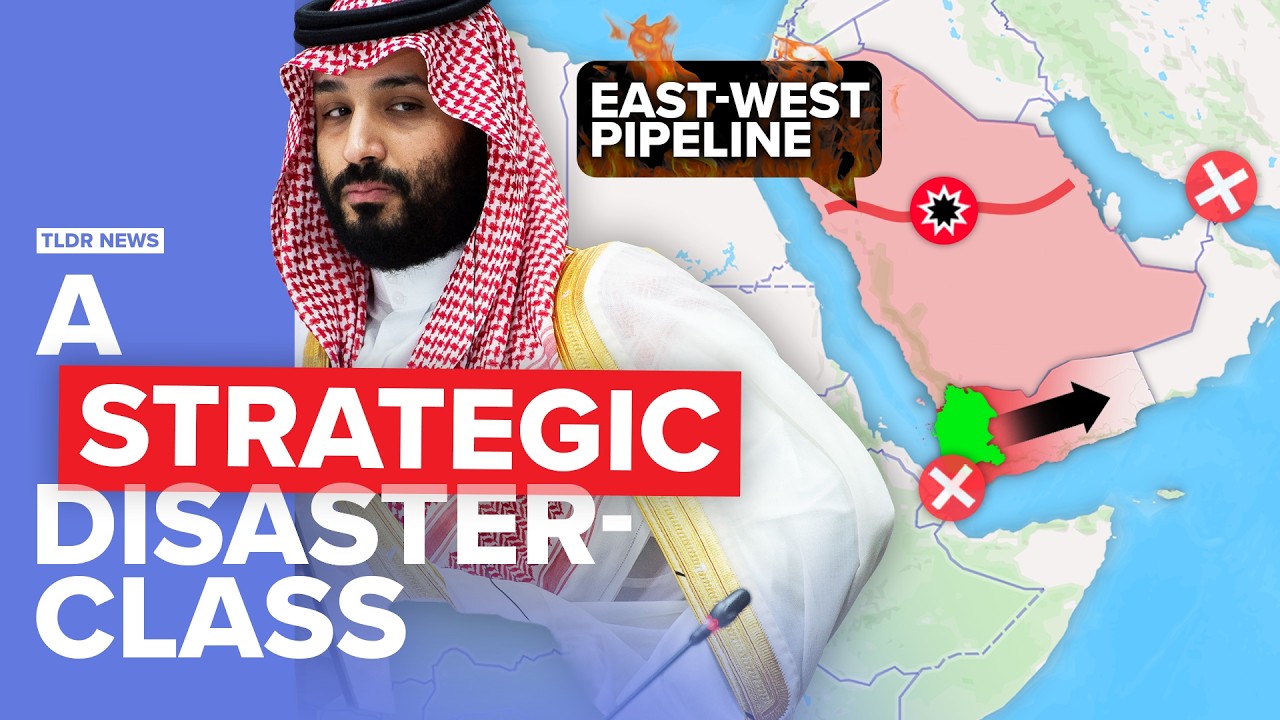
The creator reports that Saudi Arabia, after roughly two years of warming ties with Iran including a proposed security pact and a Saudi delegation at Ayatollah Khamenei's funeral in July, has in the past two months faced a Houthi offensive in Yemen that seized the Bab al-Mandeb strait, a drone attack originating from Iraq that disabled its east-west oil pipeline, and a near-total halt to oil exports through both the Strait of Hormuz and Bab al-Mandeb; Ground News separately corroborates a Houthi attack on a Saudi airbase and the pipeline strike. The video also relays an unconfirmed account that Crown Prince Mohammed bin Salman twice asked Trump for US airstrikes against the Houthis and was twice turned down. In the creator's view, Saudi Arabia is now sliding into recession, pointing to widening budget deficits and roughly -5% GDP growth by 2026 shown on Bloomberg charts, and they frame the episode around one open question: whether Saudi Arabia can dig itself out of what they call a very bad situation.
Confirmed: Saudi-Iran relations improved since the China-brokered 2023 normalisation deal. [00:15]
- Confirmed: Saudi Arabia's foreign minister delivered a letter from the Saudi king to Iran's supreme leader proposing a Saudi-Iran security pact. [00:15]
- Confirmed: Iran stopped striking targets in Saudi Arabia from mid-March, shifting its attacks to the UAE. [00:37]
- Confirmed: Saudi Arabia sent an official delegation to Ayatollah Khamenei's funeral in July. [00:46]
- Confirmed: Trump announced a Saudi-US nuclear deal in July and quietly passed it to Congress this month. [00:54]
+ 39 more takeaways
- Confirmed: Saudi Arabia redirected oil exports via the east-west pipeline to the port of Yanbu on the Red Sea after Strait of Hormuz exports collapsed. [01:19]
- Confirmed: In the past week Saudi Arabia has been attacked on all sides by Iranian proxies. [01:46]
- Confirmed: Saudi oil exports are now effectively zero. [01:46]
- Confirmed: The Houthis launched an offensive against Yemeni government positions in the southwest earlier this month. [02:31]
- Confirmed: Yemen's internationally recognised government is heavily dependent on Saudi Arabia for economic and military support and is often described as a Saudi proxy. [02:40]
- Confirmed: The Houthis, described as Iranian proxies, fought a war against Saudi-backed forces from 2015 to 2022 that ended with Houthi control of most of western Yemen. [02:50]
- Confirmed: The Yemen war restarted last month, with both sides trading airstrikes and the Houthis blockading ships through the Bab al-Mandab strait. [03:05]
- Confirmed: The Houthis took Mocha and Murad last week, consolidating control over the Bab al-Mandeb strait and pushing toward Taiz and Marib. [03:24]
- Confirmed: Turkey and Pakistan, fellow members of the Mecca alliance with its NATO Article 5 style mutual defence clause, said they will not get involved. [03:56]
- Confirmed: Pakistan's foreign minister suggested the mutual defense pact could be triggered, but Turkey and Pakistan both say it is not legally operative because neither country's parliament has ratified it. [04:07]
- Confirmed: Turkiye plans to submit the agreement to parliament soon, possibly in October, while Pakistan's government must also secure parliamentary approval and Saudi Arabia could ratify by royal decree. [04:12]
- Confirmed: Saudi Arabia's east-west pipeline was hit by drones during the Houthi offensive, forcing the Saudis to close it. [04:18]
- Confirmed: With the east-west pipeline offline and both the Strait of Hormuz and Bab al-Mandeb effectively closed, Saudi Arabia has no way to export meaningful quantities of oil. [04:54]
- Confirmed: Saudi Arabia has resisted a proposed Strait of Hormuz toll system and withdrew from an intra-Arab meeting on the strait in protest. [05:12]
- Confirmed: Trump originally said he wouldn't let Iran toll the strait but has recently signaled he doesn't mind a toll system if it gets oil flowing again. [05:29]
- Source cited: Saudi Aramco's quarterly filings show production fell from 12.6 million barrels a day in Q1 to 9.5 million in Q2, while the average price rose from $77 to $108 a barrel. [01:28]
- Source cited: A senior Turkish official, speaking anonymously to Middle East Eye, called criticism that the Mecca pact failed to respond to Houthi attacks disingenuous and said it aims to belittle the alliance. [04:12]
- Source cited: Satellite imagery suggests at least two pump stations along the pipeline suffered severe damage. [04:42]
- Source cited: Journalist Zachary Cohen of CNN reported the Trump administration privately told Gulf officials it wants future US-Iran talks focused on Tehran's nuclear program rather than reopening the strait. [05:30]
- Source cited: An Omani official said Monday's meeting on the strait was postponed, per Zachary Cohen's reporting. [05:30]
- Source cited: A Bloomberg chart shows Saudi Arabia running deficits every quarter from Q4 2022 through Q2 2026, widening sharply from Q3 2025, largely tied to spending on bin Salman's Vision 2030. [05:47]
- Source cited: A Bloomberg GDP chart shows Saudi year on year growth falling to about -5% by 2026 after a 2024-2025 recovery near 5%, indicating the economy is in a deep recession. [06:10]
- Source cited: Ground News shows a 39% Center and 38% Right leaning bias distribution among sources reporting this Saudi/Houthi/Iran story. [06:55]
- Source cited: Ground News reports the Houthis launched a major drone and missile attack on a Saudi military airbase in Khamis Mushait. [07:01]
- Source cited: Ground News reports Gulf states postponed a planned meeting with Iran to discuss reopening the Hormuz shipping lane. [07:01]
- Source cited: Ground News reports a separate attack blamed on Iran-backed fighters in Iraq disabled Saudi Arabia's main east-west pipeline as Houthis seized Perim Island at the Red Sea's mouth. [07:01]
- Source cited: Ground News reports benchmark Brent crude futures rose above $109 a barrel, with traders warning the pipeline closure could cut global supply by 4%. [07:01]
- Source cited: Ground News reports 82,000 Yemenis fled fighting near the port of Mocha this month. [07:01]
- Source cited: Ground News reports Trump confirmed he spoke with Crown Prince Mohammed and said the Houthis asked the US to stay out of the dispute while prioritizing lower energy prices. [07:01]
- Source cited: Ground News reports Iran issued a list of 77 ships facing potential detention or fines for violating Strait of Hormuz protocols. [07:01]
- Source cited: Ground News data shows sources on the left emphasise the threat of Iran while right leaning sources shift attention to the Houthis. [07:05]
- Take (host Jack Kelly): it's hard to overstate how bad the situation is for the Saudis. [04:52]
- Prediction: repairs to the pipeline are expected to take weeks and potentially up to a month rather than days. [04:42]
- Prediction (host Jack Kelly): recent history suggests the Saudis will struggle to dislodge the Houthis, jeopardizing the Bab al-Mandeb route for the near future. [05:06]
- Unverified: the Trump administration reportedly refused to help Saudi Arabia during this week's attacks, with no source named. [01:46]
- Unverified: Crown Prince Mohammed bin Salman reportedly called Trump twice asking for airstrikes against the Houthis, and Trump reportedly turned him down both times, saying he wanted to focus on Iran and avoid new fronts. [03:38]
- Unverified: the drones that hit the pipeline were originally assumed to be Houthi but later reported as launched from Iraq, presumably by an Iran-backed militia. [04:32]
- Unverified: Iran and Oman are reportedly nearing a deal that could codify a toll system in the Strait of Hormuz. [05:12]
- Open question: the video frames its central question as whether Saudi Arabia can dig itself out of the hole it is currently in. [02:00]
How this brief was shaped: News Analysis / Commentary · confidence Low
The narrator recaps confirmed events (Iran war fallout, Saudi-Iran diplomacy, Trump's nuclear deal) then pivots to explicit analysis, what has gone wrong for Saudi Arabia and whether they can fix it, and the OCR shows an actual Middle East Eye news article being cited on screen as sourcing for the claims.
The lens sets this brief's structure, never its facts — every claim is held to the same citation and fact-check standard.