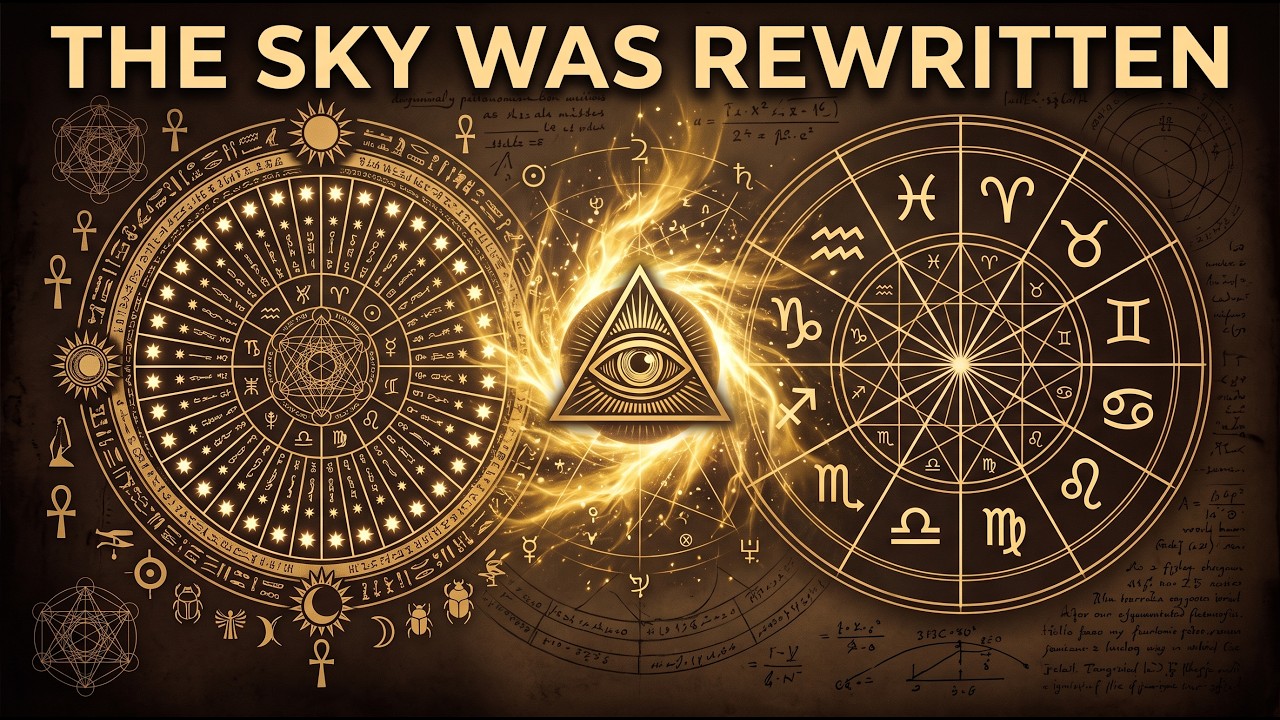
The Egyptian Decans vs. the Modern Zodiac: What Changed?
This is a narrated video essay, with the narrator's identity not stated, examining how the ancient Egyptian system of 36 stellar divisions called the Decans differed from the 12-sign zodiac used in Western astrology today. The narrator's central thesis is that the Decans were originally a stellar timekeeping and religious system tied to the actual rising of star groups, not an early version of zodiac personality signs, and that Babylonian, Greek, and Hellenistic astrologers later reorganized this system into a mathematically symbolic 12-sign zodiac containing 36 ten-degree subdivisions called decanates. The piece's center of gravity is the tension between a popular claim that Egyptians had a secret 36-sign zodiac deliberately reduced to 12, which the narrator explicitly calls compelling but historically too simple, versus the narrator's own view that the Decans survived by being reinterpreted rather than erased. The video closes by turning this history into a proposed modern practice of stargazing and cyclical self-reflection.
The narrator's central thesis is that long before the 12-sign zodiac became familiar, ancient Egyptians read the sky through a different system. [00:07]
- The narrator states the Egyptians divided the heavens into 36 stellar divisions called Decans that rose at different intervals throughout the night and across the seasons. [00:17]
- The narrator states the Decans were treated as celestial powers, not simply convenient calendar markers. [00:35]
- The narrator states the name "decan" comes from the Greek word for ten, reflecting the division of the Egyptian year into roughly 36 ten-day periods. [03:39]
- The narrator states Egyptian priests and astronomers watched the stars with extraordinary attention because the sky's regular movement was one of the most reliable clocks available to civilization. [03:05]
+ 23 more takeaways
- The narrator states the Egyptians used the decans as a celestial system of time, not as 12 personality types. [10:57]
- The narrator states the pyramid texts, among the oldest surviving religious writings, contain references to celestial destinations, imperishable stars, gods, and the king's ascent into the heavens. [05:27]
- The narrator states stars near the celestial North Pole that never set were associated with eternal existence because they returned night after night seemingly untouched by mortality. [13:29]
- The narrator states Babylonian astronomers eventually organized the ecliptic into twelve divisions. [06:45]
- The narrator states the Greeks absorbed much of this astronomical knowledge, especially during the Hellenistic period following the conquests of Alexander the Great. [06:55]
- The narrator states each of the 12 zodiac signs occupies 30 degrees of a 360 degree circle. [07:38]
- The narrator states Greek and Roman astrologers incorporated decans into the zodiac by subdividing each 30-degree sign into three 10-degree decanates. [08:26]
- The narrator states the original Egyptian concept did not survive unchanged, as a system based on actual stellar groups gradually became associated with subdivisions of the zodiac's 30-degree signs instead. [08:43]
- The narrator states there is no solid basis for the claim that ancient Egyptians used 36 personality signs like Aries, Taurus, and Gemini, arguing the Decans were instead connected to timekeeping, stellar observation, calendars, and religious cosmology. [21:49]
- The narrator states precession, caused by Earth's axis slowly changing orientation like a wobbling spinning top, takes roughly 26,000 years per cycle. [24:12]
- The narrator states modern confusion over a "missing thirteenth sign," Ophiuchus, stems from it being a real constellation the sun's apparent path crosses. [24:50]
- The narrator states this does not make the 12-sign zodiac mathematically incomplete, since it was designed as a symbolic division of the ecliptic into 12 equal parts rather than a catalog of every constellation the sun crosses. [25:12]
- An on-screen diagram titled "JOURNEY OF RA" depicts the sun god's solar barque flanked by rows of Egyptian deities, with hour markers I through XII and a section labeled "THE DUAT" underworld. [16:30]
- An on-screen circular chart titled "DISTINCTIO INTER ZODIACUM ET CONSTELLATIONES" shows the 12 zodiac signs around a central silhouette of Ophiuchus, with actual night-sky constellations mapped in the outer ring. [20:17]
- The narrator states that as the zodiac replaced the Decans, the physical stars mattered less while the geometry mattered more. [17:49]
- The narrator compares this shift to the difference between a forest, alive and irregular, and a map, cleaner and divided into coordinates so travelers can orient themselves. [17:54]
- The narrator suggests a practice of stepping outside for a few minutes after sunset or before sunrise for the next 36 nights without immediately reaching for a phone. [29:50]
- The narrator proposes adapting the later decan structure symbolically by taking a goal and working it over 30 days split into three 10-day stages of observation, alignment, and integration, while noting this is not a claim that ancient Egyptians practiced it this exact way. [32:47]
- The narrator uses the Decans as a metaphor, stating one night of observation reveals almost nothing, thirty nights reveal rhythm, and rhythm reveals structure. [35:32]
- Quoting the mottos "AS ABOVE, SO BELOW" and "NOSCE TE IPSUM" (know thyself), the narrator reframes the question from which sign a person was born under to what rhythm they are living within. [28:20]
- The narrator gives an example distinguishing observation from interpretation: "The moon was nearly full tonight" is an observation, "I felt unusually reflective tonight" is an experience, and "the moon caused my mood" is an interpretation requiring much stronger evidence. [31:56]
- The narrator warns against fatalism, rejecting lines like "my stars made me do it," "my sign means I cannot change," and "my birth chart says I am destined to fail," arguing symbolic traditions should expand awareness rather than eliminate agency. [35:48]
- The narrator closes by suggesting the greatest mystery of the Egyptian Decans is not that they disappeared but that they survived. [37:31]
How this brief was shaped: Discourse (interview / podcast / video essay) · confidence Medium
The single narrator repeatedly poses interpretive questions about what the ancient Egyptian Decans meant and whether that system answered a fundamentally different question than the modern zodiac rather than being a cruder version of it, which is thesis-driven meaning-making rather than neutral comprehensive history. The OCR sample shows dense astronomical calculation diagrams tied to the discussion but is too garbled to add reliable signal.
The lens sets this brief's structure, never its facts — every claim is held to the same citation and fact-check standard.