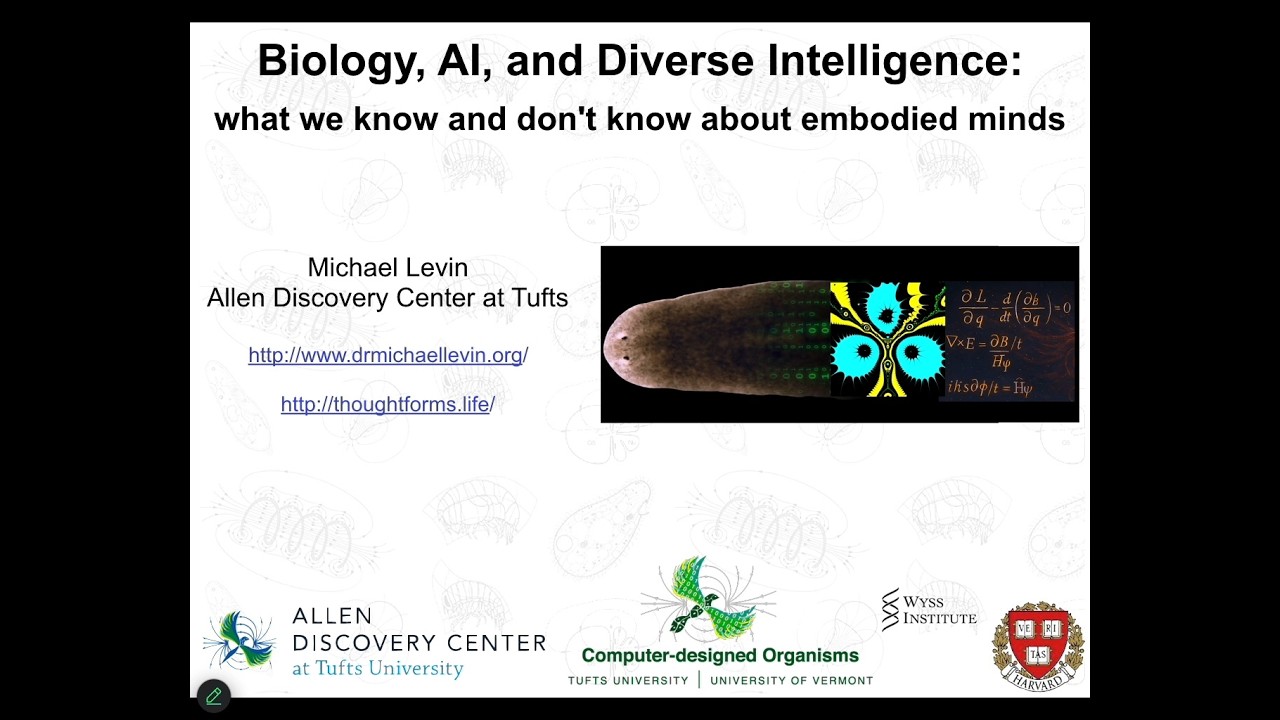
Biology, AI, and Diverse Intelligence by Michael Levin
This is a solo presentation by Michael Levin of Tufts University's Allen Discovery Center on biology, artificial intelligence, and diverse intelligence; no separate host or interviewer is identified in the source. Levin frames the central question as what living systems and machines actually are, describing two dominant camps, computationalist/molecular reductionists who treat life as a complex machine explainable by chemistry, and organicists who reject machine metaphors for life outright, and then stakes out his own third position that neither living things nor machines are fully captured by machine metaphors. The talk moves through developmental biology, bioelectric signaling, xenobots, anthrobots, and mathematical 'free lunches' from what he calls platonic space to argue that goal-directed competencies appear across many levels of biological and computational organization, not just in brains. Levin leaves open, rather than resolves, whether this apparent capacity comes from evolution, sheer complexity, or some deeper mathematical source.
Levin argues neither living things nor machines are fully captured by machine metaphors, positioning himself against computationalist/molecular reductionists, who treat life as a complex machine explainable by chemistry, and organicists, who reject machine metaphors for life entirely.
- Levin notes computationalists and molecular reductionists stop their explanatory reduction at chemistry rather than continuing further to quantum foam or particle physics, stated without evidence given.
- Levin says these two camps, computationalist/reductionist and organicist, together capture about 99% of the field's positions on life versus machines, stated without evidence given.
- Levin lays out this same third position in his Noema Magazine essay 'Living Things Are Not Machines (Also, They Totally Are),' published March 18, 2025, distinct from the peer-reviewed paper he cites later in the talk.
- [04:16] Levin uses the artwork of Adam naming the animals in the Garden of Eden as a metaphor for overcoming anthropocentrism, or at minimum 'brain chauvinism.'
+ 76 more takeaways
- Levin argues the idea to discard is a discrete, enumerable set of beings with humans as judge of what things are, while keeping the idea that naming something means understanding its inner nature, stated without evidence given.
- Levin states nearly any combination of evolved material, engineered material, and software can form a viable being, describing these as 'cyborgs and hybras,' stated without evidence given.
- Levin argues Darwin's 'endless forms most beautiful' description of life on Earth is only a small corner of the much larger space of possible embodied minds, stated without evidence given.
- Levin says a term for extending symbiosis-like ethics to synthetic and chimeric beings, aiming at 'ethical synthbiosis,' was suggested to him by GPT years earlier.
- [07:48] Levin argues there is no single magic moment that turns a pile of chemicals in an unfertilized oocyte into a being with responsibilities and dreams, describing development instead as a slow, gradual process.
- Levin notes university departments such as chemistry, developmental physiology, behavioral science, psychology, oncology, and bioengineering are named for different stages of this same continuous developmental journey, with no bright line dividing molecular machines from what we are, stated without evidence given.
- [09:59] Levin says before a computer is turned on it is just a hunk of metal subject to Newtonian laws of gravitation.
- [10:08] Levin says once turned on, electricity begins to flow and the device becomes subject to Maxwell's laws.
- [10:22] Levin says shortly after, some of those electrical flows implement logic gates, making the device understandable via boolean logic.
- [11:43] Levin cites the lacrymaria, a single free-living cell with no brain and no nervous system, as an example of a system that is highly competent within its own environment, stated without evidence given.
- [12:19] Levin argues every level of biological organization, from molecular networks to cells, tissues, organs, organisms, and swarms, has its own agendas and goal-seeking competencies, stated without evidence given.
- [13:08] Levin points to experiments cutting an embryonic blastula into separate pieces, first shown in bird embryos and also true for mammals, which produce twins or triplets.
- [13:31] Levin states the number of individual beings arising from an early embryo is not fixed by genetics and can range from zero to half a dozen or more depending on the animal.
- [14:44] Levin argues what holds cells together as a single individual is their commitment to a shared future goal, describing this as comparable to 'a collective delusion among aligned agents.'
- [14:53] Levin says bodies stay unified because cells share a commitment to goal-directed activity, not because of any central controller.
- [15:04] Levin frames embryonic development, regeneration, cancer, and aging as successes or disorders of cells aligning toward higher-level goals, stated without evidence given.
- [15:33] Levin describes brains as the conventional example of a network of cells that stores goals as memories via ion channels and electrical synapses called gap junctions.
- [16:35] Levin says bioelectricity predates neurons and brains, citing bacterial biofilms coordinating information through ion channels as the earliest known use.
- [16:56] Levin notes every cell in the body, not just neurons, has ion channels and shares electrical patterns with neighboring cells.
- [18:02] Levin says his research group developed the first molecular tools to read and write electrical information from non-neural tissue.
- [18:32] Levin describes an 'electric face,' a voltage pattern in an early frog embryo readable via fluorescent dye months before facial genes activate, that predicts the locations of the eyes and mouth.
- [19:23] Levin says rewriting the voltage pattern and inducing the 'electric face' pattern on a tadpole's gut caused an eye to form there, arguing this shows the developmental goal is encoded at the organ level rather than in gene expression or single cells.
- [19:49] Levin says normally cutting a flatworm's middle piece produces a one-headed worm because of a voltage gradient encoding one head and one tail.
- [19:56] Levin says rewriting that pattern memory to specify two heads causes the cut flatworm to build a two-headed worm, stressing these are real animals, not Photoshop or AI-generated images.
- Levin defines the 'cognitive light cone' as the size in space and time of the largest goal a system can represent, not how far it senses, stated without evidence given.
- [20:20] Levin cites limb regeneration, where amputated cells rebuild the limb and then stop, as evidence of 'anatomical homeostasis' working like a thermostat with a set point.
- [21:36] Levin says a frog was made with five legs by rewriting its anatomical set point.
- Levin says he told an audience of mental health professionals their client list will get 'really weird' as patients may have significant portions of their brain or body altered by regenerative medicine, stated without evidence given.
- [24:34] Levin introduces 'xenobots,' named after Xenopus laevis, as the first model system for understanding novel minds.
- [24:37] Levin says xenobots are created by scraping about a thousand epithelial cells from the top layer of an early frog embryo and placing them in a petri dish.
- [24:52] Levin says instead of dying, crawling apart, or forming a flat monolayer, the scraped cells self-assemble into a self-motile creature.
- [25:18] Levin says xenobots express genes for elements of hearing that embryos do not normally express, and their behavior changes significantly when sound is played to them via a speaker.
- [25:38] Levin says xenobots can gather loose cells into balls that mature into a next generation of xenobots, calling this 'kinematic self-replication,' and claims no other known creature on Earth has ever done this, stated without evidence given.
- [26:03] Levin says xenobots can form memories of experiences, remembering at least two different things for at least 24 hours and possibly longer.
- [26:33] Levin describes 'anthrobots' as made from adult, not embryonic, human tracheal cells obtained from patients undergoing tracheal biopsies, using cells the doctors do not need.
- [27:47] Levin says anthrobots express over 9,000 genes differently, about half the genome, compared to when the cells were part of the body, and when plated onto scratch-damaged neurons they form 'superbot' clusters that knit together and heal the damage over about four days.
- [28:47] Levin suggests personalized biobots made from a patient's own cells could make bodily repairs without needing immunosuppression, stated without evidence given.
- [29:18] Levin describes standard evolutionary theory as explaining an organism's form and function as the genome 'bashing against' specific past environments over millions of years.
- [29:59] Levin argues xenobots and anthrobots have no evolutionary backstory, because there was never selection for kinematic self-replication or for anthrobots repairing neural wounds.
- [30:11] Levin notes no past stage of human or frog development looks or acts like a xenobot or anthrobot, raising for him the question of when the computational cost of these competencies was paid.
- [31:08] Levin describes molecular pathways as networks of molecules that up- and down-regulate each other, traditionally studied with dynamical systems theory.
- [31:54] Levin says applying behavioral science tools to molecular network models showed the networks are trainable, have memories, and can form six different kinds of memories including Pavlovian conditioning.
- [32:14] Levin defines 'causal emergence' as the whole being more than the sum of its parts, illustrated by a rat in which no individual cell that touched a lever is the same cell that received the reward.
- [32:46] Levin says training raises causal emergence, which raises learning rate in a positive feedback loop, and that forcing the network to forget memories does not reduce the causal emergence gains already achieved.
- [33:51] Levin says even completely random molecular networks with no history of selection on Earth are already incredibly close to optimal on this intelligence/causal-emergence ratchet, arguing evolution did not need to create this property.
- [34:33] Levin argues this ratchet property comes from the mathematics describing networks and causal emergence, not physics, specific chemicals, or evolution, since it occurs before replicators exist, calling it 'a free gift from math.'
- [35:33] Levin points to the map of the iterated function z cubed plus 7 as producing a specific organic-looking pattern that no tweak to physical constants, such as the speed of light, dimensions, or cosmological constant, could ever change.
- [36:40] Levin says these mathematical truths inhabit a separate world often called 'platonic space,' after Plato and Pythagoras, a structured set of patterns not investigable the way physical facts are.
- [37:27] Levin says his research group studies 'free lunches,' meaning a built body, embryo, or robot always seems to yield more than the cost paid to design, evolve, or train it, stated without evidence given.
- [38:05] Levin lists the menu of free lunches as static patterns, trajectories, behavioral policies, and goal states or intrinsic motivations.
- [38:37] Levin states evolution readily exploits these free lunches from the platonic pattern space, stated without evidence given.
- [38:59] Levin frames an open question of whether biology's apparent 'magic' comes from evolution, sheer complexity, or some quantum effect, and does not resolve it.
- [40:19] Levin points to extremely simple, deterministic algorithms, including classical sorting algorithms studied by computer science students for 80 years, as displaying competencies not literally coded into them, such as delayed gratification and homophily, arguing this shows such behavior is not unique to biology.
- [41:01] Levin cites an example of only six lines of code that nonetheless produces behavioral competencies rather than mere unpredictability or complexity.
- [42:00] Levin calls for humility, noting most people believe human hopes, dreams, love, and inventions exceed what mechanical chemistry describes while assuming other systems are merely 'dumb,' stated without evidence given.
- [42:36] Levin argues even machines and algorithms are never fully captured by our formal models, and that looking closer reveals new relevant things even after decades of study, stated without evidence given.
- [43:28] Levin introduces 'Mambot,' a robot built in his lab at Tufts that works with the company Synmorpho and makes xenobots.
- [43:35] Levin says Mambot's AI forms hypotheses about what signals to give frog cells to build xenobots with specific properties, then physically runs the experiment.
- [43:50] Levin says Mambot can apply vibration, optical, electrical, and chemical stimulation to loaded frog cells, then uses cameras to examine the resulting form, function, and behavior before revising its hypothesis and trying again.
- [44:23] Levin says this is, to his knowledge, the first automated robot scientist system operating in morphology, meaning building multicellular beings, rather than molecular or microbiology.
- [44:47] Levin offers one perspective that Mambot is a translator interface between human scientists and cellular collective intelligence, helping crack what he calls the 'morphagenetic code.'
- [45:15] Levin offers a second perspective that Mambot is itself a collective intelligence, embodied and exploring anatomical or morphospace through the living frog-cell tissue rather than through 3D physical space.
- [45:26] Levin offers a third perspective, illustrated by a video of a turtle on a skateboard fast enough to play with a cat, that Mambot is a 'prosthetic' unlocking a new cognitive or behavioral domain for the frog cells.
- [47:56] Levin defines 'bioinspired computing' not as technology inspired by biology, but as interfaces inspired by the same source that inspires biology itself, distinguishing this from standard bioinspired engineering such as neuromorphic computing and robotics.
- [48:50] Levin describes mathematics as the lowest level of platonic space, containing only patterns simple enough to sit still for formal analysis.
- [48:57] Levin says higher, more complex layers of that space contain higher-agency patterns recognized as kinds of minds, stated without evidence given.
- [49:44] Levin says that unlike Plato's original static model, he believes these patterns are dynamic and learn and grow from experience in the physical world, but acknowledges this is an assumption he cannot prove.
- [50:13] Levin cites the paper 'Next Generation Biomedicine: Communication Across Levels of Agential Material' (subtitled 'Language Game: Talking to Non-Human Systems') by Yanbo Zhang and Michael Levin, Wyss Institute for Biologically Inspired Engineering at Harvard University, distinct from his earlier Noema magazine essay.
- [50:14] Levin says his group is building AI-based tools to communicate with molecular networks, cells, and tissues, aiming for interfaces where someone could ask their liver via phone why they don't feel well.
- [50:54] Levin describes one current effort using virtual reality and video games to create meaningful interactions with systems that have never been spoken to or heard from before.
- [51:08] Levin closes the talk with a 'Garden of Eden 2.0' framing, arguing the future will be extremely diverse and weird, and that humans are currently bad at recognizing and communicating with beings unlike themselves.
- [52:11] Levin argues the future of humanity as a mature species requires a science that goes beyond traditional 'mind blindness' to understand how different kinds of intelligence come into the physical world and ethically relate to each other.
- [52:36] Levin states four companies have licensed some of the work presented in the talk.
- [52:44] Levin notes that philosophical topics discussed for thousands of years are now generating data and applications that companies want to license, stated without evidence given.
- The talk's central tension, as Levin presents it alone rather than as a debate with another speaker in this recording, is between computationalist/reductionist and organicist camps over whether life is 'just' a machine, with Levin staking a third position between them.
- The acknowledgments credit funding from CRREL, TWCF, JTF, John Abele, DARPA, NIH, and the Paul G. Allen Frontiers Group, and credit Claude Opus 4.8 for literature searches and occasional ideas.
How this brief was shaped: Discourse (interview / podcast / video essay) · confidence Low
One narrator, Michael Levin, opens by framing a thesis about biology, AI, and embodied cognition, and the OCR shows an essay titled Living Things Are Not Machines Also They Totally Are arguing that same contested worldview against computationalist and reductionist views, which is an argumentative spine not neutral teaching. He also draws an explicit line between his published lab papers and his own speculative blog interpretation, which points toward the assertion grading that mind science content usually needs.
The lens sets this brief's structure, never its facts — every claim is held to the same citation and fact-check standard.