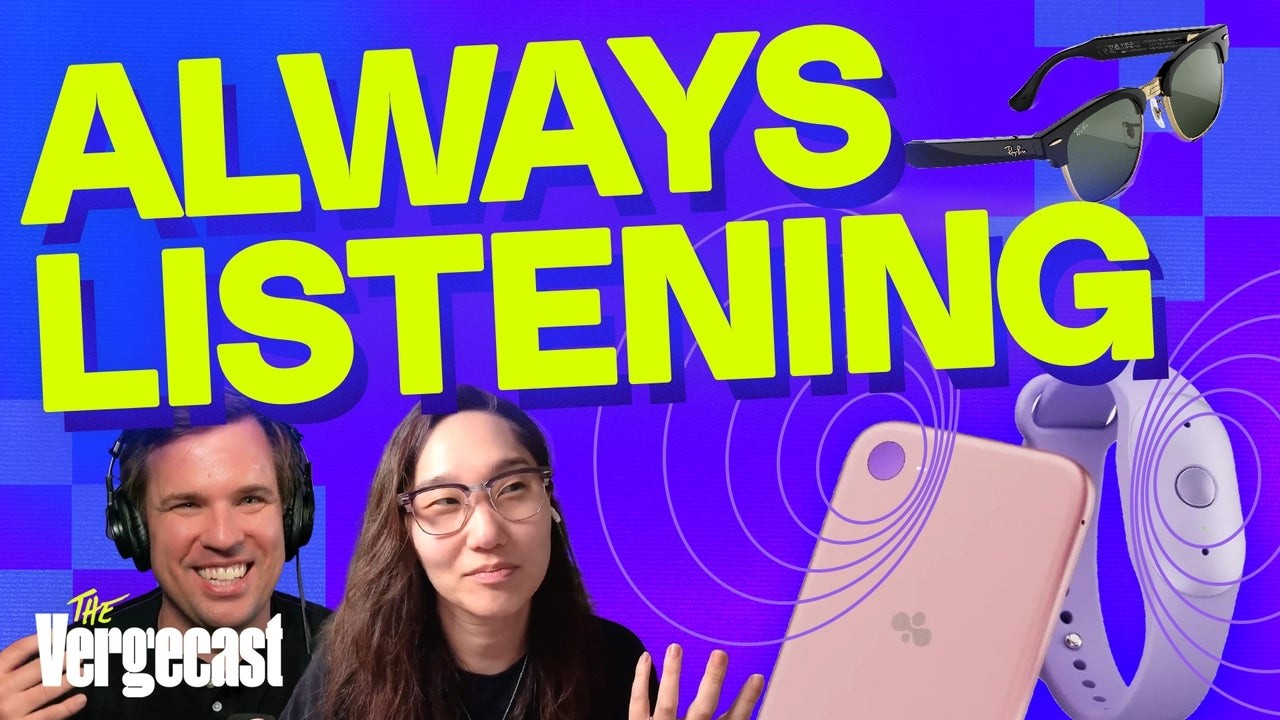
Everything's recording everybody. What now? | The Vergecast
This episode of The Verge's Vergecast pairs host David Pierce with guest Victoria Song, the site's senior wearable tech reviewer, to discuss Meta's new camera-less Ray-Ban Meta Audio smart glasses and their hearing-assistance feature, plus Amazon's always-listening Bee Frontier wearable. The conversation's center of gravity is whether dropping the camera actually solves the stigma and privacy backlash around recording wearables, with Victoria Song reporting that Meta deliberately went camera-less after a summer of 'pervert glasses' backlash, while David Pierce shares his own hands-on experience with the glasses' privacy controls. A running, unresolved tension runs through the piece over whether always-listening or always-recording AI wearables (Meta's glasses, Amazon's Bee, the Apple Watch's live rewind) can fairly be called something other than 'recording' once raw audio is discarded and only a transcript or summary remains. The episode opens with an unrelated news segment, hosted by Travis Larchuk, covering iPhone Duo pre-orders and an OpenAI-Apple trade secrets settlement.
Travis Larchuk hosts The Verge's news segment '90 seconds on The Verge' for Thursday, October 15, 2026 [00:43].
- Pre-orders for the folding iPhone Duo open the next day [00:49].
- Apple already lets customers pre-fill cart and payment info before the iPhone Duo's buy button goes live [00:49].
- OpenAI agreed not to use Apple hardware trade secrets it allegedly obtained from former Apple employees, as part of a lawsuit Apple filed in July 2026 [01:12].
- OpenAI made that agreement after a US district judge signaled he was highly likely to grant an injunction forcing the move [01:26].
+ 53 more takeaways
- OpenAI is separately accusing a former employee of sharing confidential files with Apple [01:34].
- The Verge's Sean Hollister reported that a security researcher found an AI pet called Ellico, made by Energize Labs, left millions of transcribed conversations unprotected on servers and used them to profile customers [01:47].
- Host David Pierce welcomed guest Victoria Song, The Verge's senior wearable tech reviewer, who was wearing Ray-Ban Meta Audio glasses, a Dexcom G7 CGM, an Apple Watch Series 12, and a Fitbit Edge, with her Oura ring charging [02:30].
- Victoria Song said she finds it fascinating that Meta is willing to release the Ray-Ban Meta Audio smart glasses without a camera at all, timed right after a summer of public backlash against Meta's camera-equipped glasses [03:46].
- The hosts noted that 'pervert glasses' has replaced 'glass hole' as the mainstream phrase for camera-equipped Meta Ray-Ban glasses [04:09].
- Victoria Song reported that Meta's VP of wearables, Alex Hemel, told her the audio-only glasses had been in development for two years and that Meta underestimated how much people would like discreet open-ear headphones and camera-free styling [05:00].
- The Ray-Ban Meta Audio glasses have a wireframe on the bottom that no other Meta smartglasses have had, and thinner temples than typical Meta Ray-Bans, according to the review discussion [05:45].
- Meta's AI agent Muse, described in the discussion as a 'dystopian' assistant, is slated to come to all of Meta's glasses, including the camera-less pair [06:19].
- One host pushed back on the idea that the camera-less glasses are 'nerfed,' arguing current visual AI tools aren't good yet and that pointing a phone camera at something is a better way to identify it, stated without further evidence given [07:30].
- Victoria Song's published review is titled 'I don't miss the camera on the Ray-Ban Meta Audio glasses,' posted October 13, 2026 at 2:00 PM EDT [08:31].
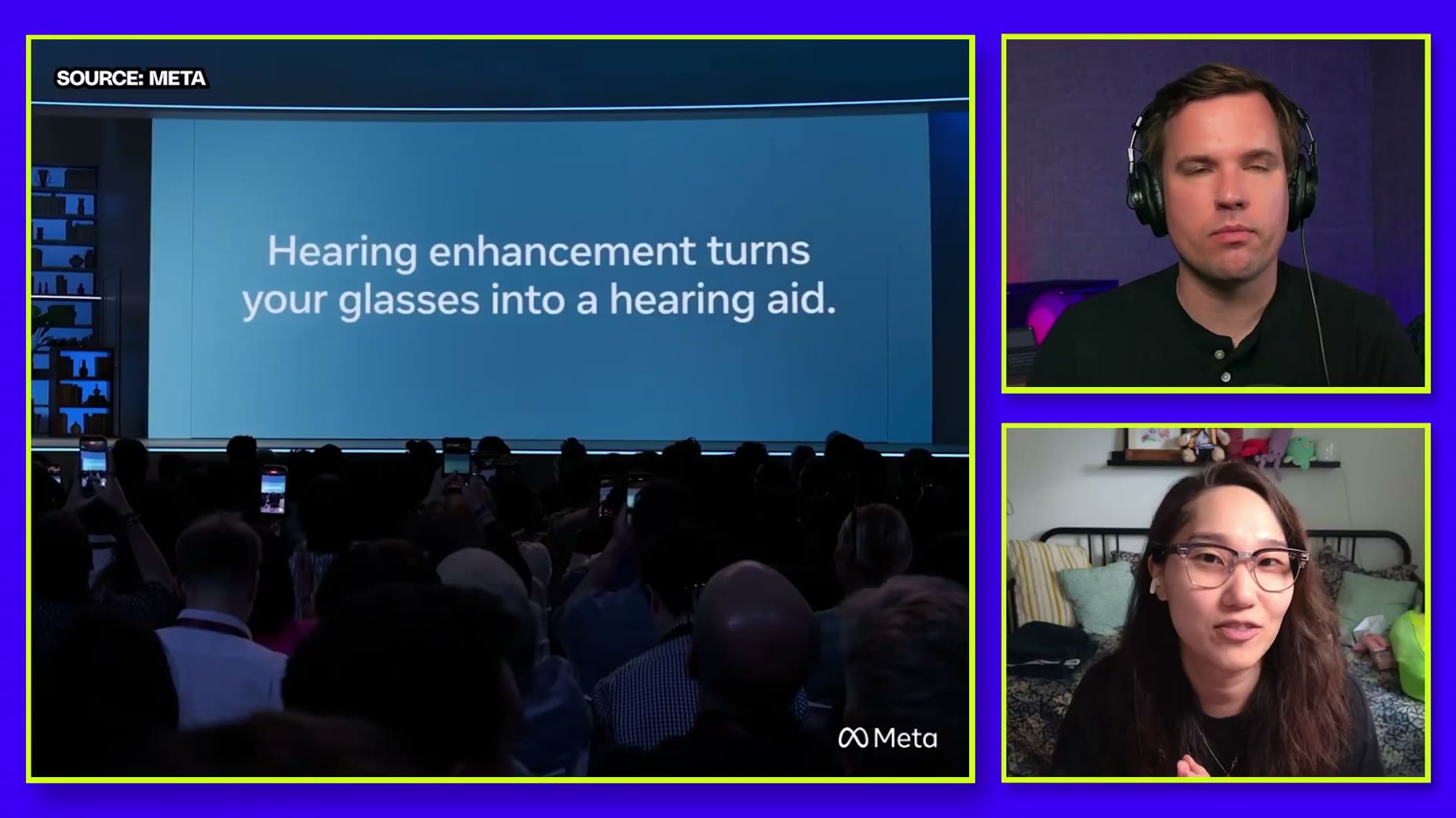
- The glasses introduce FDA-cleared hearing assistance for mild to moderate hearing loss, delivered via software for an additional $150 fee, framed in the discussion as a less-stigmatized alternative to hearing aids [09:08].
- The glasses function as a discrete hearing assistant similar to over-the-counter hearing aids, which the discussion says reduces stigma compared to visible hearing aids or using AirPods for that purpose [09:34].
- David Pierce said removing the camera made him feel more relaxed walking around in public, because it doesn't solve the broader problem people have with smart glasses [10:15].
- David Pierce said it's a little hard to accidentally start recording with camera glasses, but said he has done it himself and has seen it happen to others, stated without further evidence given [10:47].
- David Pierce said he disabled the wake word on his glasses and instead has an action button he has not yet programmed to summon the AI [11:15].
- David Pierce said there is no ambient listening on the glasses until he triggers it, at which point the AI either listens to his query or activates a translation feature [11:39].
- David Pierce said that with the translation feature as currently designed, he would have to tell the person he's talking to that the glasses are translating, which he counts as disclosure [11:54].
- David Pierce described the glasses' AI model, MuseSpark, as 'a little dumb but less dumb than before' [13:48].
- David Pierce compared the current audio-glasses trend to Bose frames from about seven years ago, calling audio-only glasses a good idea that didn't get marketing traction back then, stated without further evidence given [14:21].
- David Pierce said he loved the Bose frames when they first came out and had written a Gizmodo headline saying he was ready to dunk on them but ended up loving them instead [14:52].
- David Pierce said sound leakage on the Bose frames is real on the subway, so AirPods are still needed there, stated without further evidence given [15:05].
- David Pierce said he uses the glasses at home to listen to audiobooks or podcasts while still being able to hear his spouse [15:48].
- A sponsor segment for Jira by Atlassian described its 'teamwork graph' pulling context from Jira, Confluence, GitHub, and Slack, with integration into agents like Claude, Cursor, and GitHub Copilot via MCP [16:29].
- A sponsor segment for Granola described it as an AI-powered notepad that turns meeting audio into structured notes with decisions and action items [17:30].
- Amazon announced the Amazon Bee Frontier, after having acquired Bee, which was previously its own company [19:04].
- One host jokingly called the Bee Frontier, described as an always-listening, always-recording wearable, a 'surveillance wearable' [19:14].
- The Bee Frontier costs $74.99 [19:49].
- This year's Bee Frontier is said to be better at distinguishing the wearer's voice from broadcast voice to reduce transcription errors, stated without further evidence given [19:59].
- Amazon also offers the Bee Eclipse, a MagSafe accessory that sticks to the back of a phone [20:47].
- The Bee Frontier will have a desktop app and a pro subscription tier with integrations [20:58].
- Bee's integrations can detect products mentioned in conversation and prompt Amazon shopping links for them [21:06].
- Victoria Song wrote a separate Verge piece arguing that the industry can't just change the definition of 'recording' to describe always-listening devices [22:34].
- Bee told the host it does not record the audio file and only keeps the transcript, but the host noted this still requires recording audio first, a point of pushback against the company's framing [23:27].
- A speaker noted that California requires dual consent from both parties to be recorded, while New York and New Jersey require only one party's consent [24:19].
- A speaker described Apple's approach as attributing nothing in its transcripts, since raw audio is deleted after processing, leaving only a summary of 'dubious attribution' [24:08].
- A speaker noted that companies are arguing an AI-generated summary is not a recording and therefore not subject to the same legal or subpoena standards, stated without further evidence given [24:45].
- A sponsor segment for IDERA by Palo Alto Networks stated that non-human identities with system access are projected to outnumber human identities 109 to 1 in 2026 [25:47].
- The same IDERA sponsor segment described it as a single identity platform managing human, machine, and AI identities with dynamic access instead of permanent permissions [25:59].
- A speaker argued that people are spooked by devices that are listening, regardless of whether those devices are actually recording, stated without further evidence given [27:16].
- The Apple Watch's live rewind listening feature is opt-in rather than on by default, and it triggers a chime and a mic indicator when activated [28:42].
- A speaker argued that new AI wearables ask users to be stewards not just of their own data but of everyone else's data too [29:39].
- A speaker used an M&M metaphor, saying 10% of M&Ms (people wearing recording glasses) are 'poisoned' (creeps), making it impossible to tell who is safe just by looking [30:13].
- A speaker noted that the accessibility community faces a related problem, since visibly disabled people are assumed to have cameras for accessibility while people with invisible disabilities get accused of being perverts [30:47].
- A speaker publicly urged people online not to punch others wearing these glasses, acknowledging discomfort with wearable surveillance while noting most wearers are not creeps [31:24].
- A speaker argued that always-listening AI note-takers make sense for business, journalism (where recording is disclosed on or off the record), students, lecturers, and business meetings, citing Zoom and Gemini for Google Meet as accepted examples [32:19].
- David Pierce recounted a man running out of his house to show him a Ring doorbell video of David Pierce walking his kids to daycare three days earlier [33:35].
- Victoria Song shared a similar experience of a Ring camera verbally announcing it was recording while she walked through a neighborhood, saying that announcement at least made her aware, even though not every house does this [34:27].
- A speaker argued that tech companies want user data because it makes AI assistants more useful, requiring them to know everything about the user and the people in the user's life, and said society rather than tech companies alone should decide this tradeoff [35:34].
- Victoria Song said she started her job tracking steps and has become an 'inadvertent private spy' without fully consenting to that role [36:21].
- Victoria Song said last year's wearable device had written 'fanfiction' about her life, and some of the truthful parts were uncomfortable [36:52].
- The hosts joked that a wearable device might notice Victoria Song talked about nail glue and then serve her an Amazon pop-up for nail glue [37:10].
- Listeners were invited to email vergecast at theverge.com or call 866-VERGE-11 to share their opinions [38:00].
- The episode is produced by Josh Cajas, Kabir Chopra, Eric Gomez, Brandon Kiefer, and Travis Larchuk [38:29].
![Travis Larchuk hosts The Verge's news segment '90 seconds on The Verge' for Thursday, October 15, 2026 [00:43].](assets/PUcWwvltFcc/frame_46.jpg)
How this brief was shaped: Discourse (interview / podcast / video essay) · confidence Medium
Transcript is a multi-speaker podcast (Vergecast host plus a reporter segment and a promised guest) discussing wearables and smart glasses with back-and-forth framing, and OCR shows split-screen host/guest video-call layouts and a chatbot conversation screenshot rather than a single demo or spec sheet.
The lens sets this brief's structure, never its facts — every claim is held to the same citation and fact-check standard.