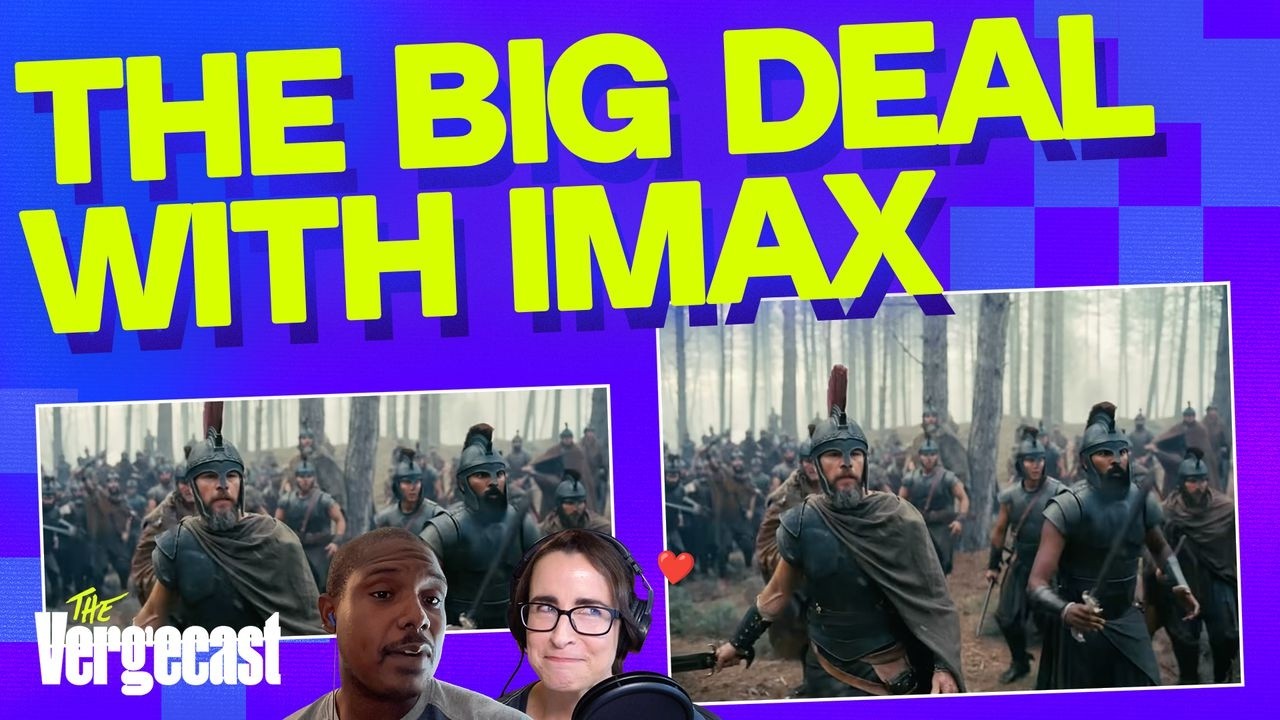
The next big thing in movies is 60-year-old IMAX tech | The Vergecast
On this episode of The Vergecast, host Jennifer Pattison Tuohy, senior reviewer for smart home, is joined by TV and film reporter Charles Pulliam-Moore to discuss the resurgence of IMAX, a 60-year-old film format, tied to Christopher Nolan's The Odyssey and the expansion of Spider-Man: Brand New Day into IMAX theaters. The conversation's center of gravity is the tension between true 70mm IMAX's unique visual and immersive qualities, championed through Nolan's technical choices, and the format's scarcity: only about 40 theaters worldwide can show it, projectors are decades old, and most people will never see a film that way. The episode also covers Disney's new Infinity Vision theater standard as a lower-cost alternative to IMAX, and opens with a separate news rundown segment on AI, gaming, and audio hardware.
Jennifer Pattison Tuohy, senior reviewer for smart home, hosts the episode joined by TV and film reporter Charles Pulliam-Moore to discuss IMAX. [00:07]
- Christopher Nolan's The Odyssey has already been selling out IMAX theaters. [00:11]
- Spider-Man: Brand New Day had the biggest box office debut ever and is expanding to IMAX. [00:16]
- IMAX is described as a 60-year-old technology. [00:31]
- In the news rundown segment, Jeff Dean, Google DeepMind's chief scientist, is leaving to start an AI systems company called Discovery Loop. [00:54]
+ 51 more takeaways
- Demis Hassabis is stepping down as DeepMind's leader to become chair and Alphabet's chief scientist, with DeepMind CTO Koray Kavukcuoglu replacing him. [01:00]
- Nintendo reported a 150% profit increase in its first quarter. [01:31]
- Nintendo is keeping a $300 million US tariff refund despite raising Switch prices, and Sony is also keeping its own tariff refunds, with both companies facing lawsuits from users. [01:31]
- Bose announced second-gen QuietComfort headphones available for pre-order August 8th for $359, with new colors, an upgraded aware mode, and immersive audio features including head-tracking and a simulated theater-like experience. [01:57]
- IMAX screens are described as showing films in the 1.43:1 aspect ratio. [03:41]
- The host describes the IMAX viewing experience as feeling like being pulled into the image. [03:56]
- IMAX is noted as one of the first movie-format companies, ahead of the curve. [04:08]
- Seeing a film shot on 70mm in IMAX is described as almost hard to put into words. [04:39]
- Sinners is cited as the last major film with a big public push to be seen in IMAX, shot partly on 15-perforation 70mm film. [04:56]
- The host notes IMAX is a 60-year-old technology now experiencing a resurgence, citing Spider-Man and The Odyssey as upcoming IMAX releases. [06:14]
- Research found that true IMAX theaters were selling out up to a year in advance. [06:39]
- The Dark Knight is cited as not entirely shot in IMAX, but as containing sequences shot in the format that helped popularize it. [07:02]
- Nolan has incorporated IMAX cameras into his filmography over the years including The Dark Knight Rises, Interstellar, and Oppenheimer, not attributable to a specific timestamp.
- The Odyssey is described as the first movie ever shot entirely in 70mm IMAX, not attributable to a specific timestamp.
- There are two types of IMAX described: 70mm film and digital, not attributable to a specific timestamp.
- Nolan is described as notoriously tech-lite, not using a smartphone, with people reportedly printing out his emails for him, not attributable to a specific timestamp.
- The guest frames Nolan's choice to shoot in 70mm as driven partly by the challenge itself, asking what working at the height of his powers looks like at this career stage, not attributable to a specific timestamp.
- IMAX cameras are described as very heavy, which limits dynamic action shots because crews cannot run with them, not attributable to a specific timestamp.
- Marketing for Sinners included giving out strips of actual film as a promotional giveaway at certain theaters. [08:57]
- Nolan had the IMAX cameras wrapped or outfitted in blimps to muffle their noise so dialogue could be recorded during filming. [12:26]
- Because the cameras were covered in this sound-muffling housing, special mirrors had to be added so crew could still see actors' eyelines. [13:02]
- A speaker calls the camera-muffling process 'very complicated,' adding it did not have to be this complicated. [13:09]
- Cast members were reportedly unaccustomed to working this way but became fascinated and excited by the process. [13:16]
- There are apparently only about 40 or 41 true 70mm IMAX theaters in the entire world. [13:41]
- The biggest immediate difference between real IMAX and digital IMAX, jokingly called 'LMAX,' is the screen aspect ratio: a tall 1.43:1 versus a wider ratio closer to but not quite 16:9. [13:54]
- Digital IMAX is described as missing some visual information present in true IMAX. [13:59]
- A speaker frames the theater experience in three tiers, true IMAX, wider IMAX, and a regular screening, saying all three offer an enjoyable experience. [14:28]
- Only about 40 theaters worldwide can show 70mm IMAX films because IMAX has not been able to build new projectors, not attributable to a specific timestamp.
- The majority of IMAX's 70mm projectors were built about 50 years ago and have only been maintained and retrofitted since, not attributable to a specific timestamp.
- IMAX reportedly lacks many of the original blueprints needed to manufacture new projectors, unlike companies that keep better records, not attributable to a specific timestamp.
- An industry-wide shift from film to digital projectors has compounded the loss of institutional knowledge and parts manufacturers for building 70mm projectors, not attributable to a specific timestamp.
- Building an IMAX auditorium requires a massive screen and costly construction, which is hard to justify given thin theater profit margins, not attributable to a specific timestamp.
- Christopher Nolan worked with a specific IMAX camera reportedly called the 'Keely' camera, named for one of IMAX's co-founders, not attributable to a specific timestamp.
- A speaker says IMAX could likely build more projectors and cameras if it invested in R&D, but questions whether that investment would pay off financially, not attributable to a specific timestamp.
- A speaker jokes that from a CEO's perspective, building more 70mm infrastructure 'doesn't really make sense... financially.' [19:25]
- A speaker has seen The Odyssey in both standard format and IMAX. [21:26]
- A speaker expected the whirlpool/Scylla monster scene but wanted a better look at what Nolan's Scylla looks like. [21:52]
- On the first viewing in a regular 35mm screening, only a couple of Scylla's tentacles were visible. [22:16]
- On a second viewing in regular IMAX, not 70mm, more of the creature's form was visible, including it scuttling back into a hole like a hermit crab. [22:56]
- A drawback of shooting in 70mm is that the vast majority of people won't be able to see the film in that format. [23:26]
- There is online debate about whether Nolan considers 70mm the definitive way the film is meant to be seen, since it contains more visual information, a tension the speakers raise without resolving it. [23:35]
- IMAX tickets are noted as being much more expensive than standard tickets. [24:07]
- A speaker says film formats becoming a talking point is exciting for film bros and cinephiles. [24:52]
- Some studios are moving toward new theater tech, with Disney hyping something called Infinity Vision. [25:44]
- Infinity Vision is not proprietary technology like IMAX, but a set of Marvel/Disney approved standards theaters must meet, according to the guest. [26:07]
- Infinity Vision certification requires a screen minimum of 45 feet wide, immersive sound like Dolby Atmos or 7.1 sound, and projection brightness of 14 footlamberts in 2D and/or 6 footlamberts in 3D, not attributable to a specific timestamp.
- The guest notes Infinity Vision standards are things a theater can tweak and have nothing to do with how the movie itself was shot or projected. [26:34]
- The guest doesn't think Infinity Vision screenings will come at a premium price, but expects it to be marketed as something moviegoers can say they saw. [26:44]
- The guest compares the marketing appeal of Infinity Vision to Vista Vision, a specific historical film shooting format. [26:59]
- The guest states Avengers Doomsday is going to make money regardless, pushing back on the idea that nobody watches superhero movies anymore, stated without evidence given. [27:20]
- The Vergecast is produced by Josh Kahass, Eric Gomez, Brandon Kefir, and Travis Lukak. [27:53]
How this brief was shaped: Discourse (interview / podcast / video essay) · confidence Low
The bulk of the sampled transcript is two Verge staffers in an interview format discussing the IMAX resurgence, with direct quotes and back-and-forth about Nolan's filmmaking intent, which is the discourse signal. The opening also contains a distinct 90-second news rundown segment (Google DeepMind leadership, Nintendo, tariffs) confirmed by OCR split-screen graphics, which is a real but minor secondary element.
The lens sets this brief's structure, never its facts — every claim is held to the same citation and fact-check standard.