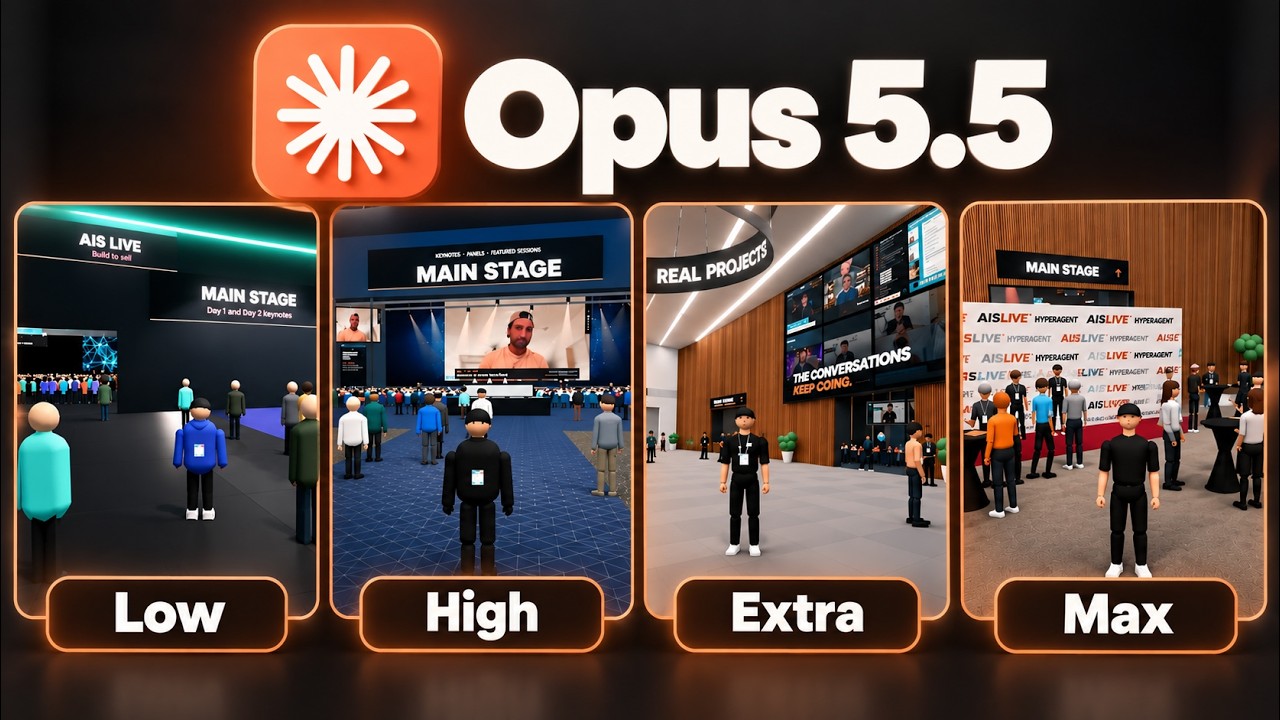
I Tested Opus 5.5 at Every Effort Level. What You Need to Know.
The reviewer ran the same 3D-world-building prompt through Opus 5.5 at every effort level (low, medium, high, extra, max, and ultracode) and declares Extra the winner. Extra delivered what he calls a phenomenal result at about half the runtime and cost of Max, while Max was judged way too much for not enough good result and High was decent but likely needed a couple more prompts to finish. Medium worked fine for general knowledge work but not for this task, which needed heavy reasoning across many videos and project files.
Verdict: Extra effort level is the winner for this 3D virtual-venue task [25:36]
- For: tasks needing heavy reasoning across many videos and project files, where Medium fell short [25:57]
- Spec: Opus 5.5 is described as smart, cheap, with amazing taste, an incredible AI model [00:06]
- Spec: Low effort took 16 minutes 43 seconds [03:52]
- Price: Low effort cost $3.91 in estimated API billing [03:52]
+ 33 more takeaways
- Spec: Low effort used 191,000 total tokens and ran 22 checks with 0 questions asked [03:52]
- Spec: Medium effort took 1 hour 13 minutes [07:01]
- Price: Medium effort cost $12.44 [07:08]
- Spec: Medium effort used 490,000 tokens and 23 checks [07:10]
- Spec: Medium effort asked 0 questions [07:14]
- Spec: High effort took 1 hour 7 minutes, quicker than Medium [10:51]
- Price: High effort cost $16.31 [10:56]
- Spec: High effort used 509,300 tokens [10:58]
- Spec: High effort asked 1 question, the only run across all levels to ask one [11:05]
- Spec: Extra effort session ran 1 hour 30 minutes [13:36]
- Price: Extra effort cost $25.92 [13:40]
- Spec: Extra effort used 733,700 tokens across 34 checks, the most so far, with 0 questions [13:45]
- Spec: Max effort took 2 hours 28 minutes and hit a compaction limit, forcing auto-compact [17:22]
- Price: Max effort cost $50.38 and used 1.18 million tokens [17:22]
- Spec: Max effort ran 51 checks, though the reviewer questioned their validity given the number of bugs, with 0 questions asked [17:30]
- Spec: Ultracode took 1 hour 35 minutes [21:20]
- Price: Ultracode cost $18.69, pricier than High but cheaper than Extra and much cheaper than Max [21:27]
- Spec: Ultracode used 606,000 tokens across 42 checks with 0 questions asked [21:20]
- Spec: Cost per check ranged from $0.18 on Low to $0.99 on Max, with Ultracode at $0.45 per check [24:16]
- Spec: Max cost 12.9x more than Low ($3.98 to $50.38) [22:51]
- Spec: Max ran 2.3x more checks than Low; total cost across all six sessions was $127 [23:05]
- Pro: Opus 5.5 is smart, cheap, and has amazing taste per the reviewer [00:06]
- Pro: The High-level venue felt the smoothest, with nice physics and a nice sliding glass door [24:32]
- Pro: In the High version the reviewer didn't notice many bugs [24:37]
- Pro: The Extra version let the reviewer chat with people, sit or stand wherever they wanted, and included mock discovery call sections [25:01]
- Con: The Low-effort build didn't feel branded, lacking the AIS Live logo and correct colors [01:55]
- Con: Walking navigation/movement animation in the virtual venue is described as really bad [14:24]
- Con: Max effort hit 93% context and had to auto-compact since it wasn't a task he could just leave running [21:57]
- Con: In the High version the reviewer couldn't talk to people, could walk through them and through walls, and couldn't sit in sessions, so it wasn't the winner [24:40]
- Con: The Extra version had no VIP after-party since that space was reused as the lounge, giving it a weaker VIP experience [25:19]
- Con: None of the six effort-level runs used sub-agents, and Ultracode wasn't spinning up the extra dynamic workflows it was meant to enable [22:20]
- Reason: Extra is the winner because it did a phenomenal job at about half the runtime and half the cost of Max [25:41]
- Booth displays visible including the 'How I Landed a $14,000 AI Deal' session topic on a display board.
How this brief was shaped: Evaluation (review / comparison / unboxing) · confidence Medium
Creator gives one AI coding agent the same prompt across every effort level and explicitly compares quality of output, runtime, cost, tokens, checks, and questions asked, which is a comparison verdict structure. OCR shows the actual prompt markdown used as the shared test case rather than a taught procedure.
The lens sets this brief's structure, never its facts — every claim is held to the same citation and fact-check standard.