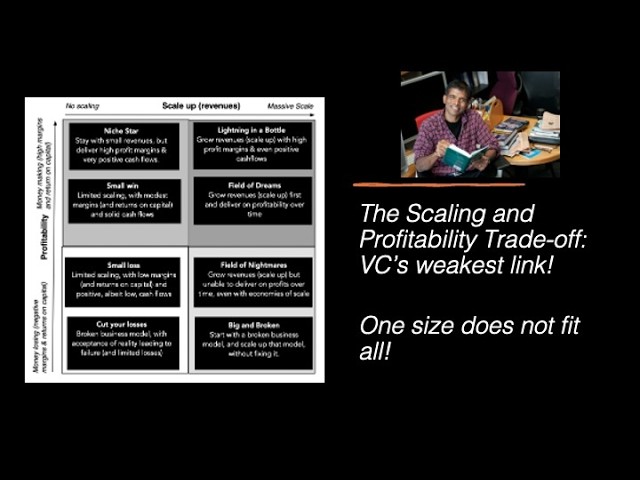
The Scaling and Profitability Trade-off: Venture Capital's weakest link!
This talk breaks down the core tension in business strategy between scaling and profitability, arguing that venture capital has tilted the norm toward scaling over the last two decades. It uses a matrix of archetypes (Lightning in a Bottle, Field of Dreams, Big and Broken, Niche Star) to classify real companies like Facebook, Amazon, WeWork, and Ferrari, then explains how VCs actually price rather than value startups and have historically underperformed the NASDAQ despite occasional outsized power law wins. It closes on a warning: a growing 'gray market' of public capital flowing into private companies (especially AI firms) is letting unformed business models scale to massive size with weak governance, which the speaker predicts will produce bigger failures ahead.
Vinod Khosla tweeted that profitability is an admission a company has no better place to invest than returning money to shareholders [00:26]
- Software companies have great unit economics because the next unit costs almost nothing to make [09:17]
- For economies of scale to improve profitability, fixed operating expenses must grow slower than revenue [09:50]
- A billion dollars of profit sounds like a lot but is a poor return on a trillion dollars invested, which is why return on capital matters more than absolute profit [10:31]
- 'Lightning in a Bottle' companies scale up fast and are profitable almost immediately, citing Facebook and Google in their early years [11:21]
+ 13 more takeaways
- Amazon is a 'Field of Dreams' company that lost money for roughly its first decade while Bezos sold the market on future profits [12:19]
- 'Big and Broken' means scaling a broken model without fixing it, illustrated by WeWork leasing buildings for 40 years and subleasing for 3 months, a duration mismatch made in hell [13:32]
- 'Niche Star' companies stay small and dominate with high margins, exemplified by Ferrari selling about 13,000 cars with margins over 20% [14:23]
- Komogumi, a Japanese shrine-building company, lasted about 1,500 years as a small family firm before closing a few decades ago [18:45]
- Peloton succeeded beyond expectations during COVID but likely damaged itself long-term by overreaching, including building too many factories [19:44]
- VCs don't truly value young businesses, they price them based on what peers are paying for similar companies using simple metrics like users or downloads [24:26]
- Example VC pricing model: $100 million in revenue in 5 years at a 10x multiple equals $1 billion in year-5 pricing [27:54]
- Cambridge Associates data shows VCs underperformed the NASDAQ across almost every period from 2001-2025 and only barely beat the S&P 500 twice [28:48]
- Early investors in companies like Anthropic or SpaceX can see 50,000% to 100,000% returns, the power law dynamic of VC investing [30:13]
- From 2023-2026 the top 1% of VC holdings delivered 80% of total returns and the top 10% delivered more than 90% [31:00]
- A 'gray market' now lets private businesses raise tens of billions while staying private, with AI companies raising hundreds of billions or trillions [35:33]
- Larger private companies with unformed business models risk becoming corporate governance nightmares with no checks and balances, citing Anthropic, OpenAI, and SpaceX [44:21]
- Capital markets have tilted further toward favoring scale, meaning more companies will go public with massive valuations and no clear business model, pointing to bigger failures ahead [48:29]