
YC Blacksmith v4
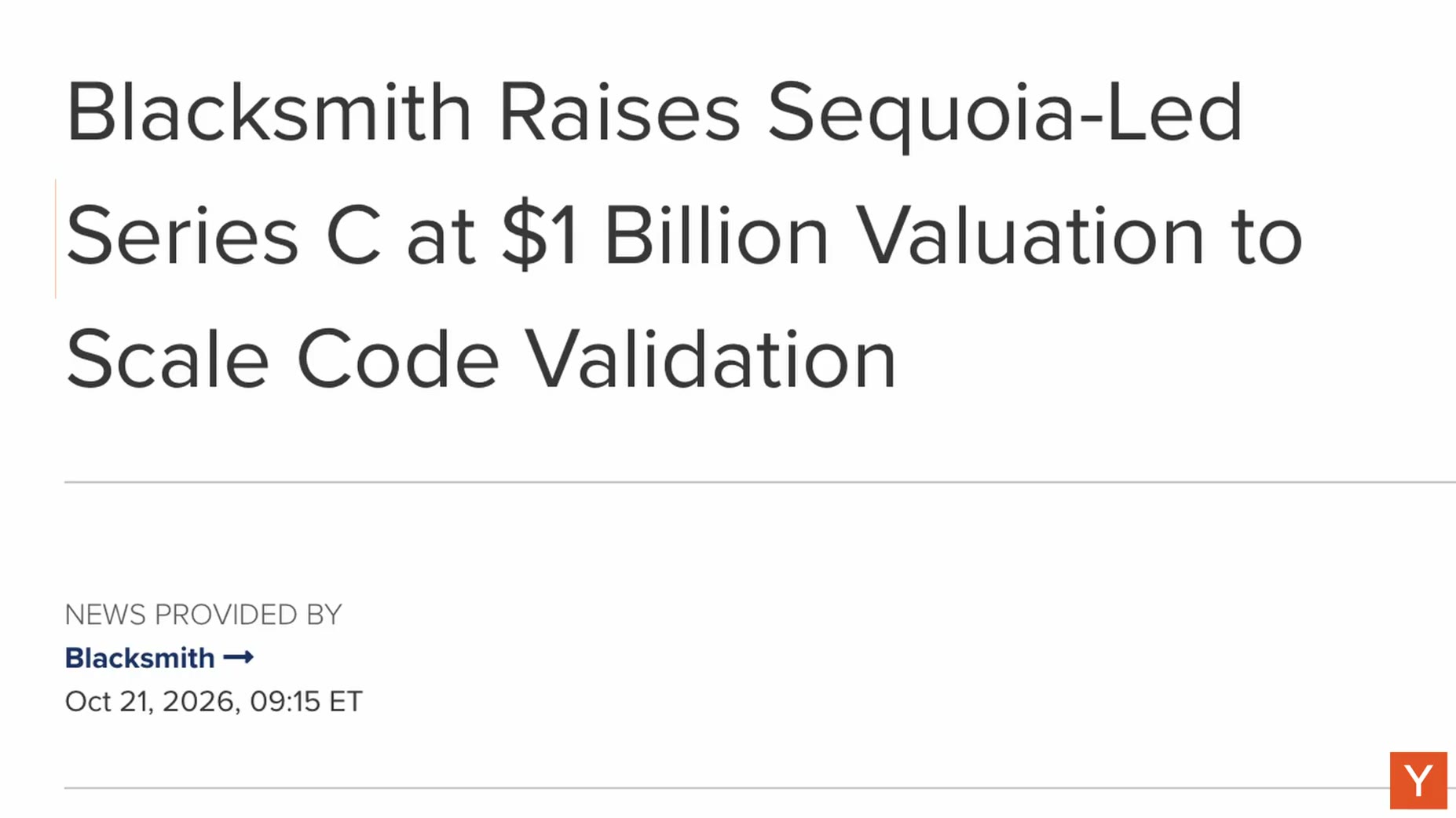
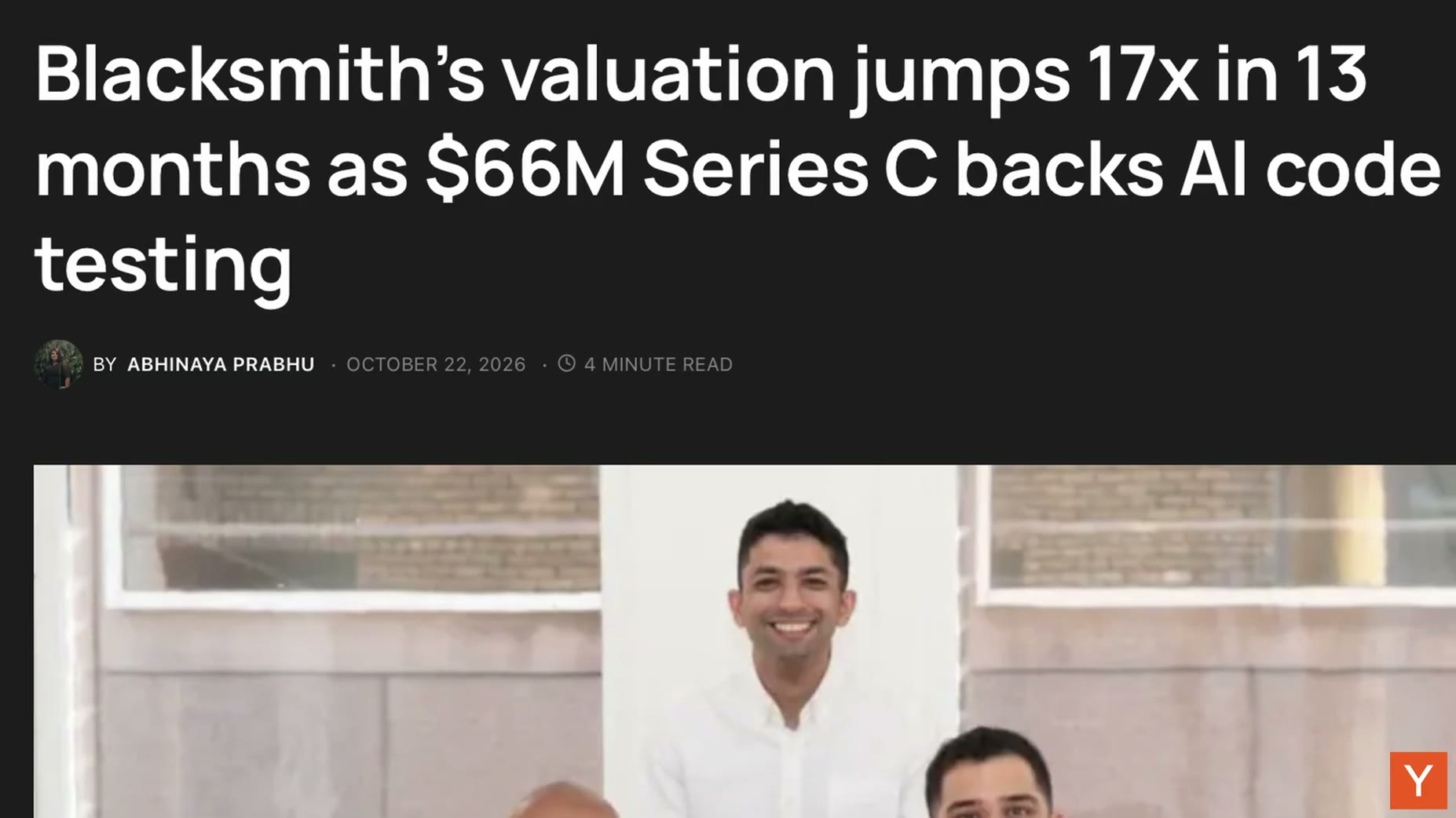
Blacksmith builds infrastructure to speed up CI (continuous integration), the checks developers run to verify their code isn't broken. The three co-founders, friends from undergrad who say they had never written a CI pipeline or worked in DevOps, say they noticed CI was universally slow and painful to manage at every company they worked at, and approached the problem as outsiders rather than platform engineers. The company says it has grown 20x in the last year and raised a Series C led by Sequoia at a $1 billion valuation, raising about $66 million, with reporting noting the valuation jumped 17x in 13 months.
Subject: Blacksmith builds infrastructure to run CI (continuous integration), the checks developers use to verify code isn't broken. [00:07]
- Situation: the founders say CI was universally slow and painful to manage at every company they worked at. [01:54]
- Strategy: the founders describe themselves as outsiders who were not platform engineers and didn't work in DevOps. [00:23]
- Decision: none of the founders had written a CI pipeline before starting Blacksmith. [00:27]
- Reason: Aditya Jayaprakash says being naive in the right way kept them from killing a good idea before it met the market. [00:30]
+ 27 more takeaways
- Strategy: Paul Bardea says agentic coding tools let developers write more code, but the bottleneck has shifted from writing software to validating it via CI. [00:51]
- Decision: the founders concluded CI workloads have a different shape than what hyperscalers like AWS, GCP, and Azure are optimized for. [02:24]
- Decision: the founders found CI workloads share characteristics with desktop applications and video games, caring more about single-thread speed than multi-threading. [02:54]
- Execution (~01:18): the speaker says his high school interest in surfing Wikipedia pages about how tech companies were founded inspired him to start his own company. [01:18]
- Execution (~01:27): the speaker chose the University of Waterloo for its startup program and because it's a very technical school many founders came from. [01:27]
- Execution (~01:34): after starting work at FAIR, the speaker began thinking a lot about ideas for what to build next. [01:34]
- Execution (~01:40): Blacksmith is the speaker's second application to Y Combinator. [01:40]
- Execution (~01:43): the speaker and his cofounders were three friends from undergrad. [01:43]
- Execution (~01:45): the three of them were all in Toronto at the time and wanted to start a company together. [01:45]
- Execution (~01:52): all three founders were engineers who were riffing on ideas for what to work on. [01:52]
- Execution (~02:20): the co-founders were database engineers while the speaker worked on search infrastructure. [02:20]
- Execution (~03:18): Blacksmith initially rented servers from a German data center services company known for hosting Minecraft and Call of Duty game servers. [03:18]
- Execution (~03:34): Blacksmith now buys megawatts of power from data center providers rather than individual machines. [03:34]
- Execution (~03:46): Erik Nordlander of Google Ventures invested in Blacksmith twice, first leading the Y Combinator round on a SAFE, then leading the Series A and joining the board. [03:46]
- Execution (~04:22): Blacksmith's approach to speeding up CI moves cached artifacts close to compute nodes to skip redundant work. [04:22]
- Execution (~05:01): Blacksmith's earliest customers were small companies similar to themselves who wanted fast CI with little red tape. [05:01]
- Execution (~05:22): without any sales team, Blacksmith secured five- and six-figure contracts. [05:22]
- Execution (~05:37): Langchain recently onboarded onto Blacksmith after previously running CI on GCP. [05:37]
- Execution (~05:44): Aditya Maru says Langchain's developers on GCP routinely waited 15 to 20 minutes just to acquire compute for CI jobs. [05:44]
- Execution (~05:51): on Blacksmith, that wait time dropped to 10-15 seconds due to an effectively infinite pool of exposed compute. [05:51]
- Execution (~06:25): Blacksmith ran a marketing campaign taking over 15 subway stations in New York and wrapping a subway train in its yellow branding. [06:25]
- Execution (~06:32): the team grew from about five people running a cluster of a couple hundred servers to 30 people with 12 engineers running many orders of magnitude more scale. [06:32]
- Execution (~07:59): after the Series B announcement, a power surge in Phoenix took out both primary and backup cooling systems at one of Blacksmith's biggest data centers, causing longer job startup times and underscoring the importance of geographic distribution. [07:59]
- Number: Blacksmith has run 20x in the last year. [00:13]
- Number: Blacksmith recently raised a Series C at a $1 billion valuation led by Sequoia, raising about $66 million. [00:16]
- Number: reporting states Blacksmith's valuation jumped 17x in 13 months as the $66 million Series C backs AI code testing. [00:21]
- Lesson: Aditya Jayaprakash's take is that being naive enough in the right way keeps you from killing a good idea before it meets the market. [00:30]
How this brief was shaped: Case Study Breakdown · confidence Low
A single founder narrates Blacksmith's origin story including the problem (slow CI), the strategic insight (being naive enough to not kill the idea), and concrete fundraising facts (Series C, about 66 million, billion-dollar valuation led by Sequoia), which reads as a reusable strategy-execution-result lesson rather than plain chronology. The OCR sample shows an unrelated Java code editor and a Wikipedia snippet that do not match the transcript topic, so it was treated as noise and the transcript drove the call.
The lens sets this brief's structure, never its facts — every claim is held to the same citation and fact-check standard.