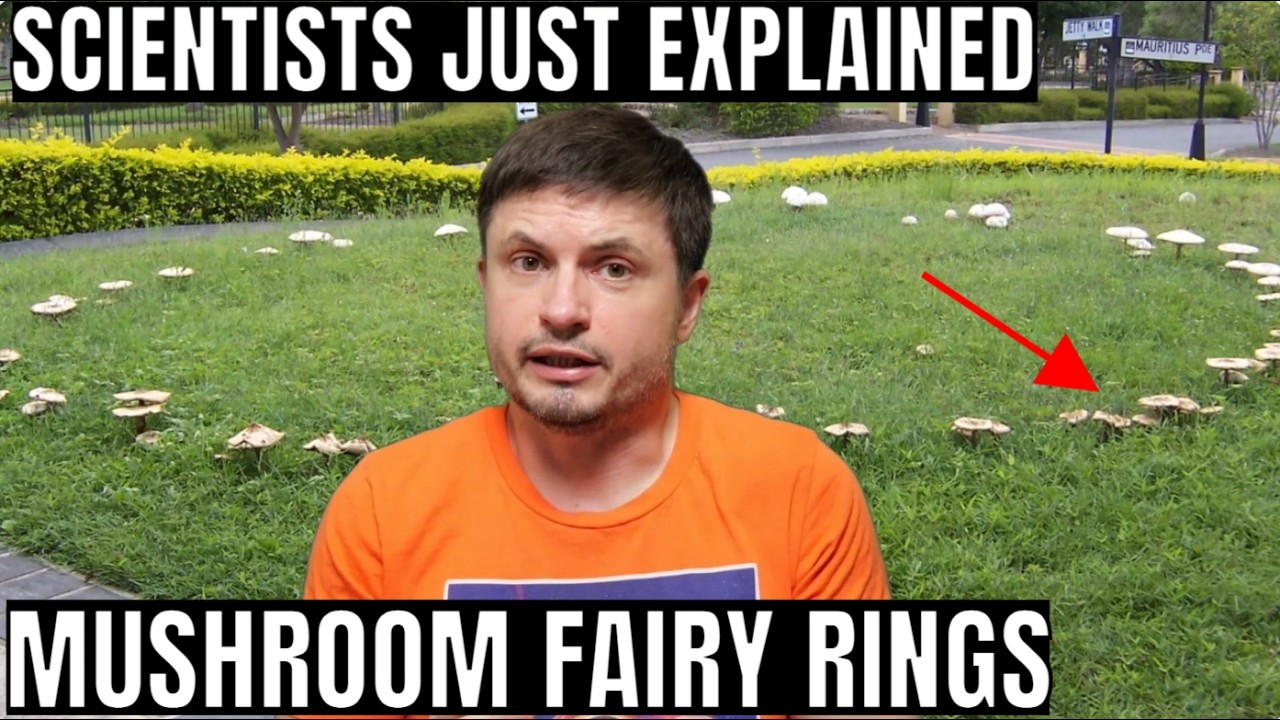
2026 Study Finally Explains Why Mushroom Fairy Rings Form
What this video is
⚡ a 16-minute video, readable in 60 secondsThis video explains the science behind fairy rings, the near-perfect circles of mushrooms that once inspired folklore about witches and elves. It traces how a 2026 Swedish study, led by mycologist Hannah Johannesson, used metagenomics and a soil transplantation experiment in a Uppsala cemetery to test competing theories for why the rings expand outward. The research confirms a mechanism called transient escape, showing the fungus temporarily depletes and later recovers its own center soil while shuttling nutrients to the growing edge. It also reveals how shedding the central mycelium may help the fungus defend itself against pathogens.
[01:25] In France, fairy rings were called Rondes Saucières (the Witches' Circle), believed to curse anyone who stepped inside.
Key takeaways
- [03:44] What looks like a mushroom is actually the sporocarp; the real organism is an underground network of mycelium and hyphae.
- [04:12] At least 100 different mushroom species are known to form fairy rings.
- [04:55] Marasmius oreades, the fairy ring champignon, is the species most responsible for forming fairy rings.
- [06:00] Underground fungi release gibberellin hormones that spur rapid grass growth, creating the rings' lush green color.
+ 7 more takeaways
- [06:44] In August 2026, a team led by mycologist Hannah Johannesson studied two large fairy rings in a Uppsala, Sweden cemetery.
- [07:28] DNA sampling found Marasmius concentrated at the ring's outer growth front, dropping to background levels at the center.
- [08:43] Researchers dug up and reoriented 30cm by 70cm by 10cm blocks of active ring soil to test how the fungus would regrow.
- [09:12] The transplant experiment tested five competing hypotheses: continue-forward, ring-escape, transient-escape, coordination, and compass.
- [12:37] Fungi shuttle nutrients from the older center of the colony out to the growing edge to fuel new growth.
- [13:24] By letting the central mycelium disintegrate into a hollow ring, the fungus shrinks its exposed area, making it harder for pathogens to wipe out the whole colony.
- [14:14] The study concludes fairy rings are a dynamic, genetically complex organism that navigates underground using a process called transient escape.
Jump to a moment
0:00The fairy ring legend2:20Actual study explaining them!2:55What is a fungus, Anton?4:10Fairy ring mushrooms and how they grow6:25Why does it make rings? Molecular analysis8:30Mushroom experiment9:105 Hypotheses10:15Results and most likely explanation12:10Why a ring and not a disk?13:35Conclusions
Their links, sorted & clickable
🏛️ Communities & courses1
Support this channel on Patreon to help me make this a full time job🔗 Other links19
Alternatively, PayPal donations can be sent hereGet a Wonderful Person TeeMore cool designs are on AmazonLinksNew CameraCPUVideo CardMotherboardRAMPSUCaseMicrophoneMixerRecording and EditingPeter G. Werner CC BY 3.0Alan Rockefeller CC BY 4.0Mark Garlick www.markgarlick.comCmglee CC BY SA 4.0Licenses usedWas this brief useful?