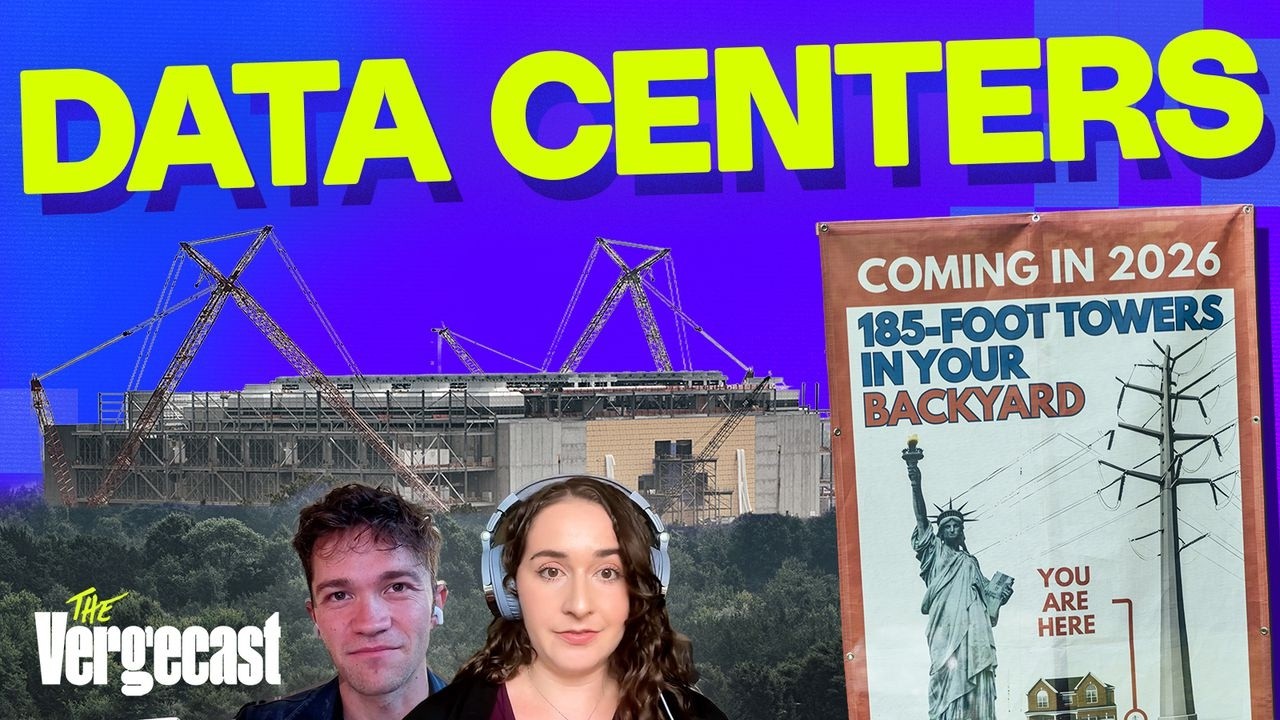
What’s happening with US data centers? | The Vergecast
This episode of The Vergecast features the host interviewing Senior Policy Reporter Lauren Feiner about her months-long investigation into Loudoun County, Virginia, which she reports is home to the world's largest concentration of data centers. The discussion traces how a 2000 zoning decision letting data centers build 'by right' on office-park land enabled rapid growth, and centers on the resulting tension between the tax revenue and school funding data centers have brought the county and the noise, energy competition, and environmental friction they have caused for residents. Feiner describes residents as divided, some supportive of data centers with caveats and others opposed over water and energy use, and says the county is now approaching the total capacity it can host. The episode opens with a separate news roundup segment on adtech, AI-in-schools, and mapping stories before the interview begins; the host's own positions or any pushback are not stated in the available material.
The episode centers on the host's interview with Senior Policy Reporter Lauren Feiner about her investigation into Loudoun County, Virginia, which she reports has become the world's largest concentration of data centers.
- Feiner reported that Loudoun County is located about 45 minutes to an hour outside Washington, DC, near Dulles airport, and has the world's largest concentration of data centers.
- Feiner reported that Loudoun County became a data center hub in part because it was home to AOL's former headquarters and has proximity to DC plus infrastructure advantages.
- [03:17] Feiner described a data center simply as a big building that stores racks and racks of servers.
- [03:29] Feiner said data center servers can belong to one company or to many different companies, since the data center company rents out the space.
+ 30 more takeaways
- [04:24] Feiner said AI now needs data centers, and because AI requires so much compute, it needs more capacity than the cloud did in the past.
- [04:50] Feiner reported that in the early days, data centers brought Loudoun County significant tax revenue, letting the county rely less on residential taxes and lower property taxes while real estate values still rose.
- [05:17] Feiner reported that the extra tax revenue let the county fund public works such as building schools and paving roads.
- [06:44] Feiner reported that as data centers expanded, local utilities have had to figure out how to supply enough energy for both the data centers and residents.
- [07:17] Feiner reported that some data centers approved for construction were told they could not hook up to the main grid until years later, which pushed them toward noisier alternative power solutions.
- [08:27] Feiner identified the Vantage VA2 facility as the main noise outlier she found in Loudoun County.
- [08:52] Feiner reported that Vantage VA2 was told, after it had already made deals with customers, that it would not be able to hook up to the main energy grid.
- [08:59] Feiner reported that until connected to the grid, Vantage VA2 self-generated power using natural gas turbines with diesel generators as backup, a practice she said many data centers use.
- [09:40] Feiner explained that the term 'by right' is specific to Loudoun County, stemming from a 2000 decision by a county administrator that land zoned for office parks could also host data centers.
- [10:27] Feiner said that under 'by right' rules, developers can build data centers on office-park-zoned land with a minimal approval process, sometimes even when the county wants to stop a project from moving into a particular location.
- [11:35] A speaker said Loudoun's issue is really about reaching a level of data center concentration that became impossible to ignore, adding that while AI expansion may have played a role, Loudoun's situation differs because it already had so many data centers before that.
- [12:18] Feiner said data center companies can build transmission lines through eminent domain because, as public utilities, they can take land if the project is deemed necessary.
- Feiner reported that a resident named Vicki, who was involved in developing the community she lives in, found trees on her property tagged with pink ribbons by Dominion Energy marking trees it would cut down to build a transmission line connecting two substations to meet energy capacity needs.
- Feiner reported that a resident named Jason Melo spent about $2,600 on two new window inserts and was quoted many thousand more dollars for new siding to mitigate data center noise, and said he can no longer relax on his porch.
- Feiner reported that residents near Dulles airport said they are used to airplane noise but described data center noise as more consistent than planes taking off and landing.
- Feiner reported attending a community meeting in July where the board of supervisors chair presented on data centers and by-right zoning, noting that real property tax rates had gone down while property values near data centers had still gone up.
- Feiner reported that Loudoun County has more than 250 data centers.
- Feiner reported that residents complained the data center industry was well organized to arrive early and get seats at the July meeting, while other attendees were sent to an overflow room on a first come, first served basis.
- Feiner reported that some residents wore light blue t-shirts reading 'I support data centers,' citing benefits like lower taxes and school funding but with caveats about environmental sensitivity, while other residents complained about intrusion on their lives and on bike and running paths.
- Feiner said other communities considering data centers reportedly call Loudoun County officials to ask about their experience.
- Feiner said Loudoun County has had a uniquely deep, decades-long experience with data centers compared to most other places in the US.
- Feiner said residents' opposition in Loudoun is driven more by concerns over water and energy usage than by rejection of the technology itself.
- Feiner said many Loudoun residents understand and use cloud services, such as phone photo storage, and accept the utility of data centers.
- Feiner said the core issue is Loudoun County running up against the total capacity the county can handle for hosting data centers.
- Feiner said she expects future data center facilities will need to move to other parts of Northern Virginia as Loudoun nears capacity.
- Feiner said some communities across the country have implemented moratoriums on data center development.
- The episode's news roundup reported that a federal judge declined the DOJ's request to force Google to sell its adtech business, instead accepting milder changes proposed by Google and the DOJ.
- The episode's news roundup reported that New York City banned generative AI use for public school students in grades pre-K through 8th grade for the current school year, while allowing high schoolers limited AI use in some classes.
- The episode's news roundup reported that teachers can use AI to plan lessons but not to grade assignments, following last year's statewide smartphone ban in New York schools.
- The episode's news roundup reported that Apple Maps renamed Lake Ontario to 'Lake America,' following a similar earlier renaming by Google.
How this brief was shaped: Discourse (interview / podcast / video essay) · confidence Medium
The core segment is a podcast host interviewing a reporter about her investigative piece on community reaction to data center buildout in Loudoun County, a clear question-and-answer exchange; OCR confirms a two-person studio mic setup plus a distinct 90-second news roundup segment covering the Google antitrust ruling and NYC AI school ban before the interview starts.
The lens sets this brief's structure, never its facts — every claim is held to the same citation and fact-check standard.