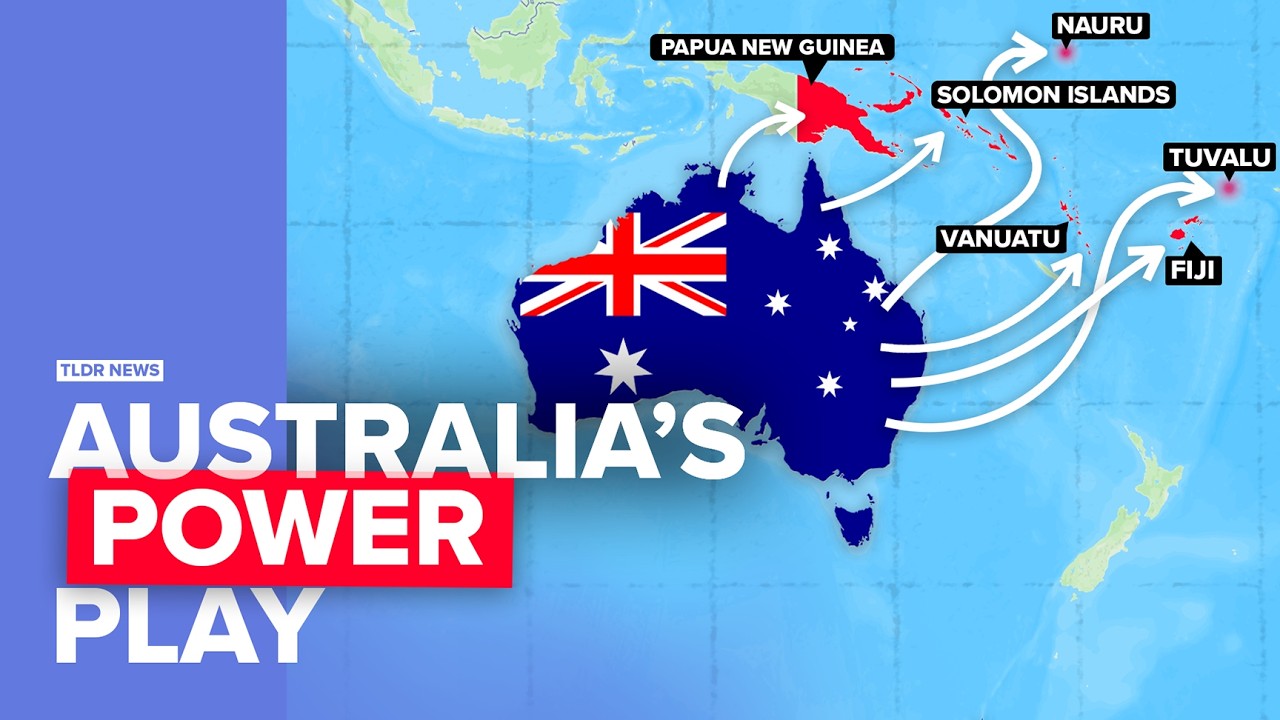
How Australia Is Becoming a Major Pacific Power
This TLDR News video is an explainer, not a tutorial: it covers Australia's diplomatic and security campaign across the Pacific to counter Chinese influence, centered on foreign minister Penny Wong's description of a 'permanent contest' with China and a string of bilateral treaties Prime Minister Albanese has signed, including with Tuvalu (2023), Nauru (2024), Papua New Guinea (the Puk Puk Treaty, 2025), Vanuatu (the Nakamal Security and Economic Treaty, June), and Fiji (the Vuvale Union and Ocean of Peace Alliance), plus newly agreed treaty negotiations with the Solomon Islands. It also traces China's competing regional moves, including the 2022 Solomon Islands security deal, live-fire naval drills in the Tasman Sea in early 2025, and a submarine-launched ballistic missile test in July, alongside the dollar figures behind Australia's aid push, such as $1.5 billion in 2024 development finance and nearly $700 million pledged to Fiji. On-screen graphics could not be reliably read for this source, so the brief reflects narration only. The video ends with an unrelated sponsored segment for ProtonMail.
Context: Australia, more than the US, has been the regional power countering Chinese influence in the Pacific. [00:04]
- Context: Australian PM Anthony Albanese has recently signed a growing list of bilateral treaties and agreements with Pacific neighbours. [00:11]
- Quote: Australia's foreign minister said the country has been using all the tools of statecraft to build its network of alliances. [00:24]
- Quote: Foreign Minister Penny Wong has described Australia and China as being locked in a permanent contest for influence in the Pacific. [01:11]
- China-Taiwan: China has largely won its diplomatic battle with Taiwan for recognition, leaving only three Pacific island states with ties to Taiwan. [01:22]
+ 33 more takeaways
- China's interests: China's Pacific interest spans economic areas (undersea cables, deep sea mining, maritime shipping routes), diplomatic ties, and security footholds meant to counter encirclement by the US and allies along the first and second island chains. [01:44]
- Timeline: reports first surfaced in 2018 of preliminary talks between China and Vanuatu over a potential Chinese base. [02:19]
- Timeline: in 2022, China and the Solomon Islands signed a security deal. [02:19]
- Outcome: no Chinese military base has materialized in the Pacific, and China has denied having such an ambition. [02:32]
- Timeline: in 2022, Chinese Foreign Minister Wang Yi toured the Pacific but ultimately failed to seal the multi-country security deal Beijing had sought. [02:38]
- China military signaling: in early 2025, China conducted surprise live-fire naval drills in international waters in the Tasman Sea between Australia and New Zealand. [03:00]
- China military signaling: in July this year, China test-fired a submarine-launched ballistic missile from the South China Sea into international waters in the Pacific. [03:10]
- Australia's strategy: a Pacific Step-up strategy launched in 2018 under the previous Australian government has accelerated since Labor took office in 2022. [03:21]
- Diplomacy: Foreign Minister Wong has made more visits to small Pacific island nations than any of her predecessors. [03:31]
- Treaty (2023): Albanese signed the Fallapilli Union with Tuvalu, covering climate mobility and adaptation and security, giving Australia an effective veto over Tuvalu's external security and defence arrangements. [03:51]
- Treaty (2024): Australia gained veto rights over Nauru's third country security deals as part of a bilateral economic and security treaty. [04:05]
- Treaty (2025): Australia and Papua New Guinea signed the Puk Puk Treaty, a mutual defence pact and Australia's first new alliance in more than 70 years and PNG's first ever alliance. [04:15]
- Puk Puk Treaty terms: it binds each country to defend the other if attacked, sets up reciprocal military recruitment, enhances PNG's defence capabilities, and lets Australia access agreed military facilities in PNG while excluding other powers. [04:31]
- Treaty (June, this year): Australia and Vanuatu signed the Nakamal Security and Economic Treaty; it did not include the veto provisions Australia sought over third country engagement in critical infrastructure but secured a commitment from Vanuatu not to permit any foreign military base on its territory. [04:51]
- Treaty (last month): Australia signed twin deals with Fiji, the Vuvale Union and the Ocean of Peace Alliance, a mutual defence pact open to accession by other Pacific militaries such as New Zealand, Tonga, or PNG. [05:12]
- Solomon Islands: new PM Matthew Whale says his government will review the 2022 security pact with China and has agreed to begin negotiations with Australia on a new comprehensive bilateral treaty. [05:38]
- Figures: Australia is by far the largest development partner in the Pacific, dispersing $1.5 billion in official development finance in 2024. [05:55]
- Figures: the Fiji deal expands training and labour mobility pathways and commits Australia to nearly $700 million in investment in Fiji over the next decade, covering education, healthcare, infrastructure and combating transnational crime. [06:09]
- Figures: the Vanuatu deal includes hundreds of millions of dollars in commitments over the coming decade. [06:25]
- Figures: Australia is earmarking more than $400 million over 10 years to bring Papua New Guinea into Australia's national rugby league. [06:48]
- Tension: Pacific Island leaders face uncomfortable decisions, including effectively surrendering their right to pursue security-related deals with other countries. [07:15]
- Tension: Pacific nations want enhanced security ties with Australia without economically shutting out China, the region's dominant trading partner. [07:37]
- China ties continue: PNG PM James Marape visited China this year to boost trade and economic ties. [07:46]
- China ties continue: last year, China signed a framework deal to upgrade its economic partnership with five Pacific Island countries. [07:46]
- China trade deal: on November 4, China's Minister of Commerce Wang Wentao signed the Framework Agreement on Enhanced Economic Partnership (EEPA) with representatives of five Pacific Island countries: Micronesia, Kiribati, Nauru, Vanuatu, and Fiji. [07:52]
- Outlook: getting caught in a tug of war between larger powers is not desirable for Pacific island nations, but successfully balancing relationships with both Australia and China could prove lucrative. [07:58]
- Sponsor/promo: the episode also features TLDR's magazine 'Too Long' Issue #009 (Autumn 2026), its longest issue ever, with articles including 'Europe Reborn,' 'The Detente No-One Saw Coming,' and 'The Dollar Remade.' [01:03]
- Sponsor: a ProtonMail ad segment pitches it as an alternative for sites that demand an email address just to view content. [08:32]
- Sponsor: ProtonMail is described as offering phishing protection and alerts if a user's email is found sold on the dark web. [08:54]
- Sponsor: ProtonMail offers unlimited email aliases with no ads, no tracking, and no profiling. [09:04]
- Sponsor: ProtonMail's Easy Switch tool lets users import email, calendar events, and contacts from another provider such as Gmail. [09:16]
- Sponsor: viewers are directed to start using ProtonMail for free at proton.me/TLDR. [09:45]
- News explainer graphic: purple map showing Australia and Vanuatu (highlighted in red) with a large pile of banded US $100 bill stacks in the foreground bottom-right.
How this brief was shaped: Deep-Dive (coding / tutorial / how-to) · confidence Low
The transcript is a single narrator systematically unpacking Australia's Pacific diplomatic strategy: the tools of statecraft, the specific bilateral treaties Albanese signed, and the history of China's evolving regional interest including the Solomon Islands security deal, with no personal contested thesis or academic course framing. The OCR/vision sample shown (Sanchez, Le Pen, Trump, the Pope, a fashion opinion piece) does not match this topic at all and looks contaminated from an unrelated source, so it was discounted and the call rests on the transcript alone.
The lens sets this brief's structure, never its facts — every claim is held to the same citation and fact-check standard.