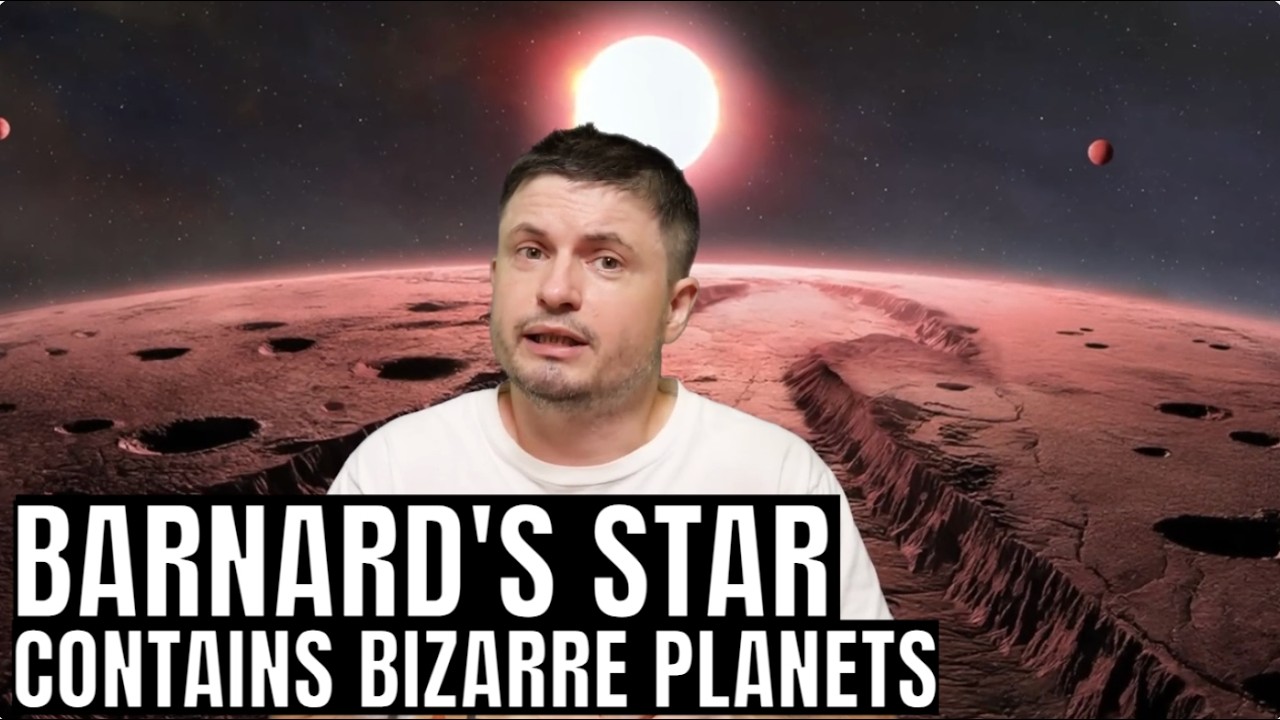
Earth’s Closest Planetary Neighbors Are Utterly Uninhabitable
This video explains the 2025-2026 confirmation of a four-planet system around Barnard's Star, the sixth-nearest star to the Sun, and what a new study's star-chemistry analysis implies about the planets' likely mineral makeup and water content. It covers the star's record proper motion, its decades-long history of debunked planet claims, the 2024-2025 radial-velocity detections using ESPRESSO on the Very Large Telescope, and the 2026 Byrne et al. study published in Monthly Notices of the Royal Astronomical Society. This is a science explainer, not a tutorial, so there is no software, install, or account setup involved. The brief is built from narration; on-screen visuals and OCR (including any table values or image credits) were not available for this pass.
Goal: explain the confirmed four-planet system around Barnard's Star and what the study's star-chemistry analysis implies about the planets' composition and water content.
- Barnard's Star has the fastest proper motion of any known stellar object.
- Barnard's Star will make its closest approach to the solar system in approximately 9000 years.
- Barnard's Star is currently the 4th nearest star to the solar system but will eventually become the closest.
- American astronomer Edward Emerson Barnard discovered its unusual proper motion in 1916, and the star was later named after him.
+ 32 more takeaways
- In a single human lifetime, Barnard's Star moves by approximately a quarter of a degree, about half the diameter of the full moon.
- Barnard's Star is an M-type red dwarf containing about 16% of the solar mass and is at least 10 billion years old, more than twice the age of the Sun.
- In the 1960s, Dutch astronomer Peter van de Kamp claimed a gas giant around Barnard's Star based on observed stellar wobble, later found to be an error from an accidental adjustment inside his telescope lens.
- In 2018 a claimed super-Earth was disproven, later found to be a massive stellar flare followed by a sunspot that can mimic a planetary transit.
- In 2025 it was officially confirmed for the first time that Barnard's Star hosts a planetary system, after over 60 years of false-positive exoplanet claims.
- In 2024 and 2025 a breakthrough occurred using high-precision instruments like the ESPRESSO spectrograph on the Very Large Telescope, and two independent teams confirmed four separate planets around Barnard's Star.
- [05:21] All four planets were discovered using the radial velocity method, detecting periodic red and blue shifts in the star's light caused by its wobble.
- All four planets are sub-Earths, smaller than Earth and Venus and only a little larger than Mars, prompting researchers to dub it a 'Lilliputian system.'
- [06:03] All four planets orbit extremely close to the star, ranging from about 0.01 to 0.04 astronomical units away, much closer than Mercury is to the Sun.
- Citation: 'The Barnard's Star planetary system: stability, composition, and evolution of four sub-Earth exoplanets' by Byrne, Guimond, Bonsor, Wang, Vaughan, and Rogers, published 24 June 2026 in Monthly Notices of the Royal Astronomical Society; confirms the planet types and states none are Earth 2.0.
- Not stated: individual exoplanet table values (per-planet mass, semimajor axis, orbital period) and an on-screen image credit were flagged as expected but are not present in the provided extraction; only the aggregate orbital range (0.01-0.04 AU) and the 9-12-16 resonance ratio were captured.
- [06:30] The study, led by Xander Byrne of Cambridge University, analyzed the chemical makeup of the Barnard's Star system to determine the planets' likely composition.
- [06:47] The Cambridge team focused on the elemental fingerprint of Barnard's Star itself, since planets are expected to form from the same material as their host star.
- [06:54] Researchers found the star has a large amount of magnesium, implying the planets likely also contain a lot of magnesium.
- [07:05] On Earth, magnesium usually forms minerals like olivines, which are very good at storing water.
- [07:23] The study suggests these sub-Earth planets are potentially dominated by a different mineral, periclase (magnesium oxide), instead of olivines.
- [07:44] Pure periclase is normally colorless but impurities like iron can make it appear grayish white, yellow, or brownish yellow; on Earth it makes up about 20% of the lower mantle, the second most abundant mineral and the primary host for iron deep inside the planet.
- [08:20] Unlike Earth, where periclase is found deep underground, on these planets it may be present everywhere including the surface, which could be a problem since periclase does not store water well and instead holds a lot of iron and other material.
- [08:29] The study suggests these planets likely have less than half the water-carrying capacity of planet Earth.
- [08:40] Because of their proximity to the star, the planets have likely been bombarded by stellar emissions for the past 10 billion years.
- [09:06] The team estimates that even if the planets started with atmospheres and surface water, radiation pressure blew off these atmospheres within the first 2 billion years, with water escaping or interacting with periclase.
- [09:08] On Earth, periclase converts into brucite when exposed to water.
- [09:36] The planets' orbital stability is attributed to orbital resonance established over billions of years in a 9-12-16 ratio.
- [10:27] The study shows that star chemistry can be used to predict planet geology, meaning knowing a planet is rocky is not enough to predict water conditions.
- [11:18] Future missions such as ESA's Plato mission and instruments like Andes on the Extremely Large Telescope could use similar techniques to find even smaller planets.
- [12:22] The discussion frames observing and characterizing a planet six light years away as a real capability.
- [12:27] As technology improves, researchers might eventually find one of these planets with conditions considered habitable.
- [12:37] No such habitable planet has been found yet.
- [12:39] The host says they will return to discuss Barnard's Star or other exciting star systems once new discoveries are made.
- [12:47] The host thanks viewers, asks them to subscribe, and promotes Patreon support with ad-free videos, name credits, and channel membership for early access.
- [12:58] The host also promotes buying a t-shirt via the description.
- [13:01] The video closes with 'Stay wonderful, I'll see you tomorrow, and as always, bye-bye.'
How this brief was shaped: Deep-Dive (coding / tutorial / how-to) · confidence Medium
Single narrator systematically explains Barnard's Star, its record proper motion, and the decades-long hunt for exoplanets, citing a specific 2026 MNRAS journal article with an on-screen exoplanet mass and orbit table, no course context and no personal thesis being argued.
The lens sets this brief's structure, never its facts — every claim is held to the same citation and fact-check standard.